A car costs £3.50 per chargeable Dartford Crossing, or £2.80 with a funded pre-pay account. A pay-as-you-go account automates payment but does not give that discount. Charges apply from 6am to 10pm every day. For a one-off crossing, pay by midnight the following day.
Rates and official guidance checked on 16 October 2026. Start payment through GOV.UK’s Dart Charge service. This guide explains what to pay and what to check; it does not take payments or access your crossing record.
How much is the Dartford Crossing?
These are charges for each crossing during charging hours, not a return ticket. The current tariff took effect on 1 September 2025, as set out in the Department for Transport’s charge update, and remains on the live official charges page.
| Vehicle class | One-off | Pay as you go | Pre-pay |
|---|---|---|---|
| A: motorcycles, mopeds and quad bikes | Free | Free | Free |
| B: cars with or without trailers; motorhomes; minibuses with up to nine seats including the driver | £3.50 | £3.50 | £2.80 |
| C: buses, coaches, vans and other goods vehicles with two axles | £4.20 | £4.20 | £3.60 |
| D: buses, coaches, vans and other goods vehicles with more than two axles | £8.40 | £8.40 | £7.20 |
For a car making two chargeable crossings, that is £7.00 by one-off payment or pay as you go, compared with £5.60 on pre-pay: a calculated saving of £1.40. This example excludes resident discounts and exemptions.
Trailers and vans: choose the correct class
The official vehicle classification keeps a car towing a trailer in class B. Do not move it into the goods-vehicle categories simply by counting the trailer’s axles. For the goods-vehicle axle rules, count droppable axles even when raised; trailer axles count only for articulated vehicles.
If your vehicle’s classification is unclear, ask Dart Charge before relying on a price. Describe the actual vehicle, seating and axle arrangement; “large car” or “small van” is not a substitute for checking its class.
When is the crossing free?
Charging hours are 6am to 10pm, including Saturdays, Sundays and bank holidays. Outside those hours, the crossing is free. These are UK local times. The current charging guidance applies the same daily window throughout the week.
Think about each leg separately. An outbound crossing during the charging window and a return after 10pm do not create two charged crossings. Base your record on when you actually crossed, not the departure time from home or the arrival estimate on your sat-nav. Do not leave payment planning until you are driving.
One-off, pay as you go or pre-pay?
The official payment service offers three arrangements. Open the one you are considering.
I want to pay for an occasional trip without an account
Use a one-off payment with your registration number. You can pay after crossing within the deadline, or buy a future crossing. A future payment is valid for 12 months and is used for the next crossing. This is a straightforward option if you prefer to keep the payment with that trip’s records.
I want automatic payment without keeping a pre-paid balance
Pay as you go links a payment card to an account. The charge is taken at midnight the following day. Choose it for automatic collection, rather than expecting the lower pre-pay tariff. Keep the card and vehicle details current.
I want the pre-pay rate
Add funds to a pre-pay account; crossings are deducted from its balance. Check that it is open, holds the correct vehicle and has sufficient credit. This arrangement needs some account housekeeping as well as offering a lower crossing price.
The current pre-pay account terms set a £15 minimum top-up. That money becomes account credit; it is not a £15 charge for one car crossing. Keeping an account does not protect against a penalty if there is insufficient money to pay a charge, and the discount does not apply to an inadequately funded crossing.
For a simple example with no other charges or top-ups, five £2.80 car crossings use £14 of a £15 balance, leaving £1. That remaining £1 is not enough for another crossing. Check the balance and any automatic top-up settings before the next journey; do not count “an account exists” as confirmation that payment is covered.
What does “midnight the following day” mean?
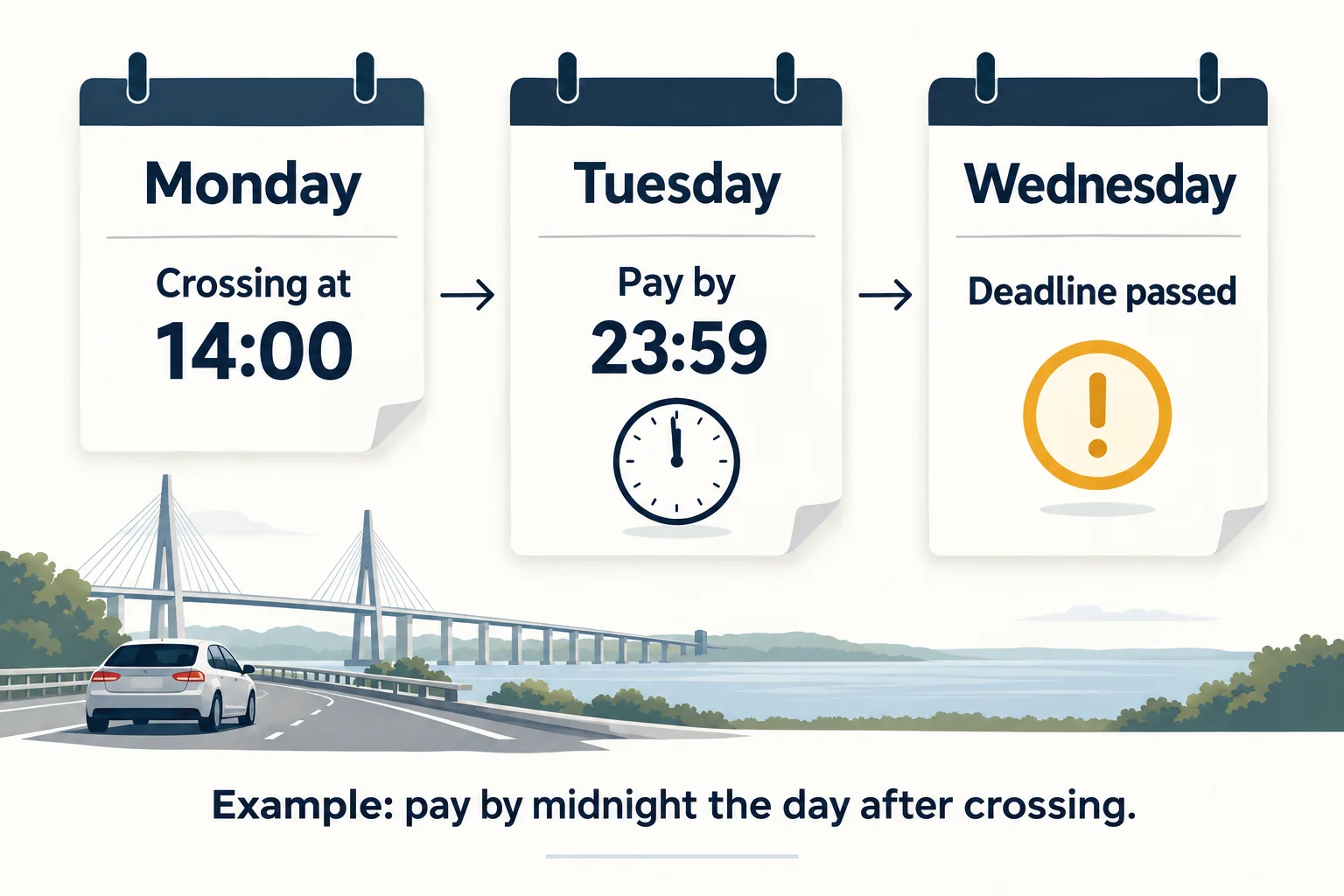
The deadline is the end of the next calendar day, not 24 hours after the journey. For example, if you cross on Monday at 2pm, complete a one-off payment by Tuesday at 11:59pm, before midnight ends Tuesday. Wednesday morning is after the deadline.
Put the date and vehicle registration in your reminder. If you cross again on Tuesday, that is another crossing with its own following-day deadline. For a busy return trip, paying for both promptly is easier to manage than relying on memory.
If your crossing or payment is not showing
Use National Highways’ Dart Charge help to check the account and payment position. Do not assume a missing entry means there is nothing to pay.
I crossed today, but cannot see it online
National Highways says account crossings appear after midnight on the crossing day. Non-account crossings can also be delayed by manual image review. You can still pay before the deadline when the crossing is not yet visible. Keep your own date and registration record.
My automatic payment failed, or I have no receipt
Check the account status, card details, available credit and payment history. For a missing email receipt, check spam and the address linked to the account, then contact Dart Charge if needed. Keep the payment reference and correspondence while resolving a discrepancy.
The separate pay-as-you-go terms make clear that a failed card payment can lead to a PCN if the charge is not paid another way. Contact the service promptly and follow its instructions; do not keep waiting simply because automatic payment was selected.
National Highways also warns that unofficial payment websites may add charges or fail to pay crossings correctly. Start at GOV.UK, follow its service link and check the confirmation before treating the task as finished.
Who does not need to pay?
Motorcycles, mopeds and quad bikes are free. The disability exemption applies where the vehicle receives free UK vehicle tax because of a disability; the vehicle is checked automatically. A Blue Badge alone is not the qualifying condition. Use the official exemption guidance to check the vehicle’s position.
Keep the reason for an exemption separate from a discount. A payment account, a local address or a parking concession is not interchangeable with the vehicle-tax condition. If you cannot establish the exemption, resolve that with Dart Charge before relying on it.
Dartford and Thurrock resident discounts
Eligible residents within Dartford or Thurrock council boundaries can apply for the local resident scheme. The current application guidance and form offer:
- £12.50: up to 50 one-way crossings over a year.
- £25: unlimited crossings over a year.
On the limited plan, another 25 crossings cost £6.25, or paying £12.50 upgrades it to unlimited. The annual resident-plan total is capped at £25. The scheme applies to one eligible vehicle; other vehicles added to the account do not automatically get the resident rate.
You must apply and provide eligibility documents. The form asks for a V5C copy and supporting proof of address, with additional instructions for company or lease vehicles. Use the current requirements for your application and wait for confirmation; living nearby does not automatically activate a discount.
If the paperwork is unclear, our V5C guide explains what the log book records. Keep the application, account confirmation and renewal information together so you can check which vehicle and plan are covered.
What if you missed the payment deadline?
Contact Dart Charge and check the actual payment position promptly. If a Penalty Charge Notice has arrived, use its details and the official PCN payment or challenge service.
The published penalty is £70, reduced to £35 when paid within 14 days, and increased to £105 if unpaid. GOV.UK says payment is due within 28 days of receiving the PCN. The original crossing charge is additional.
To challenge it, supply the registration, PCN reference and evidence explaining why it was issued incorrectly. Follow the notice’s instructions and dates. Paying an ordinary crossing charge is not the same as dealing with a PCN, and a phone payment is not a formal challenge; GOV.UK says PCNs cannot be challenged by phone.
Do not rely on another driver’s report of a first-time waiver. Any concession needs to come from the actual notice or Dart Charge’s response in your case.
A short payment checklist for the trip
- Before leaving: confirm the vehicle class and payment method; check account details if using one.
- For both legs: note the actual crossing dates and whether each fell within charging hours.
- After paying: save the reference and check the registration and number of crossings.
- If something fails: investigate promptly; keep evidence of attempted and completed payments.
- When changing cars: update the account as well as your separate vehicle paperwork.
The account terms require prompt notification when a vehicle is sold or stolen; otherwise charges can continue against the account. Do not leave an old registration attached just because you have updated DVLA.
For a hired or borrowed car, agree who will arrange the charge and retain the payment evidence. Check with the owner before adding it to an automatic-payment account, and deal with its removal when your use ends. Add the crossing payment to your wider road-trip plan, alongside the route and stops.
Based on linked government and National Highways guidance checked on 16 October 2026. Worked costs are calculations using the stated tariff, not quotations for a particular account. Check the official service for subsequent rate or process changes.