A standard speeding fixed penalty in England, Wales or Scotland is £100 and three penalty points. Northern Ireland has a different conditional-offer amount: £60 and three points, with a £5 offender levy for people aged 18 and over. A court case can produce a different fine, more points or a driving ban.
The first letter is often a request to identify the driver, rather than a bill to pay. Start by identifying the document and the jurisdiction. This guide explains those distinctions and the current official routes; it cannot determine the outcome of an individual case.
Who is the letter addressed to? Where did the alleged offence happen? What action is requested, and by what date? Keep a copy of the notice and your response. Do not assume that paying money answers a separate request for driver details.
How much is a speeding ticket?
| Where the offence happened | Standard fixed-penalty route | Course availability |
|---|---|---|
| England and Wales | £100 and three points | May be offered by police if eligible |
| Scotland | £100 and three points | Speed awareness courses are not currently available for offences committed in Scotland |
| Northern Ireland | Conditional offer: £60 and three points; £65 including the levy for an offender aged 18 or over | May be offered if eligibility requirements are met |
The England and Wales figure is set out in GOV.UK’s speeding guidance. For the separate Scottish procedure, use Police Scotland Safety Cameras. The Northern Ireland amount and course route are confirmed by nidirect. These are alternatives offered in eligible cases, not a maximum price for every speeding offence.
Use the location of the alleged offence when choosing a service, rather than your home address. A driver living in England who receives a Scottish notice needs to follow the Scottish notice’s instructions.
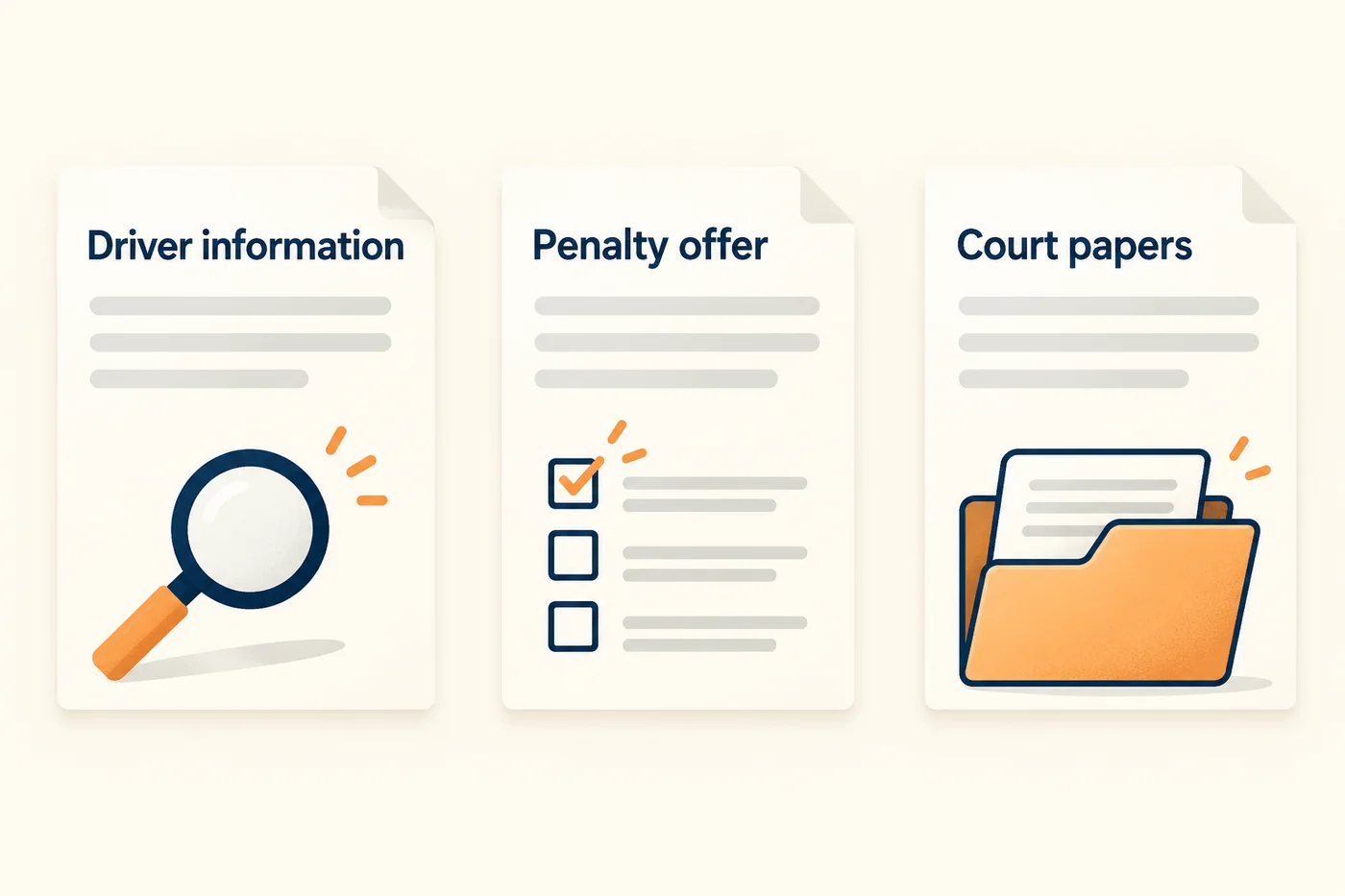
A notice, an offer and court papers are different things
| Document | What it is for | What to check |
|---|---|---|
| Notice of Intended Prosecution and driver-information request | Notifies the allegation and asks who was driving | Named recipient, registration, date, time, place and response deadline |
| Fixed penalty or conditional offer | Offers a way to deal with an eligible offence without a court hearing | Payment, licence information and every other condition of acceptance |
| Court papers | Require a response through the court process | Plea instructions, deadlines, financial-information request and any hearing details |
For a camera allegation in Great Britain, the driver-information request is commonly called a Section 172 notice. For England and Wales, Police.uk explains the 28-day response requirement and warns that failing to respond can lead to a separate offence carrying six points and a maximum £1,000 fine. Scotland has its own driver-information response procedure. Read the actual deadline on your notice; do not wait for a reminder.
If the notice names you but someone else drove, follow its process to identify that person truthfully. Do not simply give them your form to complete: Devon and Cornwall Police’s guidance explains that the named recipient must respond. If you cannot establish the driver or believe the details are wrong, contact the issuing office promptly and obtain legal advice where necessary. Guessing a name is not a solution.
Does a notice arriving after 14 days automatically cancel the case?
No. The usual 14-day requirement concerns the first notice to the registered keeper. A later notice to a nominated driver can arrive after that period. A hire or lease company may receive the first notice before naming the person using the car; a recent keeper change can also complicate the record.
The Devon and Cornwall guidance describes those situations. Keep the envelope and correspondence if timing is disputed, but do not ignore a driver-information request on the assumption that a later arrival settles the issue. Whether service was legally valid depends on the facts and applicable exceptions; that is a question for a qualified adviser, not an online deadline calculator.
Will a speed awareness course avoid points?
A course may be offered instead of the fixed penalty in an eligible case. It is not something a driver can demand. GOV.UK identifies police discretion and whether a course has been taken in the preceding three years as relevant to an offer. Check the exact course invitation, booking deadline, fee and completion requirements.
Scotland currently does not offer this option for offences committed there. In Northern Ireland, follow the Northern Ireland Road Safety Partnership process linked from nidirect. Do not book a course independently and assume it disposes of a notice.
Likewise, the frequently repeated “10% plus 2 mph” figure is not extra legal speed. The police’s explanation of enforcement guidance expressly distinguishes discretion from permission to exceed the limit. Our UK speed limits guide covers the limits themselves.
How are court fines calculated in England and Wales?
The Sentencing Council’s adult speeding guideline, updated on 5 October 2026, uses these bands:
| Band | Starting fine as a share of relevant weekly income | Guideline points or disqualification |
|---|---|---|
| A | 50%; range 25–75% | Three points |
| B | 100%; range 75–125% | Four to six points OR 7–28 days’ disqualification |
| C | 150%; range 125–175% | Six points OR 7–56 days’ disqualification |
For example, in a 30 mph limit, the recorded-speed bands are 31–40, 41–50 and 51 mph or more respectively. Those are sentencing bands, not camera enforcement thresholds. The guideline applies to adults in England and Wales; do not apply it as a Scottish or Northern Irish fine calculator. The court considers the circumstances, and very excessive speed can lead to a longer ban.
As a purely arithmetic example, a Band B starting point with £500 relevant weekly income is £500. It is not a prediction of the final amount. Plea, circumstances and the statutory ceiling matter. The Council’s public explanation gives maximum speeding fines of £1,000 on other roads and £2,500 on a motorway.
The fine is also not necessarily the whole bill. A surcharge and prosecution costs can be additional items: see the official court payment guidance. Follow the court’s request for financial information accurately. If you dispute an allegation or risk losing your licence, obtain advice before deciding how to respond.
Three years, four years and the new-driver rule
These periods answer different questions. DVLA’s endorsement table says speeding codes such as SP30 and SP50 stay on the driving record for four years from the offence. That does not make four years the usual totting-up period: GOV.UK’s disqualification guidance warns that accumulating 12 or more points within three years can lead to a ban. Individual disqualification rules and procedures can differ in Northern Ireland.
New drivers have a separate risk. Under the new-driver rules, reaching six or more points within two years of passing the first test can revoke the licence. Unexpired provisional-licence points carry forward. Regaining a full licence after revocation requires a new provisional licence and passing both tests again. Revocation and a court-imposed ban are different processes. Northern Ireland also retains the six-point, two-year revocation rule, as its current GDL guidance confirms.
For example, a new driver with three existing valid points should not treat another three-point offer as “only a small fine”. Check the actual record and dates, and get advice on the consequences. This article does not certify that anyone is entitled to keep driving.
Choose the paperwork situation that matches yours
The car was hired, leased or used by someone else
Check the named recipient and who holds the registration record. A later notice to a nominated driver is not automatically invalid after day 14. Respond through the route on your own notice and retain a copy; do not pass a notice addressed to you to someone else to sign.
I have a fixed penalty or conditional offer
Read all acceptance conditions together: amount, deadline and required licence details or documents. Use the payment route specified for that jurisdiction and keep proof. A payment receipt alone does not establish that every condition was met. Contact the issuing office if anything is missing or unclear.
I have court papers, existing points or a new licence
Record the response deadline and obtain your licence record. Keep the allegation, earlier correspondence and requested financial information together. Seek qualified advice if contesting the case or facing revocation or disqualification; do not use the example bands above to choose a plea or predict a sentence.
Keep a simple response record
- Issuing authority and reference, stored privately.
- Document type and the person to whom it is addressed.
- Offence date, location and the response deadline printed on the document.
- Action taken, submission date and proof of delivery or acknowledgement.
- Any remaining condition, promised reply or later court deadline.
If your registration address is wrong, deal with it separately as well as responding to the notice. Updating a driving licence does not by itself update the V5C: our licence details guide and V5C guide explain the different records. Do not assume an address correction extends an existing deadline.
Official sources checked 29 October 2026. General procedural information, not individual legal advice. No court outcome, course eligibility or entitlement to drive is determined by this guide.