UK speed cameras include fixed roadside boxes, linked average-speed cameras and mobile equipment operated from vans or beside the road. A yellow housing is a useful clue, but it does not tell you whether a camera measures speed at one location, calculates it along a route or also checks red lights. Appearance cannot establish whether an individual camera is operating.
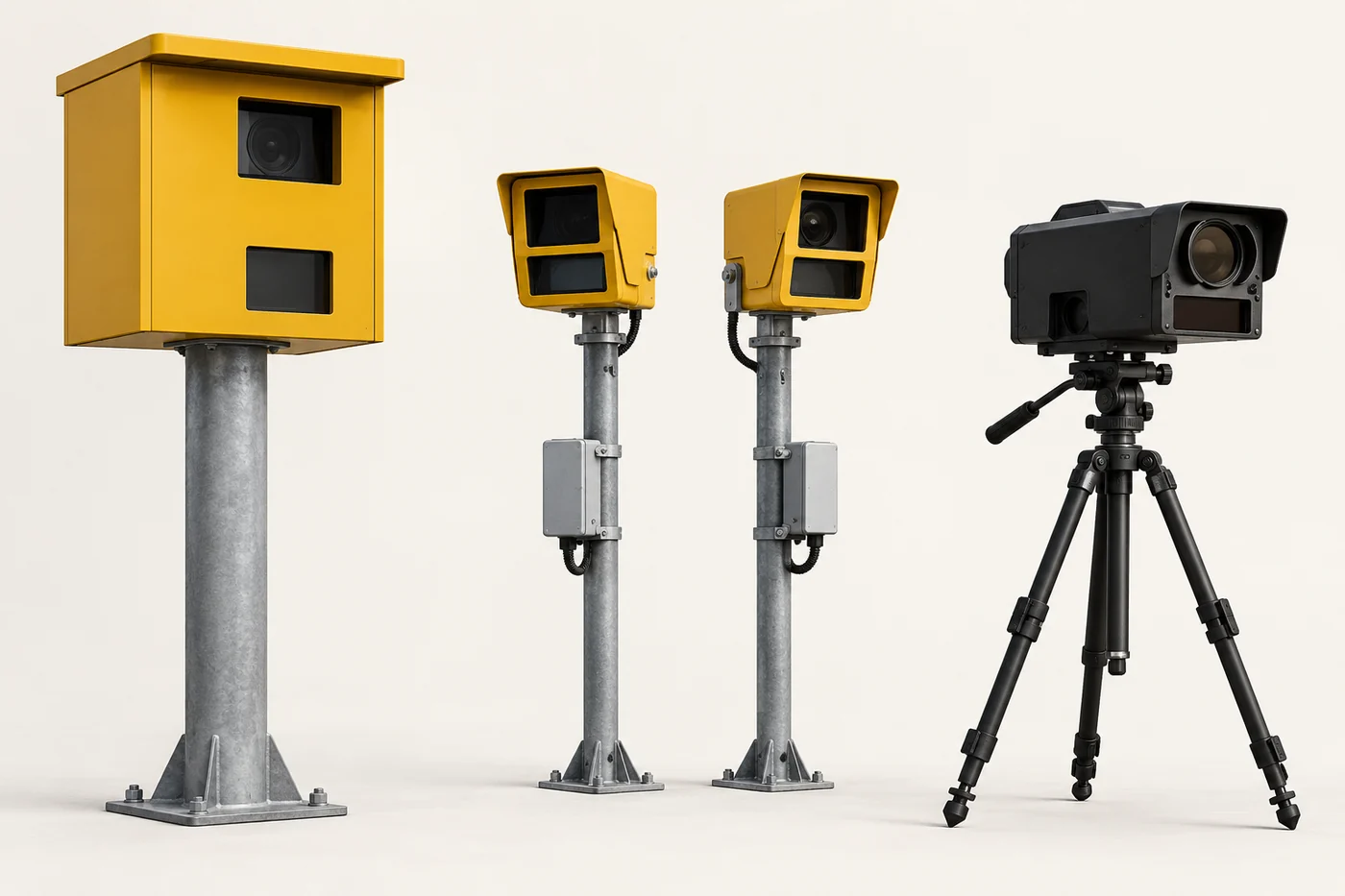
The useful distinction is what the equipment measures. This guide explains the main families, why newer cameras can look unfamiliar and what to check if a notice arrives. Examples cover Great Britain and Northern Ireland; particular models and deployments vary by area. Official sources were checked on 30 October 2026.
Speed camera types at a glance
| Family | Typical clue | What it measures | Avoid assuming |
|---|---|---|---|
| Fixed spot-speed | A permanent roadside housing, often yellow. | Speed at a particular location. | Every model needs painted road lines or a visible flash. |
| Average-speed | Linked cameras at separate points, sometimes on overhanging poles or gantries. | Average speed between recorded points. | Each camera works as an isolated speed trap. |
| Mobile | A camera van, handheld device or tripod-mounted equipment. | A measurement made using the deployed speed device. | A van’s presence reveals its exact measurement area. |
| Red-light or combined | A housing near a signal-controlled junction. | Red-light offences; some systems also enforce speed. | A green signal rules out speed enforcement. |
| HADECS motorway systems | Equipment associated with motorway gantries and variable-speed infrastructure. | Spot speed, linked to the applicable enforced limit. | Every camera near a gantry has the same job. |
The PSNI’s camera guide illustrates fixed, mobile, average-speed and red-light equipment used in Northern Ireland. It is a useful reference for those installations, rather than a universal identification chart for every UK road.
Fixed cameras: why the familiar yellow box is only one example
“Fixed” describes the installation. “Spot speed” describes the measurement. A fixed spot-speed camera records speed at its enforcement location; it does not need another camera several miles away to calculate an average.
The traditional Gatso system described by Police Scotland Safety Cameras uses radar and two rear-view images. The painted marks visible in those images provide a secondary check. They are not themselves the radar measurement.
That explains a common mistake when looking at photographs of a road: the familiar lines belong to a particular checking method. Their absence does not establish that newer equipment cannot enforce speed.
Newer cameras may have no familiar flash or road markings
Police Scotland’s June 2026 announcement about Vector SR cameras in Dundee describes tracking radar, coverage across multiple lanes and a virtual grid for secondary verification. Those installations do not need the traditional painted checking lines. Infrared imaging also removes the need for a visible camera flash.
This is an example of a specified system, not a claim that every small roadside camera is a Vector SR. If you are trying to identify equipment in a photograph, compare it with the responsible police force’s description of that site. An internet photograph of a similar-looking box is weaker evidence.
Average-speed cameras measure a journey section
An average-speed system links observations of the same vehicle at different points. The Safer Roads Humber explanation describes recording the registration and time at entry and exit, then calculating speed from the measured distance and elapsed time.
The distinction is between a measurement at a location and a measurement over a section. A single glance at the speedometer beside one camera cannot tell you what an average-speed system has recorded for that section.
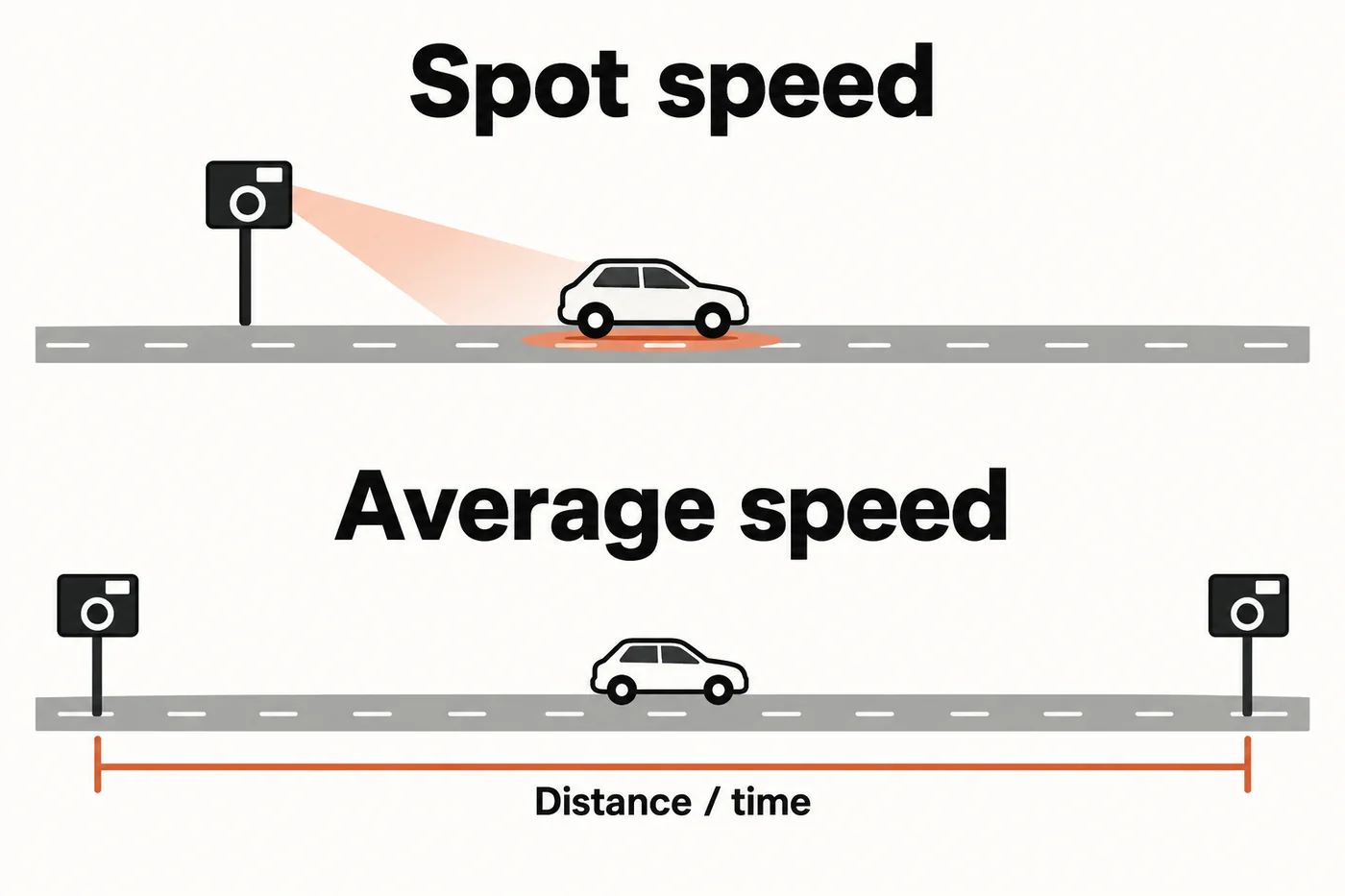
Systems may cover more than one pair of locations. Police Scotland’s equipment guide describes linked automatic number plate recognition (ANPR) cameras, front- or rear-facing arrangements and measurements involving multiple locations and lanes. That is why identifying two camera posts does not reveal the entire configuration.
For a driver, the relevant task remains following the applicable limit throughout the road section. The camera system is not a substitute for reading changes in restrictions. Our UK speed-limit guide for cars, vans and towing explains why vehicle type also matters.
Mobile cameras are a deployment method, not one shape
A mobile enforcement location may involve equipment in a vehicle, a handheld laser or a tripod. Safer Roads Humber describes operator-attended laser equipment with digital video, including deployments using vehicles and motorcycles. It also explains that its equipment can measure approaching or receding vehicles.
The observation “there was a van on the verge” therefore leaves several unanswered questions: what equipment was deployed, what it recorded and whether the vehicle in question was measured. Do not turn the direction of a van or a glimpse of an operator into a conclusion about a particular allegation.
The PSNI publishes photographs of its mobile vehicles and describes their laser and photographic equipment. Other forces can use different arrangements. These examples explain the family; they do not provide a reliable roadside test of whether enforcement is taking place.
Motorway and junction cameras can have different jobs
Surrey Police’s enforcement FAQ explains that its HADECS systems use radar and work with variable and national speed limits. Separate equipment checks the displayed variable-limit information used by the speedmeter. Several devices near one gantry may therefore be parts of a system rather than several identical speed cameras.
At junctions, a housing resembling a speed camera may instead enforce red lights, or do both jobs. Police Scotland’s Springburn Road installation announced in March 2026 is a documented combined speed and red-light example. Its dual function should not be assumed for every junction camera, but neither should it be ruled out just because the equipment faces traffic lights.
The published advisory about variable-speed camera errors
The Department for Transport’s anomaly advisory, published on 15 December 2025 and checked on 30 October 2026, describes an issue involving the interaction between some cameras and variable-speed signs on parts of England’s motorway and major A-road network. It says affected drivers will be contacted by the relevant police force. This is a specific issue, not evidence that every HADECS notice is wrong. Follow that official update for the affected cases; it is not an instruction to ignore a new notice.
ANPR and traffic CCTV are not interchangeable with speed measurement
ANPR means automatic number plate recognition. It is used within average-speed systems, but recognising a registration is not, by itself, measuring speed. Surrey Police describes other ANPR uses, including checking vehicle registrations against records of vehicles of interest.
Road cameras also support traffic management. Traffic Scotland explains that its traffic-camera feeds help control-room operators and police manage incidents. A camera’s presence on a road, or its appearance on a traffic website, does not establish a speed-enforcement function. Equally, a familiar-looking camera housing does not tell you all the equipment connected to it.
If a camera notice arrives, check the document
In Great Britain, GOV.UK explains the camera-notice process, including a requirement to provide driver details using a Section 172 notice, normally within 28 days. Read the actual document and its deadline. Northern Ireland has its own legal process: follow the issuing authority’s instructions rather than assuming the same forms or penalty amounts apply.
- Identify the document. A request for driver details is different from a penalty offer or court paperwork.
- Check the particulars. Compare the registration, location, date and time with your records. Keep the notice and record when it arrived.
- Respond accurately and on time. Use the stated official route and retain a copy or confirmation.
- Raise a specific discrepancy. Contact the issuing authority through verified contact details. If you intend to contest an allegation or cannot meet a requirement, obtain appropriate legal advice promptly.
Surrey’s FAQ makes a useful distinction: providing a driver admission identifies who was driving; it is not an admission of the alleged offence. For the separate question of possible outcomes, read our guide to speeding fines and penalty points.
Three common camera questions
Does no visible flash mean nothing was recorded?
No. The infrared equipment described above can capture images without a visible flash. Whether a particular vehicle was recorded cannot be established from what its driver noticed.
Can I treat an enforcement tolerance as extra speed allowance?
No. The PSNI’s myths-and-facts guidance explains that tolerances can vary and change. An enforcement policy does not increase the legal limit. This guide deliberately gives no “safe” excess-speed formula.
Does type approval prove that an individual notice is correct?
Type approval concerns equipment meeting specified requirements. The Home Office handbook for Great Britain sets out technical requirements, testing and measurement methods. It does not let a reader verify a specific notice from a photograph of a camera. Questions about an individual record belong with the issuing authority and, where necessary, the legal process.