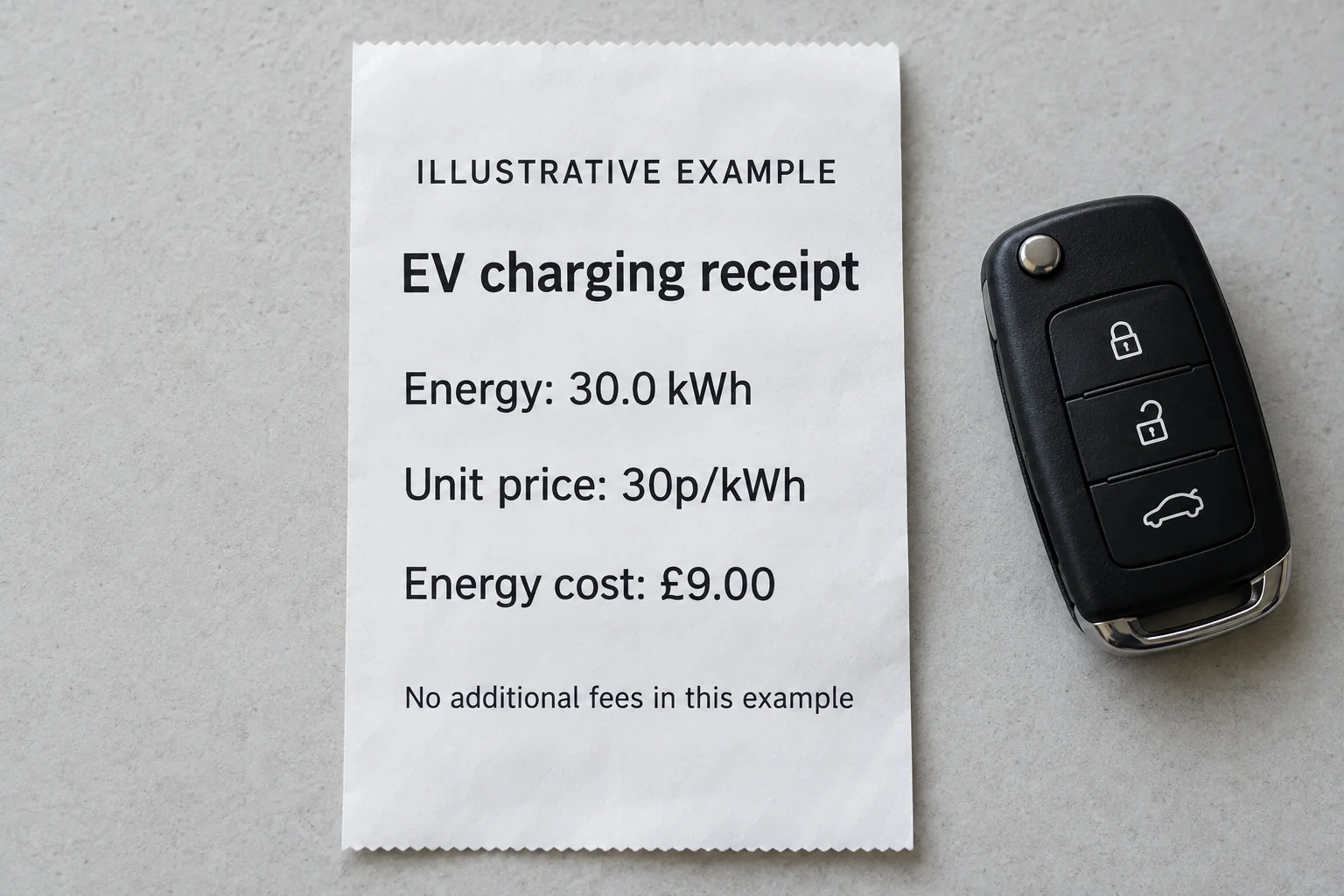
Charging cost is the electricity you are billed for, in kWh, multiplied by the price per kWh. A 30 kWh session would cost £2.40 at 8p/kWh, £9 at 30p/kWh or £24 at 80p/kWh, before any separate charges. These are illustrative rates, not current offers. Use your own tariff and the session’s metered energy for a meaningful answer.

A “full charge” price is often the wrong starting point. Most drivers top up only part of the battery, use more than one charging location and pay different prices at different times. This guide shows how to calculate a session, a month of driving and the break-even point for a public-charging subscription without treating a headline tariff as everyone’s price.
Work out the cost of one charging session
Energy cost in pounds = billed kWh × price in pence per kWh ÷ 100. Use the price including any applicable tax. If the quoted price is already in pounds per kWh, multiply directly; do not divide by 100 again.
For a completed session, take the kWh from the charger receipt or the relevant home-charging record. Multiply by the rate that applied to that energy. Where rates changed during charging, calculate each portion separately and add the results. For example, 20 kWh at 8p plus 10 kWh at 30p is £1.60 + £3 = £4.60, not 30 kWh all at the cheapest rate.
The table below makes the effect of the tariff visible. Its round-number prices are deliberately hypothetical. Energy bought means the amount billed, which is not necessarily the amount added to the battery.
| Energy bought | 8p/kWh | 30p/kWh | 80p/kWh |
|---|---|---|---|
| 10 kWh | £0.80 | £3.00 | £8.00 |
| 30 kWh | £2.40 | £9.00 | £24.00 |
| 60 kWh | £4.80 | £18.00 | £48.00 |
Do not multiply the charger’s power rating by your tariff. kW measures power; kWh measures energy. A 150 kW charger does not sell 150 kWh each time you plug in. Energy depends on the power actually delivered over time, and a car does not necessarily draw the charger’s headline power throughout a session.
Why battery capacity is not the same as electricity bought
If you are estimating a future top-up, use the car’s usable battery capacity, not automatically its larger gross capacity. The starting and finishing percentages refer to the driver’s usable operating window. Treat the resulting calculation as an estimate: the displayed percentage and the battery’s available capacity are not laboratory measurements.
Estimated battery energy added = usable capacity × (finishing percentage − starting percentage) ÷ 100. A hypothetical 60 kWh usable battery going from 20% to 80% gains approximately 36 kWh. It does not need a whole 60 kWh refill.
Some energy is used or lost during charging rather than ending up as stored battery energy. Conversion, vehicle electronics and battery temperature management can contribute. ADAC’s charging-loss measurements show why the car, charging method and conditions matter. Its measurements are not a universal loss factor for every UK session.
If, purely for a worked example, 90% of the billed energy reaches the battery, the 36 kWh top-up requires 36 ÷ 0.90 = 40 kWh bought. At an illustrative 30p/kWh that is £12. The 90% assumption is a calculation input, not a claim about your vehicle. Adding 10% to 36 gives 39.6; that is a different assumption, because “10% extra” and “10% of input lost” have different denominators.
I already have the charger’s kWh figure. Should I add losses?
No. For the energy charge, multiply the billed kWh by the applicable tariff. An extra estimated loss allowance would count the same energy twice. Check what your app’s figure measures: energy delivered by the charger and energy stored in the battery are different quantities.
I know only the battery percentage. How precise can I be?
You can produce a planning estimate using usable capacity and an explicit efficiency assumption. You cannot reconstruct a precise electricity bill from the percentage alone. Use the actual receipt or supplier’s charging record to reconcile the cost afterwards.
Home charging: compare the whole tariff
The right rate is the one on your contract or bill for the relevant charging period. An off-peak headline is useful only if your charging qualifies for it. Check the permitted window, any charging allowance, smart-meter requirement, compatible equipment and what happens when you need an immediate charge.
Intelligent Octopus Go’s own product page, for example, distinguishes managed charging from an immediate “bump” charge. It is an example of why conditions matter, not a recommendation or a price quote for your address. Other tariffs can have different rules.
Compare annual household electricity costs as well as the car’s night rate. A tariff that saves £15 a month on the car but adds £18 to other household use and standing charges is £3 more expensive overall. Those figures are hypothetical; the method is the point. Use your actual consumption pattern, particularly if you run electric heating or use substantial electricity during peak periods.
Ofgem separates unit rates from daily standing charges and explains that charges vary by region and payment method in England, Scotland and Wales. Its price-cap figures are not a personalised EV-tariff quote, and that GB framework should not be applied to Northern Ireland.
For the additional cost of charging on an unchanged household tariff, count the extra energy. You would normally pay the existing standing charge anyway. When comparing a tariff switch, include any change in standing charge and rates across the whole home. Keep a charger purchase and installation quote separate from recurring energy costs. Our home-charging guide covers the practical questions before commissioning an installation.
Public charging: check the payment method and parking terms
Read the price for the specific location and payment route before starting. An app, a contactless terminal, a roaming card and a subscription may not offer the same tariff at the same charger. IONITY confirms that its direct prices can depend on location and tariff, while a mobility-service provider may set a different price.
The UK government’s public chargepoint guidance requires the maximum charging price to be displayed in p/kWh or £/kWh before the session. Fixed charging fees belong within that displayed maximum price. Parking and overstay conditions still deserve a separate check: an energy comparison alone does not settle what a visit will cost.
Record the price shown, the provider taking payment and the completed session receipt. If something looks wrong, compare those records before contacting the provider. Do not automatically add a supposed connection fee to a quoted all-inclusive charging rate; establish what is already included.
Will a faster charger necessarily cost more for the same top-up?
No. Compare the actual p/kWh prices and other terms. A faster site may charge more, but power alone does not determine the tariff. At equal billed energy and equal unit price, the energy charge is equal. Charging speed also depends on the car and conditions.
Build a monthly budget from your driving
For an owner with records, total the charging costs across all locations over a useful period. Compare the mileage over the same period, ideally starting and finishing at similar battery percentages. Include regular workplace and public sessions; omitting an occasional expensive stop makes the result look artificially cheap.
For a prospective buyer, start with a realistic energy-consumption estimate for the exact car and your journeys. Clarify whether the efficiency figure includes charging losses. A dashboard figure usually concerns vehicle consumption; a measured wall-to-road figure already includes the energy bought. Do not apply another loss adjustment to an inclusive figure.
Here is a transparent battery-side example: 800 miles at an assumed 4 miles/kWh needs 200 kWh for driving. If an assumed 90% charging efficiency applies, the estimate becomes 222.2 kWh bought. Suppose 80% of that bought energy costs 10p/kWh and 20% costs 70p/kWh. The weighted price is (0.8 × 10) + (0.2 × 70) = 22p/kWh. Energy cost is about £48.89 a month, or 6.1p per mile.
Every number in that example is hypothetical. The shares refer to energy bought, not the number of charging stops. Using 80% cheap charging by session count can give the wrong answer if the expensive sessions are much larger. Add subscriptions, parking and any other relevant costs separately. Insurance, depreciation, finance, servicing and tyres are outside this energy calculation; see our car-choice guide for the wider decision.
Repeat the estimate using a less favourable consumption figure and a larger share of public charging. If the car is affordable only under your most optimistic assumptions, investigate those assumptions before committing. Winter journeys, motorway use and your actual charging access can change the result.
When does a charging subscription pay for itself?
Break-even kWh = subscription fee in pounds ÷ saving per kWh in pounds. In a fictional plan costing £8 a month, with 75p/kWh without membership and 55p/kWh with it, the saving is £0.20/kWh. £8 ÷ £0.20 = 40 kWh. At 40 kWh the two options cost the same; above it the membership begins to save money, provided the same price difference applies.
Use only the energy you expect to buy through that eligible plan during the billing period. Home charging cannot help recover a public-network subscription fee. Check renewals, cancellation timing, which locations qualify and whether a roaming service is excluded. If the member rate is no lower than the alternative you would actually use, there is no positive energy-saving break-even point.
Work out your charging cost
Enter your own energy amount and unit price. This calculates the cost of one session at that rate. Separate parking, idle and membership fees are excluded unless already included in your unit price. Do not add a fee twice if it is already included in your unit price.
Formula: billed kWh × price in p/kWh ÷ 100 = cost in pounds. For battery energy, estimate the electricity bought first: battery kWh ÷ (efficiency ÷ 100).
The result is rounded to the nearest penny. Use a separate calculation for each unit price if it changes during a session. This tool accepts non-negative prices only; for a negative tariff, use the same formula manually. Your bill may include other charges.
Your charging-cost check
Use these ticks as a temporary worksheet. They do not save your answers or calculate a quote.
Can free workplace or solar charging make the energy cost zero?
A genuinely free session can have a zero electricity payment for you, but verify the access and parking conditions. Solar electricity used by the car may replace electricity you could otherwise export or use elsewhere. Account for that trade-off when comparing household options; it is not automatically the same as a zero-cost resource.
For a new owner, the most useful first improvement is to keep the first month’s receipts and charging records. Replace the example figures with those observations. Energy Saving Trust’s charging advice explains the range of charging locations and tariff options; our everyday EV guide helps assess whether those options fit your routine.
Sources checked 15 October 2026. Calculations are illustrative, not vehicle tests or tariff offers. This guide covers cost estimation and contains no electrical-installation instructions.
The conversation