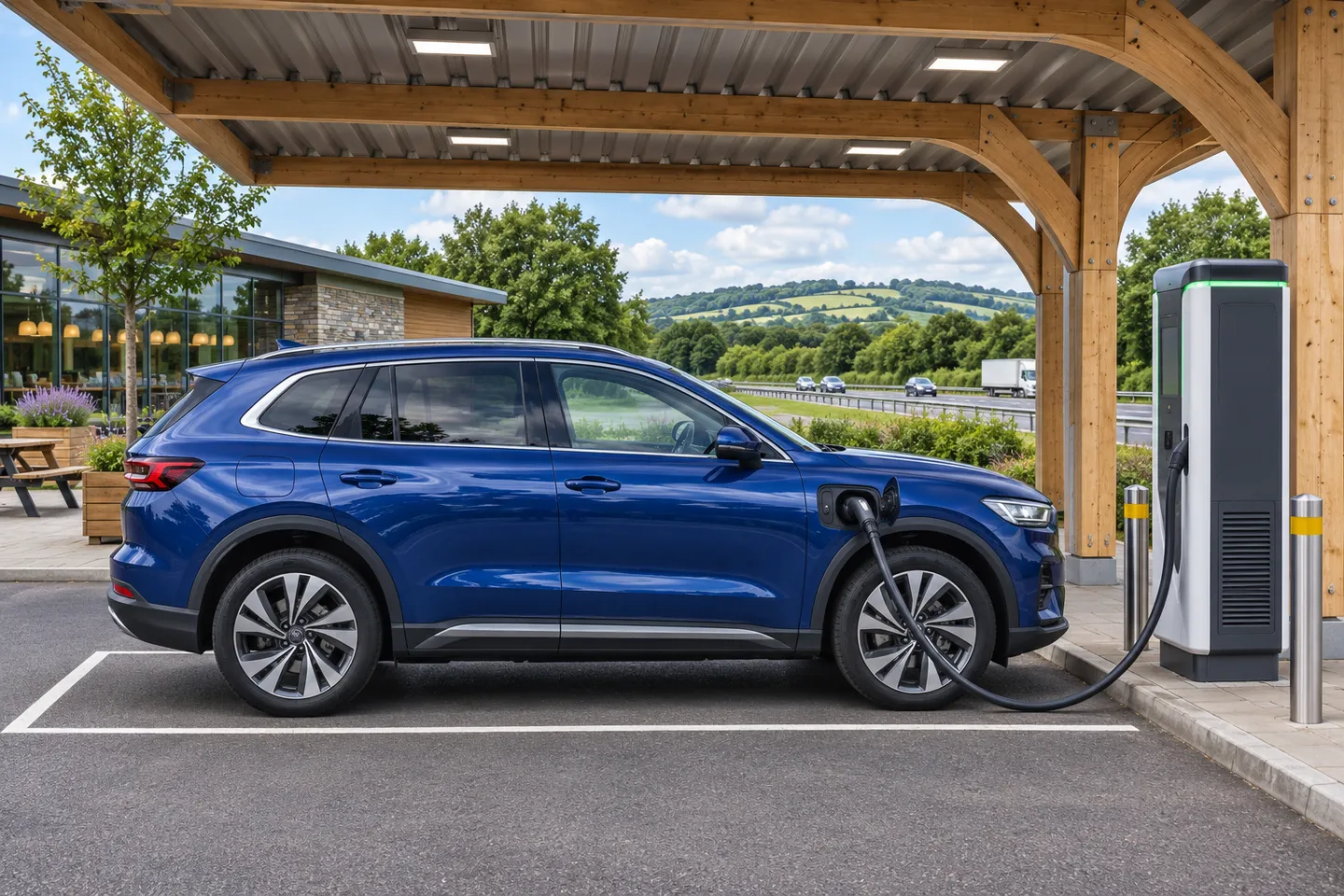
If your regular trip involves a short stop at high-power services, shortlist the Hyundai IONIQ 5 Advance 84 kWh. For a long first leg and a smaller car, consider the Kia EV3 Air Long Range. If holiday luggage fills the car before anyone has reached the motorway, try the Škoda Enyaq Edition 85 SUV first. The deciding detail may be the power of the charger on your route or whether your pushchair fits with everyone on board. [1] [2] [3]
Three electric SUVs to shortlist for a long journey
These UK specifications use combined WLTP range, a standardised test figure. Driving speed, cold weather and the load you carry can change how far you travel. Use the test figures to compare versions, then use a route estimate for the actual journey. [1] [3] See also what affects electric car range.
| Model | Combined range | DC charging estimate | Rear boot |
|---|---|---|---|
| Kia EV3 Air, 81.4 kWh, front-wheel drive, 17-inch wheels [1] | 375 miles | 10–80% in 31 min at maximum speed. Kia specifies a 400 V charger delivering at least 150 kW for maximum speed. | 460 litres |
| Hyundai IONIQ 5 Advance, 84 kWh, rear-wheel drive, 19-inch wheels [2] | 354 miles | 10–80% in 18 min on a 350 kW CCS charger in suitable conditions. | 520 litres |
| Škoda Enyaq Edition 85 SUV, 84 kWh gross, rear-wheel drive [3] | 373 miles | Approx. 29 min to 80% on a suitable DC charger. The technical table gives no starting percentage for this figure. | 585 litres |
Match the advert to the precise specification. Kia also calls its 58.3 kWh model “Air”; that version on 17-inch wheels is rated at 270 miles combined. The Enyaq figures above come from the UK guide effective 19 October 2026, for the conventional SUV body. In that same guide the Edition 85 Coupé has a different battery specification. [1] [3]
What happens when the services only have a 50 kW charger?
The IONIQ 5’s quickest published stop is 13 minutes shorter than the EV3’s. On a 50 kW CCS charger their quoted times over the same 10–80% window draw much closer. Hyundai estimates 76 minutes for the 84 kWh IONIQ 5, while Kia lists 79 minutes for the long-range EV3. For a driver who regularly stops at that type of charger, the difference on paper is three minutes. A detour to find a faster site, a queue or the time it takes the family to eat can change the choice. [1] [2]
Check the power available at the individual chargepoint, the charge level you expect on arrival and the next leg you actually need to cover. A charger marked 350 kW can serve an IONIQ 5 that accepts up to 260 kW under optimal conditions. The car’s charge rate also varies with battery temperature and condition. Time at the plug is only one part of the stop. [2]
How much difference could a second stop make?
If both stops happened to be 10–80%, two of Hyundai’s 18-minute sessions would total 36 minutes at the plug. Two of Kia’s 31-minute sessions would total 62 minutes. Repeat the same arithmetic with the 50 kW times and the totals become 152 and 158 minutes. This comparison assumes each stop matches the manufacturer’s conditions. It excludes queuing and says nothing about how many stops your car would need. [1] [2]
Work out the gap between two chargers you would actually use
Pick a route you know, including the return journey. A charger at the hotel can change which services you need on the way back. Check opening hours and access at the destination. Mark a second usable charging site if the first is busy or unavailable. Enter the expected departure charge and a comfortable arrival reserve in the car’s route planner.
To see how a reserve changes the calculation, suppose your journey estimate gives 250 miles for a full battery in the expected conditions. Leaving a stop at 80% and intending to arrive with 15% gives a nominal leg of about 163 miles (250 × 0.65). A 180-mile gap would exceed that estimate. Choose a closer stop, change the departure charge or revisit the route. The 250 miles is an illustrative input for the arithmetic, independent of the three cars’ WLTP figures. Recheck the predicted arrival charge as conditions change.
If two sites suit the route equally well, compare the price for the energy you expect to take there. The guide to calculating an EV charging session shows how to use the tariff and energy figure.
Which boot works with the seats you need?
The Enyaq’s published rear boot holds 125 litres more than the EV3’s with passengers in the back. That makes it a sensible first viewing for a family carrying a large pushchair and bags together. A wide rectangular case can still catch on wheel housings in a car with a generous capacity. Take the case or folded pushchair you use most often, and set the passenger seats before loading it. [1] [3]
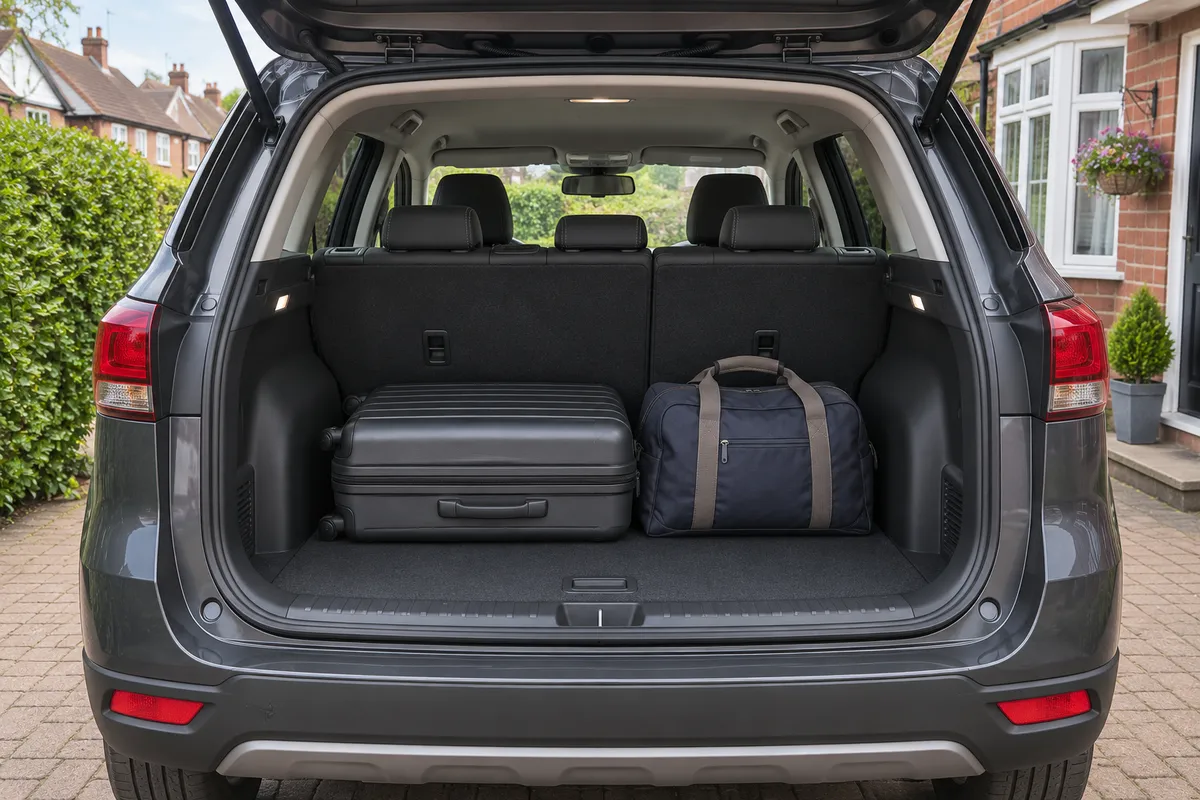
Try taking the overnight bag out while leaving the largest case in place. If you normally carry a charging lead under the boot floor, see whether you can reach it on arrival without unloading onto a wet pavement. A car that clears those two tests and reaches your usual break stop with charge to spare is a stronger match for your journey than a longer-range version that leaves a bag behind.
Sources
- Kia UK — EV3 specifications. See the UK charging, capacity and WLTP range tables and the maximum charging speed notes.
- Hyundai UK — IONIQ 5 technical and specification guide. PDF pages 2–3 cover charging conditions and the Advance rear-wheel-drive versions.
- Škoda UK — Enyaq UK brochure and technical specifications. Edition effective 19 October 2026, PDF pages 11, 37 and 38.