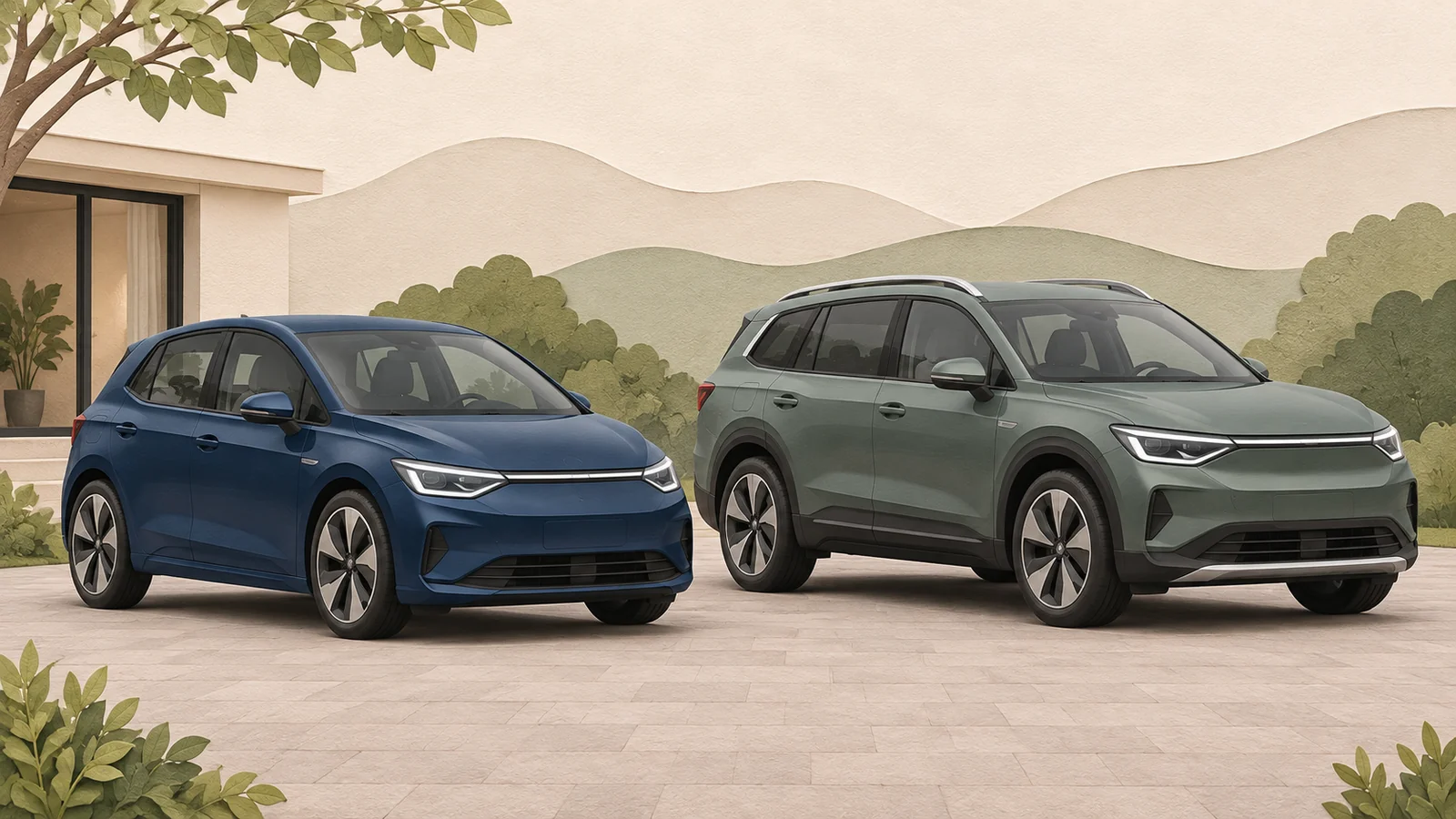
Choose the Volkswagen ID.3 if its boot and rear seats cover your everyday needs and you value a smaller car to park. Choose the ID.4 if you regularly need more load length or rear-seat width. The ID.4 is the bigger SUV, but that does not automatically make it the longer-range or better-value purchase. Battery version, age, equipment and the price of the actual car matter more than the badge number.
UK specification check: 4 November 2026. This comparison covers the existing ID.3, now advertised as available from stock, and the ID.4. The newer ID.3 Neo is a separate choice: do not apply the ID.3 figures below to a Neo quotation. Figures describe the named versions in the current UK technical tables, not every model year or used example. [1] [2] [5]
The useful difference: a smaller footprint or more room?
The question is whether the ID.4’s extra space solves a problem you actually have. If the ID.3 accommodates your passengers and luggage, a larger body adds space you may rarely use. If your pushchair leaves no room for shopping, or adult passengers sit behind tall front occupants, the ID.4 deserves a proper trial.
| Measurement | ID.3 | ID.4 |
|---|---|---|
| Overall length | 4,264 mm | 4,584 mm |
| Width, excluding mirrors | 1,809 mm | 1,852 mm |
| Boot floor length, rear seats upright | 852 mm | 965 mm |
| Rear interior width | 1,444 mm | 1,494 mm |
On those figures, the ID.4 is 320 mm longer and 43 mm wider, with 113 mm more boot floor length behind the rear seats. That extra body length is worth marking out on your driveway before a viewing. The width difference is across the whole car, not on each side. Neither width figure includes mirrors or the space needed to open doors.
For a narrow garage, measure the opening, the interior and the room to get out. For street parking, think about the spaces you usually find. Neither a reversing camera nor parking sensors change the size of the car; check which aids the specific example has and try them during the viewing.
Boot space: bring the awkward item
The ID.3 dimensions page lists a 385-litre boot. The published ID.4 pages disagree: the dedicated dimensions page says 543 litres, while the technical table says 533 litres. We have not treated either ID.4 number as universal across stock and model years. Both indicate a larger luggage compartment, but neither proves that your particular pushchair, dog crate or mobility aid will fit. [2] [3] [4]
A bulky object can fit the boot floor and still fail to pass through the opening. Test with the rear seats in the position you will use, the load cover fitted if you need it, and the boot floor at its intended height. Do not base a family-car decision on a seats-folded capacity if those seats will normally carry passengers.
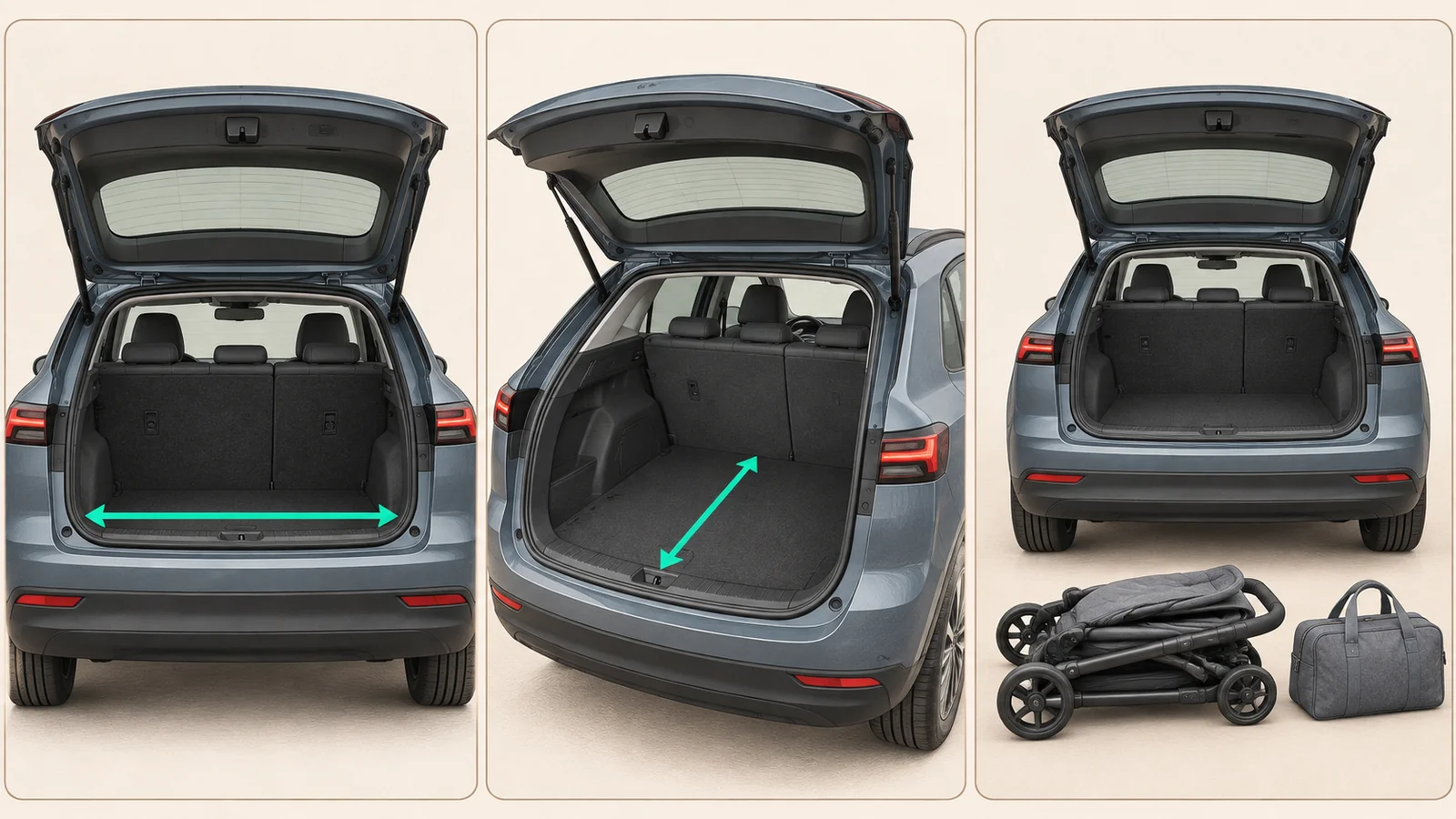
Also load the item yourself. A taller body does not tell you whether the sill is comfortable for your back or whether you can reach an open tailgate. These are reasons to try both cars in person, rather than infer ease of use from their body styles.
Range: compare the battery and trim, not just ID.3 against ID.4
The following four examples show why a broad range verdict is misleading. The smaller-battery cars sit close together in the published figures, as do the two larger-battery versions. These are specific UK technical-table entries checked on the date above. [1] [2]
| Variant | Battery listed | Combined range |
|---|---|---|
| ID.3 Pro Match | 59 kWh | 268 miles |
| ID.4 Pure Match | 58 kWh | 265 miles |
| ID.3 Pro S Match | 79 kWh | 351 miles |
| ID.4 Pro Match, rear-wheel drive | 79 kWh | 347 miles |
WLTP is a standardised comparison, not a guarantee for your motorway trip. Speed, weather, load and battery condition affect what you can cover. Plan around your regular long journey, including where you can charge and the arrival reserve you want, rather than selecting the car with a small advantage in a laboratory figure. Our electric-car range guide explains how to make that distinction.
For example, someone who makes short local trips and can charge at home may gain little from a larger battery. Someone with a frequent long motorway journey should compare charging stops for that route. A longer-range ID.3 could suit the second driver better than a smaller-battery ID.4, even though the latter is the larger car.
Charging: check the actual version and your routine
For the 79 kWh examples above, the technical tables list maximum DC charging power of 185 kW and a 26-minute 10–80% time for ID.3 Pro S Match; ID.4 Pro Match is listed at 165 kW and 29 minutes. These are published conditions-based figures, not a promise that one car always saves three minutes at a public charger. [1] [2]
Ask for the charging specification attached to the exact stock car or registration. A maximum power figure alone does not tell you the whole stop duration. Check the stated starting and finishing charge levels and any conditions alongside a quoted time.
If most charging will happen overnight, assess the home-charging arrangement before paying extra for a headline rapid-charging figure. If you depend on public charging, identify two usable locations on your normal routes and compare their tariffs and access arrangements. The home-charging questions checklist helps turn this into a practical plan.
Which costs less to own?
Compare two real quotations with matching assumptions. A new or nearly new ID.3, an older ID.4 and an ID.3 Neo are not interchangeable price comparisons. Record the car’s age, mileage, battery, equipment and warranty beside the price; a cheaper purchase may simply be a different product.
- Buying outright: compare the cash price, expected ownership period and what you could reasonably recover when selling. Treat future resale values as uncertain.
- Using finance: compare deposit, term, mileage allowance, fees, total amount payable and any final payment on the actual offers. A smaller monthly number alone does not establish lower cost.
- Running costs: obtain insurance quotes for both registrations, check the fitted tyre sizes and replacement prices, and calculate charging from the tariff you will use.
A small efficiency gap is not the whole budget
Here is an illustration, not measured ID.3 or ID.4 consumption. At 8,000 miles a year, an assumed 4 miles per kWh requires 2,000 kWh, while 3.5 miles per kWh requires about 2,286 kWh. The difference is about 286 kWh: roughly £71 at an assumed 25p/kWh, or £200 at an assumed 70p/kWh.
Those figures exclude charging losses and any subscription or parking charges. They show why the tariff and purchase-price gap deserve attention alongside efficiency. For budgeting from actual billed energy, use our charging-cost guide.
Buying used: establish what the car actually is
A registration year is only a starting point. Ask the seller to confirm the original specification and model year from the vehicle details. Do not copy today’s range or charging figures into your expectations for an older car. Battery capacity reduces with age and use, so a new-car range figure is not evidence of a particular used battery’s condition. [1] [2]
- Identify it: confirm the battery variant, trim, drive layout, first-registration date and fitted options in writing.
- Request evidence: inspect the service record and any battery-health report, including the date and what was measured. A dashboard range estimate is not a substitute for that assessment.
- Check outstanding work: ask an authorised retailer to check the VIN for recalls, campaigns and applicable software updates, and obtain records of completed work.
- Try the equipment: check the displays, phone connection, climate controls and supplied charging cables. Arrange a charging demonstration where practical.
- Separate the warranties: establish remaining general vehicle cover and battery cover, their exclusions and the process for making a claim.
The published high-voltage battery warranty is eight years or 100,000 miles, whichever comes first, subject to its terms. The capacity provision uses a 70% threshold measured by an authorised repairer. That is a warranty threshold, not a statement that every used car still has its original range or a fresh eight years of cover. Check the terms and remaining cover for the individual car. [6]
Take this decision checklist to both viewings
Set the front seat for the main driver before testing the rear seat. Bring the regular passengers where possible, plus the largest item you carry. Then open the section that matches your situation.
My main concern is parking and everyday errands
Start with the ID.3. Check that your regular load fits with the rear seats upright, then test your normal parking space and access to the charging port. If it clears those requirements, ask what specific benefit the ID.4 would add before accepting its larger footprint or a higher quotation.
I regularly carry passengers and bulky luggage
Try the ID.4 first, but use the same passengers and luggage in both cars. Check rear knee room with the front seat in its real position, boot-opening clearance and the ability to close the tailgate without rearranging everything. Choose the extra room if it solves that repeat problem, not simply because the car is called an SUV.
I make long journeys or cannot charge at home
Shortlist exact battery versions in both body styles. Compare your route, realistic charging opportunities, tariff and arrival reserve. Then test passenger comfort. If charging access is inconvenient for both, the larger car alone will not resolve it.
Our buying judgement: the ID.3 is the sensible starting point when compact dimensions and sufficient space are the priorities. The ID.4 earns its place when its extra room is useful often enough to justify the actual price and parking trade-off. Let the individual car’s specification and condition decide close calls.
Sources
- Volkswagen UK: ID.3 model page and technical data — stock availability, named variants, combined range, charging and model-year limitations. Checked 4 November 2026.
- Volkswagen UK: ID.4 model page and technical data — named variants, range, charging and dimensions. Checked 4 November 2026.
- Volkswagen UK: ID.3 dimensions — body dimensions, luggage space and rear interior width. Checked 4 November 2026.
- Volkswagen UK: ID.4 dimensions — body and load dimensions; boot-volume discrepancy disclosed in this comparison. Checked 4 November 2026.
- Volkswagen UK: the new ID.3 Neo — distinct model listing, excluded from this article’s ID.3 specification tables. Checked 4 November 2026.
- Volkswagen UK: warranties — electric-car high-voltage battery term, capacity provision and conditions. Checked 4 November 2026.