For an ordinary car without a trailer, the national limit is 60 mph on a single carriageway and 70 mph on a dual carriageway or motorway. A lower signed limit takes precedence. Vans and towing combinations can have lower limits. On street-lit roads, the usual default is 30 mph in England, Scotland and Northern Ireland, but 20 mph in Wales, unless signs show otherwise.
The number to use depends on the road, the vehicle and any restriction applying to the driver. This guide explains how to put those checks together. Rules and official guidance were checked on 27 October 2026; Northern Ireland’s new-driver transition is covered separately below.
National speed limits: cars, vans and trailers
These figures apply where the national speed limit is in force, not to every road of that type. All figures are miles per hour. The table covers ordinary cars and light goods vehicles; it does not override lower signs or licence restrictions.
| Vehicle | Single carriageway | Dual carriageway | Motorway |
|---|---|---|---|
| Car or motorcycle, without trailer | 60 mph | 70 mph | 70 mph |
| Qualifying car-derived van, without trailer | 60 mph | 70 mph | 70 mph |
| Car or car-derived van towing a caravan or trailer | 50 mph | 60 mph | 60 mph |
| Ordinary goods van, maximum laden weight up to 7.5 tonnes | 50 mph | 60 mph | 70 mph* |
*For that goods-vehicle category, the motorway limit is 60 mph if articulated or towing a trailer. Sources: GOV.UK speed-limit tables and the Northern Ireland Highway Code. Qualifying dual-purpose vehicles in Great Britain also follow the car limits; the classification needs checking, as explained below.
A dual carriageway is about separation, not lane count
A central reservation separates the two carriageways of a dual carriageway. Two lanes travelling in your direction are not enough to establish that classification: a single carriageway can have several lanes. Equally, a dual carriageway can have just one lane in each direction.
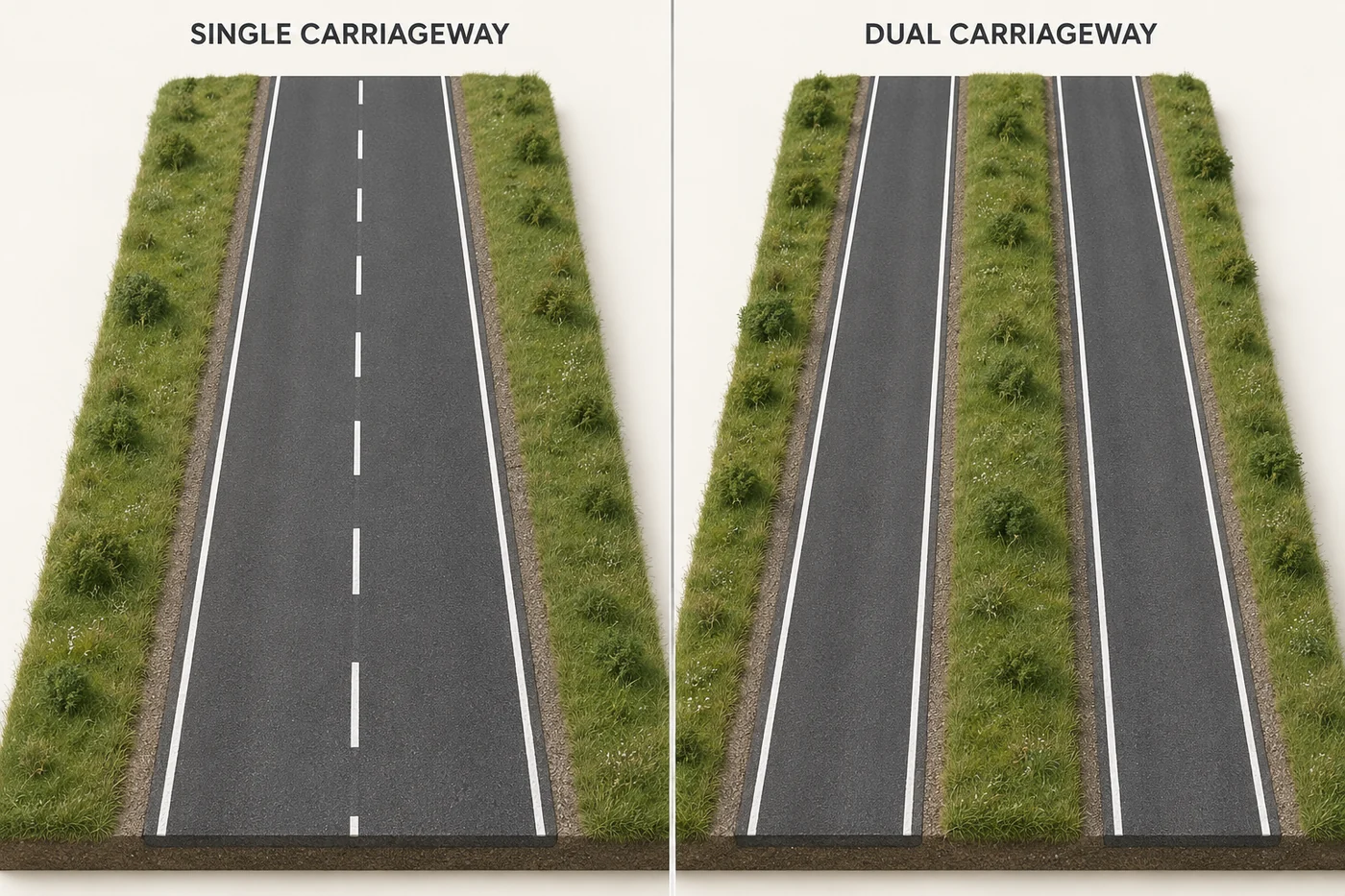
This is the distinction used in the Highway Code’s single and dual carriageway guidance. An A-road number does not tell you which layout you are on. A road can change from one to the other during the same journey.
Nor does a central reservation automatically mean 70 mph. A 40 or 50 mph sign can apply on a dual carriageway. Work out the road type, then read its signs and apply your vehicle’s limit.
What the speed-limit signs tell you
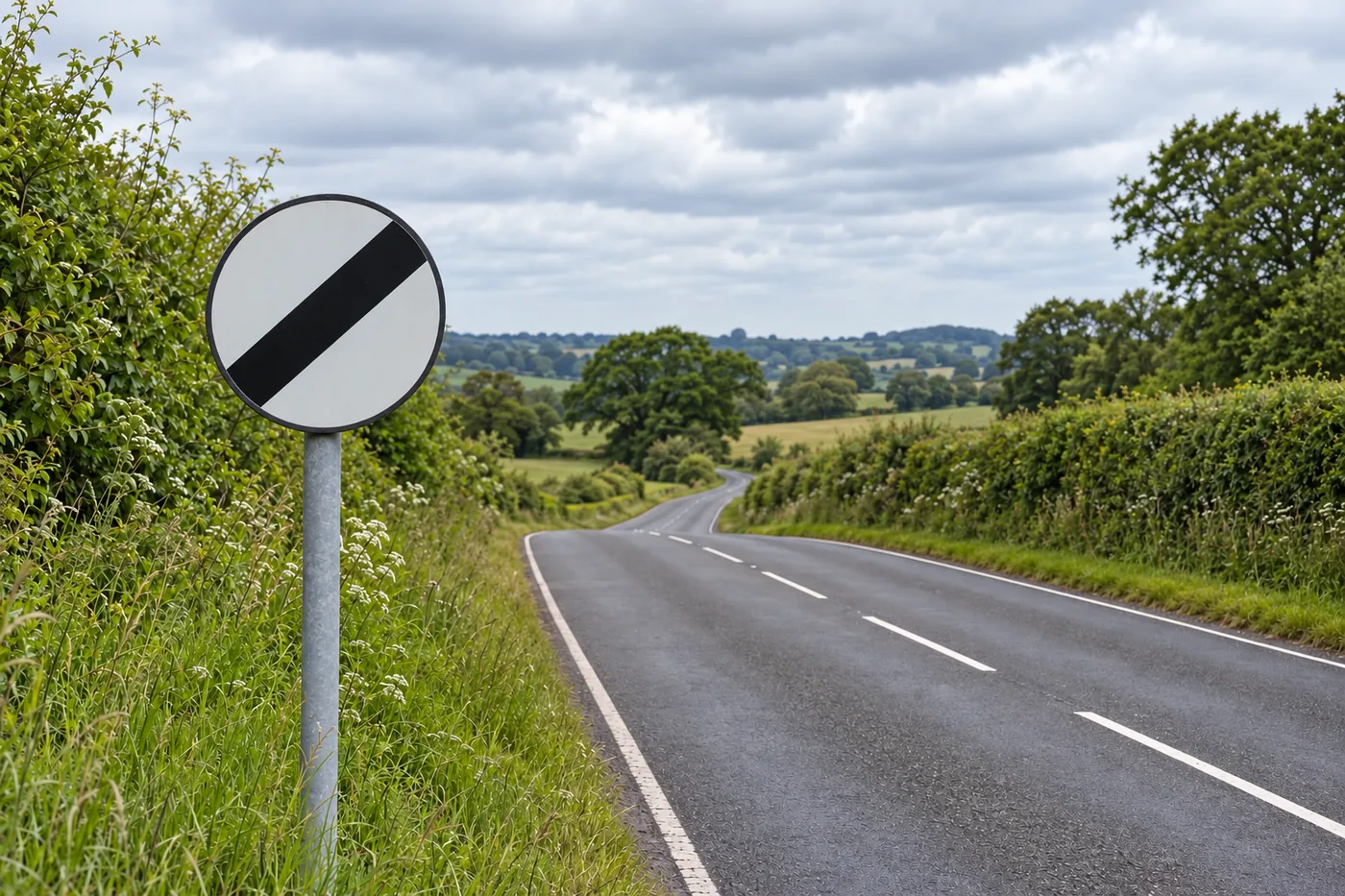
A number inside a red circle sets a maximum in mph. The white circle with a black diagonal band means the national limit for the road and vehicle class; it does not always mean 60 or always mean 70. Larger signs mark the start of a limit and smaller repeater signs provide reminders where required.
The Department for Transport’s speed-sign guide also distinguishes a blue circular minimum-speed sign from a red circular maximum. A warning sign with an advisory speed at a bend serves a different purpose again. Read the complete sign rather than treating any displayed number as the road’s legal maximum.
When a lower limit begins, that is where it applies. Do not use the first repeater or a camera position as the point at which to start observing it.
Street lights: 30 mph or 20 mph?
On ordinary street-lit roads, the usual default is 30 mph in England, Scotland and Northern Ireland, unless signs specify something else. This rule is not an instruction to drive at 30 on a lit motorway. Nor should you expect a 30 mph repeater on every lamp post: the lighting itself can identify the default restriction.
In Wales, the corresponding default is 20 mph. Not every Welsh road became 20: some roads retain a signed 30 mph limit. The Welsh Government’s current guidance says to treat street-lit residential or built-up roads as 20 unless signs tell you otherwise. On unlit roads with a 20 mph limit, additional signs identify it.
Look for the limit when entering the area, and continue checking for changes. A memory of what the road used to be is less useful than the signs you pass today. Street lighting on a dual carriageway is another reason not to assume that the car’s 70 mph national limit applies there.
Why a small van may have a lower limit than a car
Small dimensions, an empty load bay or a familiar car badge do not establish a van’s speed-limit class. The relevant weight is the permitted maximum for the classification, not simply what the vehicle happens to weigh today. Before hiring or buying, ask which class and limits apply to that exact vehicle.
Car-derived vans
In Great Britain, a car-derived van must be derived from a passenger vehicle and have a maximum laden weight no greater than 2 tonnes. Check the V5C body-type entry as well as the vehicle’s actual eligibility. An incorrect entry does not make an ineligible van qualify. If the classification is disputed, the Department for Transport says to use the lower goods-vehicle limits while the issue is resolved with the dealer or manufacturer.
Dual-purpose vehicles
This is also a defined category, not another name for any SUV, crew cab or four-wheel-drive vehicle. The Great Britain definition requires carriage of passengers and goods, an unladen weight no greater than 2,040 kg, and further construction conditions. Weight alone is insufficient. Use the DfT classification guidance and linked legal definition to check the exact vehicle; obtain manufacturer clarification where necessary.
For Northern Ireland, use its own vehicle-limit table and seek DVA clarification if your vehicle does not fit a listed class. Do not assume a tax or advertising description settles a road-traffic classification.
Our small-van buying guide explains the separate payload and fit checks. The V5C guide helps you understand the document you are checking.
Variable signs and temporary limits still count
On a motorway, a speed shown within a red circle is mandatory. A speed displayed without that circle is advisory for the conditions. The distinction is set out in the official motorway-sign guide. Advisory does not mean that the hazard can be ignored.
A red-circled 50 applies even if the motorway ahead appears empty. The cause may be beyond your view. A signed 70 does not raise a towing combination’s 60 mph maximum: both the displayed restriction and the vehicle’s own maximum matter. Highway Code rule 261 requires compliance with both.
The same care is needed at roadworks. Follow the temporary signs and their end point; the absence of workers at that moment is not evidence that the restriction has ended. A navigation display is a useful prompt to check, not permission to disregard an actual sign.
Try the limit check on three situations
These examples explain the rules, rather than judge whether a speed is safe in the conditions.
A car passes a national-limit sign on a road with two lanes each way but no central reservation
The layout is still a single carriageway. For an ordinary car without a trailer, the national maximum is 60 mph, not 70. Additional lanes do not create a central reservation. A lower restriction, driver condition or unsafe conditions can require a lower speed.
An ordinary 3.5-tonne goods van is empty on a national-limit dual carriageway
Its maximum is 60 mph. Being empty does not turn it into a car-derived van or change its permitted maximum weight. If the road is instead signed 50, that lower road limit applies.
A car towing a small trailer enters a motorway displaying a red-circled 50
The displayed maximum is 50 mph while that restriction applies. When the normal national limit resumes, the car-and-trailer maximum is 60 mph, not 70. The trailer’s small size does not remove the towing limit.
Motorhomes, heavier vehicles and Northern Ireland drivers
In Great Britain, motorhomes at or below 3.05 tonnes maximum unladen weight use the car national limits. Above that threshold, the single and dual carriageway figures are 50 and 60 mph respectively, while the motorway figure is 70. That is an unladen threshold, not a 3.5-tonne maximum-authorised-mass rule. Check the classification before relying on a campervan advert; some uses can make the vehicle a goods vehicle. See the official speed-limit table and motorhome classification notes.
Heavy goods vehicles need a separate lookup. At this check, those over 7.5 tonnes have different national single/dual limits in England and Wales (50/60 mph) from Scotland and Northern Ireland (40/50 mph). There are specific exceptions, including the Scottish A9 HGV scheme. Consult Transport Scotland and the NI table, rather than applying the light-van row.
Northern Ireland’s new-driver transition
Since 1 October 2026, Northern Ireland has been introducing Graduated Driver Licensing. Newly qualified drivers covered by the new blue R-plate scheme do not have its former 45 mph restriction. Drivers still under the amber R-plate arrangements remain restricted to 45 mph for their applicable period.
During the transition, the correct route depends on when provisional entitlement began and when the test was passed. Check the current nidirect transition table; “all R drivers can now do 70” and “all R drivers are limited to 45” are both unsafe shortcuts. Learners should also confirm their own route with the Department for Infrastructure. A lower road limit still applies.
A useful check before an unfamiliar journey
- Confirm the vehicle category and any towing or driver restriction before setting off.
- Note which country you will enter, especially the Welsh street-lit default and Northern Ireland’s new-driver rules.
- At a change of road, check its layout and the actual signs; do not infer the limit from its name or width.
- Use the lowest applicable road, vehicle or driver maximum, then choose a lower speed whenever conditions require it.
The limit is a ceiling, not a target. Poor visibility, bends, weather and vulnerable road users can make the legal maximum inappropriate. Leave time for those conditions when planning a road trip, rather than trying to recover a delay by driving faster.
The conversation