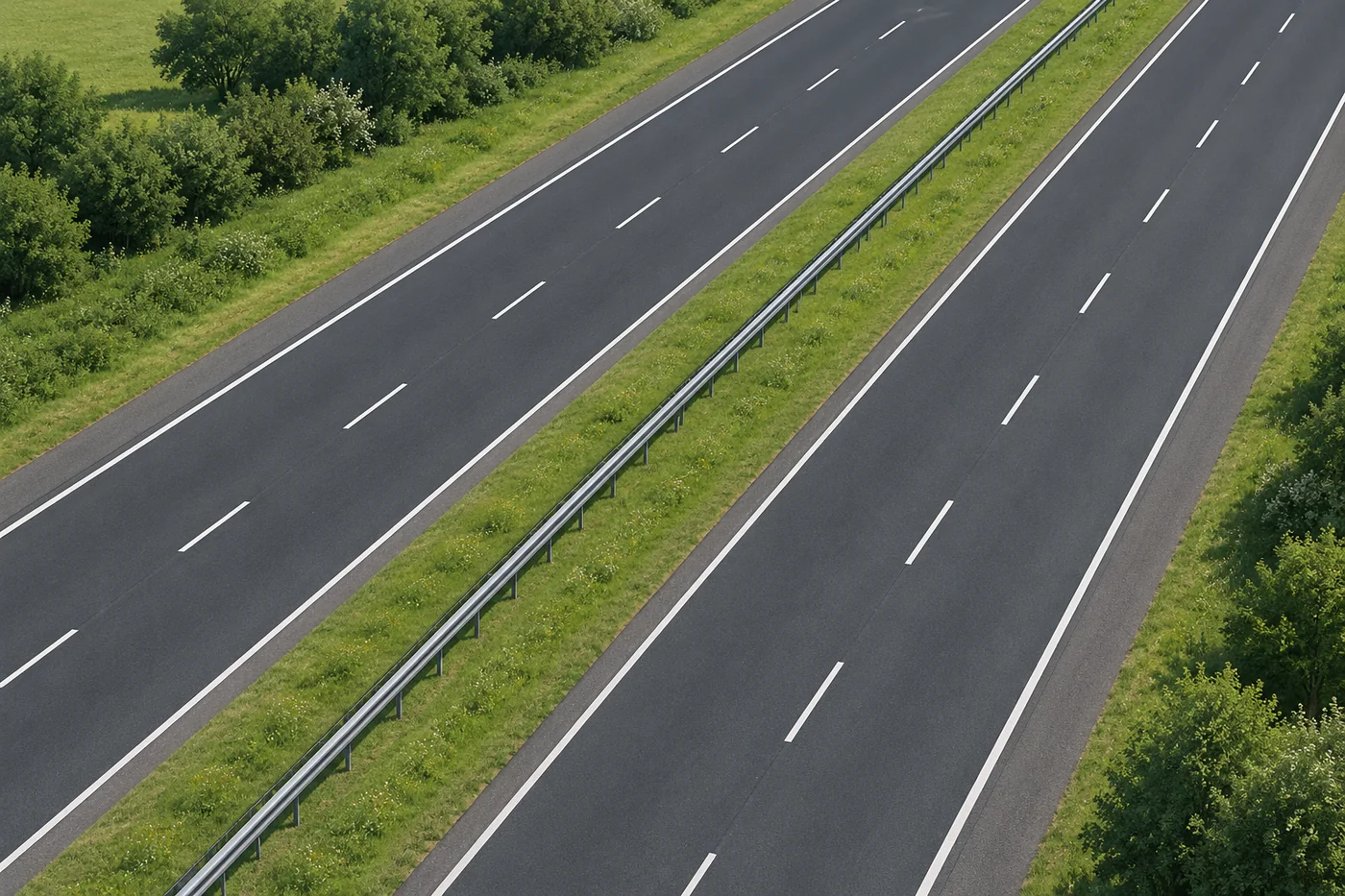
A dual carriageway has separate carriageways divided by a central reservation. A motorway is a road governed by motorway regulations, including restrictions on who may use it. These describe different things: the physical layout and the legal rules. Two or three lanes, a slip road or a 70 mph limit do not, by themselves, make a road a motorway.
That distinction matters when planning a learner journey, choosing a route for a restricted vehicle or working out what a sign actually tells you. This guide explains identification and access, with Great Britain and Northern Ireland differences checked on 29 October 2026. It does not replace practical instruction in joining or driving on fast roads.
Motorway and dual carriageway: the useful differences
| Question | Non-motorway dual carriageway | Motorway |
|---|---|---|
| What identifies it? | A central reservation separates the carriageways. | Motorway status and the signs marking its regulations. |
| Does lane count decide? | No. Count carriageways, not lanes. | No. A wide road is not automatically a motorway. |
| What colour are directions? | Normally green on primary routes, white on non-primary routes. | Normally blue, but a blue panel elsewhere may merely direct you towards one. |
| Can it have motorway-style exits? | Yes. Slip roads are not exclusive to motorways. | Yes, but junction arrangements must still be read from the signs. |
| Is a hard shoulder essential? | No. | No. Some motorway sections have no hard shoulder. |
| Does it automatically mean 70 mph? | No: signs, vehicle and driver restrictions matter. | No: a lower restriction may apply here too. |
The table describes ordinary route identification. It does not establish permission for an individual vehicle or driver to enter a road.
What makes a road a dual carriageway?
The defining feature is the central reservation, as the Highway Code’s dual-carriageway section explains. This is the physical separation between the carriageways carrying opposing traffic. It can incorporate grass or barriers; it is not simply the painted centre line.
A road with two lanes each way and only painted separation can still be a single carriageway. Conversely, one lane on each of two separated carriageways does not prevent the road being a dual carriageway. Adding another overtaking lane is not the same change as dividing the road into separate carriageways.
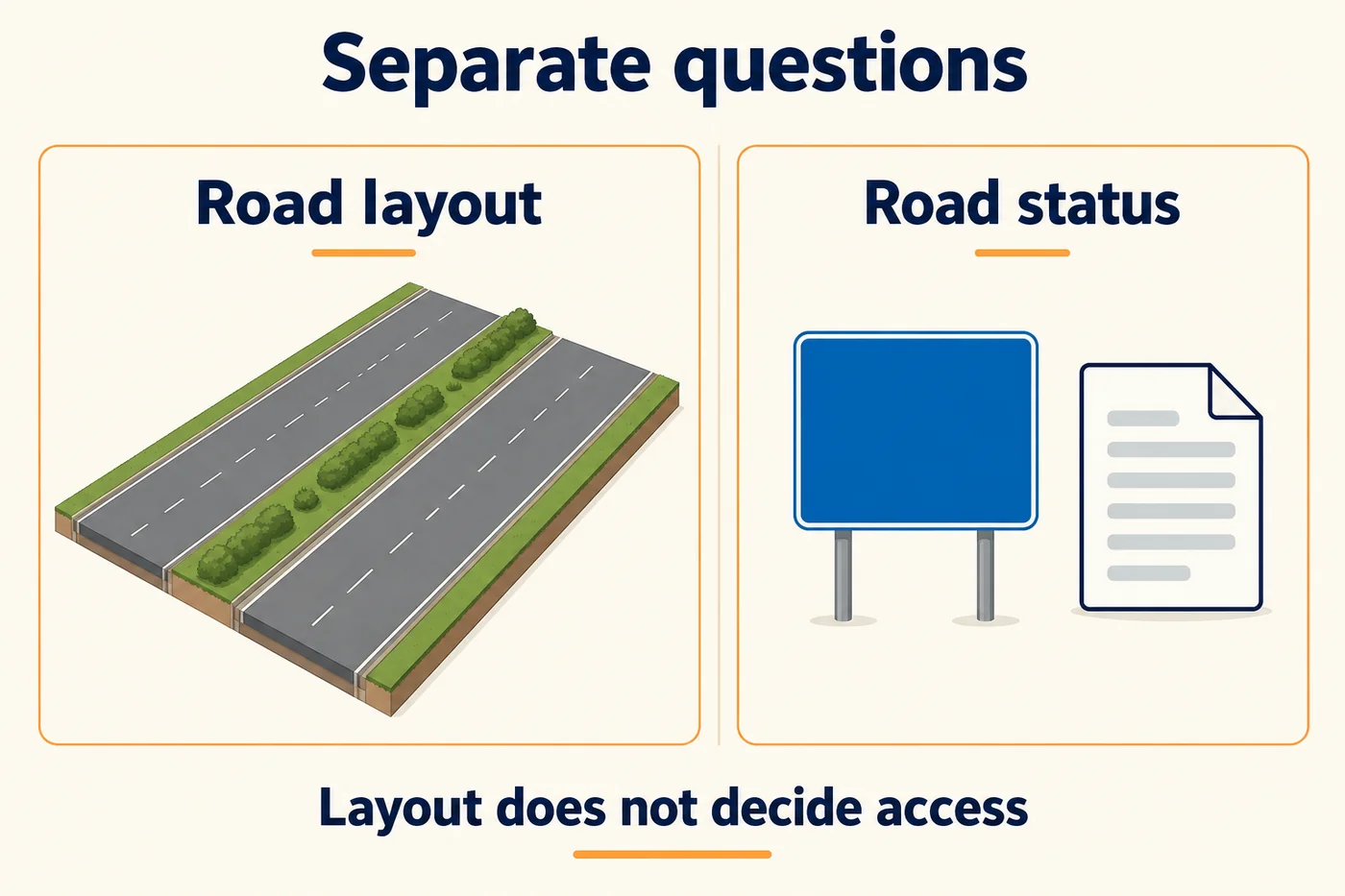
The practical mistake is to turn a visual impression into several conclusions at once: “This looks wide, so it is a dual carriageway, therefore it is a motorway, therefore I can do 70.” Each step needs its own evidence. Establish the layout, identify the road’s status, then check the restrictions that apply.
How do you recognise motorway status?
Look for the motorway symbol marking the start of motorway regulations, rather than relying on width or the appearance of a junction. The Department for Transport’s motorway-sign guide illustrates that symbol, the signs approaching a motorway and the signs where it ends.
One important distinction: a blue patch showing a motorway number in brackets, without the motorway symbol, normally indicates a route towards that motorway. It does not necessarily mean you are entering it at the next turn. Read the whole sign: the destination, route number, symbol and direction work together.
For example, when planning a learner route, seeing a motorway number in a navigation instruction is a reason to inspect the route more carefully. It is not a reason to make an abrupt manoeuvre when a sign appears. Settle the access question before the journey; follow your instructor’s guidance if you are learning.
Green signs and A-road numbers are different clues
In Great Britain, green direction signs identify primary routes; white direction signs identify non-primary routes. Both can be A-roads. Those colours classify routes for navigation rather than tell you how many carriageways they have. A blue motorway panel can also appear within a green or white sign.
The official guide to all-purpose-road direction signs shows these combinations. It also shows slip-road junctions on dual carriageways. A flyover, lane-drop exit or countdown marker should therefore prompt you to read the route signs, not declare the road a motorway.
Who may use the road?
Motorways have specific exclusions. In Great Britain, these include pedestrians, cyclists, horse riders, motorcycles below 50 cc (4 kW), agricultural vehicles and other listed classes. Provisional motorcycle licence holders are excluded. The complete list is in Highway Code rule 253; a short list in an article should not replace checking a less usual vehicle.
A non-motorway dual carriageway does not acquire that whole set of exclusions merely because it has a central reservation. However, a particular road may have its own prohibitions. “Not a motorway” does not mean “open to every road user”: check the relevant signs and restrictions, especially when planning for a cycle, slow vehicle or unusual load.
Learner car drivers in Great Britain
A learner may use a motorway only with a DVSA Approved Driving Instructor, in a dual-control car displaying red L plates, or D plates in Wales. Practice with a friend or family member does not meet that exception. Ordinary supervised practice on a suitable non-motorway dual carriageway is a different situation. The DVSA supervision guide explains route planning; suitability for your stage of learning is a question for your instructor.
Northern Ireland: do not rely on older learner advice
Northern Ireland introduced Graduated Driver Licensing on 1 October 2026. Its current Highway Code rule 253 permits learner car motorway use with an approved driving instructor. It also permits a provisional motorcycle licence holder with an approved motorcycle instructor in radio communication. That motorcycle exception differs from Great Britain.
The NI training and logbook guidance explains the optional motorway modules. The change is not permission for an unsupervised learner trip or a motorway lesson with any accompanying driver.
There are also transitional arrangements for people whose provisional entitlement began before 1 October 2026. Confirm the training and restrictions applying to you with your instructor and the Department for Infrastructure’s GDL guidance. Do not apply a Great Britain learner rule to Northern Ireland, or an old blanket ban to the new scheme.
Why the same speed limit does not make them the same road
At the national limit, an ordinary car without a trailer can have a 70 mph maximum on either a dual carriageway or a motorway. That shared number does not change access rights or make the roads interchangeable. An ordinary light goods van can have different maxima on the two, while towing changes the limit again.
Lower posted limits still apply. So can restrictions relating to the driver. Use the official vehicle-class tables and our UK speed-limit guide for that separate check, including the Northern Ireland new-driver transition. The road’s legal maximum is not a recommendation to drive at that speed in the conditions.
Hard shoulders and stopping are not identification shortcuts
Some motorway sections operate without a hard shoulder. For example, National Highways describes the M1 junctions 13–16 scheme as four traffic lanes with emergency areas instead of a hard shoulder. A road does not cease to be a motorway because there is no continuous strip beside the traffic.
Nor is an apparently empty shoulder a convenient place to consult a map or collect a passenger. Motorway stopping restrictions remain in force. On a non-motorway road, check the actual restrictions too: a clearway can prohibit stopping even where there is no yellow line. Our clearway guide explains that separate sign-reading task.
Three situations to check your understanding
Open each explanation after deciding which information is missing. These examples test identification, not readiness to drive a particular road.
A road has two lanes each way, green direction signs and slip-road exits. Is it a motorway?
Those features do not establish motorway status. The green signs indicate a primary route; the slip roads describe its junctions. Look separately for a central reservation to identify the layout, and motorway-regulation signs to establish motorway status.
A learner in England sees a blue motorway-number patch on a green sign. Must their route immediately enter the motorway?
No. The sign may point towards a motorway reached later. Check the full route and motorway symbol. If the journey does enter a motorway, the learner exception requires an Approved Driving Instructor and the correctly marked dual-control car; an accompanying relative is insufficient.
A road has a central reservation and no hard shoulder. Can its motorway status be decided from that?
No. The reservation identifies the separated layout; the absent shoulder does not settle legal status. Some motorway sections have no hard shoulder. Use the route and regulation signs, then check access and speed separately.
Before setting off on an unfamiliar route
- Check whether the planned route actually enters motorway regulations or merely passes a junction signed towards a motorway.
- Confirm any learner, vehicle or route-specific access restriction before departure.
- Treat road layout, legal access and speed limit as three separate questions.
- Plan a suitable stopping place if you need to check directions; a shoulder or a wide verge is not a substitute.
When reviewing a route with an instructor, ask them to identify the point where each relevant rule changes. That is more useful than trying to memorise a rule such as “three lanes means motorway”, which will fail as soon as the road looks different.
Official sources checked 29 October 2026. This is a source-based explanation of road identification and access, not a practical driving lesson or an assessment of an individual driver.