An urban clearway restricts stopping during the days and hours on its sign, but allows you to pick up or set down passengers. A 24-hour clearway prohibits stopping on the main carriageway at any time, including for passengers. Read the complete sign: the two restrictions are not interchangeable.
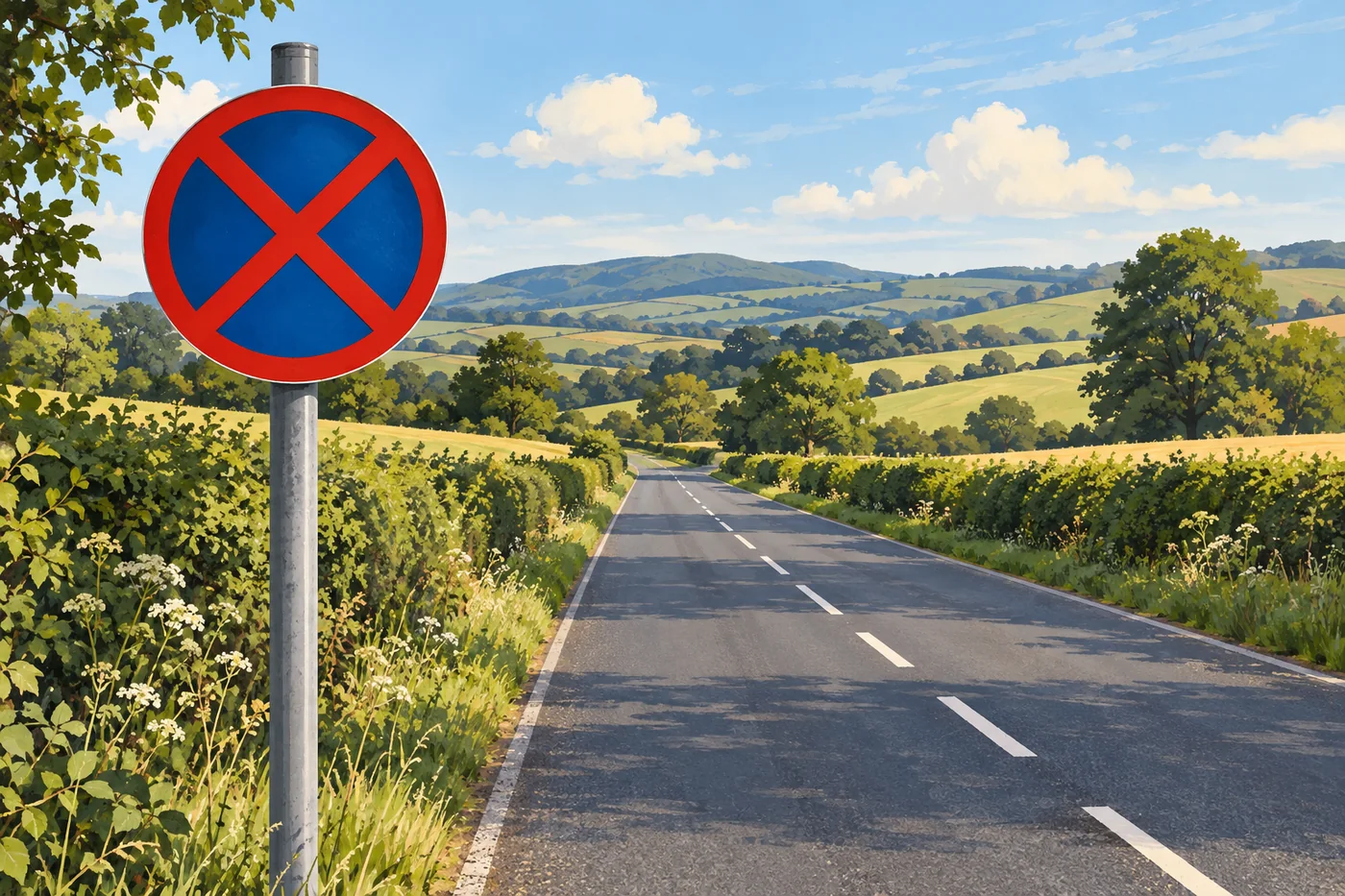
This guide covers England, Scotland and Wales. It explains how to read the signs and plan an ordinary roadside stop. Northern Ireland has separate enforcement guidance, linked below.
Clearway or urban clearway: what changes?
| Restriction | When it applies | Passenger stop | What to look for |
|---|---|---|---|
| 24-hour clearway | At all times on the main carriageway. | No general pick-up or drop-off exception. | Blue circle, red border and red cross; an end plate marks the finish. |
| Urban clearway | The days and hours on the plate. | Picking up or setting down is allowed; waiting for someone is different. | Urban clearway wording, a no-waiting symbol and operating times. |
Highway Code rule 240 makes the passenger exception specifically for an urban clearway within its operating hours. Do not transfer it to a plain clearway because the stop will be short.
How to read an urban clearway sign
Look for the words URBAN CLEARWAY, then read both the days and the time periods. The familiar symbol has a single red diagonal line across a blue circle. The wording and times tell you which restriction you are entering; looking only at the coloured circle is not enough.
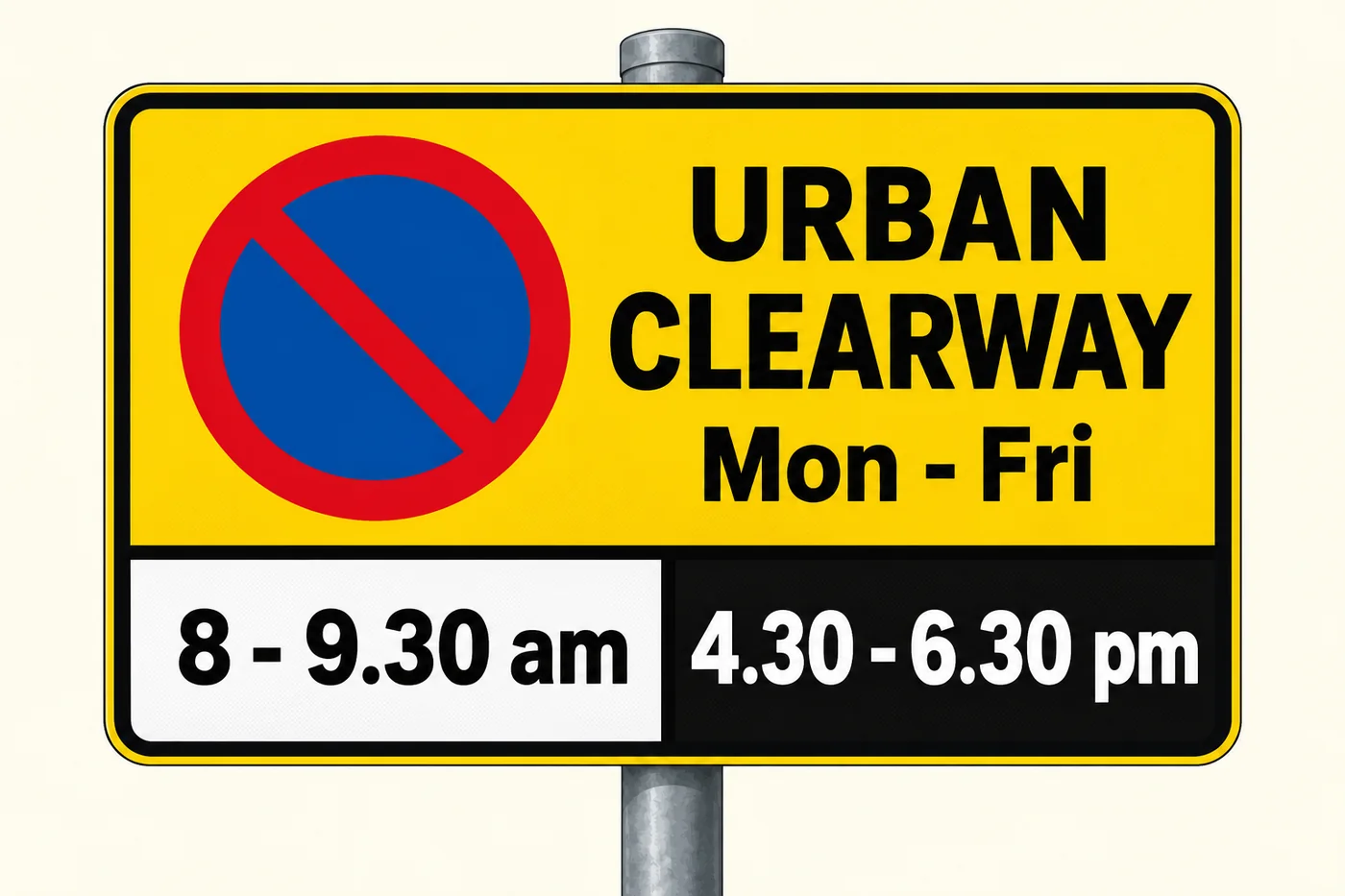
For the example above, a Tuesday at 8.45 am falls inside the restriction. Tuesday at 2 pm falls outside those particular hours. Saturday is outside the days shown. That reading answers only whether this urban clearway restriction is active: another parking, loading, bus-stop or bay restriction can still apply.
A sign with morning and afternoon periods has a gap between them, not one continuous all-day period. Check am and pm carefully. If you need several minutes to collect somebody, choose a permitted meeting place before the restricted period starts rather than treating the last minute as a parking opportunity.
The Department for Transport’s official sign guide explains that urban clearways need no special road markings. Signs are usually repeated along the route, particularly after junctions. An empty kerb without yellow lines therefore does not establish permission to stop. Look for an end sign instead of assuming the restriction ends at the next side road.
Picking up a passenger is not waiting for one
During operating hours, the urban clearway restriction covers the carriageway and verges, with an exception for picking up or setting down passengers. Use that exception for the boarding or alighting itself. It does not turn the road into a waiting area while a passenger finishes shopping or comes downstairs.
Agree a meeting point in advance. If the person is not ready, continue to a place where waiting is permitted and contact them once safely parked. Being behind the wheel, leaving the engine running or switching on the hazard lights does not change what you are doing.
Nor does a passenger exception make every position safe. Do not block a crossing, cycle facility or access, and do not pull into a bus-stop clearway on the assumption that the urban rule overrides it. A short walk to a suitable meeting place can be safer than stopping immediately outside the destination.
What a 24-hour clearway prohibits
The red cross means no stopping. On a 24-hour clearway, the restriction extends to the main running carriageway, slip roads and acceleration or deceleration areas. It is not just a ban on leaving a parked car. Pulling over to read a message or let someone out is still a stop.
A lay-by can be used unless signs say otherwise. Check its own signs before relying on it: some stopping areas are reserved for emergencies. Do not interpret “off the main carriageway” as an invitation to drive onto a verge or pavement. Separate restrictions can apply there, and an unsafe or obstructive position remains unacceptable.
The Highway Code’s parking rules also prohibit leaving a vehicle in a dangerous position or causing unnecessary obstruction. They set separate pavement-parking rules, including prohibitions in London and Scotland subject to limited exceptions. A clearway sign does not cancel those rules.
Check the situation before stopping
These examples assume an ordinary private car and no emergency, police direction or separately authorised exemption. They are reading exercises, not permission to stop at a particular location.
It is 8.45 am on Tuesday and my passenger is at the kerb
On the example urban clearway, the restriction is active. A stop for the passenger to board is within its passenger exception, provided the location is otherwise permitted and safe. On a 24-hour clearway’s main carriageway, the same reason does not allow the stop.
It is 2 pm on Tuesday and I want to park for half an hour
The example’s urban clearway hours are inactive. Now check all the other signs and markings: a paid bay, loading restriction or other waiting control may still prevent your proposed stay. The gap in clearway hours is not proof of free parking.
I only need to collect a parcel or answer a message
Neither purpose is picking up or setting down a passenger. During urban clearway hours, use an appropriate permitted stopping place elsewhere. The same voluntary stop is prohibited on a 24-hour clearway’s main carriageway.
Red routes, breakdowns and Northern Ireland
A red route has its own stopping controls. Do not use the urban clearway passenger exception as a shortcut for reading red lines or red-route signs. Our red-route guide covers those signs, bays and exceptions separately.
A breakdown is different from choosing a convenient parking place. Try to reach a place of relative safety, warn other traffic if you are causing an obstruction and arrange assistance. Follow the Highway Code breakdown guidance for your road and circumstances; do not keep driving a dangerous vehicle simply to reach an end sign.
For Northern Ireland, use Northern Ireland urban-clearway enforcement guidance. It describes a passenger boarding/alighting exemption limited to two minutes. That is a Northern Ireland enforcement provision, not a universal two-minute allowance for every clearway across the UK.
Sources checked 25 October 2026. Official guidance supports the rule explanations; the timed situations are editorial examples. No legal review or on-road testing is claimed.