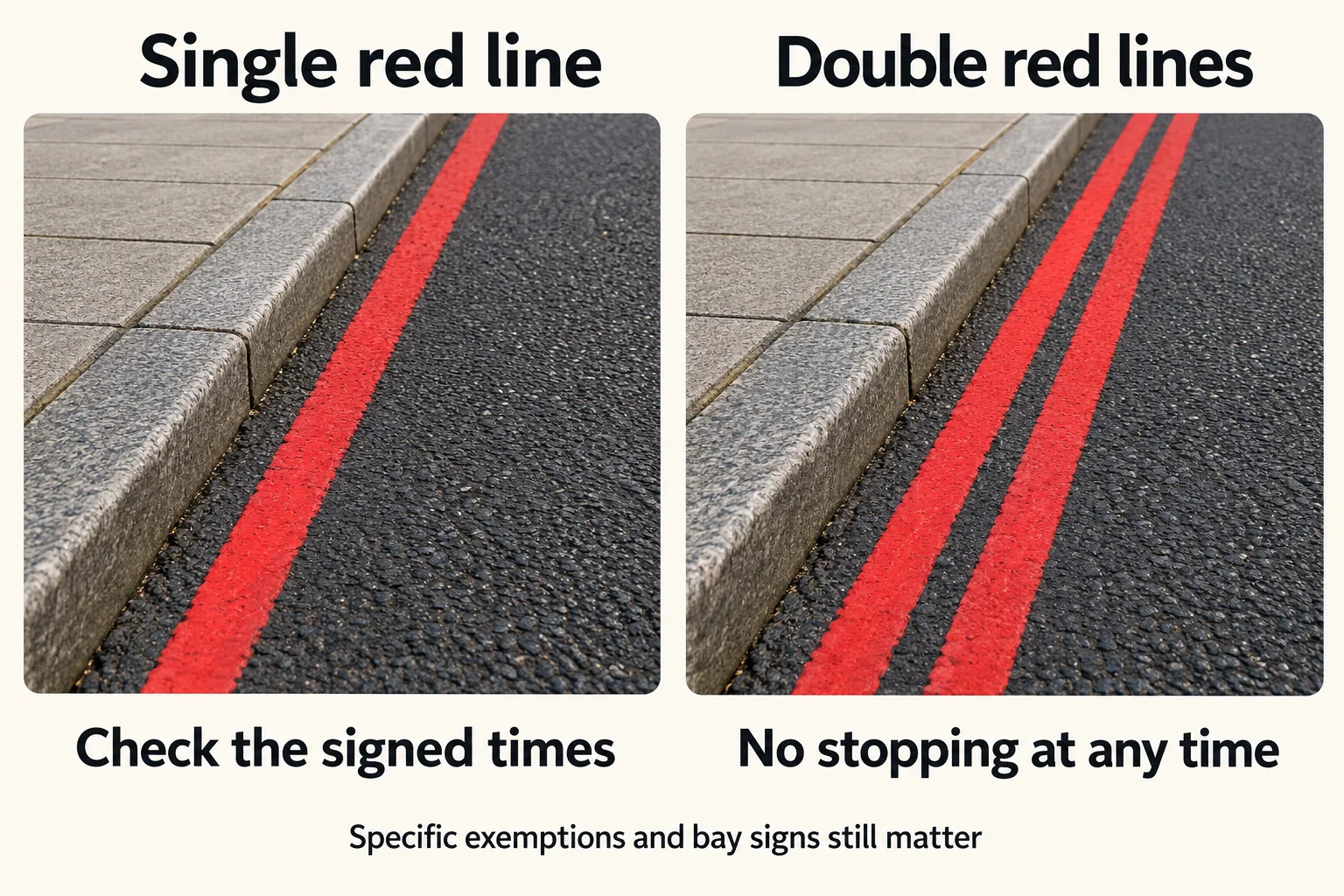
A red route is a road with stopping controls designed to keep traffic moving. Double red lines mean no stopping at any time; a single red line applies during the times on its sign. An ordinary car cannot stop briefly to collect someone or unload during those restrictions. A marked bay may allow a particular activity, but its sign decides who can use it, when and for how long.
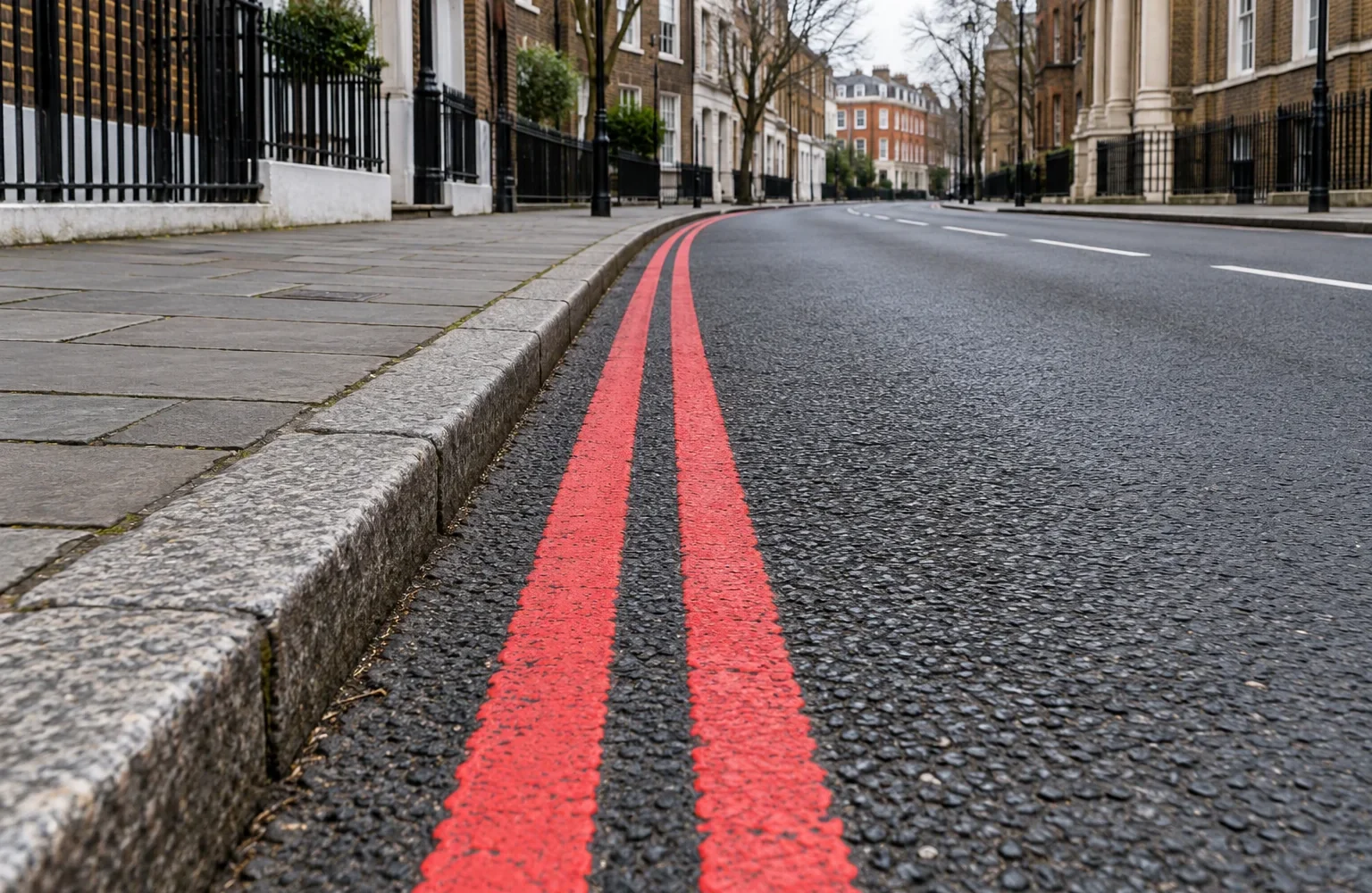
This guide explains the national sign meanings used in Great Britain, with the detailed parking and Blue Badge examples below scoped to Transport for London (TfL) red routes. Do not assume every red-lined road belongs to TfL: some London boroughs operate their own, and red routes also exist outside London. Use the authority named on the sign or penalty notice for local questions.
Single red lines, double red lines and clearways
The Highway Code’s road-marking guide distinguishes red stopping controls from yellow waiting controls. The restriction extends to the carriageway, pavement and verge. Putting two wheels on the pavement does not create somewhere lawful to wait.
| What you see | Meaning | What still needs checking |
|---|---|---|
| Double red lines | No stopping at any time. | Specific exemptions are limited. A missing time plate does not make the restriction inactive. |
| Single red line | No stopping during the signed days and hours. | Read the sign for that stretch, not a remembered time from another road. |
| Red route clearway sign | No stopping except in marked bays. | The route may have no red edge lines. Bay restrictions still apply. |
| A marked red or white bay | Potential permission for a specified activity. | Check purpose, eligibility, times, maximum stay, return limit and any suspension. |
TfL’s red-line guidance says its double-red-line restrictions run all day, every day, without needing a time plate. Its red route clearways also operate around the clock and are normally identified by signs rather than painted red lines. An apparently unmarked kerb therefore is not proof that you can pull in.
Does a quick drop-off count as stopping?
Yes. For an ordinary private car, leaving the engine running, keeping the driver inside or using hazard lights does not turn a prohibited stop into permitted parking. Plan a legal meeting point rather than asking a passenger to rush into the car beside an active red line.
The Department for Transport’s sign guide describes red routes as no-stopping controls, including passenger pick-up and set-down, with specific exceptions. Those exceptions are not a general permission for every driver: licensed taxis and vehicles displaying a Blue Badge have particular provisions. TfL also refers to some private-hire vehicles; a driver should check the rules applying to their licence and location rather than copy what another vehicle does.
Stopping because traffic lights or a queue require it is a different situation from choosing the kerb as a waiting place. Continue to obey traffic signals and directions. You must also keep crossings and their zig-zags clear under Highway Code rule 240. Our pelican-crossing guide explains a separate set of signal instructions; a red route does not override them.
How to read a red route bay
A red bay generally becomes available for its stated use during only part of the day. A white bay generally remains available throughout the day, but that does not mean unrestricted parking for everyone. It may be a loading bay, a disabled bay or a parking bay with a short stay limit.
TfL’s parking guidance explains these differences and requires drivers to check the adjacent sign. Look for a parking symbol if you need parking, and check any minimum period before you can return. Empty space inside a white box is not enough information.
- Identify the actual bay. Make sure the sign applies to the place where the whole vehicle will stand.
- Read the activity. Parking, loading and Blue Badge use are separate permissions.
- Match the day and time. Check both the period when the main restriction operates and the narrower exception, if there is one.
- Check duration and return limits. Your intended departure must fit all the conditions.
- Look for a suspension. Temporary notices may make a normally usable bay unavailable.
Worked example: a loading window
Imagine a sign saying no stopping Monday to Saturday, 7 am to 7 pm, except loading from 10 am to 4 pm for a maximum of 20 minutes. This is an example for reading the conditions, not a standard timetable.
| Arrival and purpose | Reading the sign |
|---|---|
| Tuesday, 9.50 am, collecting furniture | The loading exception has not started. You cannot wait in the bay for 10 am. |
| Tuesday, 11 am, genuine loading | The time window is open. Leave when loading finishes, and within the 20-minute maximum. |
| Tuesday, 3.50 pm, genuine loading | The exception ends at 4 pm, so the available window is at most 10 minutes, not 20. |
| Tuesday, 11 am, browsing in a shop | The loading exception does not permit shopping or general parking. |
Loading is not the same as shopping
TfL describes loading as moving goods that generally need a vehicle because of their weight or bulk. Goods should be ready when you arrive. Reasonable collection and paperwork time can form part of the activity, but the vehicle must leave once loading is complete.
Collecting a pre-ordered chest of drawers is different from visiting shops to decide what to buy. A maximum stay is a limit, not a block of free time to use after the goods are in the boot. Keep a collection confirmation or delivery record if you have one, and check the bay before starting. A receipt cannot itself make a prohibited stop lawful.
For a house move or a large delivery that will not fit the available arrangements, contact the road authority in advance about a dispensation or bay suspension. Do not assume the removal company can use the red line simply because the load is awkward.
What changes if you have a Blue Badge?
On TfL red routes, a correctly displayed Blue Badge allows a vehicle to stop on single or double red lines to pick up or set down the badge holder, then move off promptly. It does not allow parking on double red lines or waiting on a single red line during its restricted hours.
TfL’s Blue Badge guidance gives separate bay rules. In an ordinary permitted parking bay, the badge removes the normal length-of-stay restriction within the bay’s operating window, but the vehicle must leave when that window closes. Dedicated disabled bays may have their own maximum stay. Display the badge and time clock as directed.
A loading-only bay does not become a disabled parking space unless its sign also permits Blue Badge parking. TfL prohibits badge holders from stopping in bus-stop markings or on zig-zags. Check the local authority’s scheme outside TfL roads: the government Blue Badge guide specifically directs drivers to the relevant council for red routes outside London.
Three situations to check
Open the example that matches your question. These explain the rules; they cannot determine permission for a location without its signs.
It is Sunday or a bank holiday. Can I stop?
Do not assume a holiday removes the restriction. Double red lines operate continuously. For a single red line or a bay, read the days and hours actually displayed and any temporary notice. A sign covering the day of your visit still needs to be followed; a quiet road is not evidence that the control has ended.
I only need two minutes. Is there a grace period?
Do not rely on a free stopping period beside red lines. TfL distinguishes a grace period following a lawful stay in a designated parking bay from stopping where it was prohibited from the outset. A loading-only bay is not a general parking bay. Plan to leave within the actual permission rather than using enforcement tolerances as extra parking time.
The sign is hard to read or the bay is suspended
A suspension means the normal bay permission is unavailable while it applies. If you cannot establish that your planned use is permitted, find another legal place and check with the road authority. Do not assume a faded line or twisted sign guarantees cancellation of a penalty. If a notice is issued, preserve relevant photographs and explain the actual circumstances through the stated challenge process.
TfL’s enforcement explanation sets out the limits of grace periods and explains that signs and markings must adequately inform drivers. Enforcement can use CCTV; the absence of an officer beside the road does not create permission to stop.
If you receive a red route penalty
As checked on 23 October 2026, TfL lists its red route penalty at £160, reduced to £80 if paid within 14 days. Follow your actual notice for deadlines and the correct procedure. Borough-issued notices are handled by that borough, and should not automatically be treated as TfL cases.
If you believe the notice is wrong, TfL’s challenge guidance explains how to make a representation and supply evidence. Record the notice number, location, date, time and reason stated; keep any relevant sign photographs or loading documents. The person or organisation named on the notice normally needs to challenge it or authorise a representative. Do not ignore the notice while looking for advice.
A short plan before you travel
Choose a lawful collection or parking point before starting, allow time to walk from it, and agree that location with your passenger or supplier. Keep a second option in case the bay is full or suspended. On arrival, check the real signs rather than relying only on an old street image.
Red route restrictions are separate from emissions charging. Paying ULEZ does not buy permission to stop: our ULEZ guide covers that different check. Treat route charges, stopping permission and the practical loading task as three separate items in your journey plan.
The conversation