The ULEZ charge is £12.50 per calendar day for a car that does not meet the emissions standard and has no applicable exemption. It operates throughout London, 24 hours a day, except Christmas Day. Check your registration with TfL before travelling: a car’s age, fuel type or “ULEZ compliant” advert is not an individual check.
Rules checked on 17 October 2026. Start with TfL’s official vehicle checker. This guide explains the results and the payment decisions; it cannot check your vehicle or retrieve its journeys.
What does the £12.50 charge cover?
London’s Ultra Low Emission Zone sets emissions requirements for vehicles driven within it. Under the current ULEZ scheme, an affected car either meets the standard, qualifies for an exemption or incurs the daily charge. It is not a fee that every visiting car must pay.
One payment covers that vehicle’s ULEZ driving on the selected calendar day. It is not charged for every entry, and it is not a rolling 24-hour ticket. Other London road charges can still apply separately.
Which cars meet the ULEZ standards?
| Car | Minimum ULEZ requirement | What to check |
|---|---|---|
| Petrol | Euro 4 for nitrogen oxides (NOx) | The declared emissions of the actual car |
| Diesel | Euro 6 for NOx and particulate matter (PM) | The exact engine and vehicle record, not just the model name |
These are TfL’s published emissions requirements. Euro standards concern specified exhaust pollutants; a low CO₂ figure or a cheap vehicle-tax bill does not establish ULEZ status.
TfL says compliant petrol cars are generally first registered after 2005 and compliant diesels generally after September 2015, but its car guidance explicitly bases enforcement on declared emissions, rather than age. Some older petrol cars meet the requirement. A year-based shortlist is therefore only a starting point.
When buying, obtain the exact registration before paying a deposit. Match the check to the car being sold, retain the result and resolve any discrepancy with the seller and TfL. Our petrol versus diesel guide covers the broader ownership choice; ULEZ status is one part of that decision.
What about electric cars and hybrids?
Battery electric cars meet the ULEZ requirements; TfL confirms their automatic compliance. That does not remove separate Congestion Charge or tunnel obligations. For a hybrid, check the exact registration rather than treating the badge or an electric driving mode as proof of its status.
Use your checker result to choose the next step
Enter the number plate and choose the correct country of registration. The checker assesses the vehicle’s emissions and type; for other applicable discounts or exemptions, TfL directs you to sign in and use your account’s Pay to drive service.
TfL says my car meets the ULEZ standards
There is no ULEZ daily charge for that car under the current standards. Check the other schemes separately if your route uses central London or a charged tunnel. Save the result with the registration and date, particularly when buying a car or changing its number plate.
TfL says a charge applies, but I have contrary evidence
Use TfL’s vehicle registration and evidence process. It asks for the V5C or overseas equivalent, plus a manufacturer homologation letter showing the Euro standard or a Certificate of Conformity when proving ULEZ compliance. A seller’s assurance is not that evidence. If you recently changed a personalised plate, provide the log book and plate-transfer documents as instructed. Submitting evidence is not approval; ask TfL how to handle charges for an imminent trip while the record is reviewed.
I am bringing a car registered outside the UK
Use the checker before the trip. TfL’s non-UK vehicle guidance explains when you must register evidence, including where its records say the vehicle does not meet the standard but your documents show otherwise. Processing can take up to 10 working days. Until TfL accepts the evidence, its guidance says to pay the applicable charges if driving in London; you can apply for a refund after confirmation.
I qualify for a concession under another London scheme
Check the ULEZ conditions in their own right. A Congestion Charge discount does not establish a ULEZ exemption. The sections below explain the main disability and historic-vehicle distinctions; use the linked TfL rules for your circumstances.
For help identifying the document TfL wants, read our V5C log book guide. The evidence process and a payment account perform different jobs: opening an account does not itself prove compliance.
Where does ULEZ apply?
The zone covers all London boroughs and the City of London. The M25 itself is outside it. Check the full route, including a hotel, station car park or collection address, using TfL’s postcode checker and map.
A small number of postcodes straddle the boundary. Check the particular address and street rather than treating a postcode as a guarantee. A destination outside the zone does not establish that every road used to reach it is outside. Plan this before setting off; an approximate map in an article is no substitute for TfL’s current boundary.
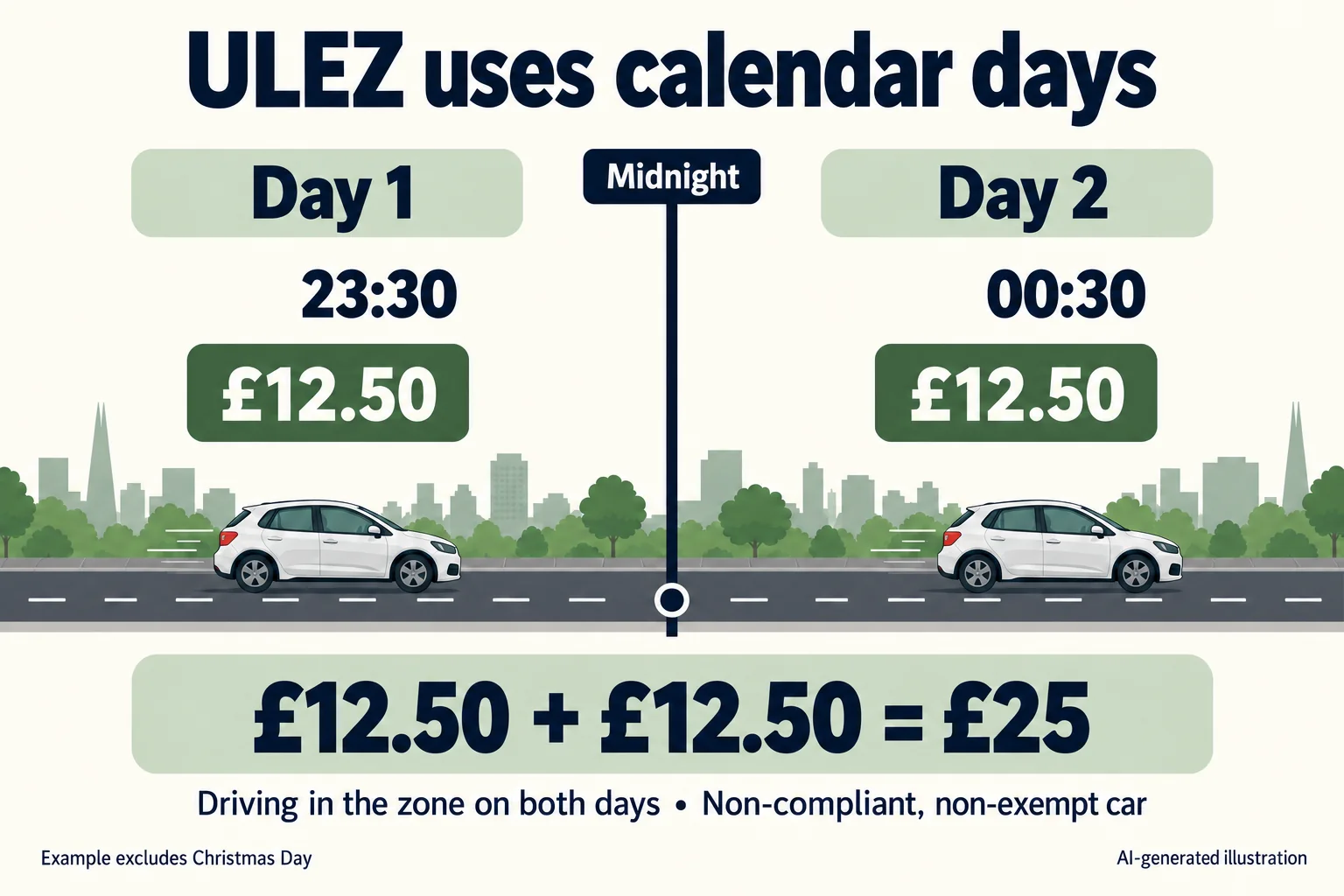
Midnight matters more than the length of your visit
The charging day runs from midnight to midnight. The following examples assume a non-compliant car with no exemption, driving inside the zone on ordinary chargeable dates.
| Journey pattern | Days charged | ULEZ total |
|---|---|---|
| Three separate trips on Monday | Monday | £12.50 |
| Driving at 11:30pm Monday and 12:30am Tuesday | Monday and Tuesday | £25 |
| Arrive Friday; stay parked throughout Saturday; drive away Sunday | Friday and Sunday | £25 |
TfL’s where-and-when guidance confirms there is no daily charge when the vehicle remains parked and is not driven. Even a short drive within the zone counts, including for residents. Christmas Day is the exception to the year-round operation; weekends and other bank holidays are chargeable.
When and how do you pay?
You can pay up to 90 days ahead, or by midnight on the third day following the journey, through TfL’s ULEZ payment routes. For a Monday journey, the following days are Tuesday, Wednesday and Thursday: pay before midnight ends Thursday. If you also drove on Tuesday, record that date separately.
Use TfL’s online service, its official Pay to drive in London app or the phone route listed on that page. Before confirming, check the registration, travel dates and that you selected the ULEZ charge. Keep the receipt. A payment for a different day or a mistyped registration may leave the actual journey unpaid.
TfL’s payment-fraud guidance warns that unofficial sites may add fees or fail to pass payment on. A receipt from an intermediary is not confirmation that TfL received the charge. Start from TfL rather than choosing a search advertisement that looks like an official payment page.
Auto Pay: check the activation date
Auto Pay bills applicable charges monthly and has no registration or renewal fee. It covers journeys from the day the service becomes active, including earlier that day. It does not cover a journey on the previous day.
If you drove on Monday and activate Auto Pay on Tuesday, deal with Monday separately. Confirm that the correct car is listed and the payment method is current. Charges can take up to five working days to appear online; an empty recent-activity list is not a reliable statement that no charge arose.
Blue Badges, disability grace periods and older cars
A Blue Badge alone does not exempt a non-compliant car. TfL’s ULEZ exemptions page distinguishes vehicle tax class from separate application-based disability arrangements.
- Qualifying disability tax class: vehicles in the DVLA “disabled” or “disabled passenger vehicle” tax class benefit from a grace period through 24 October 2027, provided the class remains unchanged. UK-registered vehicles in those classes do not need a separate TfL registration for it.
- Other disability routes: eligible wheelchair-accessible vehicles and specified disability benefits or medical circumstances have application routes. Check the evidence requirements and obtain confirmation; having an adaptation or receiving a benefit does not, by itself, complete registration.
- Historic vehicles: TfL exempts vehicles built before 1 January 1973, and vehicles over 40 years old successfully registered with DVLA in the historic tax class. Do not assume every old car has the necessary status.
Those are selected conditions, not the full eligibility list. Follow TfL’s current instructions for non-UK vehicles and any nominated-driver arrangement.
ULEZ is separate from other road charges
A car can have no ULEZ payment to make and still incur London’s Congestion Charge. The schemes have different purposes, boundaries and charging hours; do not use one result as a receipt for the other.
TfL also identifies a separate Blackwall and Silvertown tunnels charge. If your route uses the Dartford Crossing, that has its own service and deadline, explained in our Dart Charge guide. Write down each applicable scheme when planning a trip involving several crossings or zones.
Outside London, the GOV.UK Clean Air Zone service covers participating English cities and directs London and Scottish drivers to different systems. Passing one city’s check is not a universal permission for every charging zone.
If you missed payment or received a PCN
TfL’s published ULEZ penalty for a car is £180, reduced to £90 if paid within 14 days. A wrong registration or date can also result in a notice. Deal with the actual PCN; buying an ordinary daily charge is not the same as resolving it.
If you believe it is wrong, follow the formal challenge process and supply relevant evidence, such as the receipt for the correct car and date. TfL gives 28 days from service of the notice to pay or make a representation. Check the dates and instructions on your notice, and do not assume that another driver’s successful challenge guarantees the same result.
Your before-and-after trip checklist
- Vehicle: check the exact registration and resolve a doubtful result.
- Route: check the destination and roads against the official zone map.
- Dates: list every calendar day you will drive in the zone, including a return after midnight.
- Payment: confirm Auto Pay coverage or set a reminder for the correct deadline.
- Evidence: save the check, any exemption confirmation and the payment receipt.
- Other schemes: make a separate entry for each applicable charge.
Prepared from linked TfL and GOV.UK guidance checked on 17 October 2026. Examples show calendar-day charging, not a live compliance decision. Recheck the official services before travelling if your vehicle details or the rules have changed.
The conversation