A catalytic converter is an exhaust component that uses chemical reactions to reduce certain harmful gases from an engine. On most petrol cars, a three-way catalyst tackles carbon monoxide, unburnt hydrocarbons and nitrogen oxides. A warning light, rattle or P0420 fault code warrants investigation; none, by itself, tells you to buy a replacement converter.
This guide explains the component, separates it from diesel filters and helps you discuss a diagnosis or repair quote. It covers conventional combustion engines and the combustion engine in a hybrid. It is not a procedure for dismantling an exhaust or deciding remotely whether a particular car is safe to drive.
What does a catalytic converter actually do?
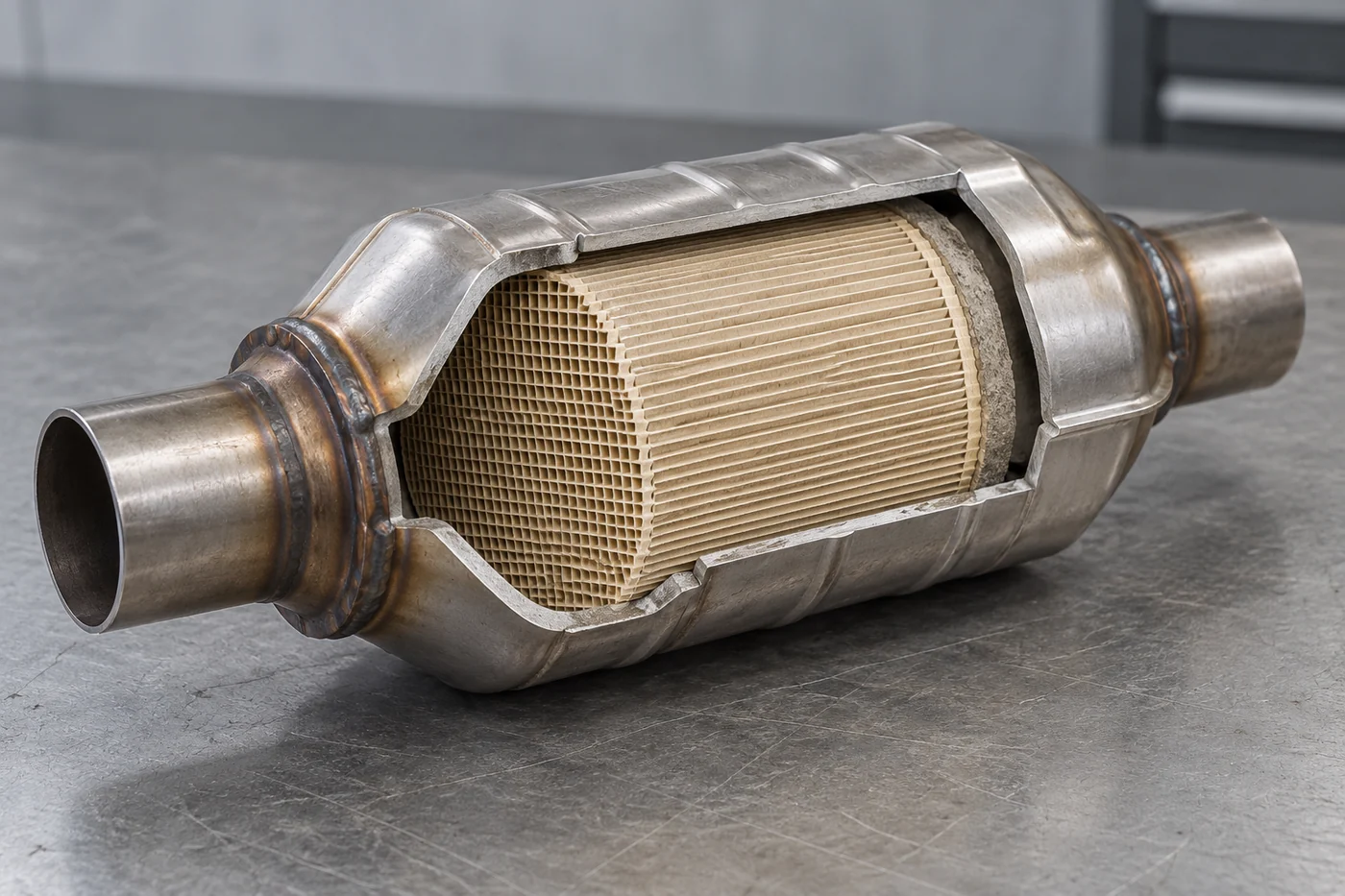
Inside its metal casing is a structure with many small passages, giving exhaust gases a large surface to contact. The coating contains catalytic materials, commonly including platinum, palladium or rhodium. Those materials promote reactions as gases pass through; the converter does not simply collect everything that leaves the engine.
In a petrol three-way catalyst, the three main jobs are converting carbon monoxide into carbon dioxide, hydrocarbons into carbon dioxide and water, and nitrogen oxides into nitrogen. Its effectiveness depends on suitable operating conditions and accurate control of the engine’s air–fuel mixture. Johnson Matthey explains both the catalytic materials and the three-way reactions.
Think of it as part of an emissions-control system, rather than a device that makes a poorly running engine harmless. It needs to work with that engine and its controls. Nor does converting these pollutants eliminate carbon dioxide: the reactions themselves produce some of it.
Is a diesel catalytic converter the same as a DPF?
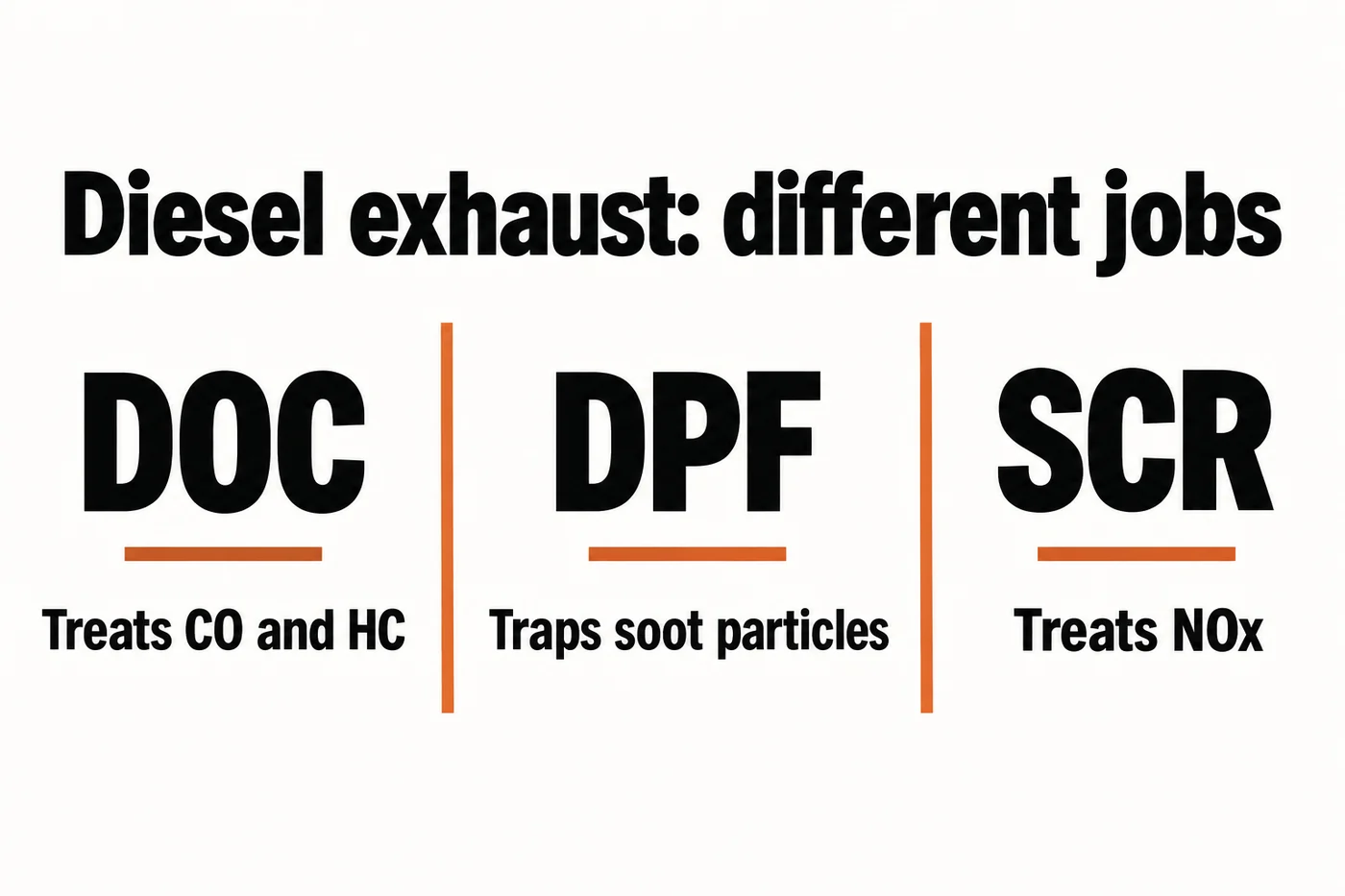
No. The names describe different jobs, even where several functions share one housing. A diesel oxidation catalyst, or DOC, deals with gases including carbon monoxide and hydrocarbons. A diesel particulate filter, or DPF, captures soot particles. Selective catalytic reduction, or SCR, is a further system for reducing nitrogen oxides; it uses ammonia, commonly generated from the urea solution AdBlue after injection into the exhaust. The VDA explains this distinction.
HELLA’s aftertreatment guide shows how filters and catalysts can be combined. This matters when a quote says “catalyst/DPF assembly”: ask which function has failed and whether the supplied part includes both. Do not assume that instructions for DPF regeneration are instructions for repairing a petrol catalytic converter.
Symptoms: what they tell you, and what they do not
The useful first step is to record the observation accurately. A description such as “the warning appeared after a rough start” gives a technician more to work with than “the cat has gone”.
| What you notice | Why it is not a diagnosis | Useful next step |
|---|---|---|
| P0420 or P0430 fault code | These codes concern catalyst-system efficiency; the converter, sensors, leaks or engine operation may need investigation. A general engine warning light alone does not identify this fault. | Keep the full scan report and warning message. Ask what further checks support the proposed repair. |
| A rattle beneath the car | Internal damage is possible, but a heat shield or another exhaust component can make a similar noise. | Describe when you heard it. Have the source located professionally. |
| Reduced power or poor acceleration | Exhaust restriction is one possibility among several engine and exhaust faults. | Report associated warnings and rough running; seek advice before continuing. |
| An emissions-test failure | The measured result is evidence of a problem, not necessarily proof of a failed converter. | Request the test readings and the diagnostic explanation, not just a parts price. |
These distinctions follow BM Catalysts’ fault-code guidance and its replacement guide, which specifically warns about mistaking other rattles for catalyst damage.
If smoke is also present, record it separately. Our guide to exhaust smoke colours explains why colour and timing are useful clues but cannot identify a failed part.
When to stop and seek help
If you smell exhaust fumes inside the car, stop safely, switch off and arrange assistance. If an engine warning flashes, particularly with rough running or loss of power, stop somewhere safe and contact a breakdown provider rather than attempting a “clear-out” drive. Follow your own handbook’s warning instructions.
Ford’s Fiesta handbook warns that flashing engine warnings may accompany a misfire that damages the catalyst, and says not to drive with exhaust fumes in the cabin. It also warns that the exhaust stays hot after shutdown. Do not touch it, crawl beneath the car to investigate, or run the engine in an enclosed space. Keep the vehicle away from dry grass or other combustible ground cover.
What should happen before a converter is condemned?
P0420 refers to catalyst-system efficiency below the threshold on bank 1; P0430 refers to bank 2. These are monitoring results, not direct measurements of the metal coating’s condition. Oxygen-sensor information helps the vehicle judge catalyst performance, so the interpretation depends on the wider system.
A useful diagnostic explanation should establish whether the engine is running correctly, whether the exhaust leaks, whether relevant sensors and wiring work, and whether there is evidence of restriction or physical damage. Ask the garage which findings distinguish the proposed fault from the alternatives.
Walker’s diagnostic guidance starts with vehicle history, other fault codes and exhaust integrity. For example, a known misfire should not be ignored while investigating an efficiency code. A scan that reports a code is the starting evidence; it is reasonable to authorise an agreed amount of diagnostic work before committing to a replacement.
If it has failed, ask why
Unburnt fuel from an engine fault can overheat a catalyst. Oil or coolant contamination and physical damage can also affect it. Walker groups failures into overheating or breakage, contamination, and structural damage. Replacing the damaged part without resolving a continuing cause risks another failure.
Bring recent service invoices and any existing record of oil or coolant consumption. Explain whether the symptom started before or after recent work, without assuming that the work caused it. You do not need to reproduce a noise, smell or misfire for the appointment.
How to compare a catalytic-converter replacement quote
A universal UK price is not a useful basis for authorising this repair. First establish the exact vehicle, engine and emissions specification, the affected converter, and what the replacement assembly contains. A quote for one component is not comparable with a quote including a larger assembly and an underlying engine repair.
Ask for a written breakdown covering:
- The diagnosis: what failed, the evidence, and any separate fault that must be repaired first.
- The part: manufacturer, part number, vehicle application and any required approval. Ask whether it is a separate converter or part of a larger assembly.
- The fitting work: labour, gaskets, fixings and any additional exhaust repairs. Sensors should be itemised with a reason for replacement.
- The total: VAT, diagnostic charges, any retest and the conditions under which extra work needs your authorisation.
- Completion checks and warranty: how the repair will be verified and what the parts and labour cover includes.
Do not choose a replacement solely because its pipe dimensions match. Walker explains that application and emissions requirements matter. Request a second diagnosis if the proposal rests only on a code, while keeping any driving restrictions in mind.
What does the MOT establish?
In Great Britain, the DVSA inspection manual covers visible emissions-control equipment and the emissions tests applicable to the vehicle. Missing, obviously modified or obviously defective original equipment can be a major defect. The petrol equipment rules have age-related conditions; the exact test depends on the vehicle. Removal is not a repair strategy.
Northern Ireland has separate inspection rules. Its exhaust-system guidance includes checks for required catalysts and particulate filters and identifies a missing standard-fit component as a major defect.
An MOT pass does not promise that a converter will remain healthy or explain a new warning. GOV.UK states that the MOT does not assess general mechanical condition. If a test has failed, keep the exact wording and readings; our guide to MOT advisories and failures helps distinguish the result categories.
Prepare a short brief for the garage
Write down the registration, engine/fuel type, mileage, exact dashboard message or codes, when the symptom appeared, and any relevant recent repair or fluid-use record. Add two requests: “Please explain the evidence before replacing parts” and “Please contact me before work exceeds the agreed diagnostic budget.” Keep the following questions with that note.
The car drives normally but has P0420. Can I ignore it?
Normal-feeling performance does not establish that emissions control is working. Arrange diagnosis and give the garage the warning details. A code alone cannot determine whether a journey is appropriate; follow the handbook and seek advice about the particular symptoms.
Will a cleaner or motorway drive fix it?
Do not treat either as a substitute for identifying the fault. A generic driving routine is not evidence that a damaged catalyst can be restored. Ask what fault has actually been established before buying an additive, and follow the vehicle manufacturer’s product restrictions. A DPF regeneration instruction addresses a different task.
What should I receive after the repair?
Keep an itemised invoice identifying the fitted part and any associated repair, the warranty terms, and an explanation of the completion checks. Ask what to do if a warning returns. Record the date, mileage and circumstances of a recurrence rather than assuming that the same component has failed again.
Sources checked 30 October 2026. This is a source-based explanation and repair-planning guide. It does not report hands-on testing or an inspection of your vehicle.
The conversation