
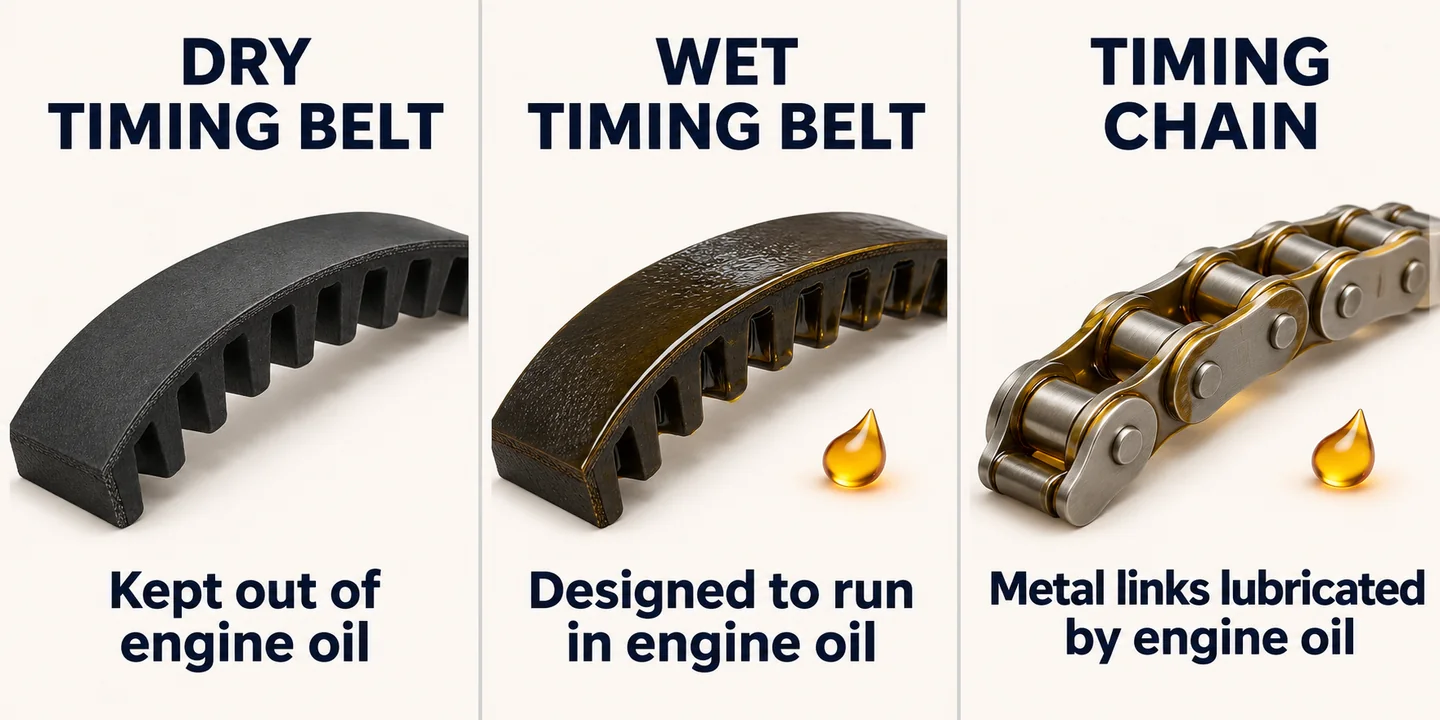
A timing belt and a timing chain do the same essential job: keep the crankshaft and camshaft movements in step so the engine’s valves operate at the right time. The belt is a reinforced toothed belt; the chain uses metal links. For an owner, the useful difference is the maintenance required by the exact engine. A chain is not a promise of unlimited life, and there is no replacement mileage that applies to every belt. [1] [3]
Before comparing cars or booking work, establish the engine version, whether it uses a dry belt, an oil-immersed belt or a chain, and what the current maintenance schedule says. Then check the evidence for work already carried out.
Featured image: AI-generated illustration. Uninstalled examples show the different materials; they do not identify any particular engine.
Timing belt vs timing chain: the main differences
A cambelt is another name for a timing belt. Its teeth engage with toothed pulleys to transmit motion without slipping in normal operation. Reinforcement inside the belt carries the load. A timing chain is an articulated metal drive working with sprockets. Both belong to a system that also controls the drive’s tension and guidance. Incorrect timing or a failed drive can cause serious engine damage. [1] [3]
| Arrangement | Working environment | Maintenance question to ask |
|---|---|---|
| Dry timing belt | A reinforced belt kept outside the engine’s oil environment. | What inspection and replacement requirements apply to this engine? |
| Wet timing belt | A specially designed belt operating in engine oil. | Which oil specification, service intervals and belt checks apply? |
| Timing chain | Metal links lubricated by engine oil. | What does the schedule require, and is there evidence of correct servicing or previous timing-system repairs? |
The table is a comparison of principles, not a parts-identification chart. Belt materials and chain designs differ between applications. [1] [3] [4]
Why a wet belt needs a separate conversation
A wet belt, also called a belt-in-oil system, is designed for contact with engine oil. It is not an ordinary dry belt that happens to be oily. The material specification and the lubricant are part of the engine’s design. With these systems, using the correct approved oil and keeping to the applicable service requirements matter to the belt as well as the engine’s lubricated metal parts. [4]
Oil contamination and unsuitable oil can harm a wet belt. That does not establish the condition of an individual car: it explains why an invoice recording the oil used is more informative than a seller’s general claim that the car has been serviced. Ask a qualified workshop to clarify missing records and any inspection requirement for the specific engine. [4]
When discussing a wet-belt car, take the full oil specification to the garage, not just a viscosity such as 5W-30. Our guide to choosing engine oil explains how to read those requirements.
How to find out which system your car has
Start with the vehicle-specific service information or ask the manufacturer or a suitable workshop to identify the engine using the VIN. Model name, engine size and registration year are useful starting details, but they are not a substitute for confirming the actual application. Manufacturer guidance explicitly distinguishes model, engine variant and age when identifying the system and schedule. [5]
Make the enquiry precise: “For this VIN and engine, what drives the camshaft, what timing-drive maintenance is required, and is there another belt-driven component with its own requirement?” Request the answer in writing or retain the relevant schedule.
Do not assume a belt visible under the bonnet answers the question. An auxiliary or accessory belt has a different role from a camshaft timing belt; seeing one does not settle what is inside the timing drive. Some engines also have a separate belt driving another component, such as an oil pump. [4]
If a listing says “chain driven” while an invoice says “belt replaced”, ask what the invoice actually refers to. It may describe another drive. Resolve the wording before treating either statement as evidence that no timing maintenance is due.
When should a belt or chain be replaced?
Use the engine’s schedule, including any age requirement
There is no useful universal answer in miles or years. Check the manufacturer’s current schedule for the vehicle, including any inspection requirement and the meaning of any age and mileage limits. Usage and engine type affect the applicable guidance. Where the schedule specifies a time limit as well as mileage, low annual mileage does not remove the time limit. [6]
For a belt already changed, keep the replacement date and odometer reading, then obtain the next requirement for that vehicle. Do not assume a sticker with a date means the whole timing system was renewed, or that a previous owner’s recollection sets a new interval.
A chain can still wear
A metal chain is not immune to wear. Wear at the joints can increase its effective length; guides, sprockets and tensioning components can also deteriorate. Oil degradation is one factor that can accelerate chain-system wear. A chain described as “stretched” is not simply an elastic band that has become longer. [3]
Check whether the particular engine has a specified chain-related maintenance item. If no routine replacement is listed, that is not a guarantee against faults or future repair costs. Maintain the engine as specified and have concerns assessed professionally rather than selecting a replacement mileage from a generic online list.
This guide does not diagnose a belt or chain from a noise, a photograph or a warning light. Timing inspection and replacement require the appropriate engine-specific procedures and equipment. A qualified technician should establish what work is necessary. [5]
What useful maintenance evidence looks like
For a used car, ask for the itemised invoice or detailed digital record supporting a claimed replacement. You want a record that can be tied to the vehicle and the job, not simply the words “full service”. Use these questions to organise the paperwork:
- Which vehicle? Does the registration or VIN match?
- When? What date and mileage are recorded?
- Which drive? Does it say camshaft timing belt or chain, rather than an unspecified belt?
- What was included? Are the kit, related parts and any additional work listed clearly?
- What remains due? Can the workshop explain the next applicable inspection or replacement requirement?
A missing invoice is a gap in evidence; it is not proof either that the job was done or that it was never done. Ask the seller to obtain a duplicate from the workshop. If the history remains unresolved, get vehicle-specific advice and a quote before agreeing the purchase price. Include that uncertainty in your used-car viewing checks.
How to compare garage quotes fairly
Give each garage the same vehicle details and the same description of the proposed job. Compare written scope before comparing totals. A low price for a belt alone is not automatically comparable with a price for a kit and related work.
Depending on the application, a timing-belt job can involve tensioning or guide pulleys and other specified parts. Where the timing belt drives the water pump, ask whether replacement of the pump is included and why. Do not assume every engine’s water pump is driven by its timing belt. [2]
- Is the quote for scheduled maintenance or for investigating a suspected fault?
- Which parts and fluids are included, and which are excluded?
- Does the total include labour and VAT?
- Will the garage contact you before undertaking additional work?
- What parts and labour warranty is offered, and what record will you receive afterwards?
If a workshop proposes a repair, ask it to explain the finding and the relevant scope in plain language. A scheduled belt change and work following a timing-system failure are different jobs. We do not give a national average price here because it would not tell you what your particular quote covers.
Our car servicing guide helps separate routine service items from additional scheduled work.
Your timing-drive record
Open the sections you need and copy the prompts into your own notes. This worksheet helps prepare an enquiry; it does not assess the condition of the engine or calculate a safe remaining life.
1. Identify the vehicle and drive
- Registration and VIN:
- Engine version or code, confirmed by:
- Camshaft drive: dry belt / wet belt / chain / not yet confirmed:
- Other relevant drive or belt, if the workshop identifies one:
2. Record the applicable requirements
- Schedule supplied by, and date checked:
- Inspection requirement:
- Replacement age and/or mileage requirement, if specified:
- Oil specification and service interval:
- Any question still awaiting written clarification:
3. Match the history and quote
- Last documented timing work: date, mileage and workshop:
- Invoice or digital-record reference:
- Parts and related work recorded:
- Next action agreed with the workshop:
- Quote total, inclusions and exclusions:
Does belt or chain decide which car to buy?
Use the drive type as one question in the purchase, not a verdict on the entire car. For two candidates, compare the confirmed engine versions, their documented maintenance, what work is approaching and the written cost of resolving any uncertainty. A clear timing-drive record makes that comparison more useful than a general claim that one material is always better.
If you cannot establish the system or maintenance requirements, keep the decision open until those questions are answered. A seller’s confidence is not a replacement schedule.
Sources
- Continental — power transmission workbook. Timing-belt construction and function, belt-in-oil designs, auxiliary drives and maintenance principles.
- Continental — Timing Belt Kit + Water Pump. Related components and the conditional connection between a timing belt and water pump.
- febi — Timing chain wear and its impact on engine performance. Lubrication, joint wear, chain elongation and related components.
- Continental — Power Transmission Group products and services. Belt-in-oil materials, oil contamination, approved lubricants and additional belt drives.
- Ford UK — Cambelt, timing belt and timing chain guidance. VIN-based identification, vehicle-specific schedules and the need for qualified timing-system work.
- Ford UK — Timing belt and water pump replacement. Engine-specific replacement guidance and reference to the owner’s manual.