The right engine oil matches the viscosity, performance specifications and any manufacturer approval required for your exact engine. Start with the vehicle’s current instructions, then compare them with the bottle and product data sheet. A familiar brand, a high price or “fully synthetic” on the front cannot establish compatibility.

Two bottles marked 5W-30 can have different applications. Conversely, a handbook may permit more than one grade under stated conditions. The job is to match the complete requirement, not to find one oil that is best for every car. This guide helps you make that match and record the evidence before buying.
Find the requirement for the engine you actually have
Use the handbook or official online manual for the correct model year, engine and market. Record the engine code if available, rather than relying on the model badge alone. Where a manufacturer provides newer service instructions, ask its retailer to confirm whether they apply to your vehicle identification number (VIN).
Oil advice can change. For example, Mobil’s UK application guidance explicitly directs owners to the manual and the latest manufacturer recommendations, including service bulletins. That does not mean replacing a handbook requirement with an unverified forum recommendation.
Copy the full specification, including suffixes, and any restrictions attached to alternative oils. Volkswagen UK tells owners to compare the VW standard in the manual with the bottle. The same checking principle is useful elsewhere, although other manufacturers use different codes and approval systems.
A registration lookup can narrow the search. Castrol’s UK finder supports vehicle details or registration searches. Check that the result identifies your engine correctly. If it conflicts with the handbook or the car has a replacement engine, stop and resolve the mismatch with the manufacturer or a suitably informed garage.
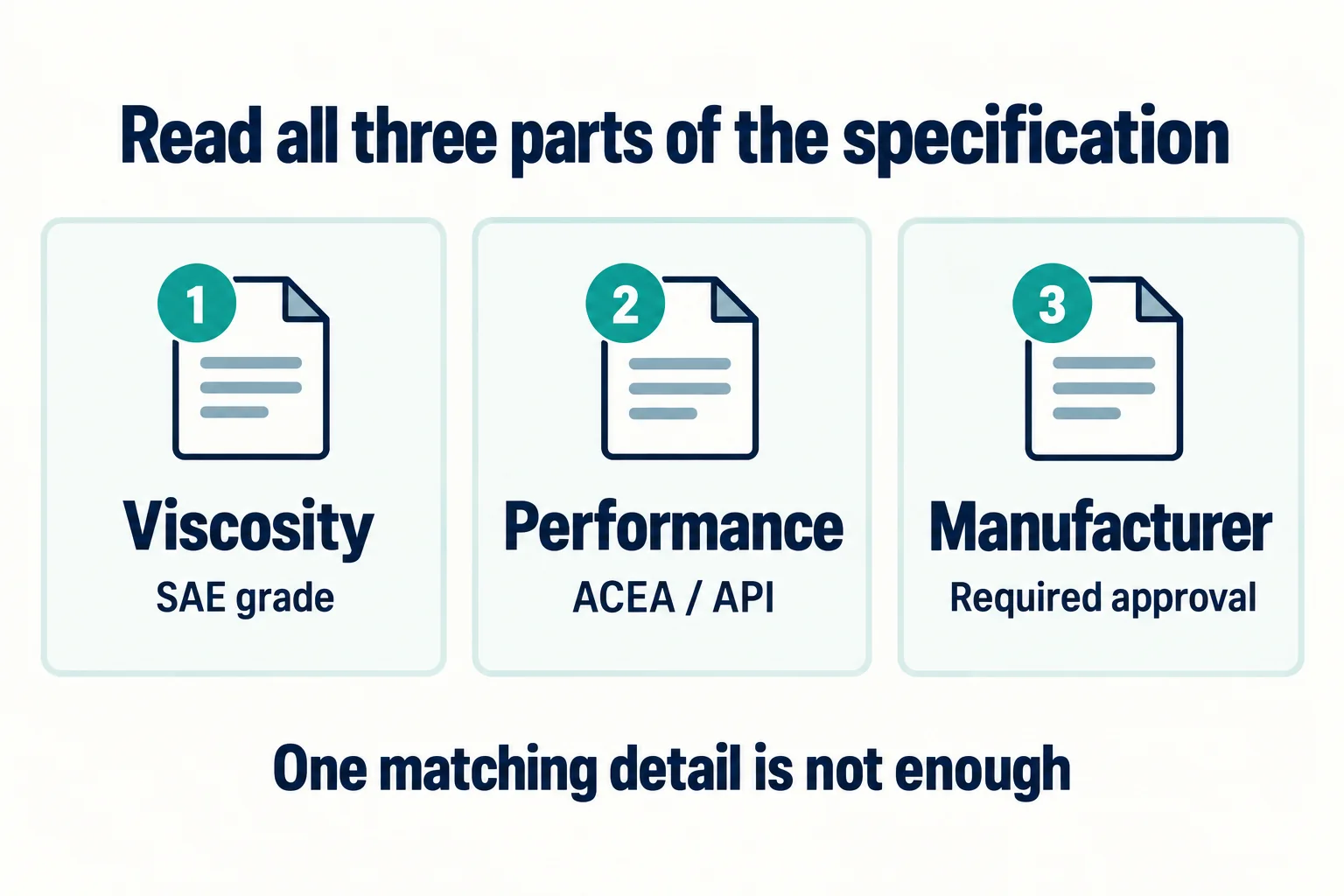
Read the oil label in three separate parts
| Marking | What it describes | What to check |
|---|---|---|
| SAE viscosity, such as 5W-30 | Oil flow and viscosity behaviour under defined test conditions. | Is this grade permitted for your engine and conditions? |
| ACEA or API category | A set of engine-oil performance requirements. | Does the exact category satisfy the vehicle’s instructions? |
| Manufacturer specification or approval | A vehicle maker’s own requirement, where specified. | Does this exact product meet the required specification and hold any required approval? |
These markings complement one another. Finding the right viscosity does not excuse a missing approval, and finding a familiar approval number does not excuse a viscosity outside the permitted range.
Viscosity: useful information, not a quality score
Viscosity describes resistance to flow. A multigrade designation such as 5W-30 combines a cold-temperature grade with a high-temperature grade. Neither number is a product rating: choosing a larger number does not automatically improve protection. The API Motor Oil Guide separates viscosity from performance level and directs owners to the vehicle manufacturer’s viscosity recommendation.
Do not choose a different grade solely because the car is older, has covered more miles or will travel in summer. First establish whether the manufacturer permits that grade. Persistent oil consumption needs assessment; a viscosity change is not a diagnosis.
ACEA and API: match the category, not just the letters
ACEA’s light-duty categories cover different engine and emissions-system needs. Its C categories address compatibility with catalysts and particulate filters, but they are not interchangeable as a group. The ACEA 2023 light-duty sequences, for example, give C2 and C3 different high-temperature, high-shear viscosity requirements. ACEA warns that some categories are unsuitable for certain engines.
Therefore, “suitable for a DPF” is not enough information to select oil for every diesel with a particulate filter. Copy the specified category rather than treating C3, C5 or another larger number as an upgrade. This is also relevant to petrol cars with particulate filters.
API categories form a separate system. API’s guide includes SQ, introduced in March 2025, and explains backward compatibility within petrol-engine performance categories. That does not cancel the required SAE grade or a separate manufacturer specification. There is no universal rule that any newer code makes an oil suitable for every older engine.
An approval and a recommendation are different claims
Read the wording around a specification number. Mobil’s UK product data sheet for one 5W-30 oil separates formal approvals, recommended applications and requirements the product meets or exceeds. Those headings should not be flattened into one list of manufacturer approvals.
Where a manufacturer requires an approved product, look for that approval and verify it through the manufacturer’s published list when available. Mercedes-Benz’s operating-fluids site identifies approved oils by the MB approval wording and publishes product lists for individual specifications. A reference to a number alone is not the same evidence.
Not every specification has a public approval scheme. In that case, establish what the vehicle maker requires and ask the lubricant supplier to confirm the exact product’s compliance. Do not reject or accept an oil merely because another brand uses different approval terminology.
Use the data sheet for the complete product name, viscosity and market. A similarly named bottle elsewhere in the range is not proof. If the bottle and current data sheet disagree, ask the supplier to identify the version being sold before using it.
Build a specification sheet before you buy
Copy these five lines into a note, then open each check below. They produce a useful question for a retailer or garage instead of “which oil is best?”
- Vehicle: model, model year, engine code and relevant market.
- Requirement source: manual page or official update, with its date.
- Required oil: permitted viscosity, performance category and manufacturer specification or approval.
- Candidate product: full name, viscosity, bottle wording and data-sheet version.
- Unresolved point: anything that does not match, plus who confirmed the answer.
Check 1: do all the required markings match?
Compare the requirement with the complete label and data sheet. If the viscosity matches but the specified manufacturer code is absent, the evidence is incomplete. Ask for confirmation of that exact specification; “it is premium synthetic oil” does not answer the question.
Check 2: is an alternative conditional?
Read the whole paragraph and its footnotes. An alternative allowed for a limited top-up is not automatically suitable for a complete service fill. Note any quantity limit, engine exclusion or climatic restriction exactly as written.
Check 3: what should the garage put on the invoice?
Ask for the actual product name, viscosity and specification, alongside the quantity used. Keep this with the service record. A line saying only “engine oil” makes the next compatibility check harder. Our car-servicing guide explains how to compare the wider scope of a service quote.
Keep top-up exceptions separate from a service fill
Some manuals allow a specific alternative only when the prescribed oil is unavailable. A Ford manual’s technical-specifications section illustrates this with separate engine applications and a limit on alternative oil between services. It is an example of how to read an exception, not an oil recommendation for your Ford.
Do not turn a model-specific concession into a general mixing rule. If you cannot establish the required product or how an exception applies, ask the manufacturer or garage before adding oil. This selection guide does not replace the car’s level-checking procedure or tell you how much to add.
Once compatibility is established, compare the practical details
Compare the price per litre, the amount you need, the seller and how clearly the product’s identity is documented. Keep the receipt and a photograph of the label. A larger discounted container is not useful if it leaves you uncertain which specification you bought.
“Fully synthetic”, “high mileage” and “long life” are not substitutes for the complete requirement. Nor does premium oil create a longer service interval on its own: use the vehicle’s applicable maintenance schedule. If two products demonstrably satisfy it, this guide has no testing evidence to declare one universally better.
If you have already used oil that may be wrong, retain the container and record the amount, date and whether the engine has run. Give that information to a qualified garage or the manufacturer; the response depends on what was used and in which engine. Do not assume either that damage is inevitable or that a small amount is automatically harmless.
Sources checked on 15 October 2026. This is a researched compatibility guide, not a product test or an expert inspection of your vehicle. The worksheet organises evidence; it cannot certify a particular oil without the vehicle-specific requirements.
The conversation