To check engine oil with a dipstick, park on level ground, follow your handbook’s engine-temperature and waiting instructions and, with the engine off, wipe, fully reinsert and withdraw the dipstick to read the level. A car with electronic measurement needs its own display procedure. Do not add oil from an uncertain reading, and never assume that the gap between the marks equals one litre.

This guide covers routine level checks and a careful top-up when your car’s instructions call for one. Find the procedure for your exact engine first: cars sharing a model name can use different measuring systems. Checking the level is separate from choosing the correct oil and deciding when it needs changing.
First, distinguish an oil warning from a routine check
If an oil-pressure warning appears while the engine is running, stop as soon as it is safe and switch off. Do not keep the engine running to see whether it clears. Read the warning’s instructions and obtain breakdown assistance if you are unsure. A satisfactory oil level does not establish that oil pressure is satisfactory.
Volkswagen UK’s red oil-pressure guidance starts with stopping safely and switching off; it directs owners to roadside assistance when the level is already correct. Its further instructions are vehicle guidance, not a universal restart test. This article does not give permission to restart or drive after a pressure warning.
A low-level message, a pressure warning and an oil-change reminder ask different questions. For example, Ford’s oil-life percentage concerns the remaining service life of the oil. A display showing 30% oil life does not mean that the engine contains 30% of its oil capacity. Read the complete message rather than interpreting an oil-can symbol alone.
Find four details in your handbook before opening the bonnet
- Measurement method: a dipstick, an electronic display, or a specified service procedure.
- Conditions: level ground, the required engine temperature, the waiting period and the ignition or engine state.
- Reading: what the marks or display mean, when a top-up is required and any stated top-up quantity.
- Oil specification: the applicable viscosity and manufacturer approval for your engine, plus the correct filler location.
Use the registration or VIN where the manufacturer’s manual finder requests it. Check the production period and engine variant rather than downloading the first manual with the same model name. If a handbook is missing, the manufacturer’s owner-support service or a dealer can identify it. Toyota UK’s owner’s-manual finder is one example of that starting point.
Prepare a clean lint-free cloth, suitable gloves and good lighting. If a top-up is needed, have the specified oil and a clean funnel ready. Avoid unnecessary skin contact with used oil; HSE’s used-engine-oil guidance recommends protective measures and good hygiene, and warns against keeping oily rags in pockets. Clean contaminated skin promptly.
Park securely away from moving traffic and follow the car’s bonnet-support instructions. Keep hands, hair and loose clothing clear of fans and belts. Ford’s checking guidance warns that cooling fans can start even with the engine off. On a hybrid, silence does not mean the vehicle is switched off: shut down the hybrid system as the handbook directs before working under the bonnet.
Should the engine be hot or cold?
There is no single temperature or waiting time that suits every car. Use the specified measuring conditions consistently; do not combine the warm-up instruction from one manual with a waiting period from another.
| Identified handbook | Stated check conditions | Why it matters |
|---|---|---|
| Ford Focus, UK manual CG3784en, August 2020 edition; builds 2 November 2020–14 March 2021 | Level ground; before starting, or after warming up and switching off with a 10-minute wait | This handbook permits two approaches; neither establishes a rule for every Ford. |
| Toyota Auris Hybrid, UK manual OM12J68E, 2015 edition | Engine at operating temperature; level ground; hybrid system off, then wait more than five minutes | The hybrid system must be off, not merely quiet. |
Sources: Ford Focus manual, printed page 427 and Toyota Auris Hybrid manual, printed pages 406–408 and 521. Their measurement conditions do not remove the risk of burns from hot components. Follow the separate precautions for adding oil too.
How to take a dipstick reading
Once the specified conditions are met and the engine is off:
- Identify the engine-oil dipstick using the handbook’s diagram. Do not pull an unfamiliar handle simply because it is brightly coloured.
- Withdraw it carefully and wipe the measuring section clean with the lint-free cloth.
- Reinsert it fully into its tube, then withdraw it again for the reading.
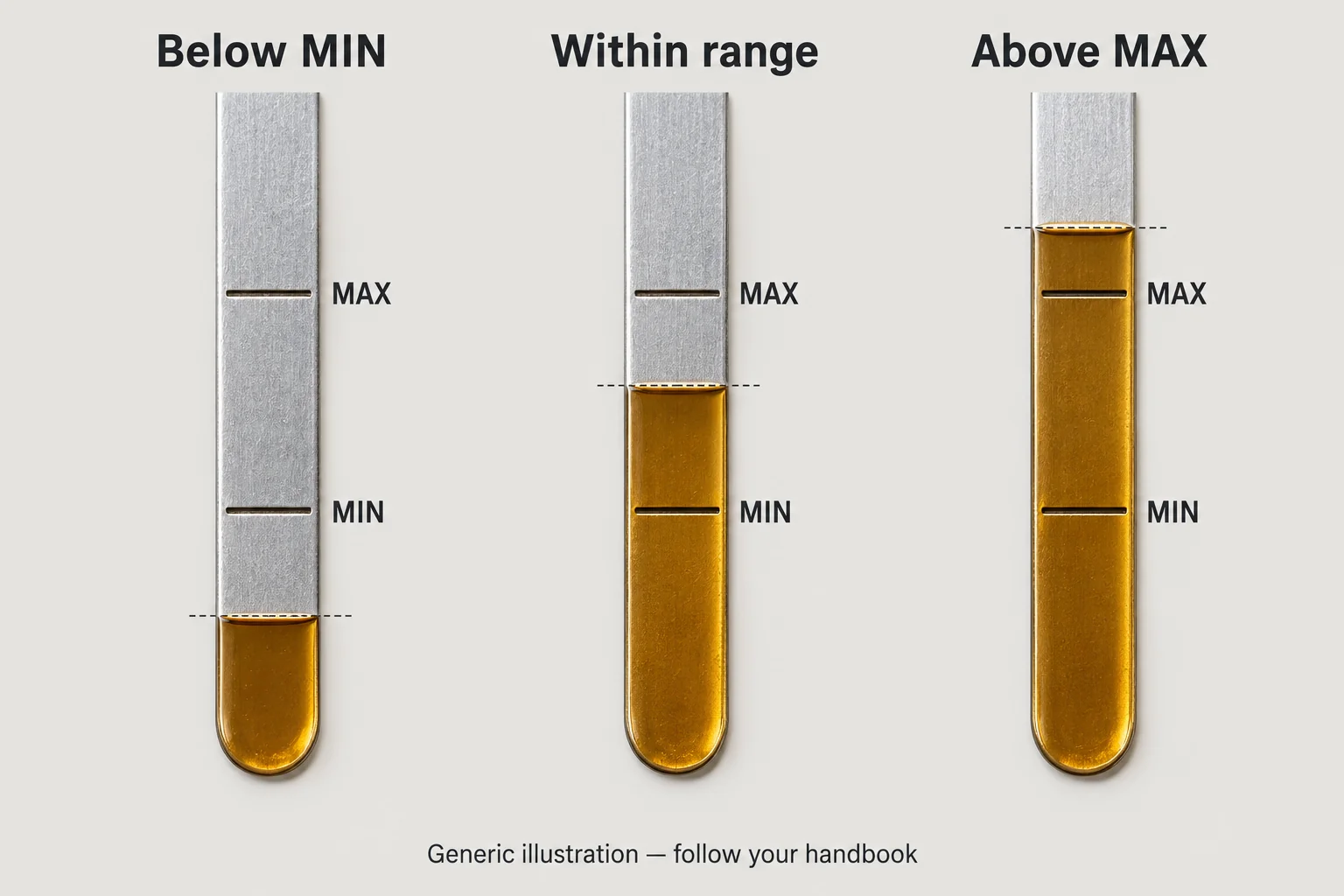
- Find the continuous oil boundary against the marked measuring area. Check how your handbook says to interpret the markings and any different readings on the two faces.
- Repeat the wipe-and-measure process if the boundary is unclear. Refit the dipstick fully when finished.
These are the basic wipe-and-reinsert steps described in the linked manufacturer guides. A smear along one edge is not a reliable level. If repeated readings disagree, pause and check that the car is level, the dipstick was seated properly and the required wait has elapsed. Ask a garage to demonstrate the reading if it remains ambiguous; adding oil is not a way to resolve uncertainty.
What the result tells you
A reading within the specified range is a level measurement, not a full engine-health check. In the cited Focus manual, oil between MIN and MAX is acceptable and no addition is required; at MIN, it says to add oil. The Auris Hybrid manual gives a different trigger: below or near its low mark. Follow the rule for your car rather than automatically filling to MAX after every check.
If a valid reading is below the minimum, address it using the correct top-up instructions before driving. If no oil appears on the measuring area after a proper recheck, do not start the engine just to obtain another reading. Seek assistance if you cannot establish the correct level or amount to add. A dry measuring tip does not tell you exactly how many litres are missing.
If a repeated, correctly taken reading is above the maximum, do not add more. Arrange advice and correction before running the engine; do not try to burn off excess oil. The linked manuals warn that overfilling can damage the engine. An unexpectedly high or rising reading needs assessment, not an assumed diagnosis from this guide.
How electronic oil-level checks differ
Use the oil-level function identified in the handbook and meet its measuring conditions. The screen may need a particular ignition state, temperature or period since shutdown. Do not apply the dipstick sequence to a vehicle without a dipstick, and do not improvise an under-bonnet check with the engine running.
For a specific example, Volvo’s UK 2021 V60 instructions describe an electronic gauge in Car Status. They explain that an unavailable value can reflect unmet measurement conditions and that the display does not immediately register added oil. They also say to add only the amount specified by a low-level message; a service-required message can instead mean that the level is too high.
The practical consequence is to record the exact message before doing anything. Do not keep pouring because the screen has not moved. Follow the model-specific refresh procedure only when the car is otherwise suitable to run: a measuring requirement is not permission to drive with an oil-pressure warning, a known low level or suspected overfill. If the display remains unavailable under the correct conditions, have the system checked.
If oil is needed, top up without guessing
First confirm the complete specification on the oil container. Our guide to choosing compatible engine oil explains approvals and viscosity; the 5W-30 versus 5W-40 comparison explains why those labels alone do not authorise substitution.
With the engine off and the handbook’s filling precautions met, identify the oil filler, clean around it and remove the cap as directed. Do not open the coolant reservoir instead. Add only what the relevant procedure requires. For a dipstick system, small additions followed by the specified settling and recheck process help avoid overshooting. For an electronic system with an explicit quantity, follow that instruction rather than chasing an immediate display change.
Castrol’s checking guide also stresses the correct specification and gradual additions to avoid overfilling. There is no universal MIN-to-MAX volume. The capacity listed for an oil-and-filter change is not the amount to pour into an engine that already contains oil.
Stop at the applicable target, secure the filler cap and dipstick, remove the funnel and cloths, and deal with spills before closing the bonnet properly. Oil on hot parts is a fire risk; if a spill is inaccessible or you cannot clean it safely, get help before starting. Do not reset an oil-change reminder merely because you added some oil.
Choose your next step
I have two different readings. Which one should I use?
Do not average them or select whichever permits a top-up. Write down whether the car moved, the engine ran, or the waiting period changed. Repeat the procedure under the handbook’s conditions. If the two faces of the dipstick disagree, use the manufacturer’s reading instruction; if there is no clear answer, ask a garage. Keep a photo of the unclear result to explain the problem.
The electronic display has not changed after adding oil.
Stop adding. Note the oil specification and exact amount already poured, the original message and the current display. Check the handbook’s update requirements. If you added more than instructed, or cannot establish the level, obtain advice before running or driving the car. A stale reading does not prove that the top-up has failed.
The level is correct, but the oil-pressure warning appeared.
Keep the engine switched off and arrange assistance, following the vehicle’s warning instructions. Report the exact message, when it appeared and the level you measured. Do not treat a normal dipstick reading as clearance to continue, or add extra oil to try to extinguish a pressure warning.
Keep a useful record between services
Use the checking interval in your handbook and include the check in your pre-drive routine. Ford UK’s maintenance advice, for example, suggests dipstick checks at least every two weeks and before long journeys; that is not a replacement for another manufacturer’s schedule. It also identifies frequent top-ups as a possible sign of a problem.
A useful note has six items: date, mileage, measuring conditions, observed level or exact display message, amount added, and oil specification. Repeat checks consistently so a garage can assess a trend. If the level changes unusually quickly, warnings recur or you find a leak, arrange inspection rather than endlessly topping up. A level check cannot diagnose the cause or establish a universal acceptable consumption rate.
Finally, a top-up does not replace the oil and filter or renew their service interval. Keep the maintenance schedule alongside your level record; our car-servicing guide explains how to organise the work and the questions to put to a garage.
The conversation