A worn wheel bearing can cause a hum, rumble or growl that changes with road speed, but tyres, brakes and other components can sound similar. Noise alone cannot identify the failed part or the affected side. Arrange a professional inspection promptly. If the car becomes unstable, steering or braking changes, or severe grinding develops, stop in a place of relative safety and seek recovery rather than continuing to investigate.
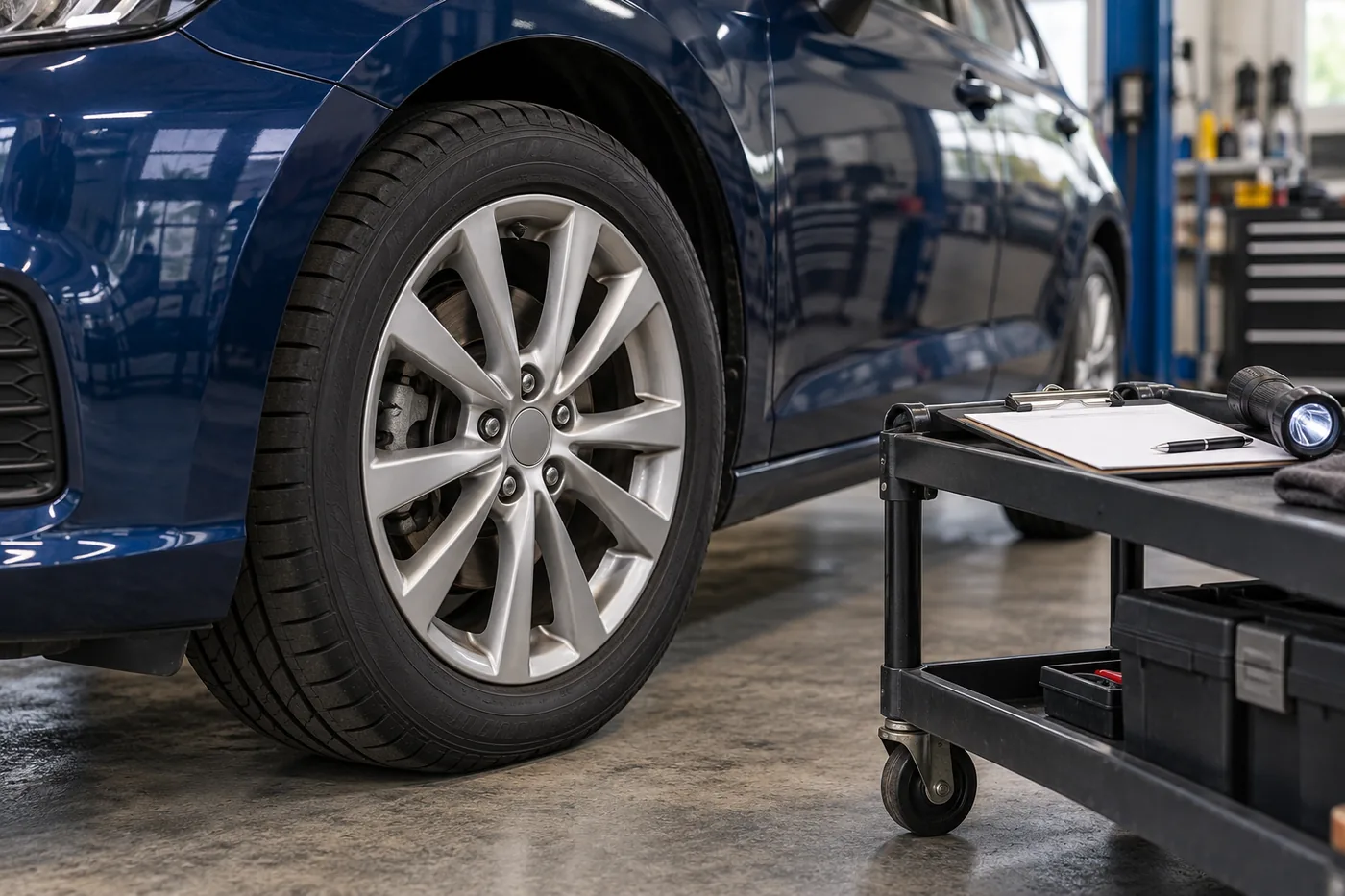
The useful first question is whether the car needs immediate assistance. The next is what you can tell the garage without guessing at a diagnosis. There is no reliable “you have another 50 miles” allowance for an uninspected wheel noise, and an online sound comparison cannot establish that a journey is safe.
What does wheel bearing noise sound like?
Descriptions include a low drone, rough rumble, growl or whine. It may become more noticeable as road speed changes or only stand out within a particular speed range. A symptom can also change during ordinary cornering. None of those observations confirms a bearing fault.
A wheel bearing allows the wheel assembly to turn while supporting it. Problems at this point can affect more than comfort: MOOG’s technical bulletin describes noise, vibration, looseness and possible ABS-related symptoms, while noting that suspension faults can also cause looseness or clunking.
Do not wait for every symptom to appear. Equally, do not order a bearing because a recording sounds like someone else’s car. Tell the garage what happened, when it started and whether anything else changed.
Could the noise be tyres, brakes or a CV joint?
Bearing manufacturer BCA explains why tyre, brake and CV-joint noises can be mistaken for a wheel bearing. Use this comparison to organise observations already made during normal driving, not to create a test route.
| What you noticed | What also needs consideration | What it cannot prove |
|---|---|---|
| Hum or growl changing with road speed | Bearing condition, tyre tread or wheel-related noise | Which component or corner is responsible |
| Noise changes on a different road surface | Tyre and road interaction | That the bearings are sound |
| Metallic scraping, especially associated with braking | Brake components and possible contact around the disc | That replacing a bearing will fix it |
| Clicking during an ordinary turn | CV joints as well as the wider wheel assembly | A particular joint or bearing has failed |
| Vibration or a change in steering feel | Wheels, tyres, bearings and suspension | That the issue is merely wheel balance |
Timken’s symptom guide also identifies tyre, CV-joint, suspension and brake problems as possible alternative explanations. The same symptom can have different causes.
A noise that seems to come from the left does not justify replacing the left bearing without confirmation. SKF’s technical note warns that bearing noise can misleadingly appear at the opposite wheel. Tell the workshop where you perceived it, but separate that impression from the diagnosis.
If a tyre-pressure warning or visibly deflated tyre accompanies the sound, report that as well. Our tyre-pressure guide covers routine checks; correcting pressure does not clear an unexplained noise or establish that the car is safe.
When to stop and when to contact a garage
Stop as soon as it is safe if the vehicle becomes difficult to control, steering or braking behaviour changes, or there is severe grinding or an apparent loose wheel. Do not continue towards a garage just because it is nearby. Request assistance and describe the symptoms. These signs need attention regardless of whether the underlying cause is a bearing.
For a new, persistent hum without those additional symptoms, contact a garage promptly and ask how the vehicle should be brought in. Do this before continuing routine use or starting a long trip. A quieter noise is not a remote assurance of roadworthiness; if there is doubt about safe movement, arrange recovery.
GOV.UK makes the driver responsible for roadworthiness, including when a current MOT certificate exists. Do not deliberately weave, accelerate to reproduce the sound, or try different braking manoeuvres to decide which side is faulty.
If the problem develops on a motorway
In Great Britain, follow the Highway Code’s breakdown guidance. Aim for a place of relative safety if possible and use hazard lights. If you cannot get to safety and cannot leave the vehicle safely away from traffic, stay inside with seat belts and hazards on and call 999 for the police. If it is safe to get out, use the side away from traffic and keep well clear of the vehicle and carriageway. Do not attempt repairs on the motorway or put out a warning triangle there.
Make a useful note for the workshop
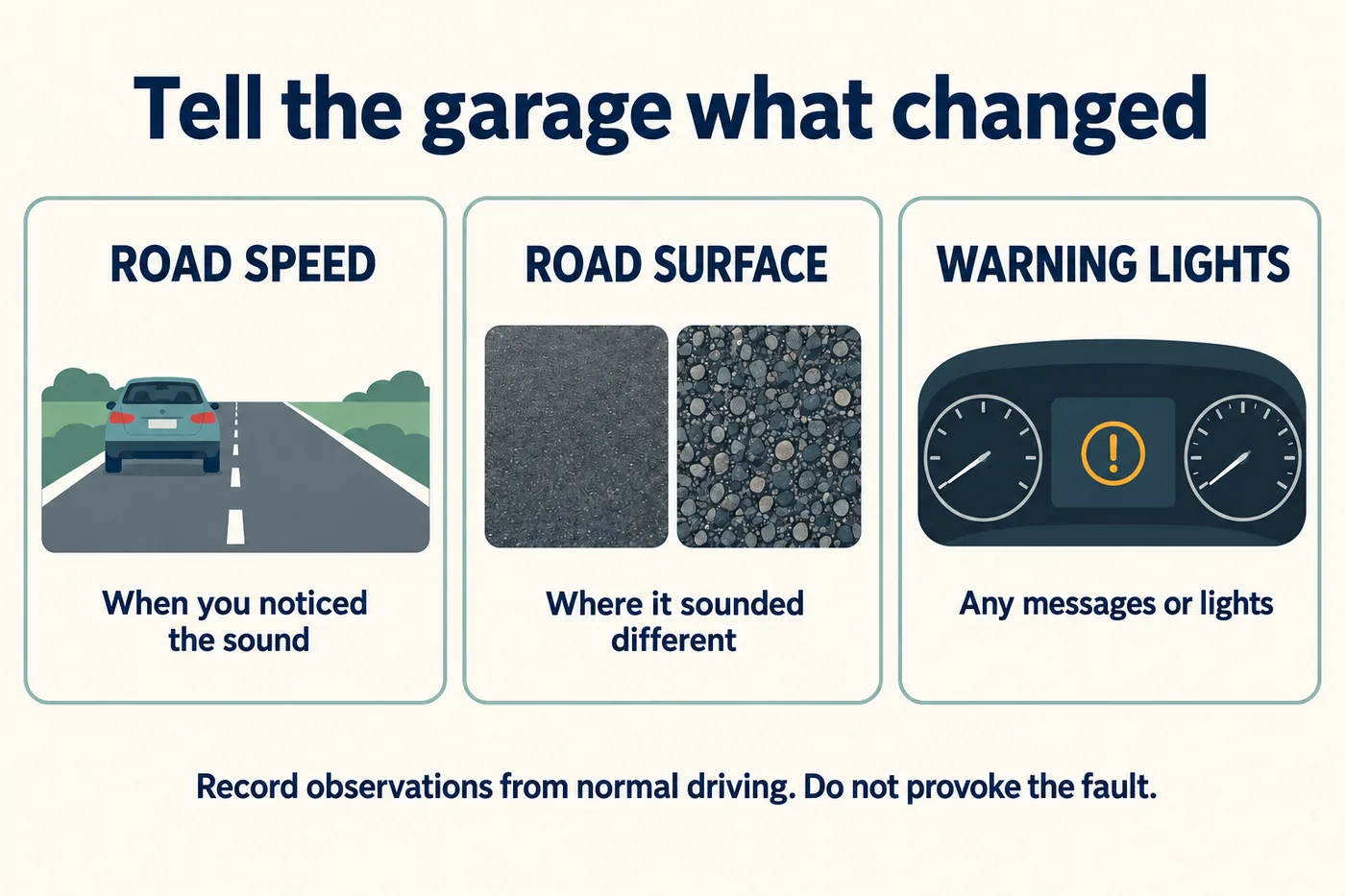
Write down what you already know once safely parked. “Unknown” is a useful answer; you do not need another drive to fill in the gaps. The following worksheet gives the technician a starting point without steering them towards a predetermined replacement.
| Information | What to write |
|---|---|
| Vehicle | Registration, model, year, mileage and relevant modifications |
| First noticed | Approximate date; whether it appeared suddenly or gradually |
| Sound | Your description: hum, rumble, scrape, click or something else |
| Conditions already observed | Road speed, surface and whether it occurred during ordinary braking or turning; leave unknowns blank |
| Other changes | Vibration, steering or braking changes, warning lights or visible tyre issues |
| Recent history | Tyre fitting, brake or suspension work, a remembered impact, and previous repair invoices |
A helpful description might be: “A new drone started this week. I noticed it on my usual commute and it was still present on smoother tarmac. I have not carried out any tests. Please inspect the noise and advise whether the car needs recovery.” Add any control changes or warnings rather than leaving them out because they seem unrelated.
What should the garage establish?
Ask for the inspection findings before authorising a replacement. The workshop should identify the affected component and location, assess the surrounding assembly and explain the proposed repair. A customer description is evidence to investigate, not a parts order.
Three questions help keep the conversation specific:
- What confirmed the fault? Ask what was found and how other plausible sources of the noise were considered.
- What exactly does the quote cover? Request the part or assembly, affected corner, labour, necessary additional fixings, VAT and any further checks.
- What happens before collection? Ask how the repair will be checked, whether a warning-light issue needs separate diagnosis, and what to do if the original sound remains.
Report an ABS warning without assuming it proves a failed bearing. SKF’s note directs technicians towards the vehicle manufacturer’s diagnostic procedure, including checking the relevant sensor system, wiring and connections. Replacing a bearing on that assumption alone can miss the actual fault.
Repair quality matters as much as the replacement part
Vehicle designs and repair procedures differ. NSK’s wheel-bearing fitting guidance uses a specific first-generation bearing example and tells technicians to follow the vehicle manufacturer’s requirements. Correct tools, cleanliness, fitting alignment and torque matter; its example is not a universal DIY procedure.
A useful quotation identifies the exact vehicle and work needed. Compare like-for-like quotes rather than a bare online part price against a fitted repair. Ask whether diagnosis is included, whether additional damaged components would require separate approval, and what parts and labour warranty applies.
If the noise follows recent wheel, brake or bearing work, tell that workshop promptly and supply the invoice. Describe the chronology without assuming who caused it. Ask for a fresh safety assessment; do not keep driving simply to see whether the sound settles down.
Will a noisy wheel bearing fail an MOT?
In Great Britain, DVSA’s section 5.1.3 classifies excessive bearing play or excessive roughness as major defects. Likely collapse, or sufficiently severe play that breakup is likely or directional control is impaired, is dangerous. Those are inspection findings, not categories a driver can assign from a sound clip.
A previous pass does not resolve a new symptom. Northern Ireland has its own testing arrangements; nidirect likewise explains that the certificate reflects the test-time condition and is not a guarantee for the rest of its validity. For interpreting the paperwork, see our MOT advisories and failures guide. Do not wait for the annual test to investigate a persistent noise.
Common follow-up questions
Can I drive a short distance if it is only humming?
No article can confirm a safe distance from that description. The part and severity have not been established. Contact the garage or recovery service before moving the vehicle and explain all symptoms; use recovery when safe movement is uncertain. Loss of control, altered braking or severe grinding needs immediate assistance.
Do both wheel bearings need replacing?
Ask what the inspection found at each wheel and what the manufacturer requires for your vehicle. If the quote includes another bearing, request the reason rather than assuming either that a pair is always necessary or that only one can be affected.
The noise has gone away. Does that clear the bearing?
No. BCA describes noise that may occur only at certain speeds or change during ordinary cornering. Tell the garage when it was last heard and whether the conditions changed. Do not deliberately recreate it; an intermittent symptom still needs assessment.
Sources checked: 1 November 2026. This is source-based guidance for describing symptoms and arranging inspection, not a diagnosis or a vehicle-specific repair procedure. Older manufacturer technical notes are used for enduring diagnostic principles, not presented as new testing.