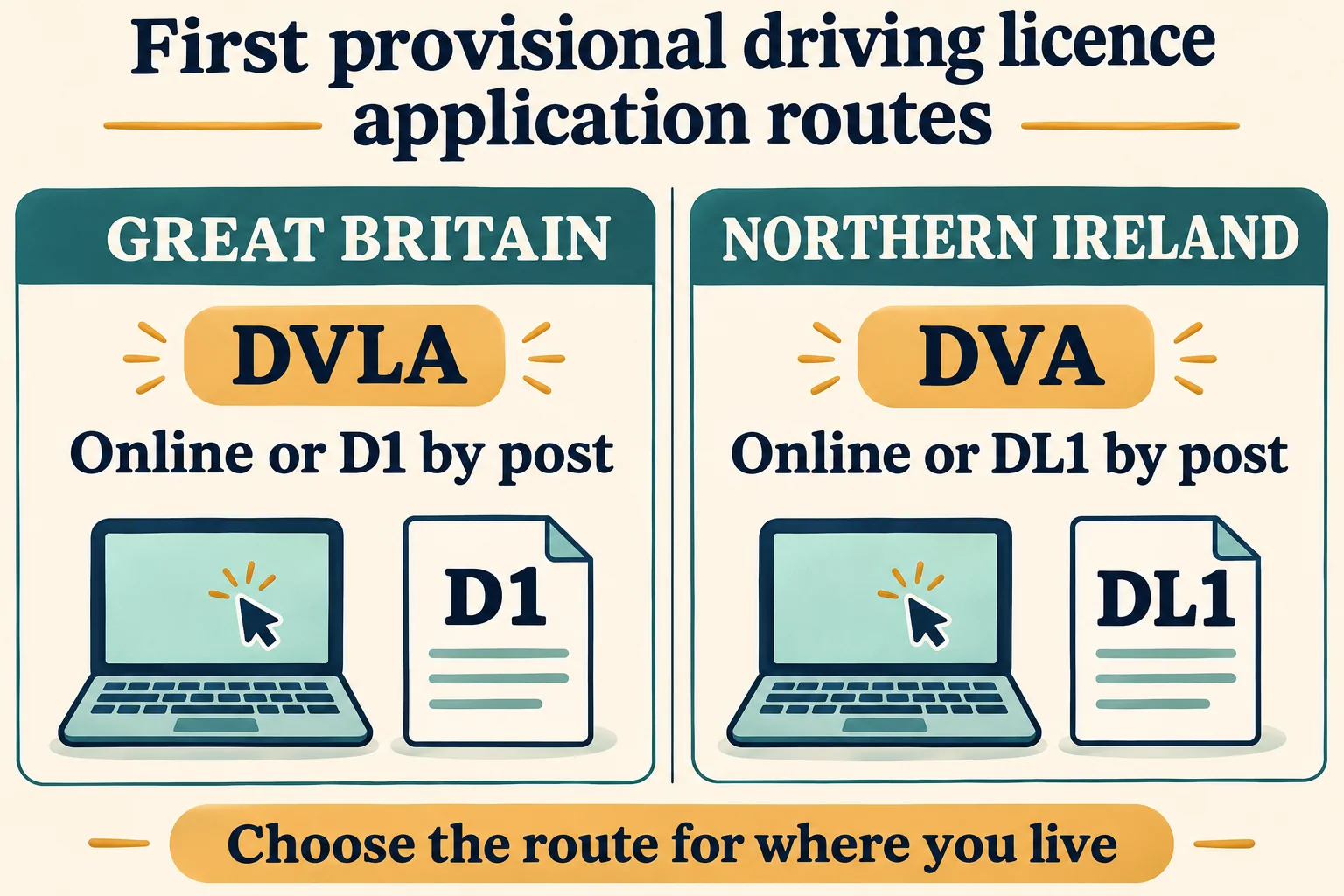
Apply to DVLA if you live in England, Scotland or Wales, or to DVA if you live in Northern Ireland. Both offer online and postal applications, but their fees, identity checks and application ages differ. This guide covers a first ordinary provisional licence for someone preparing to learn to drive a car. It does not cover exchanging an overseas licence or adding lorry and bus entitlement. [1] [4]
The first step is choosing the right issuing authority. An application confirmation is not permission to start driving: you must have the required licence, be old enough for the vehicle and meet the learner rules. [8] [9]
Which application route should you use?
| Where you live | Online | By post |
|---|---|---|
| England, Scotland or Wales | DVLA: £34 | Form D1: £43 |
| Northern Ireland | DVA: £62.50 | Form DL1: £62.50 |
These are the official application fees, not a budget for lessons, photographs, postage or tests. The GB postal route costs £9 more than applying online. Northern Ireland has its own fee schedule; do not use the GB price when budgeting for a DVA application. [2] [6]
Use the official service links in Sources below. Before supplying identity or payment details, check which authority the page names and which application you are starting. Keep this article open as a checklist, but follow the current instructions in the actual service if it requests additional information.
When can you apply, and when can you drive?
England, Scotland and Wales
DVLA accepts first provisional applications from age 15 years and 9 months. Its application page also requires you to be able to read a number plate from 20 metres and to have been given permission to live in Great Britain for at least 185 days. That wording concerns the permission you have been given; it is not an instruction to count 185 days since your arrival. Follow the official eligibility questions if your circumstances are unclear. [1]
Most people can start learning to drive a car at 17. Applying earlier does not bring the normal car-learning age forward. Vehicle categories and some disability-related circumstances have different rules, so check the entitlement relevant to you before arranging practice. [9]
Northern Ireland
For the usual car route, nidirect says you can apply up to two months before your 17th birthday, with the licence normally becoming valid on that birthday. Its guidance gives a separate earlier application route for people receiving the mobility component of Personal Independence Payment at the enhanced rate. Do not apply Great Britain’s 15-years-and-9-months threshold to a normal Northern Ireland car application. Check DVA’s current guidance for an exception or another vehicle category. [7] [8]
DVA’s form guidance says it can issue licences only to people living at a Northern Ireland address, and explains lawful-residency evidence. It also requires a health declaration. Use those instructions for your own circumstances rather than treating this checklist as a decision on your eligibility or fitness to drive. [8]
How to apply in Great Britain
- Open DVLA’s first provisional service. Sign in or create the sign-in details requested. The service tells you whether you need to prove your identity, usually using photo ID.
- Follow the identity route presented to you. Do not assume everyone must post a passport; the documentary alternatives are explained below.
- Check the application before payment. Compare your name and date of birth with your supporting evidence, and check that your address is complete. This is a useful final check even when fields have been filled automatically.
- Pay the £34 fee and retain the confirmation. DVLA sends a confirmation email after an online application. Save it somewhere you can find again. [1]
If you use post, obtain form D1 from a Post Office that supplies it, read its notes, and send the completed application and required evidence to the address on the form. The postal fee is £43. [1] [2]
What if you do not have a UK passport?
A UK passport is not the only identity route. DVLA’s document guidance describes using a valid UK passport number, a UKVI share code, or specified original documents sent by post. For the share-code route, select the purpose labelled “something else”. A UK birth, adoption or naturalisation certificate needs additional supporting evidence from DVLA’s list. [3]
The same guidance explains when a form or photograph needs another person’s signature, and who can sign. Read the rules for the route you actually use; asking any convenient friend to sign may not satisfy them. If you need to send original evidence, check travel plans first: DVLA advises considering a delay if you will need your passport within four weeks. Licence and identity documents can arrive separately. [3]
How to apply in Northern Ireland
DVA’s online preparation list is more specific. Before starting, have:
- a nidirect account with your identity verified;
- a compliant digital photograph or photo code;
- the identity document required for upload;
- a signature prepared for upload using the service’s instructions;
- the email address of an authorised photo certifier who knows you are nominating them;
- a debit or credit card for payment. [4]
Read the photo and identity links within the service before producing files. For example, preparing a signature file and arranging a certifier are separate jobs: completing one does not replace the other. If an upload is rejected, check that item’s instructions rather than repeatedly submitting the same file.
For a postal application, use DL1 from a main Post Office branch. DVA asks for original identity evidence, a passport-style colour photo and the fee. Follow the current DL1 notes for the declaration, any photo certification and the destination address. The provisional licence has a photocard and paper counterpart; keep both when they arrive. [5] [8]
A final check before you submit
Work through this list with your actual application beside you. It is a preparation aid, not a substitute for the authority’s eligibility checks.
- Right task: this is genuinely your first provisional application, rather than a replacement, renewal or change of details.
- Right authority: the route matches where you live.
- Consistent details: names, birth date and address agree with the evidence or have the required supporting explanation.
- Complete evidence: the requested photo, identity evidence, signature and certification are ready for your chosen route.
- Payment and records: check the official fee; retain the confirmation and any postal tracking reference.
- Realistic lesson date: allow for delivery and further checks rather than treating the estimated processing time as a guaranteed appointment date.
How long will the licence take?
For GB online applications, DVLA says the licence should arrive within one week, but additional checks can take longer. That estimate should not be applied to a postal application or a Northern Ireland application. [1]
DVA aims to process a fully completed application within 10 working days, yet advises allowing at least six weeks for the licence to arrive. These are different measures: processing an application and receiving the document are not the same event. DVA says to contact it if the licence has not arrived six weeks after applying. Health or personal-detail checks can extend the process. [5]
Keep the confirmation and use the issuing authority’s contact route for a delay. Avoid paying for another first application just because the expected arrival date has passed.
Common application problems
I already have a provisional licence. Should I apply again?
Start by identifying the actual task. DVLA lists renewal, replacement, reapplication after disqualification and address changes separately from the first-licence service. Our guides to renewing a driving licence and changing your name or address explain those different routes. [1]
My name differs from the identity document.
Check the authority’s supporting-evidence requirements before submitting. DVLA’s identity guidance contains a section for name changes. Do not change an answer merely to make the form accept it if that leaves the application inaccurate. [3]
Can I start lessons while the first licence is being processed?
Do not treat a receipt as a provisional licence. GOV.UK requires you to have a provisional licence when learning, and DVA expressly says first-category applicants must wait for the licence showing the entitlement. You must also meet the relevant age, supervision and vehicle requirements. [8] [9]
Once the licence arrives, check your personal details and entitlement before organising lessons or tests. For the next administrative step, see our guide to booking UK driving tests, which distinguishes the Great Britain and Northern Ireland services.
Sources
- Apply for your first provisional driving licence – GOV.UK
- Driving licence fees – GOV.UK
- Identity documents needed for a driving licence application – GOV.UK
- Apply for a provisional driving licence online | nidirect
- Applying for a provisional driving licence | nidirect
- The cost of a driving licence | nidirect
- Minimum ages and rules for learner drivers and riders | nidirect
- Driving licence application DL1 – guidance notes | nidirect
- Driving lessons and learning to drive: Overview – GOV.UK