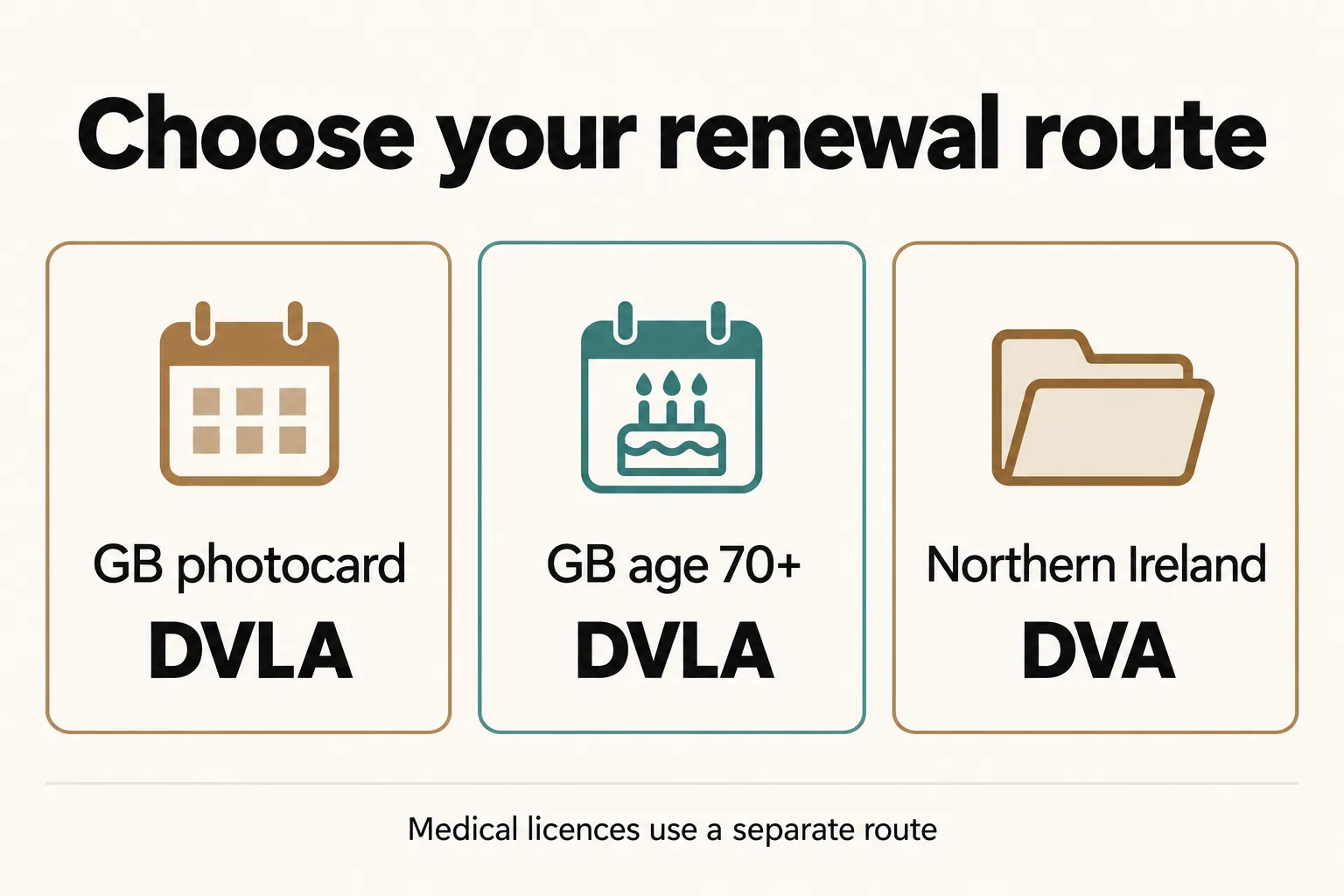
For a routine GB photocard renewal, apply through GOV.UK for £14 online, pay £17 by post or use a participating Post Office for £21.50. Renewal at 70 or over is free through DVLA. Northern Ireland has a separate DVA service and fees. Choose the route for your age, licence and circumstances before paying.
This guide covers ordinary car and motorcycle licences. Renewal keeps a time-limited licence current; it is different from replacing a missing card, changing your details or getting an entitlement back after it has been taken away. A payment confirmation alone does not establish that you may drive.
Which renewal do you need?
Look at the expiry date beside 4b on your photocard, then identify the authority and the type of renewal. A routine GB photocard normally needs renewing every ten years, but age-related and medically restricted licences have different periods. Read the date on your own document rather than adding ten years to when you remember receiving it.
| Situation | Official starting point | Key distinction |
|---|---|---|
| Routine GB photocard renewal | DVLA standard renewal | Online, postal and participating Post Office routes are available, subject to eligibility. |
| GB licence: approaching 70 or already 70+ | DVLA age-70 renewal | Free; ordinary renewal is every three years from 70. |
| GB short-term medical licence | DVLA medical renewal | A separate free process; medical enquiries can affect timing. |
| Northern Ireland resident renewing an NI licence | DVA through nidirect | Use NI forms, photograph requirements and fees. |
The links and charges below were checked on 19 October 2026. The DVLA fee table and DVA fee table distinguish renewal from replacement and other applications. Do not pay a replacement fee merely because you want a new card: first identify why it needs replacing.
Renewing a standard GB photocard
Online: £14
Start at GOV.UK’s driving licence renewal service. You must live in Great Britain and not be disqualified. Sign in or create sign-in details, then follow the identity and photograph instructions provided. A name or title change requires a postal application; a changed signature also rules out online renewal.
Before starting, put your current licence and payment card within reach and allow time to complete any requested identity checks. Follow the live service: an old guide’s screenshot may describe a different sign-in or photograph process. Save the final confirmation somewhere you can find it without reopening an unfinished application.
At a participating Post Office: £21.50
The Post Office renewal service includes taking your photograph, capturing your signature and submitting the application electronically. Its £21.50 total comprises the £17 DVLA fee and £4.50 service charge. It also sends your old licence back to DVLA.
Bring your photocard and reminder if you have one. A missing reminder need not prevent this route when you have the card and your name or title has not changed. Check that the branch offers DVLA photocard renewal and whether it needs an appointment. Age-70 renewals go directly to DVLA; branch staff cannot process those through this service.
By post: £17
Use a D1 pack from a Post Office offering the relevant DVLA services. The standard renewal requires the completed form, a recent printed passport-type photograph, your photocard if available, and the applicable cheque or postal order payable to DVLA. Name changes need evidence too. The current standard-renewal address is DVLA, Swansea, SA99 1DH.
Check the form before sealing the envelope, especially if combining renewal with another change. Our name and address change guide covers the evidence and separate vehicle records. It is worth writing your intended changes on a private checklist so you do not renew the photograph while overlooking incorrect personal details.
For the printed image, follow the passport-style photograph rules linked by DVLA: a clear, unaltered image, suitable background and correct dimensions matter. Use the renewal form’s instructions for the number of photographs and what to send; a passport application is a different transaction.
Renewing at 70 and afterwards
The GB age-70 service is available if you are 70 or over, or will be within 90 days, and your licence has expired or will expire within 90 days. You must meet the service’s residence, eyesight and driving-eligibility conditions. Renewal is free, and from 70 the ordinary renewal interval is three years.
For the postal route, use the D46P reminder form, or D1 if the reminder has not arrived. Wanting to retain C1 or D1 vehicle categories changes the process: they cannot be renewed through this online age-70 service. Check the specific entitlement route before submitting an application limited to ordinary car driving.
For example, someone who only intends to drive a car and someone who wants to retain an additional medium-sized vehicle entitlement may be the same age but need different applications. Make a list of the categories you actually need rather than assuming the renewed card will automatically preserve everything.
Can you drive while the renewal is pending?
Do not interpret “I have applied” as an unconditional extension. For GB applications, DVLA’s INF188/6 guidance on driving while an application is pending explains when Section 88 may apply. Its criteria include all of the following:
- You meet the medical fitness standards and have not been told by a healthcare professional not to drive.
- You previously held a valid licence, keep its applicable restrictions and drive only vehicles covered by both your previous entitlement and current application.
- DVLA has received a correct, complete application within the past 12 months.
- Your last licence was not refused or revoked for medical reasons, you are not currently disqualified, and you are not reapplying after disqualification as a high-risk offender on or after 1 June 2013.
Section 88 cover ends when you receive the new licence, DVLA refuses the application or revokes the licence, you become disqualified, or the application becomes more than a year old. You must continue to meet the criteria throughout the waiting period.
Read the complete guidance for your circumstances. If medical eligibility is uncertain, discuss it with your doctor or healthcare professional before driving. A saved form, an incomplete submission or an application still in the post is not evidence that DVLA has received a complete application. Do not assume Section 88 will be recognised abroad.
Northern Ireland uses DVA’s separate conditions, described in its renewal guidance. These cover receipt of a valid qualifying application, previous licensing, medical eligibility, disqualification and existing restrictions. Use those conditions for an NI application.
Northern Ireland: renewal through DVA
Use the nidirect online renewal service if you live in Northern Ireland. Have your NI licence number and expiry date, a digital photograph or photo code, an email address and a payment card if a fee is due. You can update an address online, but a name change needs a different route.
If you cannot supply a digital photograph, use the appropriate postal application; ordinary car and motorcycle applications use DL1. The online service also excludes certain older licences issued before 1 April 1999 where identity has not been checked. Use its instructions rather than a GB D1 form.
The standard NI expired car or motorcycle renewal fee is £30. DVA accepts renewals up to two months before expiry. At 70+, the NI age-70 guidance says the licence normally lasts up to three years, with no renewal fee when applying within two months of expiry or after it has expired. C1/D1 renewals require the postal route and a doctor’s DLM1 report.
NI licences retain a paper counterpart. Keep it with the photocard and follow the application instructions for returning documents; the GB counterpart changes did not remove the NI document. DVA’s photocard guide explains the expiry and vehicle-category fields.
Timing and situations to check
How long should renewal take?
DVLA says a standard online renewal should arrive within a week; postal and Post Office applications should arrive within three weeks, with longer waits possible for checks. Online renewal starts from approval, not the old expiry date. DVA aims to process complete applications within ten working days but says to allow at least six weeks for delivery. Contact DVA after six weeks without arrival, and do not leave it beyond ten weeks: its guidance says that would require a paid duplicate. These are published service expectations, not guaranteed travel deadlines.
My licence is medically restricted
Use the GB short-term medical renewal route for a qualifying one-, two-, three- or five-year licence. A medical referral can prolong processing. If your licence was taken away or surrendered for medical reasons, check the separate reapplication process instead of treating it as an ordinary renewal. Northern Ireland applicants must use DVA. This guide cannot determine whether you meet the medical standards.
I still have an old GB paper licence
A valid paper licence does not automatically need exchanging simply because newer licences have photographs. The DVLA paper-licence guide sets out the circumstances requiring a new document, including a name or address change or a missing or damaged licence. Check its validity and your circumstances before paying for an exchange. The ordinary age-70 renewal requirements still need attention when applicable.
Before you submit, check these six things
- Authority: confirm whether you are applying to DVLA or DVA, and that the service matches where you live.
- Dates and categories: note the expiry date and every entitlement you want to retain.
- Combined changes: check whether your name, title, signature or address also needs updating.
- Photograph and evidence: follow the current application’s requirements, not another document’s checklist.
- Submission record: keep the confirmation, date and any postal reference; record when to follow up.
- New licence: check the details when it arrives, follow instructions for the old document and set your next reminder.
Keep identity and payment details within the official application service. Motoring Desk does not process licence applications or need a copy of your licence.
The conversation