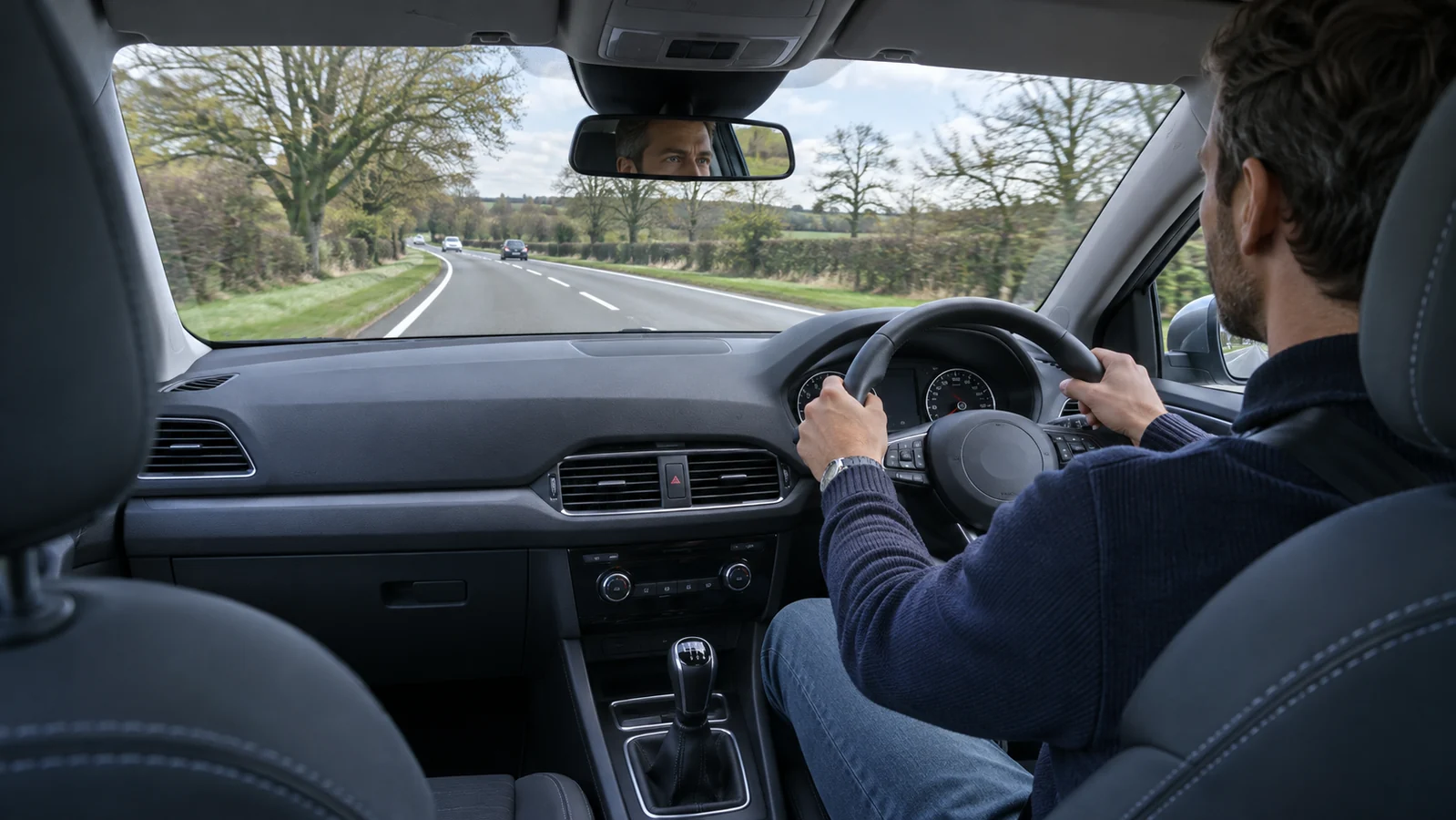
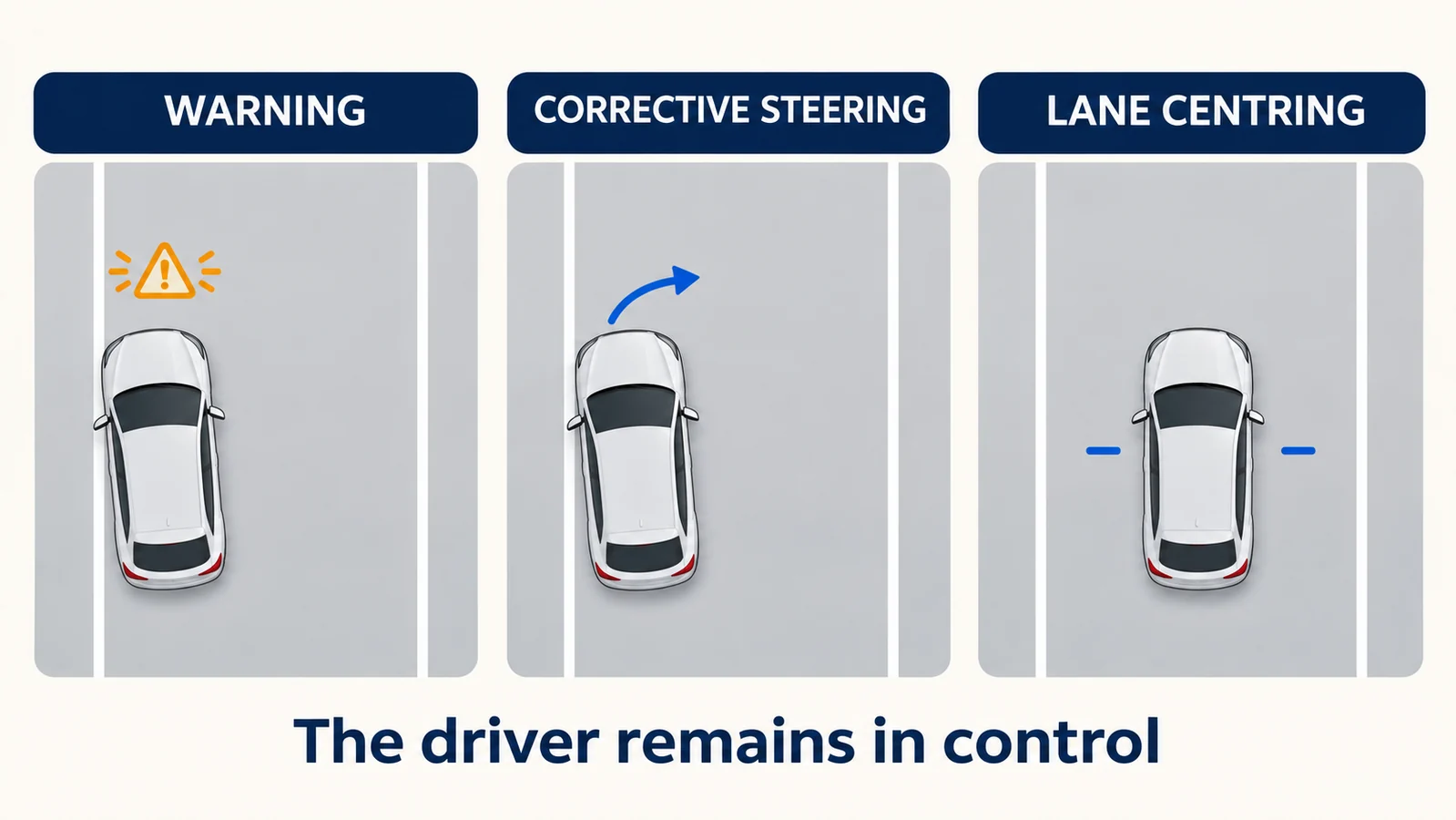
Lane assistance can warn that your car is drifting out of its lane, make a corrective steering input, or help it follow the lane continuously. Those are different functions. None of the ordinary driver-assistance features discussed here makes the driver free to stop watching the road or taking responsibility for the car. [1] [3]
If you are asking whether lane assist is dangerous after an unexpected steering movement, do not dismiss the experience as normal. Keep control of the car, stop somewhere safe before investigating settings or messages, and seek professional help if its behaviour makes you unsure you can control it safely. This guide explains the distinctions and what information to collect; it cannot diagnose your steering system remotely.
Warning, lane keeping and lane centring: what changes?
| Function | What it can do | What you should not assume |
|---|---|---|
| Lane departure warning | Alert the driver when the vehicle approaches or crosses a detected lane marking. | An alert-only feature will also steer the car back. |
| Lane-keeping assistance | Apply a correction when an unintended lane departure is detected. | It will continually position the car in the middle of the lane. |
| Lane-centring assistance | Provide ongoing steering support to follow the lane near its centre while operating conditions are met. | It will handle every bend, missing marking or traffic situation. |
These are functional descriptions, not a guarantee of what a button or acronym means. The distinction between a warning, a departure correction and continuous assistance is useful when reading a specification. [3]
Names overlap. For example, the UK 2021 Honda Jazz manual calls its system Lane Keeping Assist System while describing steering support towards the middle of a detected lane. Its name alone would not tell you that. Read the operating description for the exact model, year and equipment, rather than relying on “LKA”, “LKAS” or “LCA” in an advert. [9]
Lane assist is not the same as adaptive cruise control
Steering support and speed control are separate jobs. A combined highway-assistance feature may use adaptive cruise control for speed and following distance while lane centring assists with steering. That combination still requires an engaged driver. [8]
The distinction can matter even while a system appears switched on. In the cited V90 Cross Country 2020 manual, Pilot Assist can be running without its steering assistance being active: a grey steering-wheel symbol has a different meaning from a green one. That is a specific example, not a universal colour code. The same manual describes lane assistance separately. [4]
Before using an unfamiliar car, find the handbook’s explanation of enabled, available, actively assisting and fault. Do not treat a lit button, a set cruising speed or the absence of a warning as proof that every assistance function is working.
Why can lane assistance be unavailable or react unexpectedly?
A camera’s interpretation of the road is not the same as a driver’s understanding of it. The cited XC90 2027 manual describes problems at lane splits and merges, conflicting roadworks markings and worn lines. It also notes that shadows, barriers or repaired road-surface edges can be mistaken for markings. Those are documented limitations of that system, not a diagnosis of every unexpected steering movement in another car. [5]
Visibility matters too. The V90 2020 camera guidance describes reduced performance in heavy rain, snow and fog, as well as glare and unclear markings. It warns against placing objects or stickers around the camera’s windscreen viewing area. Your car’s sensor arrangement and cleaning instructions may differ. [6]
A useful way to record an incident is to separate four things:
- The road: worn lines, temporary markings, a merge or another visible change.
- The conditions: rain, spray, low sun or an obstructed view.
- The selected function: warning only, departure correction or a combined assistance mode, as named in the car.
- The car’s message: the exact wording, rather than your interpretation of an unfamiliar icon.
Write the details down after stopping safely. They help a workshop distinguish your report from a vague description such as “the car pulled”. They do not prove that the assistance system caused it; steering, tyres and other vehicle systems may need assessment.
Should you turn it off?
Follow your car’s instructions for the particular function and conditions. There is no responsible universal instruction to leave every lane system enabled everywhere, or to disable every system permanently.
For example, the S60 2014 manual identifies roadworks, winter conditions, poor road surfaces and poor visibility as situations where its lane-keeping function may struggle and recommends deactivation in demanding conditions. That advice belongs to that specific system. It should not be copied into a generic button sequence for a different car. [7]
Equally, switching off one setting may not disable all related interventions. The XC90 2027 manual explicitly says some safety steering interventions can remain available when lane keeping is turned off. Read the separate descriptions of lane keeping, road-departure support and any emergency intervention fitted to your car. [5]
Learn the controls while parked. If you need to examine menus or read a message during a journey, find a safe place to stop first. Great Britain’s Highway Code Rule 150 warns against distraction from vehicle systems and keeps responsibility with the driver using assistance. [2]
A parked-car checklist before using an unfamiliar system
Use this as a handbook worksheet, not a road test. Fill the gaps from the instructions supplied for your vehicle; a missing answer is a reason to ask the manufacturer or supplying dealer.
- Identify the equipment. Record the model year, exact feature name and any package listed for the car.
- Describe the job. Does it warn, intervene near a boundary, provide continuous steering support, or combine functions?
- Read the operating limits. Find the specified road types, speed conditions, marking requirements and exclusions. Do not borrow another model’s threshold.
- Learn its status display. Identify the difference between selected, ready, active and unavailable, including fault messages.
- Find the driver instructions. Read the steering, attention, cancellation and warning-response requirements.
- Check related settings. Establish which other assistance functions remain active and what the handbook says happens after restarting.
Do not deliberately drift towards a line, release the steering wheel or cover a sensor to see whether the car intervenes. An absence of intervention would not establish a safe operating limit. A salesperson’s explanation should clarify the controls and documentation without requiring you to provoke a hazardous situation.
Windscreen work, warnings and workshop checks
Tell a repairer about the car’s driver-assistance equipment before windscreen work. The V90 2020 manual, for example, requires workshop recalibration of its camera and radar unit after replacing the windscreen. That is a vehicle-specific requirement, not a DIY calibration method or a universal claim that every windscreen repair needs the same procedure. [6]
If unexpected behaviour starts after work, supply the invoice and ask the repairer to check the relevant manufacturer requirements. Ask what was inspected, whether calibration was required and completed, and what record is available. A warning disappearing is not, on its own, a documented explanation of the original concern.
For a persistent warning, repeated unexpected intervention or uncertain steering behaviour, report the exact symptoms and follow the vehicle’s warning instructions. Do not keep reproducing the event on public roads or assume that switching a menu setting off has repaired a fault. Our car-servicing guide explains how to agree work and collect clear records from a garage.
Questions worth asking when choosing a car
Does a higher safety star rating mean better lane centring?
Do not use the overall star rating as a direct lane-centring comparison. Euro NCAP publishes its Assisted Driving gradings separately, considering assistance competence and safety backup. Match any result to the assessed model and equipment, then read its explanation rather than comparing labels alone. [8]
Can I take my hands off because the car is steering?
Not merely because a lane-assistance feature is present. The hands-on systems cited here require active driver control. Follow the exact feature’s approved operating instructions; do not defeat its attention or steering warnings. Assistance and self-driving are different categories in Great Britain’s Highway Code. [1] [9]
Is an uncomfortable intervention proof of a fault?
No, but it is worth investigating. A reported intervention could involve a documented limitation, a misunderstood mode or a problem requiring diagnosis. A generic article cannot decide which. Preserve the circumstances and message, and ask for an assessment rather than accepting a blanket claim that every tug is normal.
Sources
- Department for Transport: The Highway Code: Introduction.
- Department for Transport: The Highway Code: Rule 150.
- NHTSA: Driver Assistance Technologies.
- Volvo Cars UK: V90 Cross Country 2020: Difference between Pilot Assist and lane assistance.
- Volvo Cars UK: XC90 2027: Lane keeping aid.
- Volvo Cars UK: V90 2020: Limitations for camera and radar unit.
- Volvo Cars UK: S60 2014: Lane Keeping Aid limitations.
- Euro NCAP: Assisted Driving gradings.
- Honda UK: Jazz 2021 Owner’s Manual: Lane Keeping Assist System.
Sources checked 6 November 2026. Manufacturer examples apply to the identified manuals and are not a statement that every model year or software version works alike. This article explains documented functions and limits; it does not report an on-road system test.