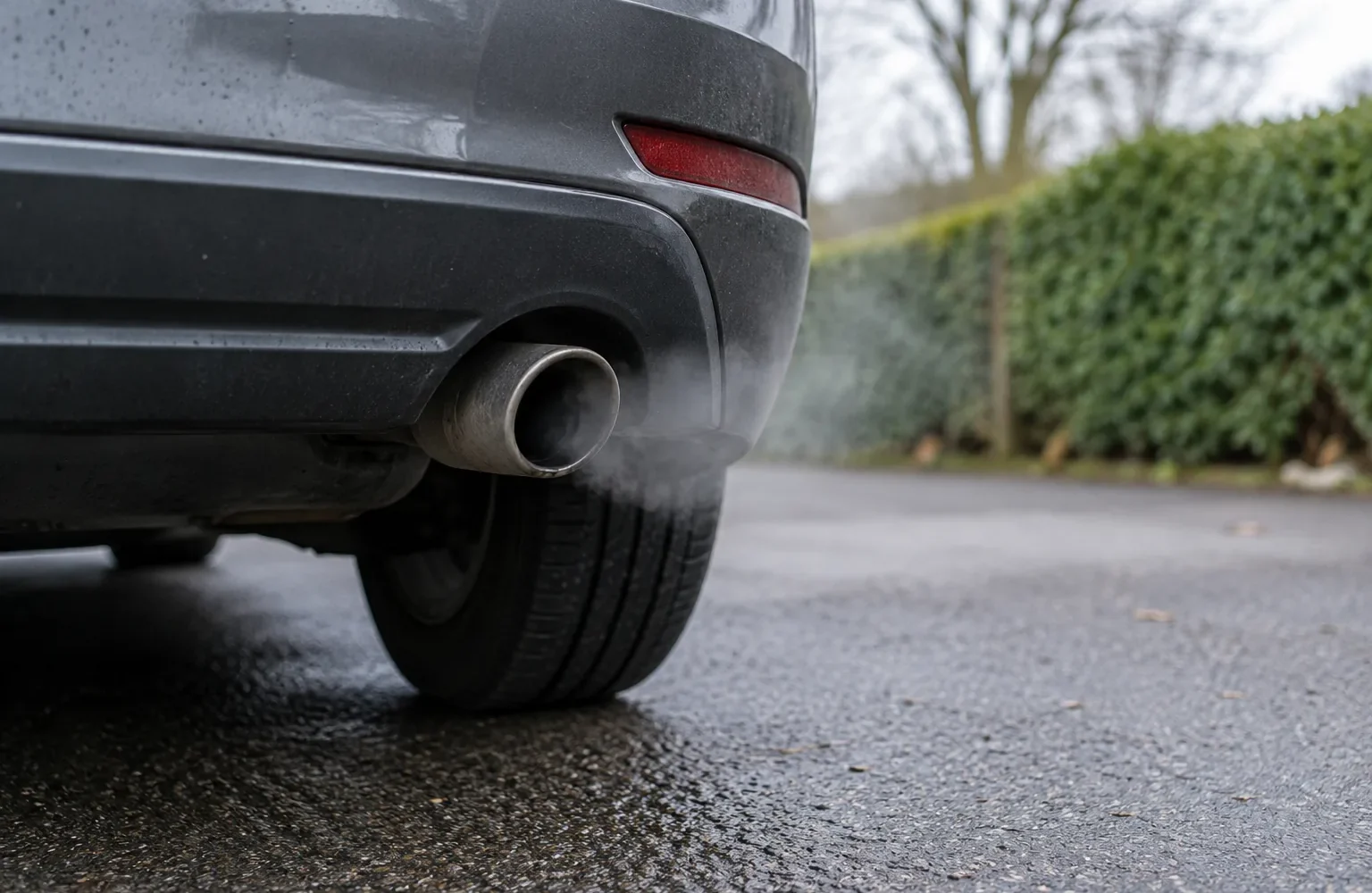
The short answer: a light white plume on a cold start can be condensation. Persistent white smoke, blue-grey smoke or repeated black smoke needs investigation. Colour is a clue, not a diagnosis: where it comes from, when it appears and any warning lights matter just as much. If there is overheating, an oil-pressure warning, severe rough running or smoke from under the bonnet, stop safely and get help.
A cloud behind the car can look alarming, particularly on a cold morning. It can also be difficult to describe: what looks white against a dark hedge may look grey against the sky. Before looking for a replacement part, separate what you have actually observed from what you think has failed.
This guide covers petrol and diesel exhaust smoke, including combustion engines in hybrids. It helps you decide what information to give a breakdown provider or garage. It cannot establish a fault remotely or certify that a car is safe to drive.
When to stop and get help
Use this guide only once you are safely parked. Smoke accompanied by an overheating indication, an oil-pressure warning, a flashing engine warning, severe loss of power or rough running calls for prompt attention. Stop as soon as it is safe, switch off and contact your breakdown provider. Do not repeatedly restart the engine to reproduce the symptom. The AA’s warning-light guide explains why oil pressure and temperature warnings need immediate action; the handbook gives the instructions for your particular warning.
If you suspect a fire, get people away from the vehicle and moving traffic when safe, call 999 and ask for the fire service. Do not open the bonnet or go back for belongings. See Hampshire & Isle of Wight Fire and Rescue Service’s vehicle-fire advice.
On a motorway or other high-speed road, getting to a place of relative safety takes priority over inspecting the car. If you cannot get clear of a live lane and cannot exit safely, keep your seat belt and hazards on and call 999 for the police. This is the Highway Code’s breakdown advice, not a reason to remain in a burning vehicle: tell the operator about any fire or immediate danger and follow their instructions. Read rules 275–277.
What each exhaust colour can mean
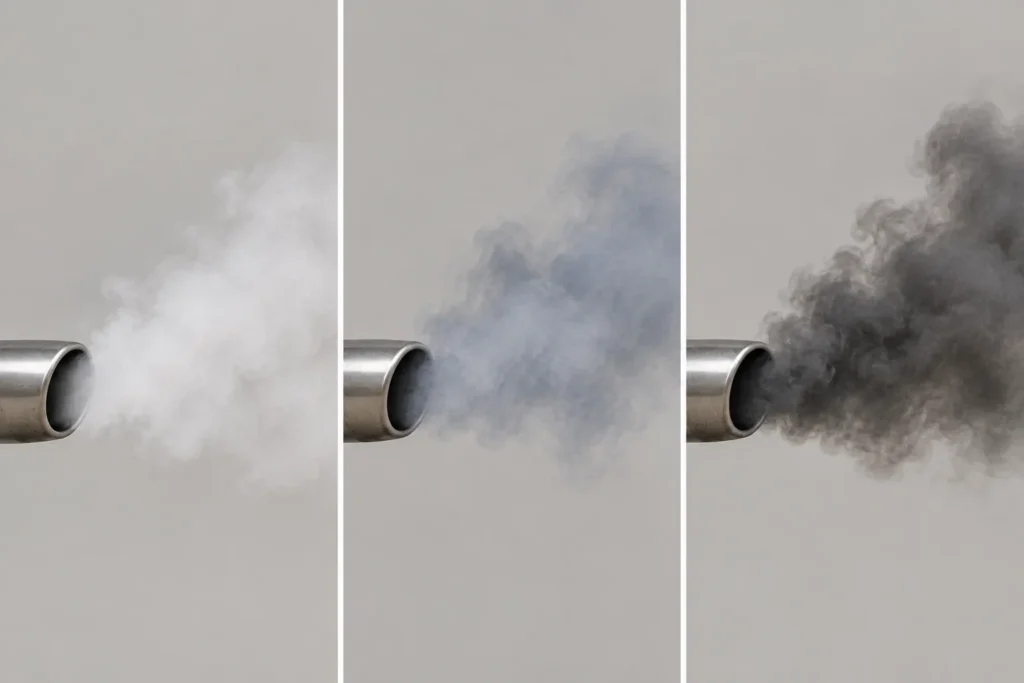
Use the table to organise the possibilities, then read the relevant section. The same colour can have more than one cause, and mixed or uncertain colours belong in the description you give a technician.
| Observation | Possible explanation | What matters next |
|---|---|---|
| Thin white vapour at a cold start | Condensation may be visible. | Does it fade as the engine warms, without other symptoms? |
| White smoke that persists | Coolant entering combustion is one possibility. Diesel combustion faults can also produce white smoke. | Note temperature warnings, rough running and any known coolant loss. |
| Blue or blue-grey smoke | Oil entering combustion is a possibility. | Record when it happens and any measured oil consumption. |
| Repeated black smoke | A fuel/air imbalance or incomplete combustion may be involved. | Record loss of power, warning messages and whether it occurs under load. |
| Smoke from the bonnet, cabin or an uncertain source | This is not established as an exhaust issue. | Stop safely and seek assistance; treat suspected fire as an emergency. |
The colour patterns above are described by RAC’s smoke guide and diesel-system specialist United Diesel. They are starting points for investigation, not proof that a particular component needs replacing.
White vapour or persistent white smoke?
Temporary vapour after a cold start can be moisture in the exhaust becoming visible. Persistent white smoke once the engine is warm is a different observation. The AA explains condensation and coolant-related causes, including head-gasket or cylinder-head problems. Diesel fuel that is not burning properly is another possible explanation, so “white” does not automatically mean “head gasket”.
Describe the sequence rather than assigning a fixed time limit. “A light plume at the first start on a cold morning that faded during normal use” tells a garage something different from “dense smoke began after the engine was already warm”. Do not keep an engine running just to see whether a worrying cloud clears.
If you have already noticed coolant loss, include it in the report. Give dates and any actual amounts added if you know them. “The level was below the minimum mark on two cold checks” is more useful than “it seems to use water”. Do not inspect the reservoir at the roadside if it puts you near traffic or a hot engine.
A coolant level and a smoke colour still do not identify the leak's route. Avoid buying a head gasket, pouring in a sealing product or authorising a major repair based only on an internet symptom match. Ask what inspection or test will establish the cause first.
Blue-grey and black smoke: different clues
Blue or blue-grey smoke
Oil burning in the engine can produce blue smoke. United Diesel lists several possible routes, including worn rings or valve seals and excess engine oil. That range is why an observed colour cannot distinguish a small component fault from internal engine wear. Its technical note covers these possibilities.
Useful context includes whether the plume appeared on starting, after idling or during ordinary acceleration. Report events you have already seen; do not rev the engine or ask someone to stand behind it to manufacture a test. If the symptom began after servicing or an oil top-up, give the garage that timing without assuming the work caused it.
If you routinely check oil, bring your records. Write down the mileage, reading and quantity added rather than estimating from memory. Do not add oil simply because the exhaust looks blue: an oil level needs to be checked using the vehicle's specified procedure.
Black smoke
Black exhaust smoke can point to too much fuel for the available air. RAC discusses air-filter and fuelling faults, while United Diesel also identifies intake and turbo-related possibilities in diesel systems. These are areas a technician may investigate, not a shopping list of parts to replace.
“It smokes when accelerating” needs context. Was it a brief event, did it recur at ordinary speeds, was the engine cold, and did a warning appear? Record what you remember. A video taken by a passenger while safely parked may help show an existing symptom, but do not reproduce it for the camera or use a phone while driving.
What about diesel particulate filter regeneration?
A diesel particulate filter, or DPF, traps soot and periodically burns accumulated material through regeneration. RAC explains the process and blockage warnings. A DPF warning and visible smoke are observations to report separately; one does not prove the other is normal.
Regeneration behaviour depends on the vehicle and the type of cycle. For example, Ford warns that the exhaust becomes very hot during and after regeneration in its model-specific handbook section. That is a reason to consult your own instructions, not to borrow a procedure from another car.
Do not respond to unexplained smoke by attempting a high-speed “clear-out” drive, a stationary forced regeneration or a generic revving routine. Give the breakdown provider the exact dashboard message and vehicle details. Ask whether the car needs recovery or a workshop check before any further journey. If a manufacturer-approved regeneration procedure is appropriate, it needs to match that vehicle and its current fault state.
Make a useful record for the garage
The tool below turns observations into a short handover note. It does not select a failed part, calculate a probability or give permission to continue driving. If you are unsure about a colour or source, say so: uncertainty is useful information.
Describe what you noticed
Use only after stopping somewhere safe. Record what you already saw; do not run or restart the engine to reproduce smoke. If there are flames or immediate danger, get to safety and call 999. Do not put yourself at risk to complete this tool.
At a roadside breakdown, follow the Highway Code's breakdown instructions, including what to do if you cannot safely leave the vehicle.
This record helps you explain symptoms to a garage or breakdown service. It does not diagnose a fault or give permission to drive.
Enable JavaScript to create a summary. You can also note the observations below on paper; warning signs still need professional assessment.
Add the vehicle's registration or model, engine/fuel type and mileage when contacting the garage. Keep personal details out of notes you intend to share publicly. The form works in this page; it does not send your answers to Motoring Desk.
Example of a useful report
“Diesel hatchback, 92,000 miles. A grey-looking plume from the tailpipe appeared after the engine was warm yesterday. I noticed a loss of power at the same time and stopped. The dashboard said ‘Engine malfunction’. I have not restarted it. I cannot tell whether the smoke was blue or black.”
This fictional example separates facts, timing and uncertainty. Compare it with “the turbo has gone”: that skips the evidence and may lead the conversation towards a repair before anyone has inspected the car.
What can you check yourself?
Start with information that does not require running the engine: the warning message you saw, the service history, recent work and the relevant handbook pages. If the car is safely parked, cool, and there is no suspected fire, a visual fluid-level check may be useful if you know the manufacturer's procedure.
Never remove a coolant cap with the engine running or the cooling system hot. Pressurised coolant can escape. Keep hands and clothing clear of cooling fans, which can start or continue operating after shutdown. Ford covers these hazards in its owner's manual maintenance section. Use the handbook for your own car to locate the correct reservoir and checking conditions.
Do not touch the exhaust, crawl under a running vehicle, inhale fumes to identify a smell, or run the engine in a garage. Leave pressure testing, fuel-system work and exhaust-system dismantling to a suitably equipped professional. If the surroundings or the procedure are uncertain, skip the check and report what you already know.
For routine preparation after the fault has been resolved, our pre-drive checks help organise the ordinary maintenance checks. A routine checklist is not a substitute for investigating a new symptom.
What to ask the garage, and what the MOT tells you
When arranging the inspection, give the symptom record and ask three practical questions:
- Should the vehicle be recovered? Describe warnings and changes in how it drives; do not assume a nearby garage means the journey is appropriate.
- What will the initial diagnostic work cover? Ask what the proposed checks are intended to establish and what the initial charge includes.
- Will you contact me before replacing parts? Request a written explanation of the findings, the proposed repair and any further checks needed.
There is no useful universal repair price for “exhaust smoke”. The symptom can lead to very different investigations. Compare quotations for the same confirmed fault and scope of work, including labour, parts, tax and any follow-up checks, rather than comparing unrelated online averages.
For MOT tests in Great Britain, the inspection manual treats excessive smoke or vapour that could obscure other road users' vision as dangerous. It also lists visible smoke from a DPF-equipped vehicle during the relevant diesel test as a major defect. These are test criteria with specified procedures, not a home diagnosis. See DVSA's emissions inspection rules. Northern Ireland has a separate testing system.
Do not wait for the next MOT to investigate a new smoke problem. Equally, “it passed last month” does not explain what you are seeing today. Give the garage the current symptoms even if there were no previous advisories.
Other questions
Can I drive a short distance with exhaust smoke?
A colour chart cannot settle that. The warning lights, engine behaviour, source of smoke and actual fault determine the risk. Use the stop conditions above and describe the situation to a breakdown provider before continuing with an unexplained or persistent symptom.
Does white smoke always mean a blown head gasket?
No. Temporary cold-start vapour and diesel combustion problems are among the alternatives discussed above. A head-gasket diagnosis needs evidence beyond the colour of a cloud.
Should I clear a warning code before visiting the garage?
Keep a record of the message and ask the garage before resetting anything. The useful aim is to preserve the sequence of events for the person investigating it, not to make the dashboard look normal before the appointment.
Sources checked on 11 October 2026. This is a research-based guide to observations and next steps, not an inspection of your vehicle.