
Choose screenwash by the protection it provides after dilution, its compatibility with your car and how you will measure it. A ready-to-use winter fluid is convenient; a concentrate offers a choice of mixtures, but only its own dilution table tells you what each mixture can withstand. The biggest minus-temperature number on a bottle does not necessarily apply to a reservoir topped up with water.
This guide compares published product instructions, rather than ranking products we have not tested. The examples below show how to read a label, calculate the amount you need and avoid carrying a summer mixture into freezing weather.
Ready-to-use or concentrate: which should you buy?
| Format | Useful when | Check before buying |
|---|---|---|
| Ready-to-use | You want to refill without measuring a dilution. | The temperature claim applies to the supplied product. Follow the label; adding water changes that mixture. |
| Concentrate | You can measure the product and water accurately and want to select a labelled seasonal mixture. | The ratio for your intended conditions, the quantity it actually makes at that ratio and any water-quality instructions. |
| A product described as all-season | You want one product to use throughout the year. | Whether it is supplied ready-to-use or needs different dilutions. The phrase alone does not specify winter protection. |
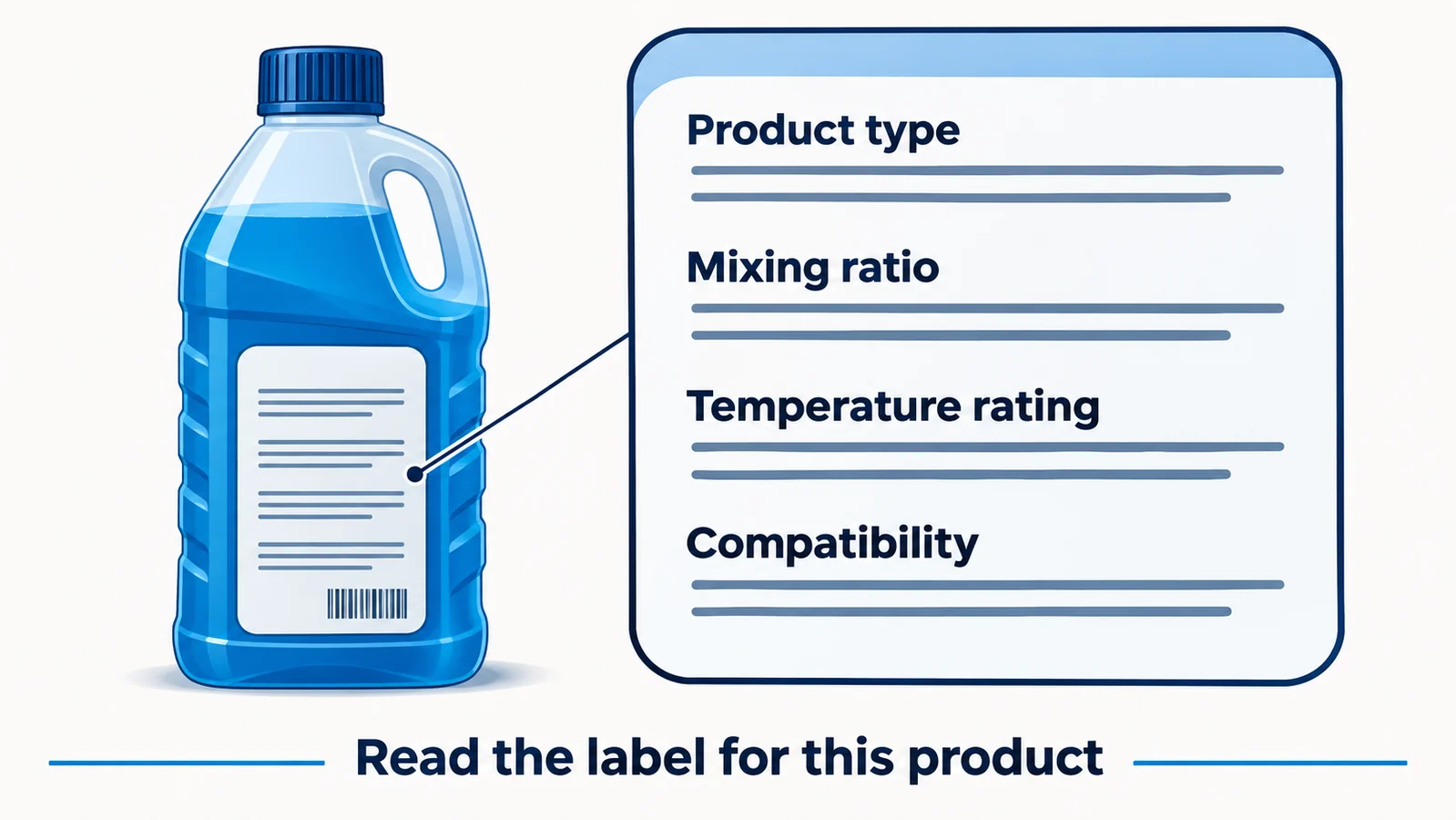
With either format, read the back label before comparing bottle sizes. Ready-to-use fluid removes the measuring step; it does not remove the need to check winter protection and vehicle compatibility.
What actual winter dilution tables tell you
These are selected entries from two manufacturers’ published product instructions, checked on 6 November 2026. Ratios here mean parts screenwash concentrate to parts water. They are product-specific declarations, not results from a Motoring Desk cold-chamber test. Check the code and current label on the bottle you buy. [1] [2]
| Exact product | Concentrate : water | Manufacturer’s stated temperature |
|---|---|---|
| Autoglym Ultimate Screenwash 500ml, SWAS500 | 1:9 | −3°C |
| Autoglym Ultimate Screenwash 500ml, SWAS500 | 1:4 | −6°C |
| Autoglym Ultimate Screenwash 500ml, SWAS500 | 1:2 | −14°C |
| Ravenol Winter Screenwash Concentrate, product 1420100 | 1:2 | Approximately −10°C |
| Ravenol Winter Screenwash Concentrate, product 1420100 | 1:1 | Approximately −20°C |
The first product also lists −45°C when undiluted. Its 1:4 mixture is listed at −6°C, so using the headline number to describe that diluted mixture would be wrong. Bottle yield changes too: 500ml at 1:4 makes 2.5 litres, while the same amount at 1:2 makes 1.5 litres. For the second product, one litre at its stated 1:2 ratio makes three litres. These quantities follow directly from the ratios. [1] [2]
Choose a labelled mixture appropriate to the coldest conditions expected where the car will be parked and driven, including your destination. Do not select a temperature limit warmer than the conditions you expect, or invent an intermediate ratio and assume its temperature rating lies halfway between two table entries. If the label’s meaning is unclear, ask the manufacturer before relying on it.
How to measure a screenwash dilution
Read which liquid comes first. In a 1:4 concentrate-to-water instruction, one part concentrate plus four parts water makes five parts of finished mixture. It does not mean one part concentrate in four parts total.
- To make one litre at 1:4: measure 200ml concentrate and 800ml water.
- To make 2.5 litres at 1:4: measure 500ml concentrate and two litres of water.
- To make one litre at 1:9: measure 100ml concentrate and 900ml water.
These are arithmetic examples, not recommended mixtures for every screenwash. Use the ratio on your chosen product. For a ratio written 1:n, divide the required finished volume by n + 1 to find the concentrate volume; the rest is water. Confirm whether a product instead uses percentages or says to add a bottle to a particular volume.
Use a clean, clearly marked measuring container suitable for the product, following its handling instructions. Do not eyeball a fraction of the reservoir: the amount already inside changes the calculation. Keep remaining product in its original labelled container and follow its storage precautions. Keep it away from heat and ignition sources and out of children’s reach; never use a drinks bottle. The cited safety sheet also specifies eye and hand protection when handling that concentrate. [4]
The old fluid in the reservoir counts too
A top-up does not instantly replace the liquid already in the car. Suppose you have two litres of plain water in the reservoir and add one litre of a correctly prepared 1:4 mixture. That added litre contains 200ml of concentrate. The resulting three litres contain 200ml concentrate and 2,800ml water: a final ratio of 1:14, not 1:4.
That example demonstrates dilution only. It does not establish a freezing temperature. You cannot calculate a dependable protection figure by averaging two temperatures printed on different bottles, particularly when the original product or mixture is unknown.
Before cold weather, establish what is already in the system and consult the product maker or your workshop if you cannot work out how to obtain the specified mixture safely. Do not use repeated washer operation as a DIY draining method. Ask the workshop to establish the correct mixture and check the system if its contents or condition are uncertain.
Can I mix different brands of screenwash?
Do not assume that two products are interchangeable because their colours or headline temperatures match. Check the instructions for both products and your vehicle. If the manufacturers do not confirm the combination, ask before mixing. Even a permitted combination does not automatically inherit the stronger product’s declared winter rating.
Compatibility: the handbook comes before the colour
Check the washer-fluid section for your exact model and year, including any requirements relating to headlamp washers. The cited owner handbook, for example, calls for approved washer fluid and says to follow the product’s dilution instructions for the conditions. It also warns against filling when the engine is hot. Do not interpret another vehicle’s handbook as an approval list for your own car. [3]
When comparing bottles, ask the supplier to confirm any handbook requirement that the packaging does not answer. A product’s colour, fragrance, “premium” label or low-temperature claim does not answer a separate compatibility question. Keep the bottle code so the manufacturer can identify the formulation you mean.
Use automotive screenwash intended for the washer system. Do not substitute engine coolant, household glass cleaner or washing-up liquid. Those products do not demonstrate that they meet the washer-fluid instructions you are trying to follow. Use a purpose-formulated product with the required application and dilution information, rather than trying to create your own chemical recipe. [3]
Compare the cost of usable winter fluid
Compare like-for-like protection before comparing price per bottle. Divide the price by the litres of finished mixture produced at your chosen labelled dilution. A large “makes up to” quantity may refer to a weaker mixture than you need.
For example, if a one-litre concentrate bottle’s label specifies 1:4 for the conditions you need, it makes five litres: divide its actual price by five. If that label instead requires 1:1 for colder conditions, the same bottle makes two litres: divide the price by two. For a five-litre ready-to-use bottle, divide its price by five. Compare only products that meet your car’s requirements and intended conditions.
Also consider how easily you can measure and store the fluid. Buying concentrate to save money is less attractive if you have nowhere suitable to prepare it accurately. Conversely, a clearly labelled concentrate may suit someone who already has a clean measuring container and understands the different seasonal quantities.
A final check before filling and driving
- Match the bottle. Check the exact product code, ready-to-use status or dilution instructions, temperature claim and handbook compatibility.
- Account for the existing fluid. Do not describe an unknown reservoir mixture as winter-protected merely because you have added winter screenwash.
- Identify the correct filler. Park safely, switch the vehicle off, allow hot components to cool and follow the handbook’s under-bonnet precautions. Confirm the washer symbol and location; cap colour alone is not identification.
- Follow the product’s handling and filling directions. Avoid spills, close the cap and store the remainder as its label requires, out of children’s reach.
- Check the result while stationary. With sufficient fluid present and the screen and wipers clear of ice, check that the washers supply fluid and the blades clear it effectively. Do not keep operating a system that is frozen or fails to spray.
The official maintenance guidance requires clear windscreens and windows and tells drivers to keep washers and wipers working. The GB MOT inspection manual treats washers that do not work or supply enough fluid to clear the windscreen as a major defect. A full reservoir alone does not prove that the system works. [5] [6]
If you cannot maintain a clear view, do not set off. If visibility deteriorates during a journey, stop somewhere safe and get the problem resolved before continuing. Winter-rated screenwash does not replace clearing ice and demisting before departure. [7] Add the washer check to your other checks before your next drive.
Sources
- Autoglym — Ultimate Screenwash 500ml, SWAS500: product instructions and dilution table. Checked 6 November 2026.
- Ravenol — Scheibenfrostschutz Konzentrat / Winter Screenwash Concentrate, 1420100: technical product data. Checked 6 November 2026.
- INEOS Automotive — Grenadier owner’s handbook: washer fluid level check and refill, pages 172–173. Checked 6 November 2026.
- Autoglym — Ultimate Screenwash safety data sheet, GB English: handling and storage. Checked 6 November 2026.
- Department for Transport — The Highway Code, Annex 6: vehicle maintenance, safety and security. Checked 6 November 2026.
- Driver and Vehicle Standards Agency — MOT inspection manual, section 3.5: windscreen washers. Checked 6 November 2026.
- Department for Transport — The Highway Code, rule 229: preparation for icy and snowy weather. Checked 6 November 2026.