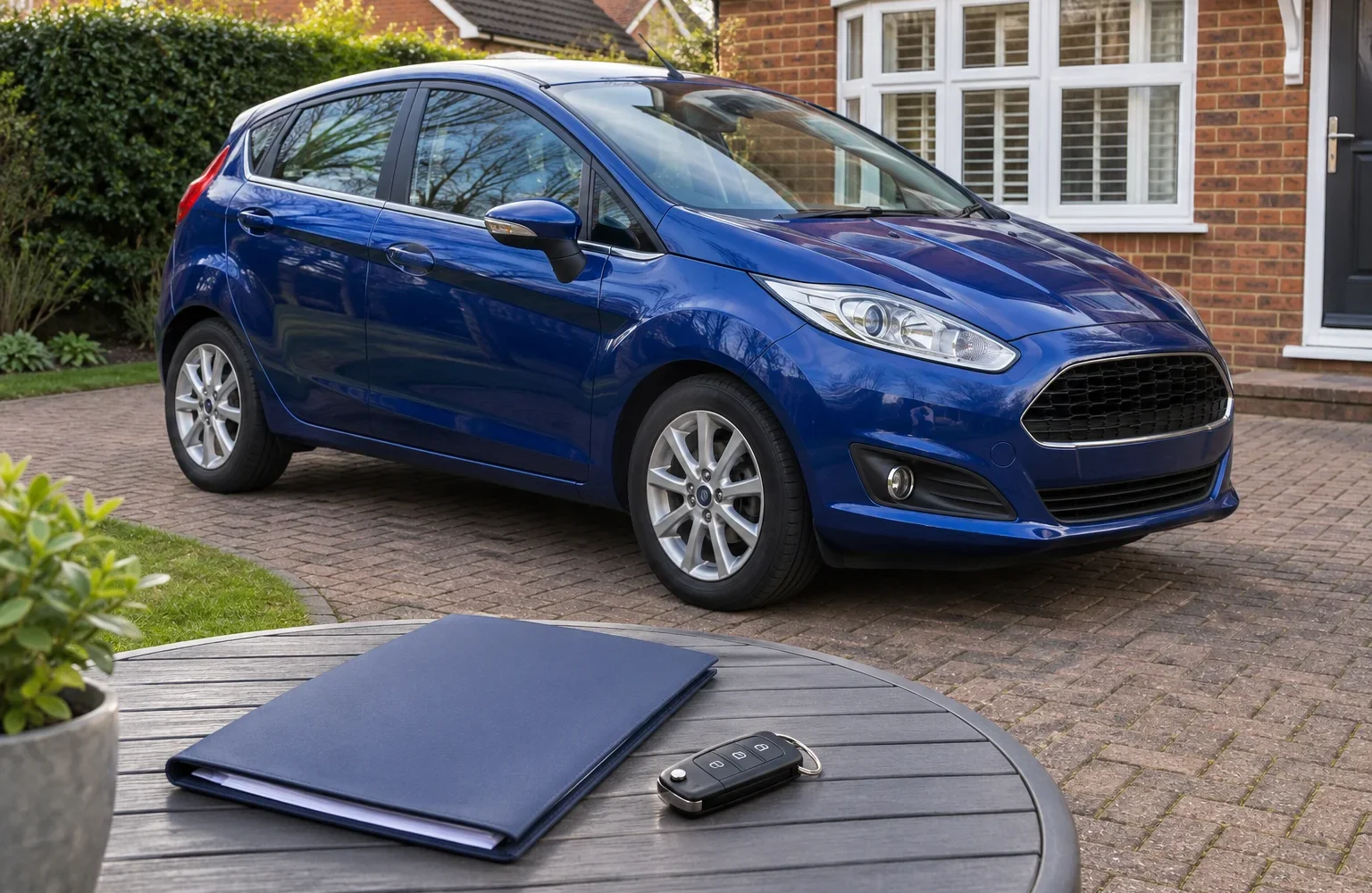
To check a seller’s claim that a used Ford Fiesta has had its cambelt replaced, ask for an invoice tied to the car, a clear description of the work, and the date and mileage. Then have the applicable maintenance schedule confirmed for that engine. “Belt done” in an advert leaves too much unanswered to value as a completed job.
The timing belt, also called a cambelt, keeps the camshaft and crankshaft synchronised; failure can stop the engine and cause damage. Replacement guidance depends on engine type and usage. [1] That is why this guide does not assign every Fiesta a single age or mileage limit.
Identify the engine before debating an interval
Collect the registration, VIN, engine description and any record of an engine replacement. Ask a Ford service department or a suitably qualified workshop to identify the fitted engine and confirm its maintenance requirements in writing. If the advert, vehicle documents and workshop information disagree, resolve that before interpreting a bill.
A trim badge or the word EcoBoost is not a complete maintenance specification. Avoid making the purchase turn on a forum interval for a car with a similar name. Ask which schedule applies to this car, what evidence supports previous work, and what work is now due. Keep these as three separate questions.
The manufacturer’s scheduled servicing is tailored to vehicle type. [2] A stamped service entry may be useful, but ask what the service actually included rather than assuming it covered the particular replacement mentioned in the advert.
What a useful invoice should let you establish
| Detail | What to look for | Follow-up when unclear |
|---|---|---|
| Vehicle identity | Registration or VIN matching the Fiesta | Ask the issuing workshop to clarify any mismatch with the seller’s permission |
| Timing | Completion date and recorded mileage | Compare them with the surrounding service and MOT records |
| Work description | Named belt or system, parts and labour | Ask exactly what was replaced, rather than treating “belt” as a complete description |
| Related items | Any additional work or exclusions recorded | Have the workshop explain whether the documented scope met the requirements for that engine |
| Issuer | Workshop identity and invoice reference | Request a legible complete copy rather than a cropped total |
Do not fill gaps with guesses. An invoice for a belt alone may need clarification about labour; a labour line with an abbreviation may need the parts record. Neither automatically proves that the claim is false. The aim is to turn a vague statement into a job that the workshop can identify and explain.

Keep the chronology, not just the latest receipt
In a hypothetical example, a seller produces a bill dated two years ago at 52,000 miles and the car now displays 68,000 miles. The arithmetic establishes a claimed 16,000 miles since that bill. It does not establish that the work was appropriate, that all required items were replaced or when another replacement is due.
Write the invoice into the wider maintenance timeline and retain the wording exactly in your private notes. Ask about oil-service records and other scheduled work too; a single large invoice should not end the history review. Have a workshop assess any maintenance gap against the engine-specific requirements, rather than treating a recent replacement as a reset of the whole car’s history.
Use the Great Britain MOT history to compare test dates and recorded mileage. [3] It is a chronology check, not a replacement invoice. Also check for outstanding safety recalls by registration and obtain any vehicle-specific advice from the manufacturer. [4]
If there is no invoice
Ask whether the seller can obtain a duplicate or a written explanation from the workshop that performed the work. Give them the specific missing information: identity, date, mileage or job description. “More history” is a much less useful request.
If the evidence remains unavailable, record the claim as unverified. Before negotiating around it, obtain an inspection and an itemised written estimate of any work the workshop considers necessary for this Fiesta. An advertised discount is not automatically enough to cover an unknown job. You can choose another car if the uncertainty does not suit your budget.
Does a smooth test drive verify a cambelt replacement?
No. A test drive does not document what a workshop replaced, when it did so or which parts were used. Use the invoice and appropriate workshop assessment for those questions. Do not attempt to inspect concealed components or dismantle the engine during a viewing.
Take our car viewing checklist alongside the service questions. A convincing belt record is one part of assessing a used Fiesta; it does not settle the condition of the rest of the car.