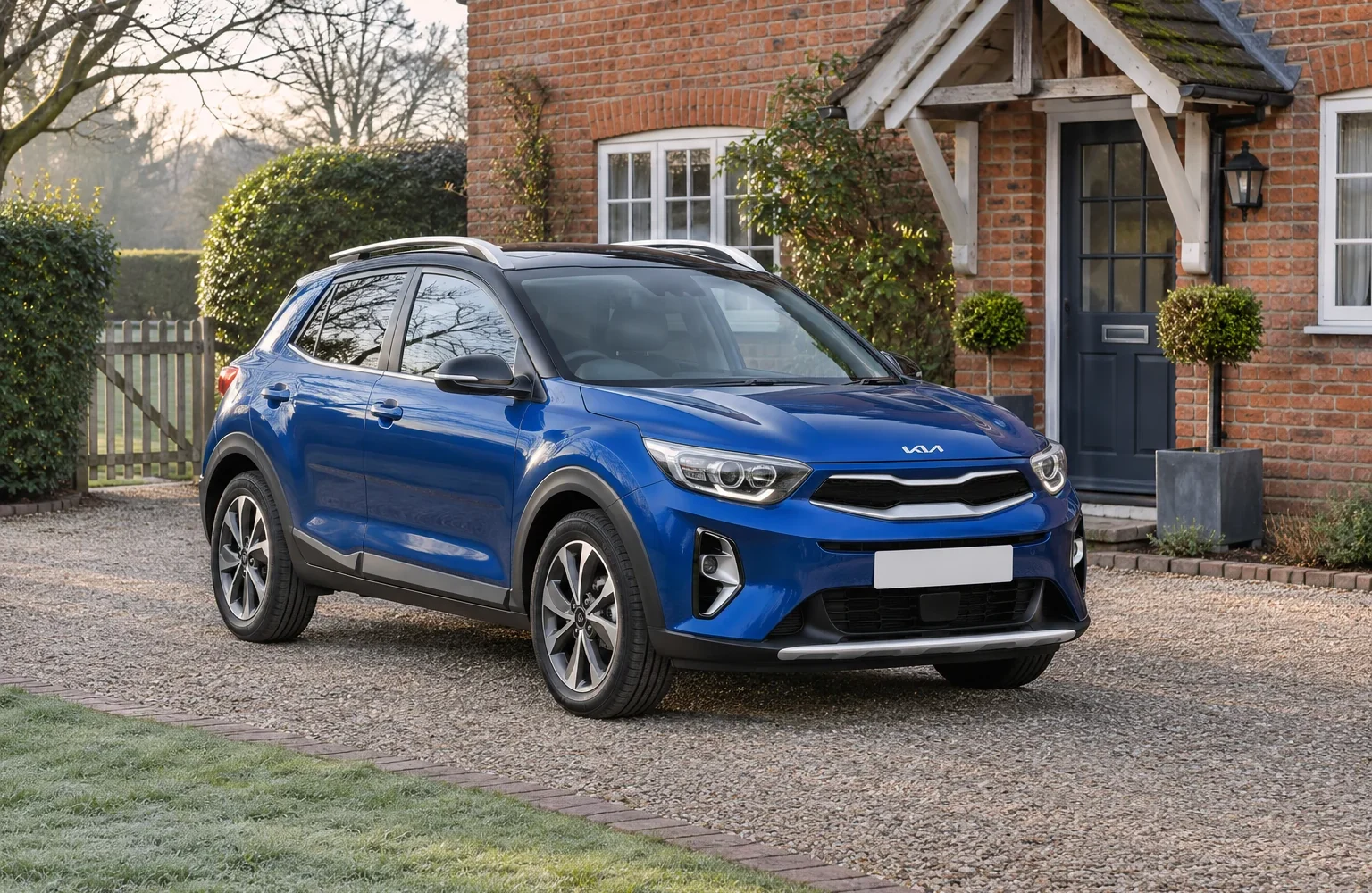
Check the full engine and gearbox description before comparing two used Kia Stonics. In Kia’s February 2021 UK brochure, both the 99bhp Stonic ‘2’ and the 118bhp 48V GT-Line were listed with a seven-speed DCT option. The word automatic therefore does not, by itself, establish that a car has the 48V mild-hybrid system. [1]
Use a dated specification as your starting point
The examples below come from that particular UK brochure. They are a cross-check for an advert, not a promise that every Stonic registered in 2021 has the same specification. Ask the seller to confirm the build version for the individual vehicle.
| Brochure entry | Gearboxes listed | Useful distinction |
|---|---|---|
| ‘2’: 1.0 T-GDi, 99bhp | Six-speed manual or seven-speed DCT | This entry is not labelled 48V |
| GT-Line: 1.0 T-GDi, 118bhp, 48V | Six-speed manual (iMT) or seven-speed DCT | The 48V designation is explicit |
Here, iMT identifies the manual option; DCT identifies the dual-clutch automatic. Keep those gearbox labels separate from the hybrid description when recording the car’s details. [1]
Understand what the 48V label is telling you
Kia describes this EcoDynamics+ system as a mild hybrid: its 48-volt battery supports engine assistance, with energy recovered during deceleration. The brochure also describes conditional engine-off sailing for the iMT system. It says operation depends on factors including charge level, driving conditions and speed. [1]
That description is useful context, but it cannot tell you whether a particular car is behaving correctly. Ask the seller to explain the controls and handbook guidance before a normal test drive. Do not deliberately provoke engine-off behaviour to prove that the system works. Any warning message or unexplained interruption needs proper assessment.

Send the seller a precise request
Before travelling, ask for the registration, the complete engine and gearbox description, and confirmation of whether the car has the 48V system. Request a photograph of the gear selector and the relevant specification paperwork. A cropped headline saying ‘1.0 petrol’ leaves too much unanswered.
Copy the same fields into your notes for every candidate. If one advert says 48V and another only says DCT, leave the second car’s hybrid field as unconfirmed until the seller supplies evidence. An empty field is more useful than a guessed answer that later distorts your comparison.
For example, a buyer who wants an automatic can establish that both brochure examples have an automatic option, then compare the actual cars’ condition, service records and equipment. A buyer specifically seeking 48V needs the extra confirmation. Neither requirement can be settled solely by a photograph of the wheels or a trim badge.
Keep specification and service history together
Ask for invoices associated with the vehicle, including an explanation of any recorded work on its transmission or electrical system. If there is a repair claim, request the invoice and the result rather than accepting ‘all sorted’ as the complete history.
Check the MOT results and recorded mileage, and make the separate safety-recall enquiry. These records add evidence about the car but do not replace confirmation of its specification. Our viewing checklist covers the remaining documents and inspection questions. [2] [3]
Is a 48V Stonic automatically the better used buy?
The label alone cannot decide that. First establish which system and gearbox the car actually has, then assess its condition, records and suitability. This guide makes no reliability ranking, repair-cost forecast or guaranteed fuel-saving claim.