An electric car’s range depends on the energy available in its battery and how much it uses per mile. Speed, temperature, heating, wind, hills and load all change that consumption. Use the official WLTP figure to compare cars, then plan individual journeys around the charge you will actually start with, suitable consumption evidence and an arrival reserve.

A car advertised with 300 miles of range does not promise 300 miles on every trip. Equally, a lower dashboard estimate on a cold morning does not, by itself, prove that its battery has deteriorated. Understanding what each number represents makes both buying and travelling easier.
WLTP range, displayed range and your next journey
WLTP range is a standardised test result. The Vehicle Certification Agency explains the laboratory basis of WLTP, which allows meaningful comparisons. Check the exact battery, drivetrain, wheels and trim, and whether the quoted electric range is combined or city. A city figure is not a motorway forecast.
Displayed remaining range is an estimate, but manufacturers calculate it differently. It may use a fixed rated consumption, recent driving or other information. Do not assume the number beside the battery symbol understands the journey you have in mind.
A route prediction can use the destination and road ahead to estimate arrival charge. For example, Tesla’s Model 3 manual distinguishes its rated range display from consumption-based projections and navigation estimates. The details are model-specific: learn your car’s displays before relying on them.
Compare like with like when shopping. On the road, the useful question is “what charge should remain at my next dependable stop?” rather than “am I achieving the brochure number?”
The two numbers behind a range estimate
Usable battery energy: kWh
Kilowatt-hours measure an amount of energy. Gross capacity describes the battery’s total rated capacity; net or usable capacity describes the portion made available for use. They are not interchangeable. Manufacturers can publish both: Audi’s archived Q8 e-tron technical information lists separate gross and net values.
Check which figure an advert uses. For a used car, the original specification is not a measurement of its present battery condition. Do not treat any protective battery buffer as extra mileage you can safely plan to use.
Consumption: miles/kWh or kWh/100 miles
Miles per kWh tells you how far the car travels for each unit of energy: higher is more efficient. kWh per 100 miles tells you the energy used over a fixed distance: lower is more efficient. A figure in kWh/100 km covers a different distance, so check the units before comparing.
- 4 miles/kWh equals 25 kWh/100 miles: 100 ÷ 4 = 25.
- 20 kWh/100 km is approximately 32.2 kWh/100 miles, not 20.
- kW measures power, such as charging power; it is not battery capacity or distance.
Use consumption measured on the same basis as your energy estimate. A driving-consumption display and a charger’s billed energy are different measurements; energy used during charging is not all available for the next drive. Check what the car’s trip figure includes, especially cabin or battery conditioning.
What changes electric-car range?
Speed and air resistance
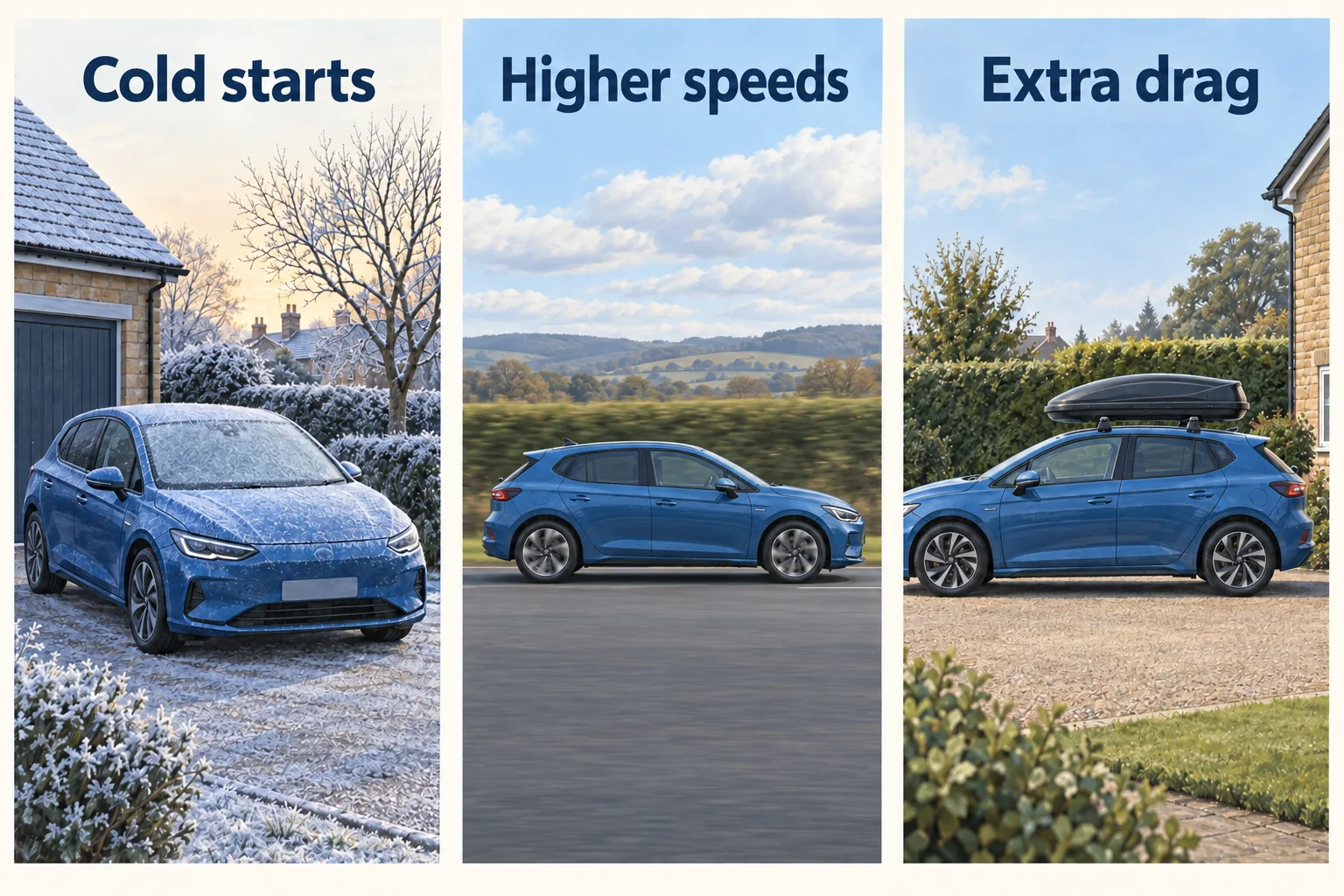
Sustained higher speeds require more energy to overcome air resistance. Michelin’s range explanation highlights that this relationship is not linear. A consumption average from local roads is therefore a poor starting assumption for a long motorway leg. A headwind can add demand even when your speed is unchanged.
Cold weather, heating and short journeys
A cold battery can have less energy available, while warming the cabin and battery also requires energy. Repeated short trips can make the warm-up demand particularly noticeable per mile. Hot-weather cooling uses energy too. These effects depend on the car, conditions and journey, so there is no single winter percentage to subtract from every WLTP figure.
Tesla’s cold-weather guidance distinguishes cold-related unavailable energy from the energy required for heating. A heat pump can help heating efficiency, but its presence is not a guarantee of a particular winter range; check the exact car’s equipment and relevant journey evidence.
Hills, weather, tyres and luggage
Climbing needs energy; descending may recover some through regeneration, but not all the energy spent going uphill. Wet or snowy surfaces, tyre condition and pressure can affect consumption. Extra mass also matters, while roof boxes, roof-mounted bikes and trailers change air resistance as well as load. Volvo’s UK range guide covers these interacting factors.
That makes your actual holiday setup important. A dry solo commute cannot establish the range of the same car carrying a family, luggage and roof box in winter. Nor should you apply one towing penalty to every trailer and route.
A worked example: the same battery, three outcomes
Here is a deliberately simplified energy budget. Assume a car has 60 kWh of usable capacity, starts at 80% and is planned to arrive at 20%. The assumed energy available for that leg is:
60 × (80 − 20) ÷ 100 = 36 kWh.
Estimated distance is energy available ÷ consumption per 100 miles × 100. The consumption values below are invented arithmetic inputs, not test results, typical figures or forecasts for particular weather.
| Assumed consumption | Equivalent efficiency | Calculated distance |
|---|---|---|
| 20 kWh/100 miles | 5 miles/kWh | 180 miles |
| 25 kWh/100 miles | 4 miles/kWh | 144 miles |
| 30 kWh/100 miles | About 3.33 miles/kWh | 120 miles |
For a hypothetical 140-mile leg, the middle assumption leaves little room before reaching the chosen reserve, while the higher-consumption assumption does not fit the plan. The practical response is to add a dependable charging opportunity, not to treat 144 miles as a promise.
The 80% departure and 20% arrival figures are example inputs, not universal charging advice or a guaranteed safe reserve. Real state-of-charge displays, available capacity and consumption are estimates, and conditions can change. Choose a larger margin when alternatives are sparse or uncertain; follow the manufacturer’s charging guidance for your battery.
Match the evidence to the journey
| Your journey | Evidence worth using | Planning check |
|---|---|---|
| Short winter commute | Several similar cold-start trips, including the return leg. | Can your charging routine replace that energy reliably? |
| Long motorway trip | Consumption at comparable legal speeds and temperatures, plus the car’s route estimate. | Identify a main charging stop and a reachable alternative. |
| Family holiday with roof box | Evidence with a similar load and roof equipment. | Allow more uncertainty than for your usual unladen journey. |
| Remote or hilly destination | The whole route, including the return and charging detours. | Verify destination charging rather than assuming a map pin guarantees access. |
If you are choosing a car, ask for a sufficiently representative test drive and record the conditions. A brief warm urban drive cannot answer a winter motorway question. Our electric-car suitability guide helps connect this to your everyday routine.
How to improve range without compromising safety
- Prepare while plugged in. Where supported, schedule cabin preconditioning before departure. Ford’s UK range guidance explains how using the connected supply can reduce the battery energy needed to heat or cool the cabin on the road. It still uses electricity; check your car’s settings and supply requirements.
- Remove unnecessary drag and load. Take off unused roof equipment in accordance with its fitting instructions and remove unnecessary luggage. Keep necessary safety equipment.
- Use the specified tyre pressures. Follow the vehicle’s guidance for its tyres and load. Do not overinflate to chase range; use our tyre-pressure guide for the checking process.
- Drive smoothly and anticipate normally. Avoid needless acceleration and late braking, while keeping a safe following distance and a speed appropriate to traffic, weather and the limit. Do not follow a lorry closely for reduced drag or select neutral to save energy. Great Britain’s Highway Code rule 122 warns that coasting in neutral can reduce control.
- Keep visibility and comfort adequate. Use demisting, heating, lights and other safety functions when needed. If an economy mode restricts climate control, understand its limits; clear windows take priority over an efficiency figure.
Regeneration recovers some energy when slowing; it does not reward unnecessary acceleration followed by braking. Stronger regeneration is not automatically the most efficient setting for every road. Follow the handbook and remain ready to brake. For example, Tesla documents reduced regenerative braking with a cold or full battery; behaviour and brake blending differ between vehicles.
Before setting off: four checks to open
Have I planned the whole trip, not just the outward leg?
Include the return, diversions and travel from the destination to a charger. Check access hours, connector compatibility, payment method and recent status. Keep an alternative within your planned margin. A charging location on a map is not a reservation or a guarantee that a unit will work when you arrive.
Does my consumption assumption match today?
Compare the route, temperature, load and roof equipment with the evidence you used. Enter the destination in the car’s suitable route planner. If the estimate is already tight before departure, revise the charging plan rather than hoping to outperform it.
What if the predicted arrival charge keeps falling?
Reassess early at a safe stopping place, or ask a passenger to check options. Choose an earlier reachable charger while you still have alternatives. Do not operate planning apps while driving or continue towards a distant charger simply because it was the original plan.
Does a lower estimate mean the battery needs replacing?
No single range estimate establishes battery health. Compare similar journeys and check whether charge level, weather, tyres or settings changed. If a large unexplained change persists, or the car shows a fault warning, follow its guidance and arrange a qualified assessment. Do not deliberately run the battery flat as a home capacity test.
For a longer trip, pair these energy checks with our road-trip planning guide. Reliable charging opportunities and a plan that tolerates a changed forecast matter more than extracting the last possible mile.
Sources checked on 15 October 2026. This is a researched planning guide, not a road test. The worked example uses hypothetical inputs. Manufacturer features and operating instructions vary by model, software and specification; consult the handbook for the car you use.
The conversation