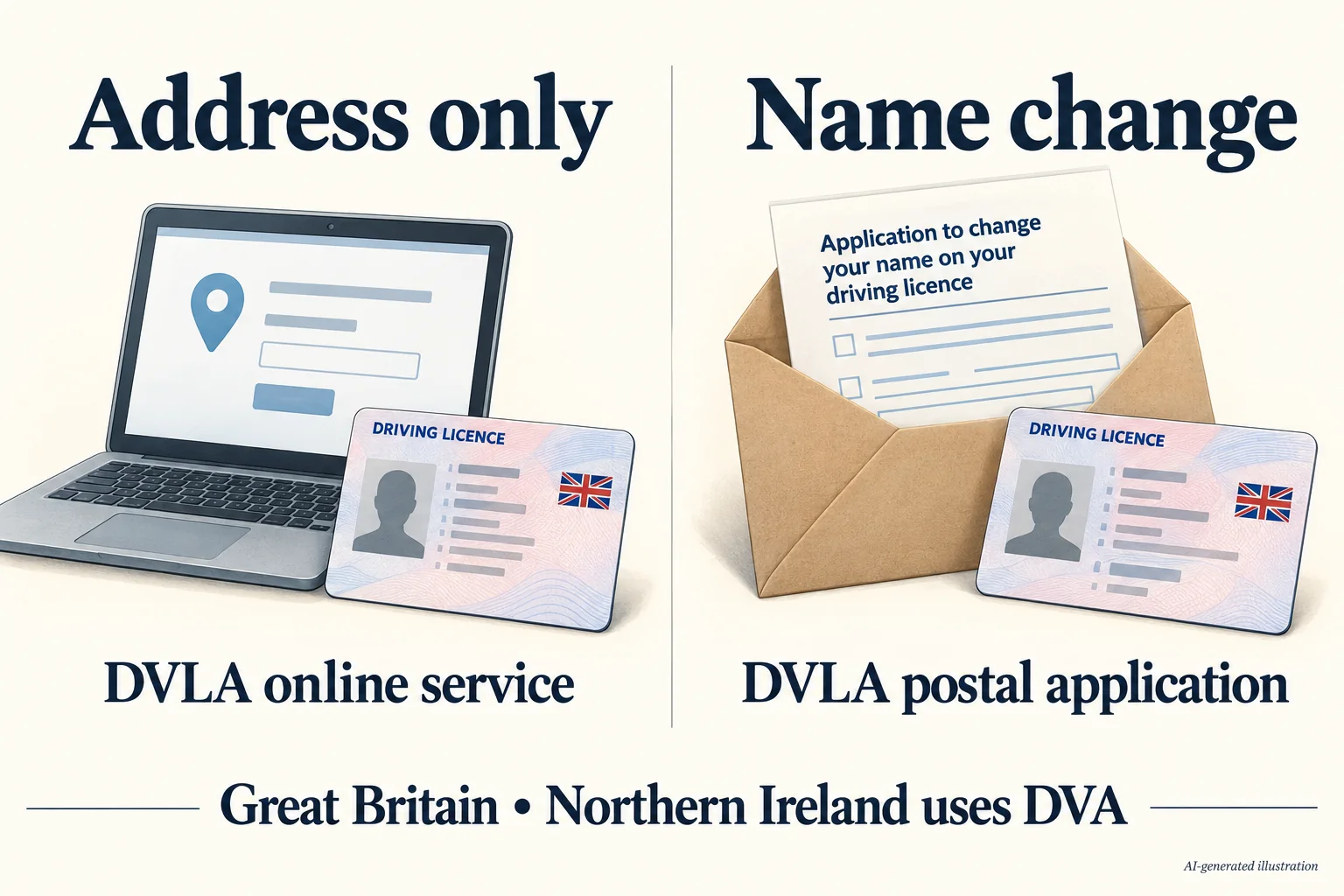
Changing a name or address on a GB driving licence is normally free. An address-only change can be made online or by post. A name change, including a name and address change together, needs a postal application. Northern Ireland uses DVA rather than DVLA, with separate forms and services.
Start by deciding which details actually need updating. A house move, a new surname, a replacement for a lost card and a licence renewal are different transactions, even when they happen together. This guide covers ordinary car and motorcycle licences; lorry and bus applicants should use the relevant vocational forms.
Your driving licence identifies you as a driver. Your car’s V5C identifies its registered keeper. Updating one does not update the other. Keep a separate record for each application so a new licence arriving does not leave unfinished vehicle paperwork out of sight.
Choose the route that matches your change
For England, Scotland and Wales, use DVLA’s address-change service or name-change instructions. These are the official starting points.
| Your situation | Route | Check before starting |
|---|---|---|
| GB licence: address only | Online or by post | Have your licence available; online applicants must live in Great Britain and not be banned from driving. |
| GB licence: name, or name and address | By post using D1 for a car or motorcycle licence | Choose the evidence that links your previous and current names. |
| NI licence: address within Northern Ireland | DVA online service or postal route | Check the expiry date and whether you have both licence parts. |
| NI licence: name | By post using DL1 for an ordinary licence | Use DVA’s evidence requirements, not DVLA’s D1 instructions. |
Changing your name: the GB postal process
Get a D1 form from a Post Office that stocks DVLA forms. Complete it for your current name and address, and enclose your existing photocard or paper licence plus the required evidence. For an ordinary car or motorcycle name-change application, DVLA gives the postal address as DVLA, Swansea, SA99 1BN. Use the address for your actual application: a combined renewal can have different instructions.
A title change uses the same process. DVLA says evidence of a title is unnecessary unless it is hereditary. If you have a paper licence, include a recent passport-style photograph. A change of name alone does not require you to pay for a new photograph on an existing photocard. Follow the current name-change checklist, including what to do if the old licence is unavailable.
Which name-change evidence is accepted?
The DVLA identity-document guide lists different routes. After marriage or divorce, a valid nine-digit GB passport number updated with your new name can provide name-change evidence; do not automatically post the passport. Other options include a marriage or civil partnership certificate, the specified divorce documents with a birth, adoption or naturalisation certificate, a deed poll or a statutory declaration.
A deed poll or statutory declaration also needs supporting evidence in the new name. Date rules apply: for example, a listed bank statement or utility bill must have been issued within the previous 12 months. The guide gives a separate route for valid identity documents, with issue dates after the declaration and, where applicable, the most recent GB licence.
Use originals where required, not photocopies or laminated certificates. Your previous-name licence or identity document is also needed. Where identity documents are posted, they return separately from the licence; the guide explains tracked-return envelopes. If the names on your documents do not form a clear chain, check with DVLA before posting an incomplete application.
Changing your address: online or by post
The GB online service covers full and provisional licences. You sign in or create sign-in details, and the service tells you whether identity verification is needed. Follow its instructions rather than a screenshot of an older application form. DVLA says an online address-change licence should arrive within a week.
If you need a postal application, the DVLA postal instructions distinguish two cases:
- Photocard: complete the changes section of the D741 letter supplied with your licence and return it with the card. Without that letter, use D1 for a car or motorcycle licence.
- Paper licence: use D1 and send the licence, the required identity evidence and a passport photograph.
Adding a name change means using the name-change evidence too. A postal address change usually takes around three weeks, but checks of identity or medical details can take longer. DVLA asks you to contact it if the licence has not arrived within three weeks. Keep the submission date and any postal reference.
You cannot put an overseas address on a British driving licence. If moving abroad, contact the licensing authority in your new country. If moving between Great Britain and Northern Ireland, check the receiving authority’s licence-exchange requirements instead of assuming the ordinary address form applies.
What does the change cost?
These are DVLA’s standard GB fees, checked on 17 October 2026 against its driving-licence fee table. They are official application fees, excluding postage or any third-party service charge.
| Change | Online | By post |
|---|---|---|
| Address only | Free | Free |
| Name only | Not available | Free |
| Photograph, including photograph and address together | £14 | £17 |
| Photograph and name together | Not available | £17 |
| Replacement for a lost, stolen, damaged or destroyed licence | £20 | |
DVLA’s change pages specify no photograph-update fee for people over 70 or with a medical short-period licence. Do not send a fee merely because a new card will be issued: a free details update and a paid photo update are different services.
For example, changing a surname while keeping the existing photocard photograph is normally free. Asking to replace that photograph at the same time normally makes the postal fee £17. A missing licence is another issue to declare, rather than treating the application as an ordinary free update.
Northern Ireland: use DVA and keep both parts
A Northern Ireland licence includes a photocard and paper counterpart. DVA says to report name or address changes immediately. Its licence-update guidance explains the routes. A GB D1 form is not the NI DL1 form.
For a name change, follow the DL1 guidance and send evidence linking your old and new names with your licence. A new photograph is not normally required for a name or address change without renewal if your new-style NI photocard was issued after 1 April 1999. Follow the form’s requirements for your own circumstances.
The NI online address service is for people still resident in Northern Ireland. You need your licence number and expiry date, an email address and a printer; both licence parts must be sent to DVA. If either part is missing, explain that and pay the applicable replacement fee.
If the NI licence has expired or expires within two months, that service directs you to renew instead. Moving outside Northern Ireland requires advice from the licensing authority where you now live. The NI fee table lists a name or address change as free when both parts are surrendered; a replacement for a lost or stolen licence is £30. Do not apply the GB £20 replacement fee to NI.
Which other vehicle records need attention?
Use this as a separate paperwork list, not as a claim that submitting one form updates every organisation.
- V5C for each vehicle you keep: update the keeper’s details separately. The V5C address service has different routes for a simultaneous name change. Our V5C log book guide explains the document and missing-document situations.
- Vehicle-tax Direct Debit: use DVLA’s Direct Debit details-change instructions if this is how you pay.
- Retained private registration: check the name and address on any V750 or V778 using the personalised-registration guidance.
- Insurance, finance and other accounts: check the notification requirements of each provider. Updating DVLA or DVA does not complete those separate account changes.
If you are buying or selling during a move, keep a change of keeper separate from correcting your own address. Our used-car viewing checklist helps you organise the vehicle documents; it does not replace your personal licence application.
Check these situations before sending anything
My licence is also due for renewal
Check the GB renewal instructions before choosing the details-change route. A name or title change prevents online renewal; the application must go by post. Renewal has its own form, photograph, fee and postal-address instructions. Do not copy a name-change-only postal address onto a renewal package without checking.
I want to drive while the replacement is being processed
DVLA says you can continue driving while waiting after a routine name or address update. That does not restore an expired, revoked or disqualified entitlement. Northern Ireland has specific conditions for driving before the licence returns, set out in DVA’s guidance. If renewal or medical eligibility is also involved, check that situation directly instead of relying on the routine-update rule.
I have already submitted an application and something is wrong
Keep the application reference, submission date and details of the correction you need. Contact the authority handling that application through its official service. Do not send a second set of original documents simply because the first card has not arrived yet. Check whether the delay is within the timescale given for your application and whether the authority has requested more information.
Your final application checklist
- Confirm the issuing authority, where you now live, your licence type and its expiry date.
- List all the changes: name, address, photograph, missing licence or renewal.
- Use the official service or the correct current form, and check the evidence for that combination.
- Check spelling, address and postcode against the supporting records before submitting.
- Keep the confirmation or postal reference, plus a private note of any original documents sent.
- Track the licence and vehicle-record updates separately. Check the new licence when it arrives and follow any instructions about returning the old card.
This is an editorial guide to the official application routes, not an application service. Do not send Motoring Desk your licence number, passport details or identity documents.
The conversation