Choose a small van by checking three things in order: whether your heaviest working load is within the actual vehicle’s weight limits, whether your largest item fits through the doors and inside the lined load bay, and whether the van suits your daily route. A large cubic-metre figure or a headline “up to” payload cannot answer all three.
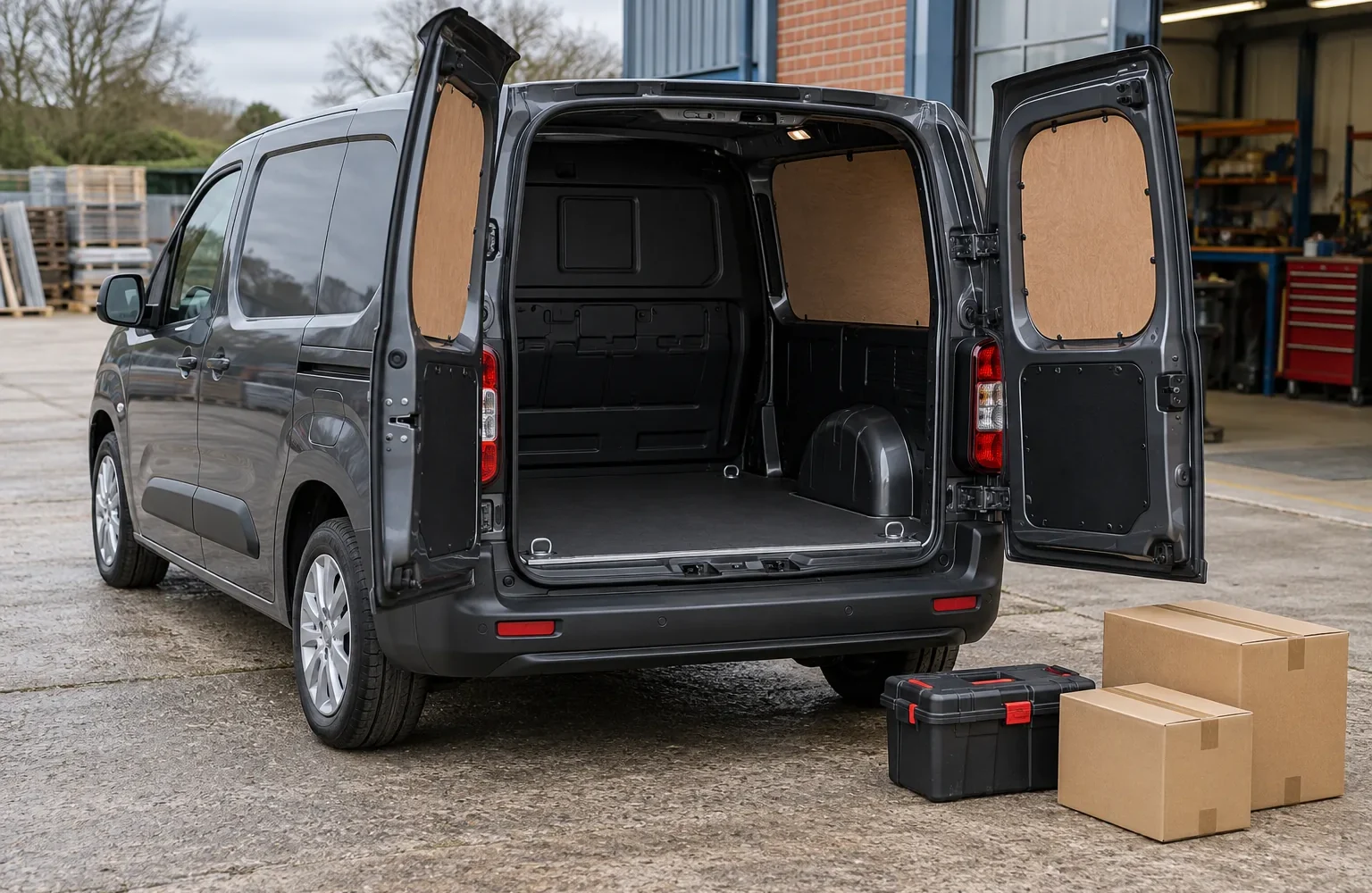
Bring a list of your equipment, its weight and its dimensions to a viewing. Include the things that stay aboard: shelving, a trolley, tools, charging cables and a second person’s kit. For a used van, match that practical check with the exact engine or battery version and its maintenance history.
This is a specification-led buying guide for UK buyers, not a road test or a reliability ranking. Manufacturer examples were checked on 21 October 2026. The legal guidance linked below on loading and vehicle classification applies to Great Britain.
Start with the load you actually carry
Write down a normal day and the busiest day you expect the van to handle. A florist carrying light, bulky arrangements and a tradesperson carrying dense tools can need very different vans even if both work locally.
- Heaviest day: people, fuel, permanent fittings, tools, goods and packaging, including anything collected on the return journey.
- Largest single item: length, width and height in the orientation in which it must travel. Include handles, packaging and a pallet or trolley if it travels with the item.
- Access: whether the item must enter through a side door, whether you need room to reach other equipment, and how it will be secured.
- Parking: driveway length, width with mirrors, height restrictions and space to open the rear doors.
A van that only just fits today’s equipment may become awkward when you add racking. Conversely, buying a longer van for an occasional oversized item can make every normal parking manoeuvre harder. Price a suitable occasional hire option against the cost and inconvenience of running more van all year.
Payload: what is left after the people and equipment?
Maximum authorised mass (MAM), often called gross vehicle weight (GVW), is a limit for the whole loaded vehicle. It is not the weight of goods you can put in the back. The official vehicle-weight definitions distinguish this from an empty vehicle’s weight and from gross train weight for a vehicle-and-trailer combination.
A quoted payload is calculated from a specified vehicle weight. Read the manufacturer’s definition: does that weight already include a driver, fuel or particular equipment? Do not subtract an assumed 75kg driver twice, or assume a driver is included when the specification says otherwise. Factory options and later additions can change the weight of the actual van.
The most useful check for a working vehicle is a weighbridge measurement in a clearly recorded condition. DVSA’s van guidance says the loaded limit includes the van, people, fuel and load, and points drivers to a local weighbridge. Record what was aboard when weighed; a ticket with the driver, full fuel tank and regular tools included cannot be compared directly with a bare-vehicle brochure figure.
A worked weight example
The following figures are hypothetical, not the specification of a named van. Suppose a van has a plated GVW of 2,500kg. It weighs 1,900kg with its driver, fuel, existing racking and regular tools already aboard.
| Item | Weight | Running total |
|---|---|---|
| Van in the recorded working condition | 1,900kg | 1,900kg |
| Additional passenger | 80kg | 1,980kg |
| Extra equipment not present at weighing | 50kg | 2,030kg |
| Goods and their packaging | 400kg | 2,430kg |
The initial allowance was 2,500 − 1,900 = 600kg. After adding the passenger and extra equipment, only 470kg remained for goods. The proposed 400kg load leaves 70kg below the gross limit. That 70kg is unused allowance in this example, not a recommended safety margin or proof that the load is safe.
Check the individual axle limits as well. A van can be below its total limit while too much weight sits on one axle. Ask the weighbridge operator about recording axle loads and check the final loaded arrangement. Moving equipment, changing the number of occupants or adding a conversion can invalidate an earlier calculation. If a verified weight or limit is missing, resolve it before loading to a presumed maximum.
Measure the opening as well as the load bay
Cargo volume describes space, but not the shape of the object that will fit. A large box may fit between the walls once inside yet be too tall for the doorway. A cabinet may fit at floor level but meet a sloping bulkhead higher up.
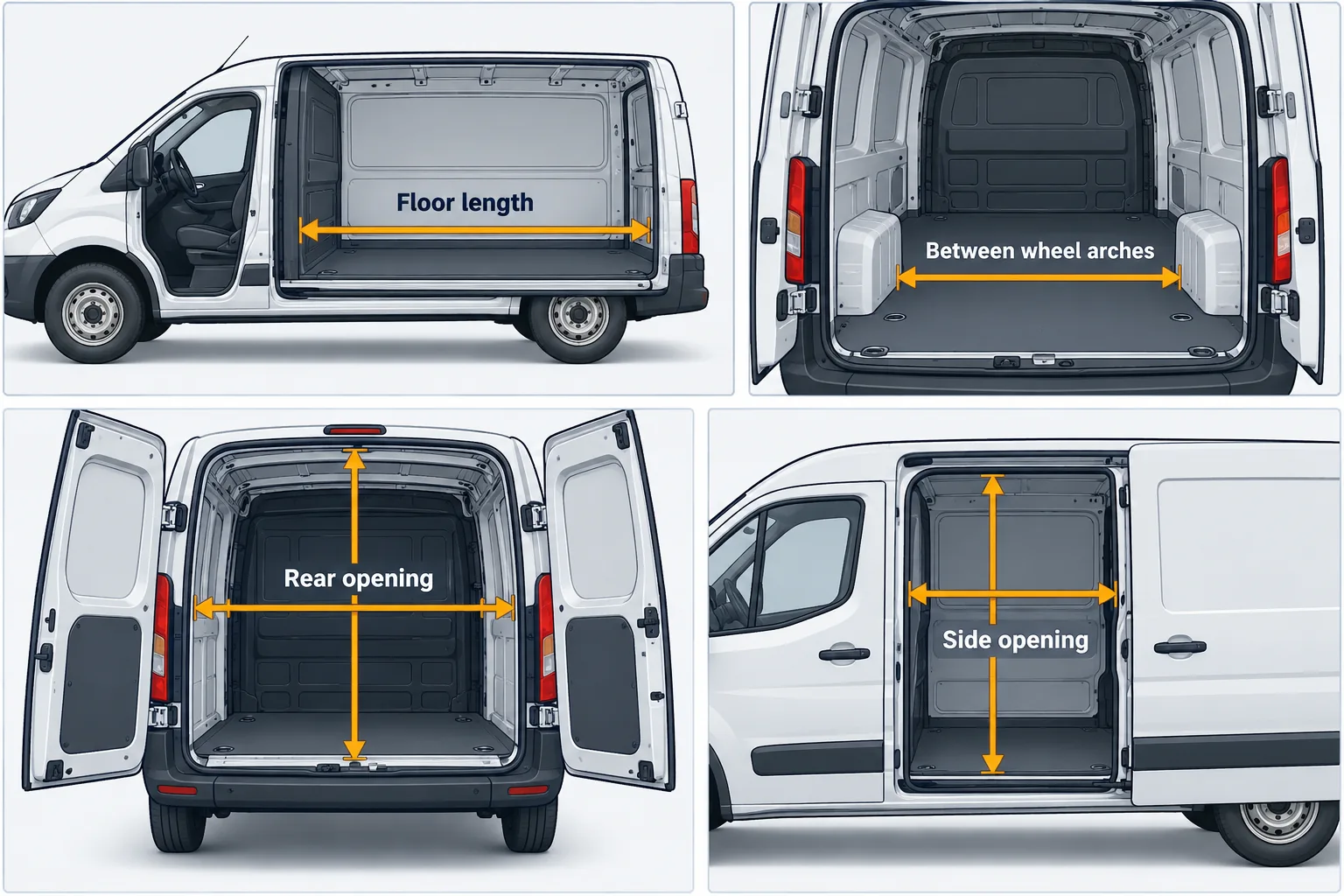
| Measurement | Where to check | Why it can rule a van out |
|---|---|---|
| Usable load length | From the closed rear doors to the bulkhead, at the item’s floor and upper heights. | A long item may fit low down but foul the bulkhead above it. |
| Width between wheel arches | The clear gap after liners, shelves or protective covers are fitted. | The widest body dimension does not describe this narrower floor area. |
| Rear opening | Clear width and height at the tightest point, including trim and door hardware. | An item cannot use internal space it cannot enter. |
| Side opening | Clear opening with the sliding door fully open, plus space to turn the item. | Side loading may be essential where rear access is blocked. |
| Internal height | From the finished floor to the lowest obstruction over the intended load position. | Flooring, roof fittings and a curved roof reduce useful clearance. |
| Outside dimensions | Overall length, mirror width and actual height with roof equipment. | The van must fit your parking and access restrictions too. |
Use a tape measure and, with the seller’s agreement, a lightweight template or the real item. Allow room to handle and secure it. A full-width pallet fitting on the floor does not prove the van can carry that pallet’s loaded weight, or that the equipment needed to load it is compatible.
Short, long or crew van: compare the same configuration
L1, L2, short wheelbase and long wheelbase are range labels, not universal dimensions. Check the exact manufacturer’s drawing for the model year and body. A crew van gives some of its space to rear seats; its maximum cargo figure may require those seats to be folded.
For example, Renault’s UK Kangoo dimensions page lists 3.3m³ for the L1 panel van and 4.2m³ for the L2, with an 813mm side loading opening on the L2. It separately describes the L2 crew cab as carrying up to five people with up to 2m³ of load space, rising to nearly 3m³ when the rear bench is folded. Those figures show why “Kangoo L2” alone is not a complete specification.
A load-through hatch or folding passenger seat may accommodate a narrow long item without creating a longer full-width cargo floor. Check the permitted configuration and restraint instructions. Do not remove or modify a bulkhead to make an item fit.
The same care applies to weight claims. Ford’s current UK Transit Connect utility page advertises maximum gross payloads of up to 790kg for the long-wheelbase range and 782kg for the short-wheelbase range. These are range maxima, not a promise for every engine, transmission, trim or option combination. Ask for the weight calculation for the van on your order or the vehicle you are viewing.
Diesel, petrol, hybrid or electric: write down the working day
Compare the actual powertrain versions that meet your load requirements. Do not transfer a diesel model’s payload, service schedule or towing figure to the electric van with the same name. Battery sizes, charging equipment and model years can change even while the basic body looks similar.
For an electric van, record the longest ordinary route, a realistic unplanned detour, where it will charge and how long it will remain there. Check whether the intended charger is accessible when the van is loaded and whether the charging port position suits the parking bay. Discuss a representative loaded demonstration with the retailer instead of treating a published range as a guaranteed working distance.
A useful example of version checking is Renault’s October 2026 Kangoo announcement, which describes a new 52kWh battery and says updated prices will follow. A global announcement does not establish the specification or availability of a particular UK stock vehicle. Confirm the model year, battery and charger on the order rather than combining numbers from different pages.
Our guide to fitting an electric vehicle into everyday life helps structure the charging questions, although its car examples do not establish a van’s payload or loaded range. For any powertrain, compare written servicing requirements, energy or fuel costs for your route, insurance, tyres and the cost of time off the road.
What about the most reliable small van?
A model name is too broad to settle that question. A used example’s engine, age, maintenance, previous work and repairs need checking. This guide does not have a comparable long-term failure dataset for the exact versions, so it does not award a reliability winner.
Ask for dated service invoices and match them to the VIN, mileage and manufacturer’s schedule. Investigate gaps, repeated repairs and any modifications. Inspect the load floor, door mechanisms, bulkhead and fitted shelving as carefully as the cab; obtain a qualified inspection where condition or conversion work is uncertain.
Use the official MOT-history service to review the available test record and recall service to check outstanding safety recalls. An MOT record is not a full maintenance history or a guarantee against later faults. Our questions to ask before a viewing provide a starting point; add van-specific questions about former use, loads and installed equipment.
Check load security and road classification before buying
Look for a suitable, undamaged bulkhead and accessible load-securing points; ask for the ratings and instructions for the fitted restraints and racking. In its current van load-security guidance, DVSA says working vans must have a protective bulkhead between the load compartment and cab and advises securing large or heavy items. It also says not to store work tools or other load items in the cab. Plan storage and restraint before purchase, including how the remaining load stays secure after deliveries.
For Great Britain, do not assume that a compact van qualifies for car speed limits. A car-derived van must meet the legal definition, including a maximum laden weight of no more than two tonnes. Check the V5C body type and the actual classification; an empty vehicle being below two tonnes does not establish eligibility. Resolve discrepancies with the dealer or manufacturer and follow the Department for Transport’s classification guidance. Passenger conversions and crew vans need their own checks.
Your final shortlist: open the check that matters most
My load is heavy but compact
Obtain the plated gross and axle limits, then establish the van’s working weight with people, fuel and permanent equipment accounted for. Record the weight of the proposed goods and packaging. Arrange an axle-weight check for the loaded layout. If the sums depend on a range-maximum payload or an unexplained empty weight, the van has not passed this check.
My load is bulky or awkwardly shaped
Record the item’s full dimensions, including protrusions, and the route it must take through the door. Check the wheel arches, upper bulkhead clearance and finished floor. Try a lightweight template and confirm access to restraints. A volume figure alone is insufficient, even when the total cubic metres exceed the item’s calculated volume.
I carry passengers as well as equipment
Check the number of approved seats and the cargo area with those seats in use. Include all occupants and their kit in the weight budget. Confirm that passenger access, load restraint and bulkhead arrangements remain correct in the configuration you will actually drive. Do not base the decision on a folded-seat cargo figure when those seats must be occupied.
Before paying, keep a written record of the exact version, your load and weight checks, the fitted equipment, the maintenance evidence and any unanswered question. Choose from the vans that satisfy those requirements; then compare price, comfort and convenience on an equal basis.
The conversation