A pelican crossing is a pedestrian-operated crossing with traffic lights and pedestrian figures on the far side of the road. Its distinctive driver signal is flashing amber after red: you must give way to anybody on the crossing. You may move cautiously only when the crossing is clear. A flashing green pedestrian figure means do not start crossing; people already crossing should finish.
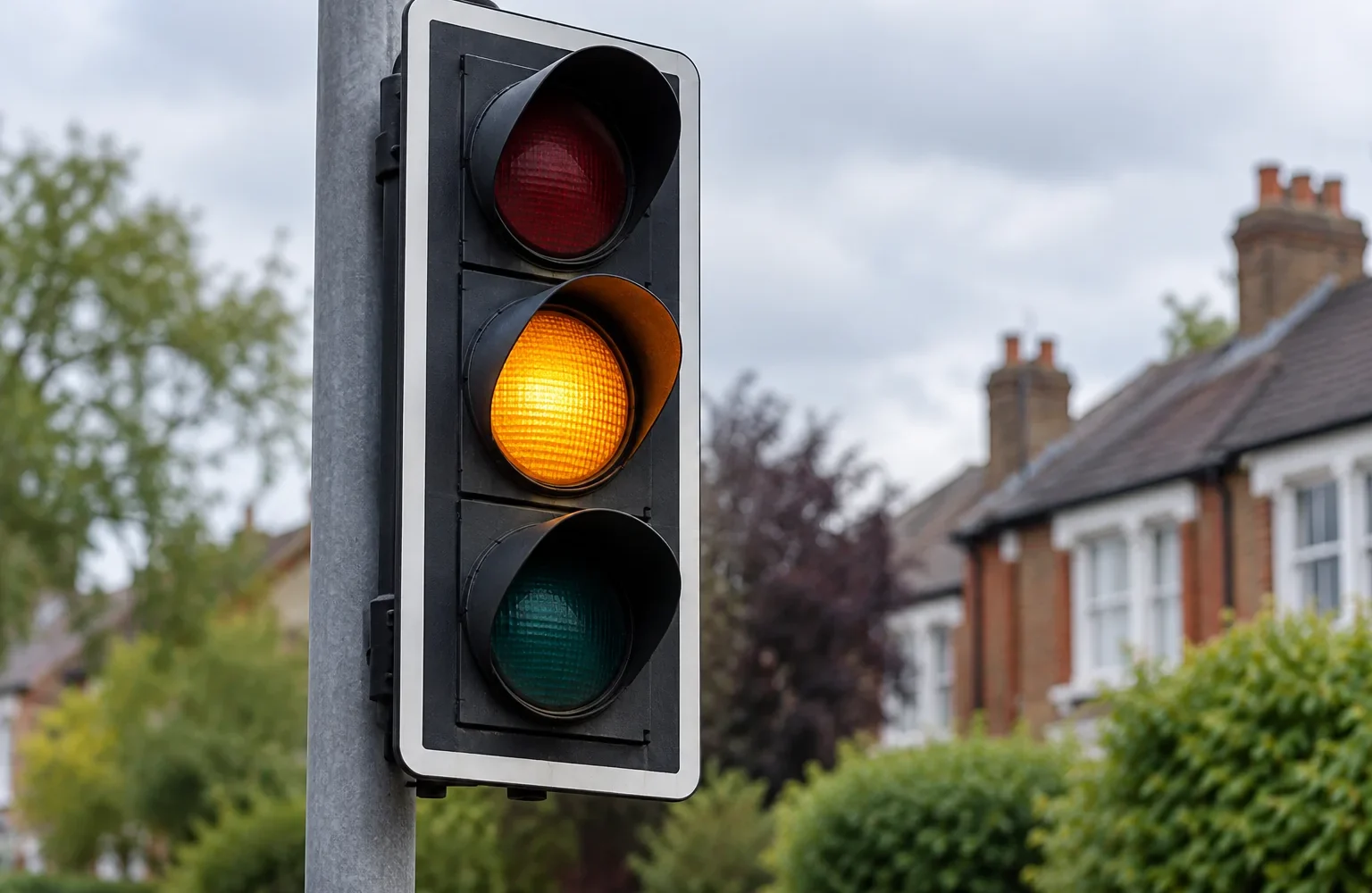
The flashing phase is the part most easily confused with an ordinary amber light. This guide separates the two, explains central islands and gives practical examples. The main references are the Highway Code and Department for Transport guidance for England, Scotland and Wales; Northern Ireland’s official guidance is linked separately below.
What makes a crossing a pelican?
Pelicans have a push button for pedestrians, red and green pedestrian figures across the road, and red, amber and green signals facing approaching vehicles. Cambridgeshire County Council’s crossing guide identifies the far-side pedestrian display and flashing phase as features of the older design.
The position of the figures is a useful clue, but it is not enough on its own. Other signal-controlled arrangements can also have far-side pedestrian displays. Watch the signal that controls your route, rather than deciding what you may do from a remembered crossing name.
For comparison, a puffin has pedestrian figures beside the waiting area and no flashing amber vehicle phase. Our puffin crossing guide explains that separate system and its detectors. Do not apply the pelican flashing-amber rule to red and amber showing together at another crossing.
Pelican crossing lights: the driver sequence
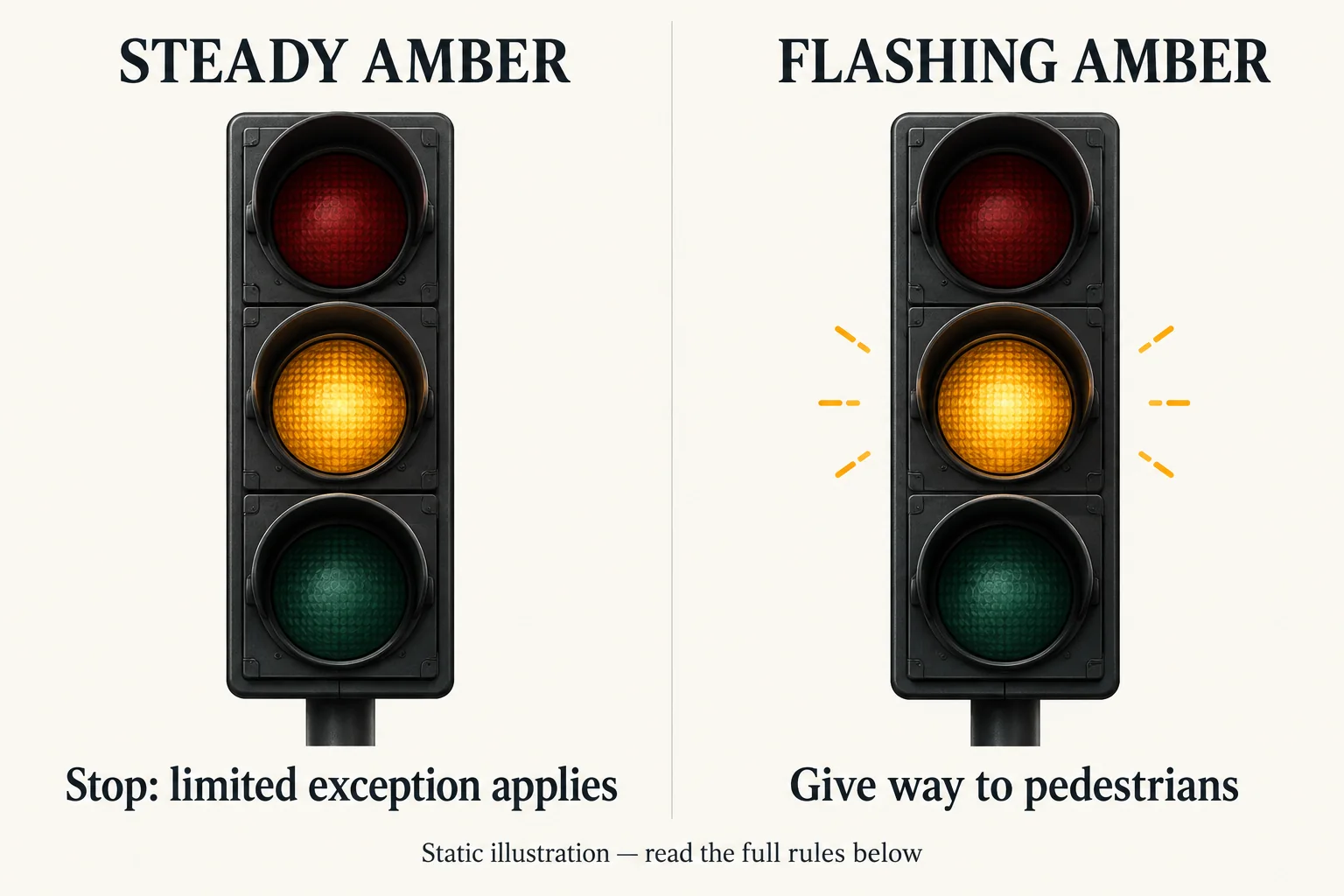
The sequence is green, steady amber, red, flashing amber, then green again. The Department for Transport’s crossing guide explains that flashing amber replaces the usual red-and-amber stage. It is a separate instruction, not an early green.
| Signal | Your decision |
|---|---|
| Green | Proceed only if the way is clear. Give way to anyone still crossing. |
| Steady amber | Stop at the line, unless you have already passed it or are so close that stopping might cause an accident. |
| Red | You must stop behind the stop line, even if the crossing appears empty. |
| Flashing amber | You must give way to pedestrians on the crossing. If nobody is on it, you may proceed cautiously. |
The steady-amber exception comes from the Highway Code’s signal meanings. It is about your position and whether stopping would cause an accident; it is not a general invitation to accelerate through. Rules 196 to 198 cover the pelican’s red and flashing-amber requirements and people still crossing after green appears.
Do you have to wait for green?
At a pelican, not necessarily. Flashing amber permits cautious progress when no pedestrians remain on the crossing. The useful question is whether the whole crossing is clear, not whether someone has passed the front of your car. Look beyond the nearest lane and any island.
Leave the crossing clear in a queue: a permitted signal cannot create a space for your car on the other side. Keep watching people as well as traffic. Someone’s hesitation or unexpected movement matters more than the impatience of a driver behind you.
A central island does not always mean two crossings
A pelican that runs straight across the road remains one crossing even with an island in the middle. Under Highway Code rule 197, you must wait for people crossing from the other side of that island. An empty lane immediately in front of you is therefore not a sufficient check.
A staggered arrangement is different: the pedestrian routes on either side of the refuge are offset rather than in line. These are two separate crossings. For pedestrians, rule 28 says to press the second button and wait for its steady green figure. Do not carry permission from the first half into the second.
What pedestrians should do when the green figure flashes
Highway Code rules 18, 22, 24 and 28 set out the walking side of the crossing:
- Press the button and wait. A red figure means do not cross.
- When the green figure is steady, check that traffic has stopped before starting.
- If the green figure starts flashing while you are still at the kerb, do not begin.
- If you are already crossing, continue to the other side without delay.
- Stay within the crossing, between the studs; do not take a diagonal shortcut through the zig-zag area.
The flashing green figure is a clearance phase for somebody already on the road. It is not a countdown challenge for somebody arriving at the button. Nor is stationary traffic on your side proof that the opposite stream has stopped: use the pedestrian signal and check both directions.
Three situations to practise
Open an example to check the decision. These illustrate the rules; they do not assess a person’s driving competence.
My amber is flashing and a person is beyond the centre island
First identify the layout. If the pelican goes straight across, treat it as one crossing and wait for that person, including when they are crossing towards you from the other side. Do not decide using only the width of your lane. A staggered arrangement has separate crossings with their own signals.
The vehicle ahead starts moving, but I cannot see the crossing clearly
The other driver’s movement is not evidence that your path is clear. Make your own observation of the signal, pedestrian route and exit space before proceeding. In particular, do not use a moving queue as permission to stop across the studs.
I reach the button while the green pedestrian figure is flashing
Wait for the next steady green phase, then check the traffic before starting. The flash is for people finishing a crossing they have already begun. Do not follow somebody who stepped off before you arrived: they may have started during a different signal.
Zig-zags, bicycles and accessible signals
The clear area around a crossing protects sight lines. Highway Code rule 240 prohibits stopping or parking on a pedestrian crossing, including the area marked by zig-zags. Waiting because the crossing signal tells you to stop is different from choosing that area for a passenger pick-up.
For a cyclist wishing to cross the road, rule 81 says to dismount and wheel the bicycle across a pelican. A toucan is a different facility designed for pedestrians and cyclists to cross together; a green pedestrian figure alone does not identify a cycle crossing.
Some pelicans provide an audible signal or a rotating tactile cone beneath the push-button box. Camden Council’s explanation describes these aids and their relationship to the green figure. The absence of a bleep does not change the meaning of the lights.
Northern Ireland and older crossings
Northern Ireland’s Highway Code, rules 196 to 199, gives the same core pelican instructions: stop for red, give way to pedestrians during flashing amber, and proceed cautiously only if it is clear. It also covers straight-across crossings with islands. Its legislative references are Northern Irish; the GB references above should not be substituted for them.
The separate Northern Ireland pedestrian guidance covers the red, steady green and flashing green figures and staggered crossings. Use these local sources when learning or refreshing the rules there.
For Great Britain, the Department for Transport says new pelicans are no longer installed, but existing examples remain. An older crossing still calls for correct use. Familiarity with a route is no reason to anticipate a light change; checking the actual signals remains the task each time.
Official guidance checked on 22 October 2026. Prepared by Motoring Desk editorial from the sources linked above. No driving-instructor endorsement or practical driving assessment is claimed.
The conversation