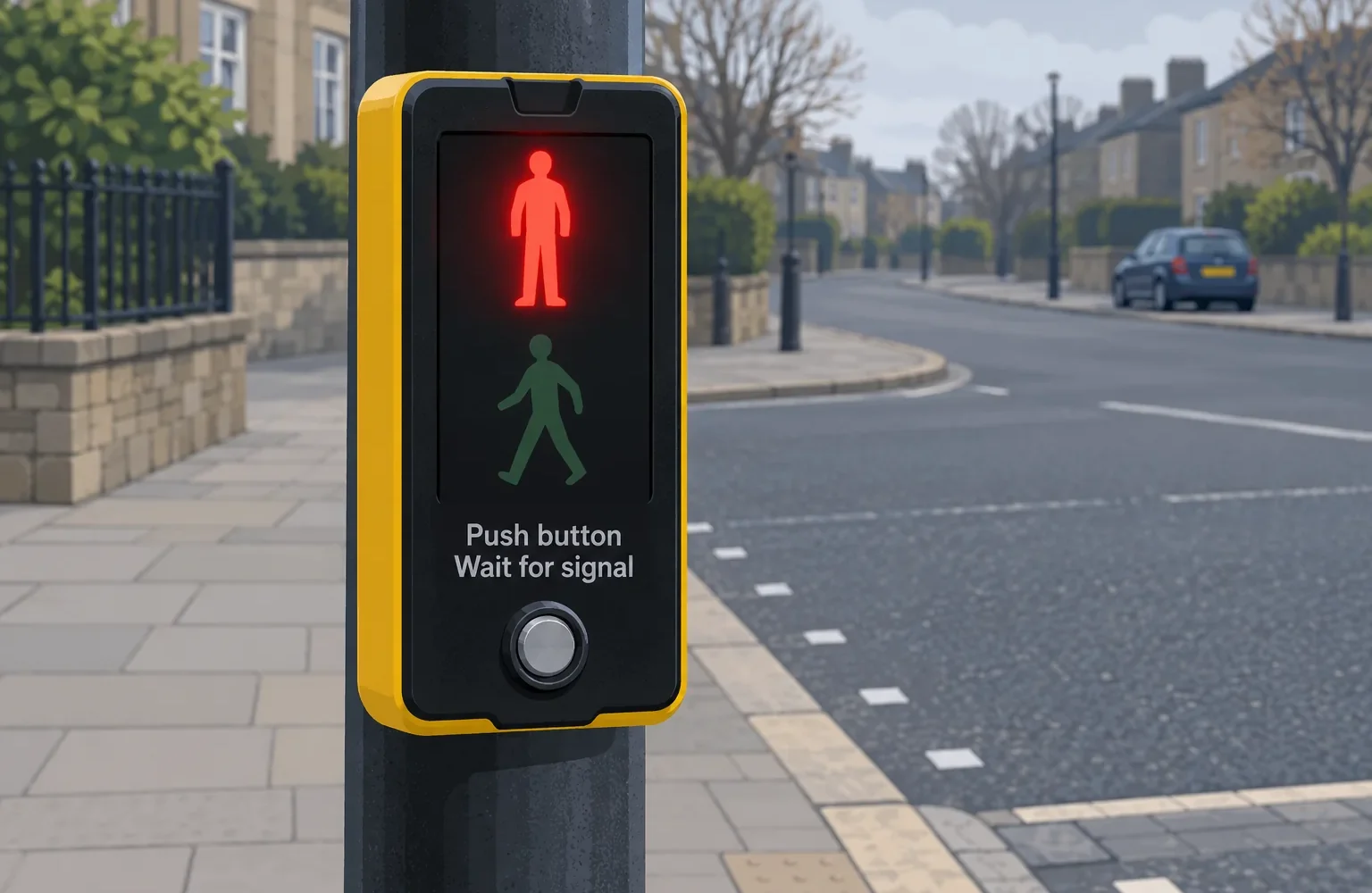
A puffin crossing is a signal-controlled pedestrian crossing with red and green figures beside the waiting pedestrian, rather than across the road. Sensors detect people waiting and crossing. For drivers, the crucial distinction is that there is no flashing amber phase: wait for green, then proceed only if the crossing and the road ahead are clear.
This guide explains the signals and common misunderstandings using the Highway Code for England, Scotland and Wales. Northern Ireland has its own official guidance, linked below. It is a reference for understanding a crossing, not a live indication that a particular road is safe to enter.
How to recognise a puffin crossing
Look for the pedestrian signal above the push button on the same pavement as the person waiting. This is called a near-side signal. It lets pedestrians look towards approaching traffic while checking the display. The name comes from Pedestrian User Friendly Intelligent Crossing; the memorable part is the position of the pedestrian display, not the bird.
Tower Hamlets Council’s crossing guide describes the near-side display and the sensors. A puffin crossing does not have a flashing green pedestrian figure. A nearby signal head or a pole-mounted detector on its own is not enough to identify every crossing arrangement: follow the display that controls your route.
What the lights mean for drivers
The vehicle signals follow the ordinary traffic-light sequence. The table below translates the Highway Code’s light-signal meanings into the decisions relevant at a puffin crossing.
| Vehicle signal | What it means | Common mistake |
|---|---|---|
| Red | Stop behind the stop line. | Moving because the pedestrian appears to have finished. |
| Red and amber together | Still stop. Wait until green appears. | Treating the amber lamp as permission to move. |
| Green | You may proceed if the way is clear. | Following a queue onto the crossing without space to clear it. |
| Amber alone | Stop, unless you have already crossed the line or are so close that stopping might cause an accident. | Confusing steady amber with a pelican crossing’s flashing amber. |
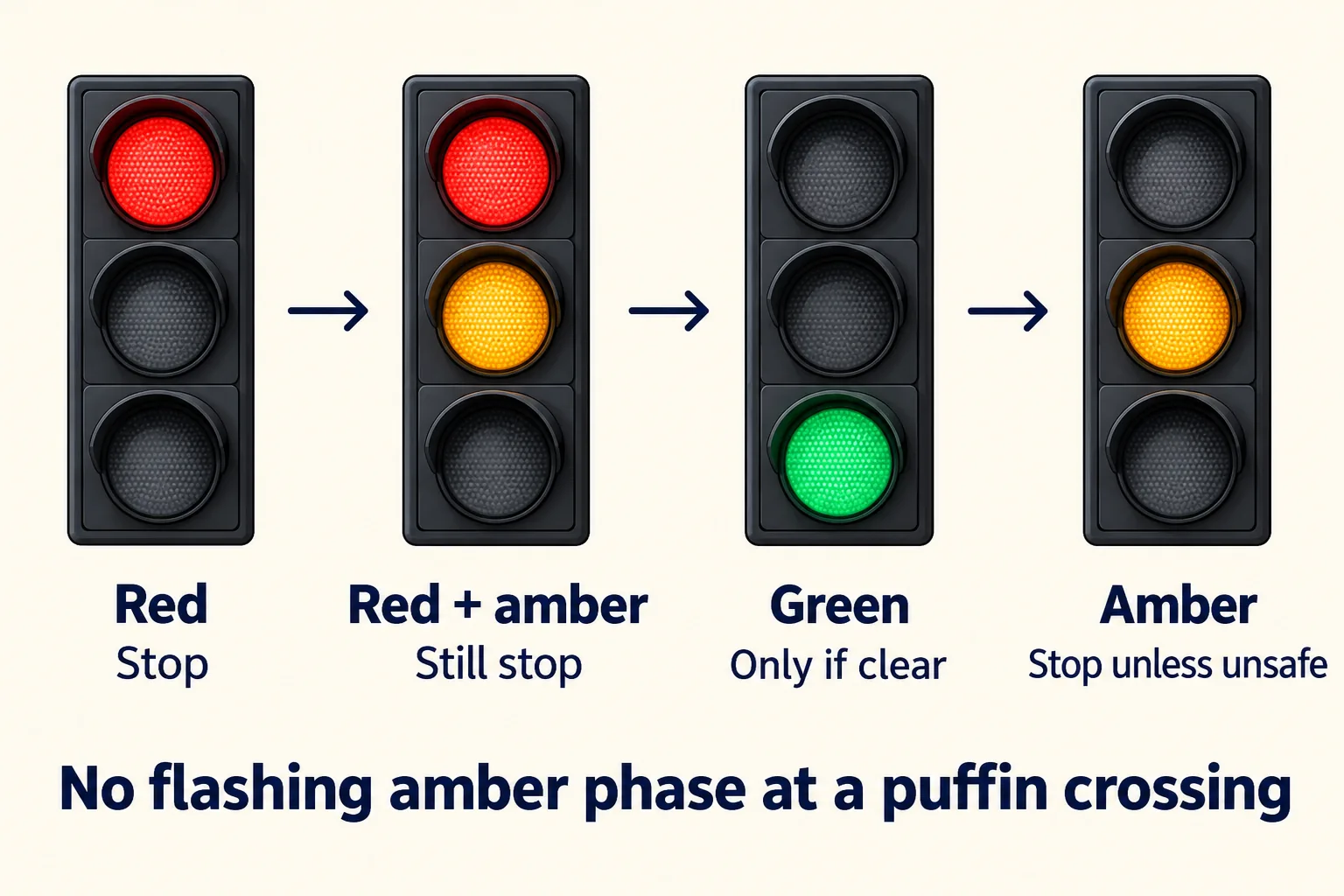
Signals answer one question: whether traffic may proceed. They do not remove the need to check for someone still crossing. Highway Code rules 198 and 199 say to give way to people still crossing after green appears and to keep the crossing clear when the exit is blocked. If the signal-controlled crossing is not working, the Code advises extreme caution.
What the sensors do, and what they do not promise
A puffin crossing can vary the pedestrian crossing time in response to people using it. A waiting-area detector can also cancel the request if the person presses the button and then leaves. The Department for Transport’s crossing explanation distinguishes these functions from a fixed assumption that every pedestrian needs the same time.
This explains why pressing a button does not always lead to an immediate change. It does not create a countdown that you can infer from how long somebody has waited. As a driver, use the actual signal, not a guess about the detector. As a pedestrian, wait for the appropriate green figure and check that traffic has stopped.
The red pedestrian figure may return while somebody who began on green is still crossing. The crossing holds traffic on red during the pedestrian clearance period. The returning red figure tells somebody at the kerb not to start; it is not an instruction for the person already crossing to turn back.
Using the crossing as a pedestrian
Highway Code rules 18, 21 and 23 provide the essentials: press the button, wait for the green figure and check that traffic has stopped before starting. Cross within the crossing, between the studs, rather than diagonally through the zig-zag area. Keep looking while you cross.
If you start on green and the figure goes out, continue to the other side without delay. Because the display is beside the waiting area, it is normal not to see it in front of you as you cross. Do not look for a flashing green warning phase: puffins do not use one.
A queue of cars is not a substitute for the pedestrian signal. Vehicles may be stationary on one side while traffic still moves on the other. At a staggered crossing, where the two halves do not line up across a central refuge, treat the second half as a separate crossing: press its button and wait for its green figure.
Puffin, pelican and toucan: the distinction that matters
For a driver, the main trap is importing a pelican rule into a puffin crossing. At a pelican, flashing amber follows red; drivers must give way to pedestrians on the crossing and may continue cautiously if it is clear. A puffin has no such phase. Red and amber together remains a stop signal.
For a pedestrian, a pelican normally places the figures on the opposite side of the road, whereas the puffin display is near-side. A toucan is designed for pedestrians and cyclists to cross together and includes cycle signals; its vehicle lights also have no flashing amber phase. A bicycle symbol is a meaningful distinction, not merely a different name for a puffin. See the official crossing illustrations for the layouts.
Three situations worth checking before you need them
Open each example for the reason behind the answer. These are learning examples, not a test of whether you are fit to drive.
The last pedestrian has left, but my light is still red
Remain behind the stop line. An empty-looking crossing does not cancel a red light. The useful distinction is between observing that a person has finished and receiving permission to proceed; only the latter changes what the signal allows.
My light is green, but the queue beyond the crossing has stopped
Wait until there is room to clear the whole crossing. Leaving half the car across the pedestrian route defeats the purpose of the clear space even if you entered on green. Watch the exit, not just the bumper ahead.
I am waiting to walk and cannot see a green figure across the road
Check the display beside the push button on your side. On a puffin, looking only at the opposite pavement means looking in the wrong place for the pedestrian instruction. If a crowd obscures it, do not infer permission from other people beginning to move.
Audible signals, tactile cones and Northern Ireland
Some crossings provide audible or tactile assistance; the absence of a bleep is not a different permission to cross. The Highway Code explains that a bleep or voice signal may accompany the steady green figure, and a tactile signal may help deafblind pedestrians.
Northern Ireland’s official puffin-crossing guide gives its own stop, wait and cross instructions, explains the waiting and crossing detectors, and describes tactile cones and possible audible signals. It also directs queries about a local crossing to DfI Roads. Use that local guidance in Northern Ireland rather than assuming every GB rule citation is its legal reference.
For a longer journey, our road-trip planning guide covers preparation and breaks. The crossing itself calls for attention to the signal, the people and the available space, however familiar the road.
Official guidance checked on 21 October 2026. Written by Motoring Desk editorial from the sources linked in the text; no driving-instructor endorsement or examination assessment is claimed.
The conversation