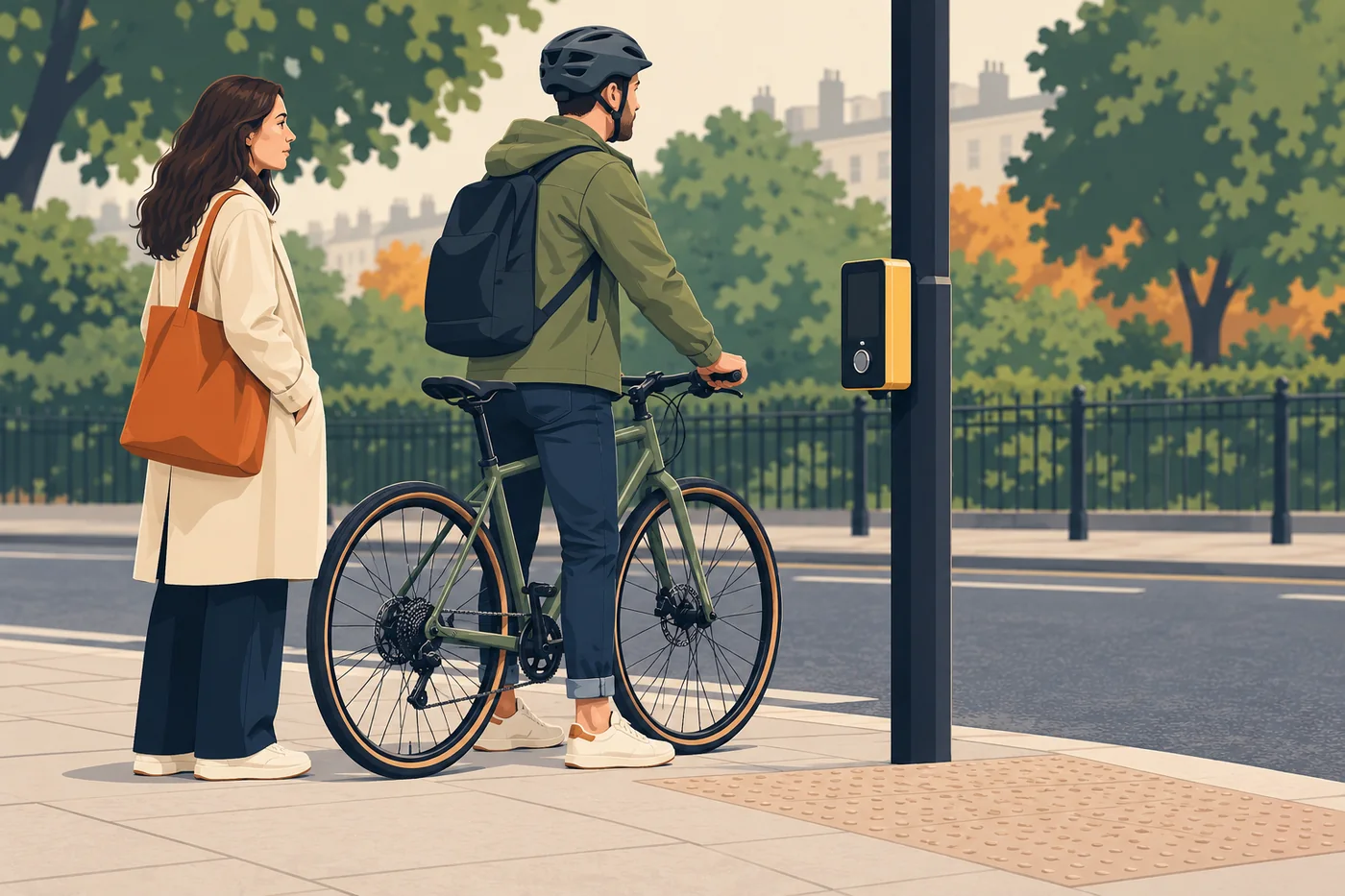
A toucan crossing is a traffic-light-controlled crossing shared by pedestrians and cyclists. Both receive a green crossing signal together, and cyclists may ride across without dismounting. For drivers, the key distinction from a pelican is that there is no flashing amber phase: wait for green, then move only when the crossing and your route ahead are clear.
This guide covers England, Scotland and Wales. It explains the crossing itself, the signals that apply to different road users, and the situations in which a green light still means waiting.
How to recognise a toucan crossing
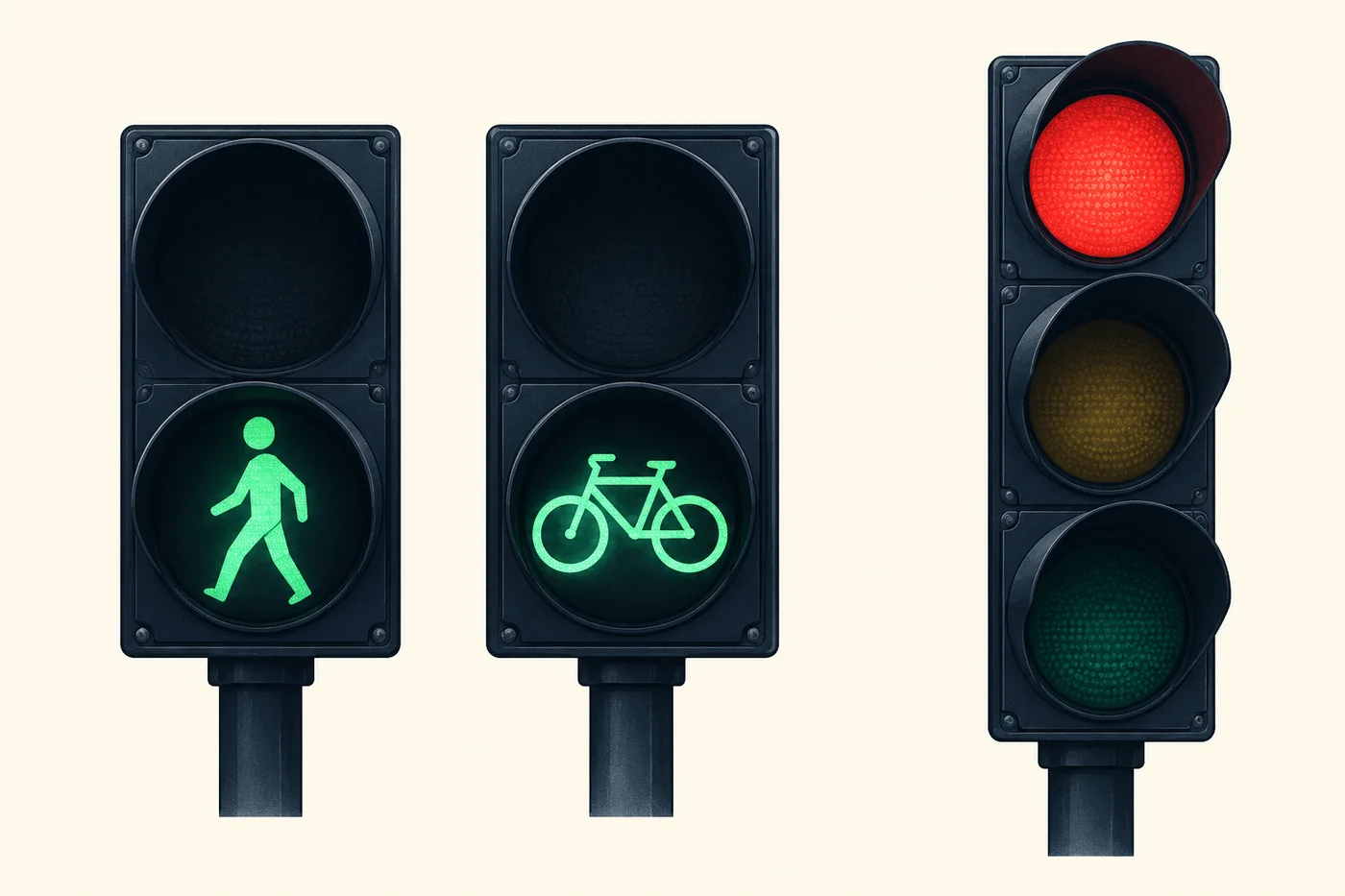
Look for pedestrian and bicycle symbols together. The name comes from “two can” cross: people walking and people cycling. A wide crossing alone is not enough to identify it; the cycle symbol is the useful clue. Road Safety Scotland explains the name and symbols.
The pedestrian and cycle displays may be beside you, above the push button, or across the road. These are called near-side and far-side signals. Far-side arrangements have red and green pedestrian figures but may have only a green bicycle symbol. Do not assume every toucan has a red bicycle light.
Follow the display for your crossing. A green light visible elsewhere at a junction may control a different movement. See the Department for Transport’s illustrated crossing guide for both signal arrangements.
What drivers must do at the lights
A toucan uses the ordinary traffic-light sequence. These are the meanings of the signals facing vehicles travelling along the road, as set out in the Highway Code’s traffic-light guide.
| Signal facing you | Your action |
|---|---|
| Red | Stop before the stop line and wait. |
| Red and amber together | Remain stopped. This is not permission to move. |
| Green | Proceed only if your way is clear, giving way to anyone still crossing. |
| Steady amber | Stop, unless you have already passed the stop line or are so close that stopping might cause a collision. |
The difference between steady amber and flashing amber matters. A toucan has the former in its normal sequence, but not the pelican’s flashing amber stage. If the crossing becomes empty while your light remains red, you must still wait.
Check the crossing and the space beyond it
Green does not reserve a space for your car. If a queue leaves insufficient room beyond the crossing, stay back. Do not follow the car ahead into a position where your vehicle would obstruct people crossing.
Someone may still be finishing their journey across when your light turns green. Give way and let them finish; do not edge towards them. If the signals have failed, proceed with extreme caution, rather than treating the crossing as having disappeared. These points follow Highway Code rules 192, 194, 198 and 199.
How to cross on foot
- Find the crossing control. If the red figure is showing, press the button and wait.
- Watch your pedestrian signal. Wait for the green figure, then check that traffic has stopped before stepping out.
- Keep looking and listening. Cross within the crossing area, remaining aware of cyclists sharing the space.
Stationary traffic is not a substitute for the crossing signal. A queue on your side may conceal moving traffic in the other direction. The Highway Code specifically warns against assuming that congestion means it is time to cross.
Some crossings provide an audible indication or a tactile signal for people with sight or hearing impairments. Their presence varies; silence does not tell you which light is showing. The relevant guidance is in Highway Code rules 24–26.
Can you cycle across a toucan?
Yes. You can remain on your bicycle and use the shared crossing when its green cycle signal shows. Approach through the appropriate cycle facility and leave room for people walking or wheeling.
Ride considerately. Avoid passing closely or quickly, particularly from behind, and be ready to slow down or stop. A crossing shared with pedestrians is not a place to maintain your normal road speed. A bell can alert someone to your presence, but do not assume they can hear it or will move aside.
Permission to ride across does not mean you may ride on an ordinary pavement beyond it. Follow the onward cycle route and any separation between cycling and walking areas. These distinctions are covered by Highway Code rules 62–64 and 81–82.
What if you are cycling along the road?
The green bicycle crossing symbol is for the route across the carriageway. It does not let a rider travelling along the carriageway pass the vehicle stop line against red. Read the signals governing the direction you are actually travelling.
Toucan, puffin and pelican: the useful differences
| Type | Who crosses? | Distinctive point |
|---|---|---|
| Toucan | Pedestrians and ridden cycles together | Pedestrian and cycle symbols; no flashing amber for traffic. |
| Puffin | Pedestrians; cyclists wheel their bikes | Pedestrian display beside the waiting area; no flashing amber. |
| Pelican | Pedestrians; cyclists wheel their bikes | Far-side pedestrian display and a flashing amber vehicle phase. |
For the other two types, read our puffin crossing guide and pelican crossing explanation. The comparison is supported by Essex Highways’ crossing guide.
Toucans are not the only crossings where cyclists can remain mounted. A parallel crossing has a cycle crossing alongside a zebra crossing, without the toucan’s signal sequence. A cycle-only signalled crossing is another separate arrangement. Identify the facility rather than applying the toucan rules to every place where bicycles cross a road.
Check your understanding before your next journey
Open each situation to check which signal or observation matters. These examples explain the rules; they do not replace observing the crossing in front of you.
The crossing is empty, but my vehicle light is red. Can I go?
No. An empty crossing does not cancel the red light. Wait until green and check the route before moving.
The green bicycle symbol appears while I am riding along the road. Is it for me?
No, if it faces the route across the road. Continue to obey the signals controlling your own direction of travel.
The crossing has an island. Can I assume one signal covers everything?
No. The Department for Transport distinguishes crossings in a straight line, which operate as one crossing, from staggered sections, which operate separately. On a staggered crossing, check the signal for the next section rather than following someone ahead.
At an unfamiliar crossing, locating your signal before moving is more useful than remembering the animal name. Look at the symbols, your direction of travel and the actual traffic together.