Choose a pressure washer for the space where you wash, the water supply you can provide and a nozzle the manufacturer approves for cars. A higher maximum bar figure does not make a machine a better choice for paintwork. Reach, controllable spray, compatible accessories and manageable storage often matter more in everyday use.
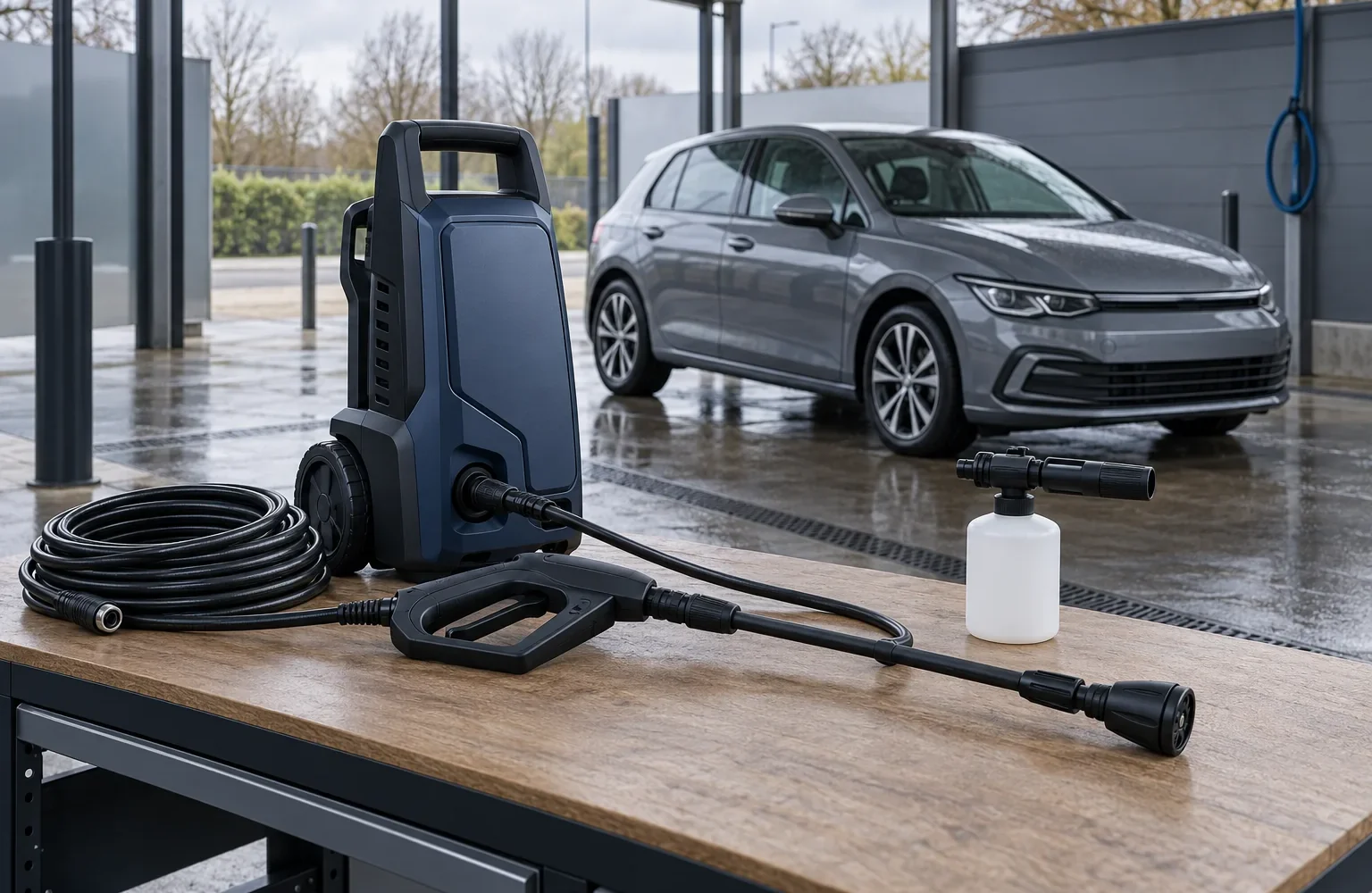
Before comparing offers, check your car’s cleaning instructions and whether you have a suitable place to wash it. This guide explains the specifications worth comparing, uses two current UK products as worked examples, and gives you a buying checklist. The examples come from manufacturers’ documents; we have not tested these machines against each other.
Start with the wash location
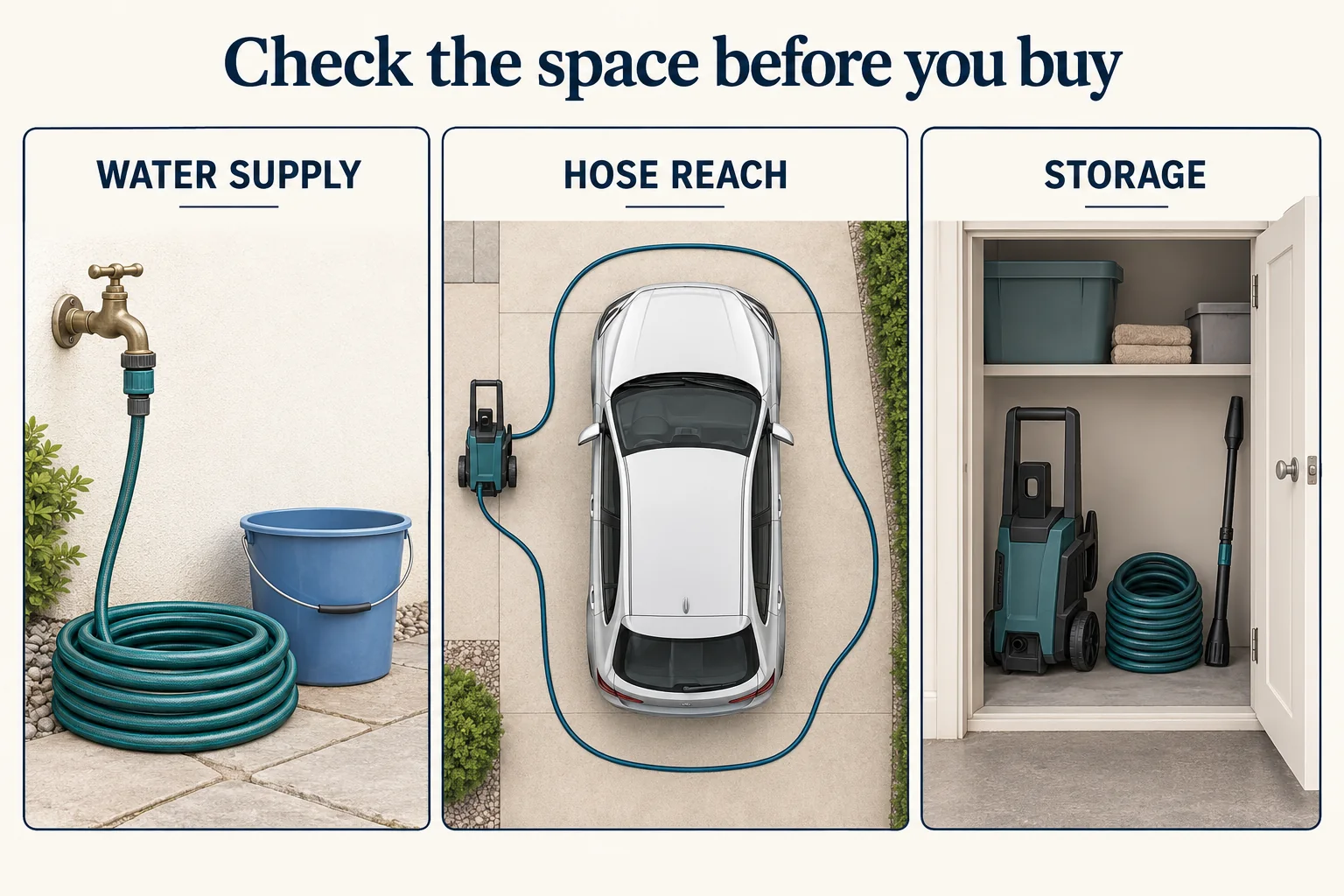
Walk around the parked car as if you were holding the lance. Where could the machine stand without being pulled over? Can the high-pressure hose reach the far side without dragging across paintwork? Where will you store the unit, gun and hoses afterwards? Measure the route you actually need, allowing for corners, rather than only the straight distance from the tap.
Check the available water supply against the proposed machine’s inlet requirements. A washer with a tank-suction feature still needs the specified hose, filter and setup; a garden bucket beside any pressure washer does not make it self-priming. A long list of accessories is no substitute for a workable site.
Consider runoff before buying equipment. The Environment Agency’s business guidance for England identifies vehicle washing as a source of contaminated water and explains that surface-water drains discharge to the environment. Business discharge requirements are not a blanket household rule, but the drainage distinction matters to anyone washing a car. Find out where your washwater goes; do not assume every drain leads to treatment. If you cannot arrange suitable drainage, use a properly managed wash facility.
What bar, flow rate and watts tell you
| Specification | What to compare | What it does not establish |
|---|---|---|
| Pressure, in bar | Whether the figure is maximum or working pressure, and how the spray is controlled | A safe setting for every car, nozzle or surface |
| Flow, in litres/minute or litres/hour | Use the same units and compare similarly labelled figures | Your actual water use during a whole wash |
| Motor input, in watts or kilowatts | Electrical requirements and the supply specified in the manual | A measured ranking of cleaning ability or durability |
| Hose and cable lengths | Which length is high-pressure hose, which is electrical cable, and what is included | The total usable reach from your tap and socket |
| Weight and dimensions | Whether accessories are included in the quoted weight | How comfortable it will be to lift or pull in your storage space |
A maximum pressure figure describes a limit in the specification, not a command to use that pressure on a car. Likewise, maximum flow and maximum pressure should not be assumed to occur together under your operating conditions. Ask for the working figures if the distinction matters to your comparison.
For units, multiply litres per minute by 60 to obtain litres per hour. A quoted 7.5 litres/minute is 450 litres/hour. As an arithmetic illustration, a constant 7.5 litres/minute for four minutes of trigger-on time would use 30 litres. That is not a measured wash result: actual flow, pauses, settings and water used separately in buckets change the total.
Two UK examples: compare the package as well as the machine
The following specifications were checked on 22 October 2026. These are examples of how to read a specification, not a “best tested” ranking or a statement that you need either model.
| Item | Kärcher K 4 Power Control Flex Car & Home Plus | Bosch AdvancedAquatak 140 |
|---|---|---|
| Product reference | 1.324-311.0 | 06008A7D70 |
| Listed maximum pressure | 130 bar | 140 bar |
| Listed maximum flow | 420 litres/hour | 7.5 litres/minute, equivalent to 450 litres/hour |
| High-pressure hose | 8 metres | 8 metres |
| Power cable | 5 metres | 5 metres |
| Weight without accessories | 12.1 kg | 18.0 kg |
Sources: Kärcher’s UK product page and Bosch’s UK AdvancedAquatak 140 page. Both supply several cleaning accessories. An included rotary or dirt-blaster attachment is not evidence that it belongs on car paint.
The useful comparison here is broader than 130 versus 140 bar. Both list the same hose length, while their stated weights differ by 5.9 kg. If you must lift the machine over a step after every wash, that is a reason to check handling in person. If your existing hose cannot reach the far side of the car, neither headline pressure figure resolves the problem.
Match the full product reference when comparing retailers. Similar model names can identify different kits. Count the car-appropriate lance, hose, water connection and detergent attachment you actually need, then price missing items separately. A patio accessory adds little value if the car is your only intended use. Check the current warranty conditions, repair route and availability of replacement hoses before paying.
Nozzle choice and distance: use the relevant instructions
Do not copy a universal internet recommendation such as “maximum power at one foot”. The nozzle, surface condition and manufacturers’ instructions matter together. The Kärcher K 4 Power Control manual, for example, specifies at least 30 cm from painted surfaces and prohibits its dirt blaster on car tyres, paint and sensitive surfaces. That is a model-specific limit, not proof that any jet becomes suitable at 30 cm.
The car’s requirements can add restrictions. Volvo’s UK guidance for the 2022 XC40 describes sweeping movements, a minimum 30 cm distance and avoiding direct spray on locks or inside the fuel-filler flap. Use the manual for your own car and any separate wrap, paint-protection film or coating aftercare instructions. Existing lifted edges, peeling finishes or damaged paint need assessment before pressure washing.
Choose a machine whose approved car-cleaning setup you can identify and control. If a bundle contains only a powerful-looking attachment and the seller cannot show the relevant instructions, resolve that before purchase. Colour-coded interchangeable tips are not a universal specification across all equipment.
Check electrical and water requirements before first use
Electrical Safety First’s outdoor guidance recommends RCD protection, undamaged leads and connectors, appropriately rated outdoor extension equipment and fully unwound cable reels. Keep connections dry and protect them from damage. Do not improvise an electrical arrangement because the supplied cable is shorter than expected; seek a qualified electrician’s advice if the supply is unsuitable.
Read the washer’s complete safety section, including protective equipment, water connection and shutdown instructions. The cited K 4 manual calls for appropriate protective clothing and goggles, excludes people without suitable protection from reach of the spray, and warns against aiming the jet at people, animals, live electrical equipment or the washer itself. Damaged hoses or equipment should not be used.
For that K 4, the manual also specifies a suitable system separator for connection to drinking-water supplies. Check the requirements for the exact equipment and your supply rather than assuming a tap adaptor alone is sufficient. Choose manufacturer-approved hoses and couplings; an accessory that physically clips into place is not automatically approved.
A buying checklist you can take to the shop
- Write down the job. One small car occasionally, several vehicles regularly, or separate patio work? Keep the car-cleaning attachment requirement explicit.
- Record the location. Water supply, drainage, space around the car, storage dimensions and any steps the machine must cross.
- Identify the exact package. Full model reference, included hose length, approved car lance and detergent application method.
- Check the manual before ordering. Find car-use restrictions, electrical and inlet requirements, compatible accessories and storage guidance.
- Compare the complete purchase. Add genuinely necessary accessories and any suitable supply equipment to the advertised price.
- Check handling and support. Try the weight and controls where possible, and confirm replacement parts and service arrangements.
Keep a shortlist with three columns: requirement, evidence in the manufacturer’s documentation and any unanswered question. A blank evidence column is a question for the supplier, not a reason to assume that a more expensive machine will solve it.
Choose the next step for your situation
I only wash one car occasionally. Do I need a large machine?
Not necessarily. First check whether a compact machine provides an approved car lance, adequate reach and a workable water supply. A larger unit may add storage and lifting demands without solving your particular constraint. A suitable hose-based wash or managed wash facility may also meet your needs. Compare the task and setup rather than buying extra pressure just in case.
I want snow foam. Is a car kit enough?
Check the exact detergent attachment and connector, plus the chemical maker’s permitted application method. A small included foam bottle and a separate foam lance may have different dilution instructions and draw rates. Our snow-foam guide explains bottle dilution and concentration at the panel. Do not pour an arbitrary bucket-shampoo mix into the machine.
The washer leaves traffic film. Should I move the nozzle closer?
Do not reduce the distance below the applicable instructions or switch to an aggressive nozzle to chase remaining dirt. Rinsing and contact washing perform different jobs. After a suitable pre-wash and rinse, a careful contact wash with a compatible car shampoo may still be needed. Stop if the surface is lifting or damaged; more pressure is not a repair.
After the wash: make the next setup easier
Follow the machine’s specified shutdown, depressurising, drainage and frost-protection procedure before storage. Clean accessories as instructed, check for damage and keep the model reference and manual with your purchase record. Do not leave detergent preparation until the car is already wet and the equipment running.
A useful purchase is one you can set up correctly, use with the right attachment and put away without a struggle. Complete the site and compatibility checks first, then compare the machines that satisfy them.