Choose car shampoo for the finish you are washing, the protection already on it and the way you intend to apply it. For an ordinary maintenance wash, look for a dedicated automotive shampoo with clear dilution instructions and explicit compatibility with your wax, coating, wrap or paint. Compare the cost of a correctly mixed bucket, not just the bottle price or the amount of foam.

A bottle labelled “ceramic”, “pure” or “wash and wax” does not answer every buying question. Some products simply clean; others leave a water-repellent layer. A shampoo that suits glossy paint may be unsuitable for a matt finish. This guide compares those choices using manufacturer instructions. The named products are examples of different formulations, not winners from a hands-on test.
Start with the finish, then choose the job
Before shopping, find out whether the car has ordinary gloss paint, matt or satin paint, a vinyl wrap, paint-protection film or an aftermarket coating. If a detailer applied a coating, ask for its aftercare instructions and product name. “Ceramic-coated” alone is not enough to establish which cleaners and maintenance products the installer permits.
| Your situation | Useful starting point | Check before buying |
|---|---|---|
| Gloss paint with an existing wax or sealant | A maintenance shampoo explicitly described as compatible with that protection | Whether it leaves an additional film, and whether you want that effect |
| A professionally applied coating | The coating maker’s approved wash and aftercare routine | Whether a separate topping product is required, optional or discouraged |
| Matt or satin paint | A product explicitly approved for the particular finish | Current product instructions; do not assume a gloss-enhancing formula is suitable |
| A wrap or paint-protection film | The film manufacturer’s cleaning guidance | Permitted chemistry, finish effects and any restrictions around edges or damaged film |
| Heavy dirt before a contact wash | A suitable pre-wash followed by the appropriate shampoo | Application method, dwell time and rinsing instructions for each separate product |
Use that table to eliminate unsuitable products before comparing fragrance, bottle size or accessories. If the finish is unknown, a query to the supplier is more useful than a stronger mixture. New paint and recently applied coatings may also have a waiting period before washing; obtain that instruction from the painter or installer.
Pure shampoo, wash-and-wax and snow foam do different jobs
A cleaning shampoo can keep the result simple
A shampoo sold without added wax or gloss enhancers is useful when you want to clean the car and assess the existing finish separately. For example, Bilt Hamber describes Auto-Wash as wax-free. That tells you something about its formulation; it does not establish that it is the best cleaner for every vehicle.
Keep a record of the products already on the car. If you change the shampoo, add a drying aid and apply a new spray sealant on the same day, it becomes difficult to know which product caused the finish you like or dislike.
A shampoo with a finishing effect may suit a simpler routine
Autoglym Bodywork Shampoo Conditioner is a low-foaming, pH-neutral product that leaves a water-repellent film. Its current UK instructions specify two capfuls in 10 litres of water. The same page says it is not suitable for matt or satin paint. Those restrictions matter more than a broad description such as “gentle”.
A combined wash-and-protect product can make sense if its finish is compatible with your car and fits your routine. Do not assume it replaces the preparation, application or durability of a separate protective treatment. Compare what the manufacturer actually promises for that exact product.
Snow foam is an application and pre-wash choice
Do not transfer a foam-lance dilution to a bucket wash. Autoglym Polar Blast, for example, is primarily a pre-wash designed for a foam gun and is not recommended for bucket use. Its manufacturer only suggests replacing shampoo in very lightly soiled circumstances. A foam bottle, a shampoo bucket and the mixture reaching the car are different stages; the instructions for one are not a universal recipe for the others.
Does pH-neutral mean safe for every car?
No. Treat pH as one specification, not a complete compatibility test. The Bodywork Shampoo Conditioner example above is pH-neutral yet carries a matt/satin exclusion. Finish, dilution, application and the product’s full instructions still matter.
Be careful with old advice, including advice published by the manufacturer. An older Autoglym matt-paint article gives broader shampoo guidance than the current product page. For a purchase today, use the latest instructions for the exact bottle and confirm anything that conflicts with your vehicle’s aftercare guidance. Do not use an old blog post to overrule a specific current exclusion.
Work out the cost per wash
First choose a product that fits the car. Then divide the bottle volume by the dose needed for your usual water volume. Divide its price by that number of washes. This compares the shampoo alone; it excludes water, equipment, delivery and other products.
Number of washes = bottle volume in ml ÷ dose per wash in ml.
Shampoo cost per wash = bottle price ÷ number of washes.
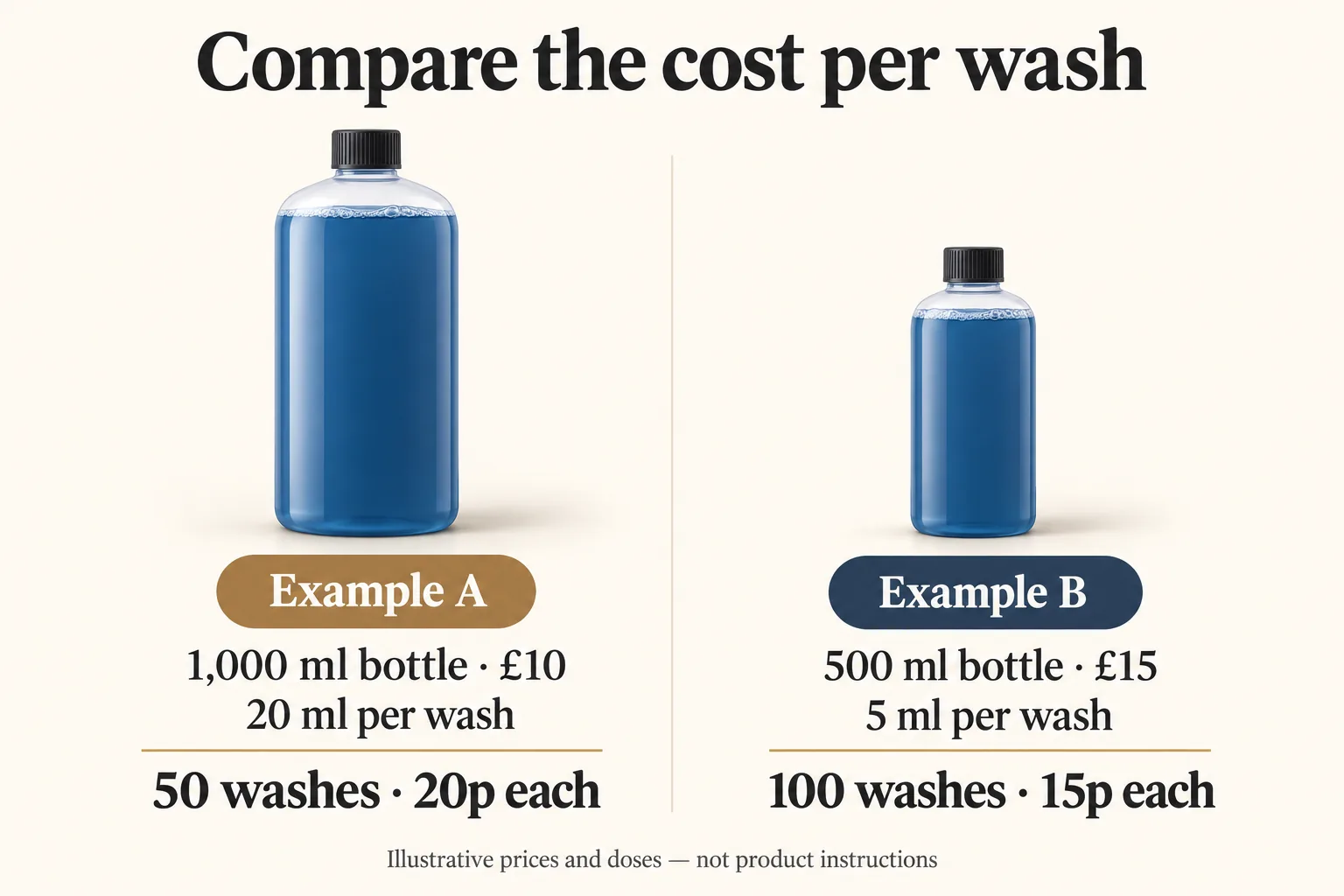
Assume both example doses are intended for the same 10-litre bucket. Example A costs £10 for 1,000 ml: at 20 ml per wash it gives 50 washes, or 20p each. Example B costs £15 for 500 ml: at 5 ml per wash it gives 100 washes, or 15p each. The smaller, more expensive bottle costs less per wash because its assumed dose is much smaller. That is a calculation, not evidence that it cleans better. A second bucket refill, spills or a different permitted dilution would change the result.
Real instructions can be very concentrated: Bilt Hamber’s Auto-Wash FAQ specifies 5 ml in up to 10 litres of water. Measure such a dose with a dedicated, clearly labelled measure. Do not reuse food utensils for cleaning chemicals, assume every bottle cap holds the same volume or substitute another brand’s dose. Follow the label if your bottle’s instructions differ.
A wash routine that protects the work you have already done
The basic sequence is to remove loose dirt before contact, wash with clean equipment, rinse and dry. Autoglym’s beginner guide describes rinsing first and washing from the upper panels down. Gtechniq’s wash guide describes a separate clean-water bucket for rinsing the mitt between panels.
- Read the label before opening the bottle. Check the permitted surfaces, dilution and any protective-equipment or storage instructions. Use each chemical separately as directed.
- Prepare clean tools and a cool surface. Keep grit out of the wash mitt and buckets. Follow the product’s weather restrictions; avoid letting the solution dry on the car.
- Rinse off loose contamination. Use any chosen pre-wash according to its own instructions before the contact stage. Do not try to compensate for remaining grit by scrubbing harder.
- Wash manageable sections. Rinse the mitt frequently and keep wheel-cleaning tools separate from paintwork tools. Replace dirty rinse water as needed.
- Rinse thoroughly and dry with suitable clean equipment. Check the result before adding another product. Shampoo is not a scratch repair.
A two-bucket arrangement can help organise the job, but it does not make contaminated equipment harmless. If a mitt falls on the ground, replace or thoroughly clean it before it touches paint again. Avoid washing where dirty water will run into a surface-water drain; check your local water company’s disposal guidance or use a suitable contained wash facility. The Environment Agency’s drainage guidance for businesses in England explains why contaminated washwater needs attention; its business rules should not be mistaken for a complete guide to domestic washing permissions.
Choose the situation that matches yours
My shampoo produces very little foam
Check the manufacturer’s description before adding more. Some formulations deliberately produce less foam. Confirm the dose, water volume and intended application method. A thicker foam blanket is not, by itself, a comparative cleaning test, and adding extra concentrate makes your cost-per-wash estimate wrong.
I have a ceramic coating and want stronger water beading
Find the coating’s maintenance instructions first. The answer may be a normal wash or a specified maintenance treatment, rather than changing to a shampoo that leaves its own film. Do not diagnose coating failure solely from the appearance of water immediately after applying a new product.
There are spots or marks after washing
Check whether the solution dried on the surface, whether rinsing was complete and whether drying equipment was clean. Do not immediately reach for an abrasive polish, especially on matt paint, film or a coating. If ordinary washing does not resolve the marks, identify the contamination and the finish before choosing a separate treatment.
Your buying checklist
- Write down the finish and any existing protection.
- Confirm compatibility on the current product label.
- Choose whether you want cleaning alone or an added finishing effect.
- Check that the product suits a bucket, foam gun or other intended method.
- Calculate the dose and cost for your usual water volume.
- Check storage requirements and whether you will realistically use a large bottle.
Cosmetic care is separate from mechanical upkeep. For the work covered by a garage service, see our guide to car servicing. If you are cleaning a used car for a viewing, our viewing checklist helps keep condition and paperwork checks in perspective.
Product instructions checked on 19 October 2026. Always follow the current label and the vehicle, coating or film manufacturer’s instructions.
The conversation