Choose the Volkswagen T-Cross if a smaller parking footprint, a sliding rear seat and the option of a manual gearbox suit your needs. Shortlist the new-generation T-Roc if you want a larger boot with the rear seats in use and a petrol mild-hybrid automatic. Before comparing prices, check which T-Roc generation is being offered: the current car is substantially different from the older model still common in used listings.
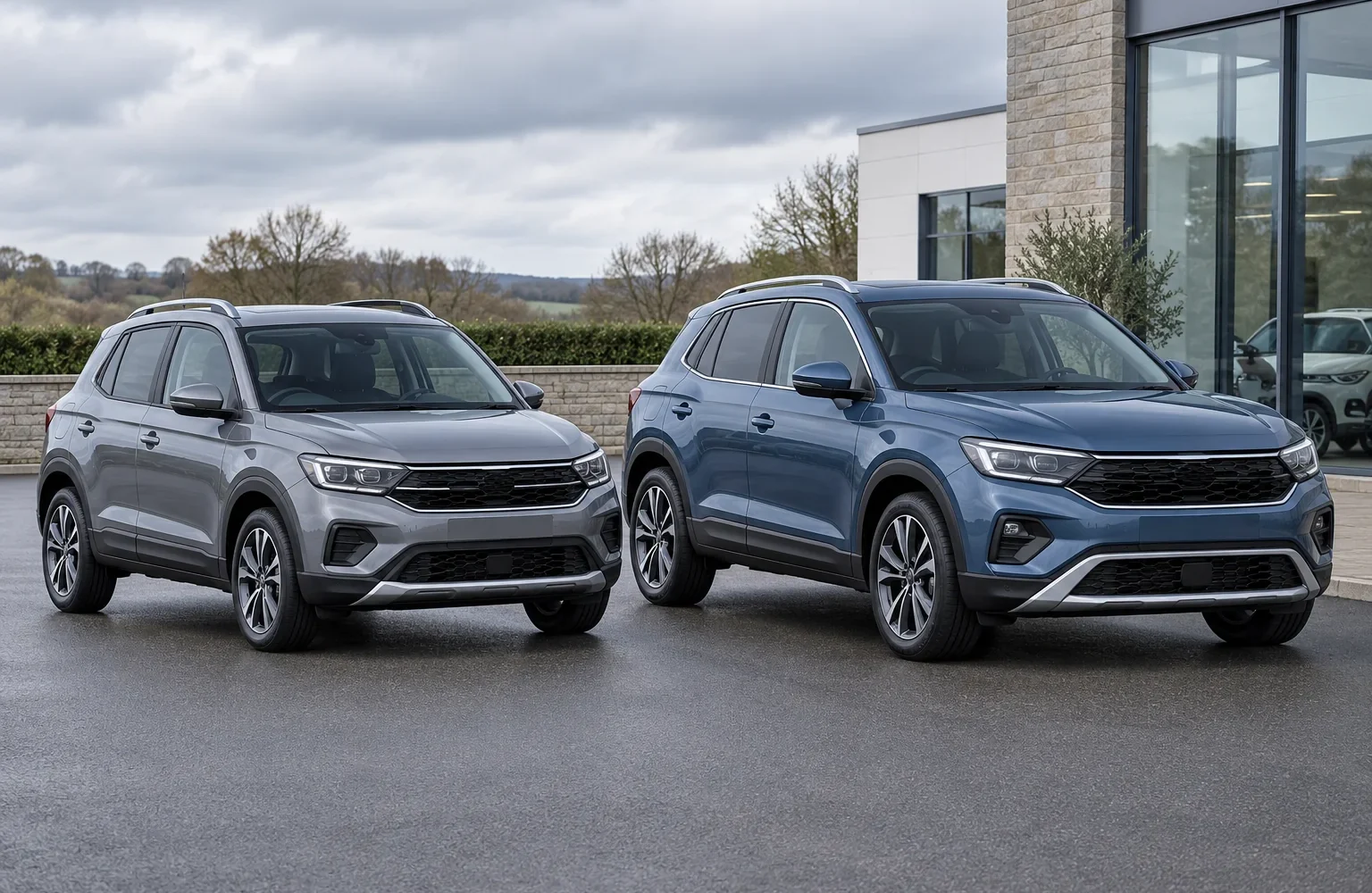
This UK buying comparison uses manufacturer specifications checked on 22 October 2026. It covers the current five-door petrol T-Cross and new-generation five-door T-Roc 1.5 eTSI, with a separate section for older T-Rocs. It is a specification-led guide, not a claim that we have road-tested these cars.
T-Cross vs T-Roc: the useful differences
| Question | T-Cross | New-generation T-Roc |
|---|---|---|
| Length | 4,127mm | 4,372mm |
| Body width, excluding mirrors | 1,760mm | 1,828mm |
| Wheelbase | 2,551mm | 2,629mm |
| Boot with rear seats upright | 385–455 litres, depending on rear-bench position | 475 litres |
| Powertrain covered here | Petrol; UK range lists 95–150PS | 1.5 eTSI petrol mild hybrid, 116PS or 150PS |
| Transmission choice | Manual or seven-speed DSG, depending on engine | Seven-speed DSG for the eTSI versions compared here |
Dimensions come from Volkswagen UK’s dedicated T-Cross dimensions and new T-Roc dimensions pages. The current T-Cross range page confirms the seat-dependent boot capacity and transmission choices. Check the retailer’s specification for the exact trim, model year and options; these figures are not measurements of every car carrying either badge.
On those published dimensions, the T-Roc is 245mm longer and 68mm wider at the body. That is roughly 25cm of additional length, which can matter on a short driveway. Body width alone cannot tell you whether either car clears a garage entrance: measure with the mirrors in the position needed to drive through, and leave room to open the doors.
Which one is more practical for a family?
Start with passengers, then compare the boot
The T-Cross has a particularly useful trade-off: its rear bench slides so you can allocate space to knees or luggage. Volkswagen describes 140mm of adjustment in its technical explanation of the updated T-Cross. Moving the bench forward increases the boot figure, but it also changes the space available to the people sitting there.
Set the driver’s seat for your normal driving position, then put your regular rear passenger behind it. Only after that should you see how far the T-Cross bench can move while remaining comfortable. A maximum luggage number is of little use if reaching it leaves your passenger cramped.
The new T-Roc’s larger quoted boot is a reason to try it if you regularly carry both people and luggage. It is not proof that your particular pushchair, mobility aid or dog crate will fit. A long folded frame can be awkward in a larger but differently shaped boot; the parcel shelf, load-floor position and tailgate opening all matter.
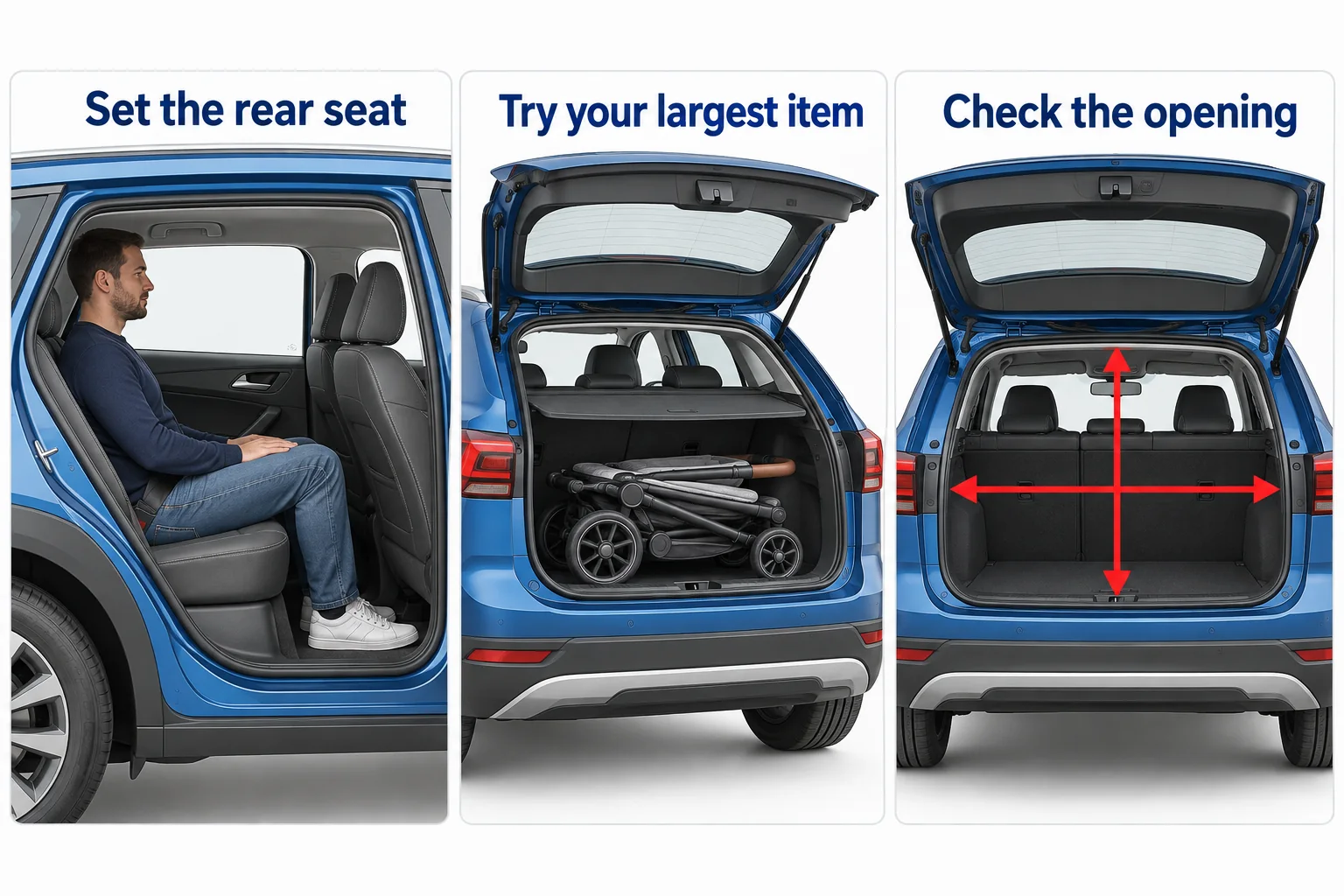
- Set the seats for the people who travel. Bring the child seat if relevant and have its compatibility and installation checked against both manufacturers’ instructions.
- Try the largest everyday item. With permission, load your folded pushchair or a lightweight size template. Include handles and wheels.
- Close the tailgate gently. Check that the load does not depend on forcing the parcel shelf or moving a passenger seat out of its required position.
- Add the ordinary bags. A boot that accepts the pushchair alone may still fail the weekly shop.
For occasional bulky loads, test how the seats fold and whether you can lift an item over the sill. For everyday accessibility, get in and out several times on both sides. Neither a litre figure nor a taller body establishes which seat height works for your knees, back or mobility needs.
Engines and gearboxes: compare the version you will buy
The T-Cross is the relevant starting point if you specifically want a manual from these current ranges. Its UK line-up includes five- and six-speed manuals as well as seven-speed DSG, depending on engine. Check the full engine and gearbox description rather than assuming every trim can be ordered with either.
Volkswagen UK’s T-Roc technical data lists the 1.5-litre versions at 116PS and 150PS. They are eTSI mild hybrids with DSG. Its published 0–62mph figures are 10.6 and 8.9 seconds respectively; those figures describe straight-line acceleration, not how either car will feel on your route.
In Volkswagen’s eTSI explanation, a 48-volt system recovers energy and assists the petrol engine. Do not interpret the mild-hybrid badge as a promise of a usable electric-only commuting range. Our mild-hybrid guide explains that distinction.
Volkswagen has also announced a separate full-hybrid system for the T-Roc. That announcement does not make an eTSI stock car a full hybrid, or establish the UK delivery date and specification of a different version. If a retailer offers a Hybrid or another powertrain, obtain its own UK data instead of applying this eTSI comparison.
On the test drive, use the kinds of roads and manoeuvres you actually do: pulling out of a junction, joining a faster road, a low-speed reverse into a parking bay and a hill if your route includes one. In a DSG car, assess whether the response to your inputs feels predictable. Our automatic gearbox guide explains how a dual-clutch gearbox differs from other automatics. We have not measured either car’s ride, cabin noise or real-world economy here.
Is the T-Cross cheaper to own?
Compare the two actual cars on your shortlist, not one model’s entry price against another’s heavily equipped version. A discounted stock car, a different gearbox or an older registration can change the gap. Ask for itemised on-the-road quotes with the same must-have equipment, and record any delivery conditions.
| Cost | What to obtain for each car |
|---|---|
| Purchase or finance | Cash price, or the full finance quotation including deposit, term, mileage, fees and any final payment. Compare the same ownership outcome. |
| Insurance | A quote for the exact registration or full model specification, using the same driver details and cover. |
| Fuel | The exact variant’s consumption figure as a comparison starting point, plus a realistic allowance for your route. |
| Servicing and tyres | Written service requirements and prices for the actual wheel and tyre size. |
| Used-car catch-up work | Any imminent service, worn tyres, missing maintenance evidence or inspection findings priced before purchase. |
A small fuel-economy difference may be less important than the purchase-price gap. Here is a deliberately hypothetical example, not a forecast for either Volkswagen: at 10,000 miles a year and petrol at £1.50 per litre, 50mpg costs about £1,364 a year; 47mpg costs about £1,451. The difference is about £87 a year.
The calculation uses UK imperial gallons: annual miles ÷ mpg × 4.54609 × price per litre. Replace the assumptions with your own, and do not treat an official combined figure as a guaranteed result. A higher monthly payment or another set of tyres can outweigh a modest fuel saving.
Buying used? An older T-Roc changes the comparison
The current T-Roc numbers above do not describe the earlier-generation car. For example, Volkswagen’s October 2017 UK T-Roc brochure, page 29, lists 445 litres with the rear seats upright, or 392 litres for the 4MOTION versions specified there. Those are historical examples, not a blanket specification for every used T-Roc.
Ask for the build/model year, engine, gearbox, drive system and body style. A registration date alone does not settle the generation, and the T-Roc Cabriolet needs its own comparison. Match the exact car to its contemporary UK brochure or retailer specification.
Check service invoices against the vehicle and mileage, then inspect the car and drive it from cold where possible. Have unexplained warning lights, poor starting, unusual noises or gearbox behaviour investigated before committing. A shared badge or engine family does not establish that two used cars have equal condition or running costs.
Our questions to ask a used-car seller help organise that conversation. We do not have comparable failure data for every engine and generation, so this comparison does not declare either model the reliability winner.
Which should be on your shortlist?
Open the situation closest to yours, then use it as a viewing checklist.
I park in a tight space and usually carry one or two people
Try the T-Cross first. Measure your actual entrance, parking length and door clearance, then check whether its luggage space works with the seats where you need them. If you want a manual, confirm the specific engine offers it. Keep the T-Roc on the list if its extra size causes no practical problem and the exact quote is attractive.
I regularly carry rear passengers and a full boot
Try both with those passengers and your largest luggage item. The new T-Roc’s larger published boot makes it worth investigating, but use the T-Cross bench in a position that genuinely suits the people aboard. Choose the car that passes both checks at once, without assuming the maximum T-Cross boot setting preserves maximum legroom.
I am comparing a nearly new T-Cross with an older T-Roc
First identify the T-Roc generation and exact drivetrain. Compare maintenance evidence, condition, warranty terms and imminent expenditure alongside space and equipment. Do not apply the new T-Roc’s mild-hybrid powertrain or 475-litre boot specification to the older car. Arrange an independent inspection if you cannot establish its condition confidently.
The useful winner is the car that fits your passengers, luggage, parking space and budget in the configuration you will actually use. Take the same checklist to both viewings and keep the written specifications with the quotes.
The conversation