There is no standard number of minutes you can park on a single yellow line. During its restricted hours, you must not wait or park unless a valid exemption applies. Outside those hours, the yellow-line restriction is inactive, but other controls can still prevent parking. Read the roadside time plate or the controlled parking zone entry signs before leaving the car.
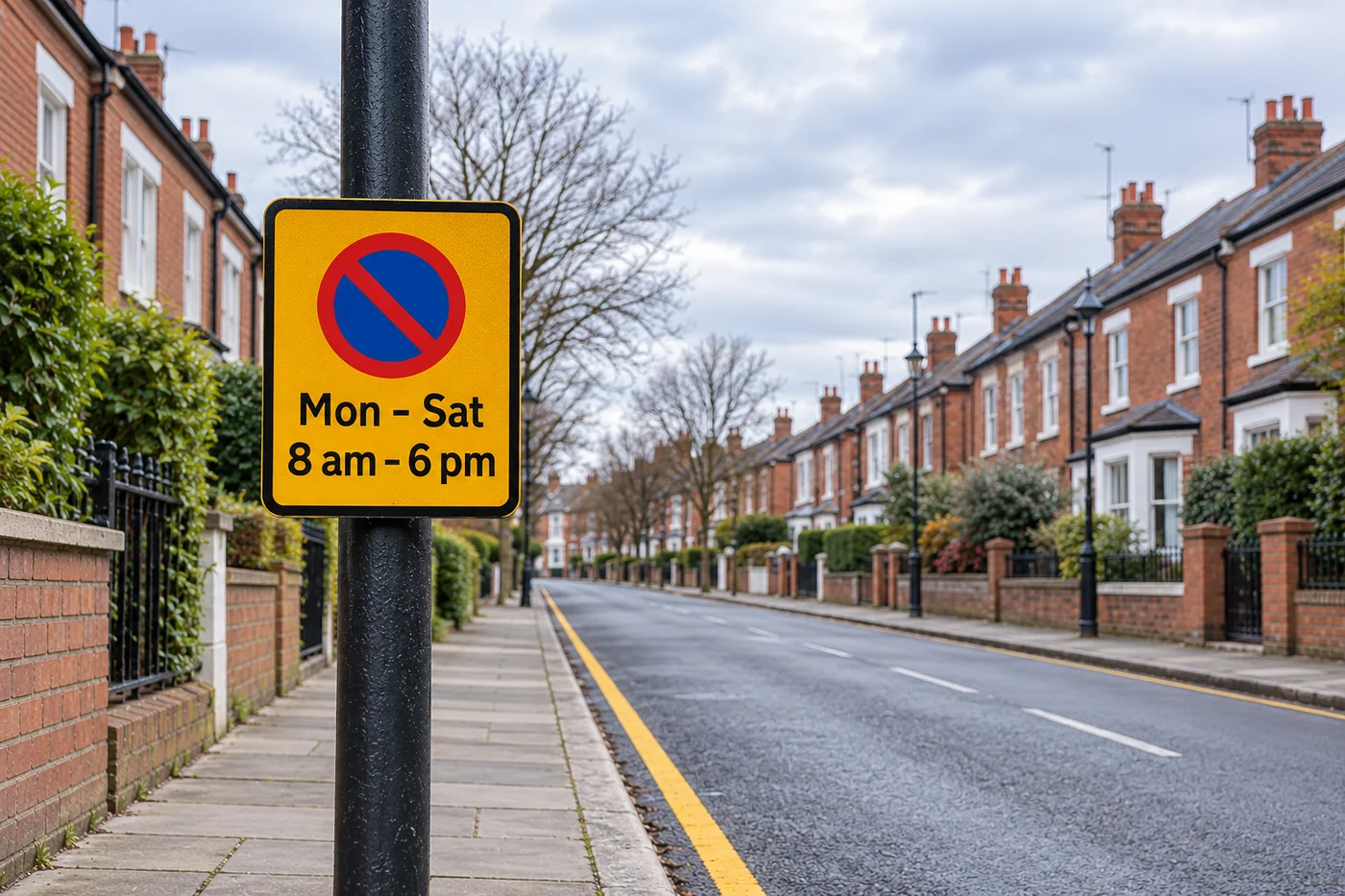
This guide explains ordinary on-street restrictions, with separate Blue Badge guidance for England, Scotland, Wales and Northern Ireland. Yellow paint in a private car park does not automatically carry the same rules: read the operator’s terms there.
How long can you stay on a single yellow line?
The useful question is when does the restriction operate?, rather than whether you get five, ten or twenty minutes. Highway Code rule 238 prohibits waiting and parking on yellow lines during the hours shown by the relevant signs. Staying in the driver’s seat does not create an exemption.
Suppose a sign says Monday to Saturday, 8 am to 6 pm. On Tuesday, the waiting restriction runs from 8 am until 6 pm. A driver arriving at 7.30 am cannot assume a two-hour stay: the restriction starts halfway through it. A driver arriving at 6.30 pm is outside those particular hours. These are examples, not standard UK parking times.
Before an overnight stay, check the next morning’s start time as well as tonight’s end time. If the sign has separate morning and afternoon periods, check each period separately. Photographing the plate and setting a reminder can help you keep track, but neither changes the restriction.
Evenings, Sundays and bank holidays
There is no general rule that a single yellow line becomes available after 6 pm or all day on Sunday. The Department for Transport’s sign guide explains that a plate showing times but no days applies every day, including Sunday. A bank holiday normally follows the restriction for that day of the week unless the plate expressly says otherwise.
For the Monday-to-Saturday example above, Sunday is outside the stated days. A Monday bank holiday is still a Monday. An event-day sign may add a different restriction, so check for that too. Do not copy what another parked driver has done or rely on the hours of a nearby paid bay.
What if there is no sign beside the line?
You may be inside a controlled parking zone (CPZ). Its entry signs give the hours for single yellow lines that follow the zone’s restriction. An individual plate is not required beside each of those stretches. Where a stretch operates at different times, an adjacent plate identifies the difference. Hackney Council explains this distinction and warns that some restrictions differ from the surrounding zone.
If you missed the entry sign, find the zone’s official council map and hours, then check that you are in the correct zone and that the stretch has no different plate. A sign across the road or a parking meter’s tariff is not a reliable substitute. If the relevant hours remain unclear, choose a clearly permitted space rather than treating the missing plate as permission.
Northern Ireland uses the same distinction between a single-line time plate and a controlled-zone entry sign in its official yellow-line enforcement guidance.
Waiting, passenger stops and loading are different
A yellow-line waiting restriction is different from a no-stopping restriction. Picking up or setting down passengers can be permitted, as can genuine loading or unloading where it is not prohibited. The activity matters: sitting outside a shop waiting for someone is not the same as a passenger actually getting in or out.
| Your purpose | What matters |
|---|---|
| Waiting for a friend or going shopping | This is not an ordinary passenger boarding or loading exemption. Find permitted parking. |
| Passenger getting in or out | Use only the time needed for the actual boarding or alighting. Check for a separate no-stopping restriction and choose a safe position. |
| Moving goods to or from the vehicle | Check the loading rules, kerb marks and signs. An active loading ban prevents relying on the loading exemption. |
| Parking with a Blue Badge | Check the rules for that part of the UK, local exceptions, loading bans and the badge display requirements. |
Loading limits are not identical everywhere. For example, Kensington and Chelsea’s guidance allows up to 40 minutes for unloading heavy or bulky goods on yellow lines where no loading restriction applies, and requires continuous loading activity. That is a local rule, not a 40-minute national parking allowance. Check the relevant authority’s conditions before planning a collection or delivery.
Nor is an enforcement officer’s observation period free parking time. Hackney explicitly distinguishes observation from permission: officers may need to establish whether loading or another exemption is taking place. Do not build a short shopping stop around an assumed grace period.
Read the yellow marks on the kerb as well
The long yellow line beside the kerb concerns waiting. Short yellow strokes across the kerb concern loading and unloading. A single kerb mark means a loading ban at the times on its plate; double kerb marks mean a loading ban at all times. Manchester’s loading guidance illustrates the distinction in words.
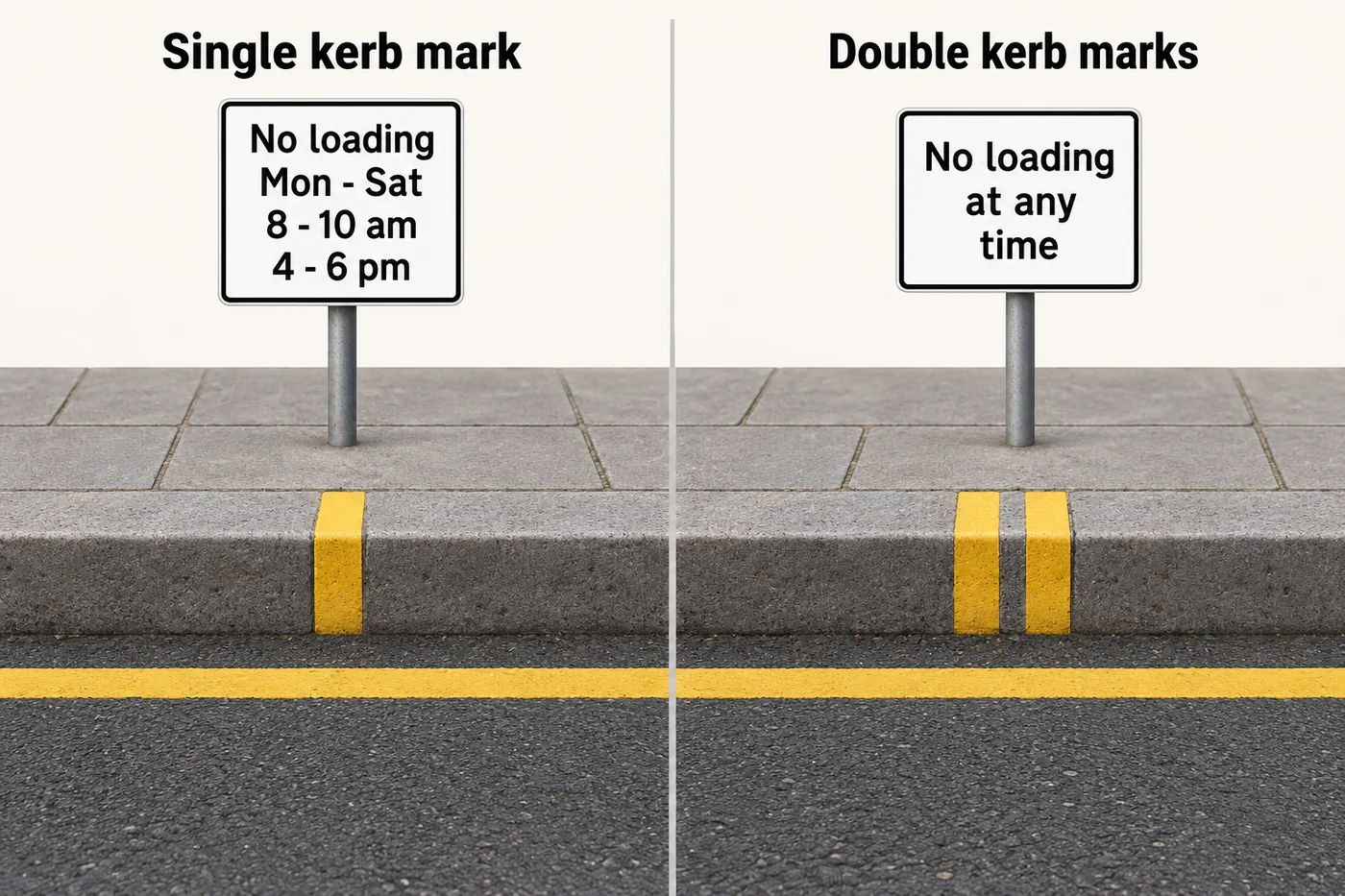
Check both sets of hours. A waiting restriction and a loading ban need not have the same timetable. The loading plate is normally white, while a waiting time plate is yellow. A ban can apply along a length of kerb even though the short marks are spaced apart; the gap between marks is not a loading space.
Can Blue Badge holders park on single yellow lines?
Often, but the concession has conditions. It is not permission to cause danger or obstruction, disregard an active loading ban, or use a badge for somebody else’s independent shopping trip. Check the destination’s rules rather than assuming your home authority’s arrangements apply.
| Where | Time and checks |
|---|---|
| England | Usually up to three hours, with the badge and arrival clock displayed. Generally unavailable during a loading ban. Parts of central London have different arrangements. |
| Wales | Usually up to three hours, safely and without obstruction, with badge and arrival clock. Check loading restrictions and any specific local concession. |
| Scotland | Usually no time limit on yellow lines where loading is allowed and parking is safe. Check local signs and display the badge correctly. |
| Northern Ireland | Up to three hours where the concession applies, with the badge displayed. Do not park within 15 metres of a junction or during a loading ban. |
The English guidance and Welsh guidance also require at least a one-hour gap before parking the same vehicle again in the same road or part of a road on the same day. Set the clock to the quarter-hour period in which you arrived, as their instructions explain.
For Scotland, North Lanarkshire Council confirms the usual absence of a time limit, while mygov.scot sets out the loading and safety conditions. Northern Ireland’s badge-holder guidance explains its three-hour concession and display requirements. Off-street car parks set their own conditions.
Work through three common situations
These examples assume no other restriction and an ordinary car without a Blue Badge exemption. They show how to read the signs, not permission for a particular street.
The plate says Mon–Sat, 8 am–6 pm. Can I stay from 5.50 pm?
The waiting restriction is still active until 6 pm. Arriving ten minutes before the end does not create a ten-minute parking allowance. Use a permitted space until the restriction has finished.
It is Sunday, but the plate only says 8 am–6 pm
With no days stated, those hours apply every day. At midday on Sunday, the waiting restriction is active. A plate that expressly says Mon–Sat would give a different result.
The waiting hours have ended, but there are double kerb marks
The double kerb marks indicate an all-day loading ban. The end of the waiting period does not cancel that separate control. Check the full signs and use another permitted place for your intended stop.
Before you leave the car
- Identify the restriction for the exact stretch and side of the road.
- Read the days, times and any zone or event-day conditions.
- Check kerb marks, loading plates and temporary notices.
- Consider the whole stay, including when a restriction next begins.
- Confirm that the position is safe and that you are not blocking access or pedestrians.
Driving partly onto the pavement does not evade a yellow-line restriction: it normally covers the adjacent footway and verge too. Separate safety and pavement-parking rules also apply. The absence of an active yellow-line restriction does not override crossing zig-zags, a bus-stop clearway or another prohibition.
If the line is red, read our red-route stopping guide. If the road has a clearway sign, use our clearway and urban-clearway explanation; a yellow-line exemption must not be transferred to a different restriction.
Official sources checked 27 October 2026. The sign examples are illustrative. This article explains published guidance and does not claim legal review or a site-specific parking assessment.