The Taigo is the narrower, shorter choice if parking space or a manual gearbox is your priority. The new, second-generation T-Roc offers a larger published boot volume, a wider cabin and mild-hybrid automatic powertrains. The useful comparison is the exact car you can buy: an older T-Roc has different dimensions and engines, and a larger luggage figure does not guarantee that your awkward load will fit.
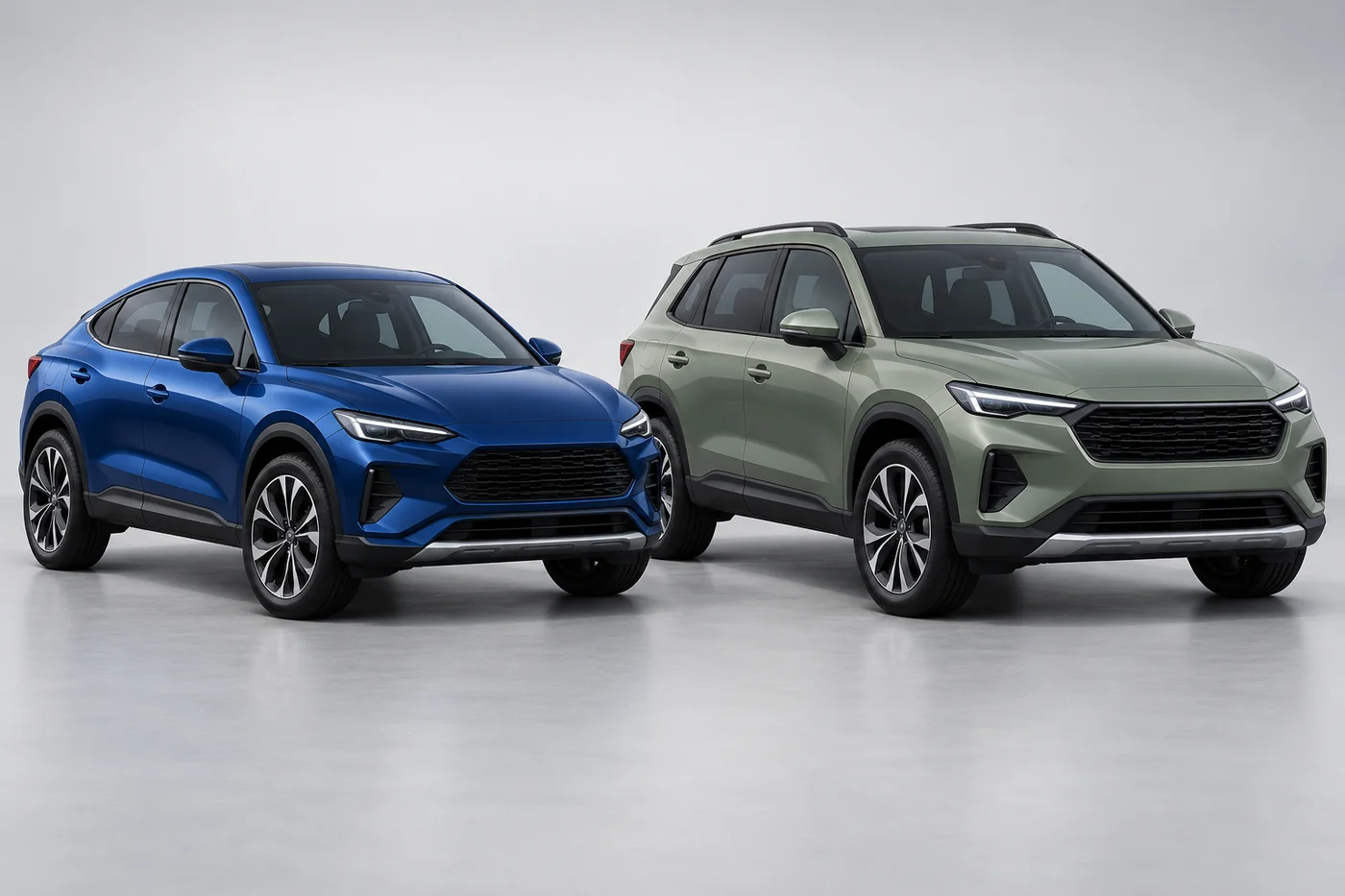
This guide compares the current UK Taigo with the new five-door T-Roc, using Volkswagen information checked on 29 October 2026. It is a document-based buying comparison, not a road test. We have not measured these cars or independently tested their fuel consumption. Older T-Roc hatchbacks and the T-Roc Cabriolet need their own specification checks.
Which is bigger: the Taigo or T-Roc?
| Measurement | Taigo | New T-Roc |
|---|---|---|
| Length | 4,266mm | 4,372mm |
| Body width, excluding mirrors | 1,757mm | 1,828mm |
| Height | 1,518mm | 1,573mm |
| Wheelbase | 2,554mm | 2,629mm |
| Boot volume, rear seats upright | 440 litres | 475 litres |
Sources: Volkswagen UK’s dedicated Taigo dimensions and new T-Roc dimensions pages. These place the T-Roc 106mm longer, 71mm wider across the body and 55mm taller. The difference matters at a narrow garage entrance or beside another parked car, even when both fit comfortably within the marked bay.
Body width excludes the mirrors. Measure your entrance and obtain the mirror-out width for the exact version before committing. A folded-mirror parking position is not a substitute for enough room to enter, leave and open the doors normally. Check tailgate clearance under a low garage roof too.
Be careful with mixed-generation comparisons. Volkswagen’s international launch sheet lists the new T-Roc at 4,373mm, while its current UK dimensions page gives 4,372mm; this guide consistently uses the UK figure. More significantly, older T-Roc dimensions circulating online refer to the previous generation. A one-millimetre source difference will not decide a purchase, but confusing the generations can.
Boot space: the T-Roc wins on litres, but test the shape
The published difference is 35 litres with the back seats upright. That makes the T-Roc worth inspecting first if you regularly run out of luggage space, but it is not a promise that every item fits better. The opening, floor height, wheel housings and angle of the closed tailgate all affect usable space.
There is a useful example in Volkswagen’s technical data: the Taigo’s listed boot length with seats upright is 943mm, compared with 812mm for the new T-Roc. A car can have a longer load floor and still have less total volume. See the current Taigo technical tables and T-Roc technical tables. Treat these as starting measurements and verify the floor setting on the car in front of you.
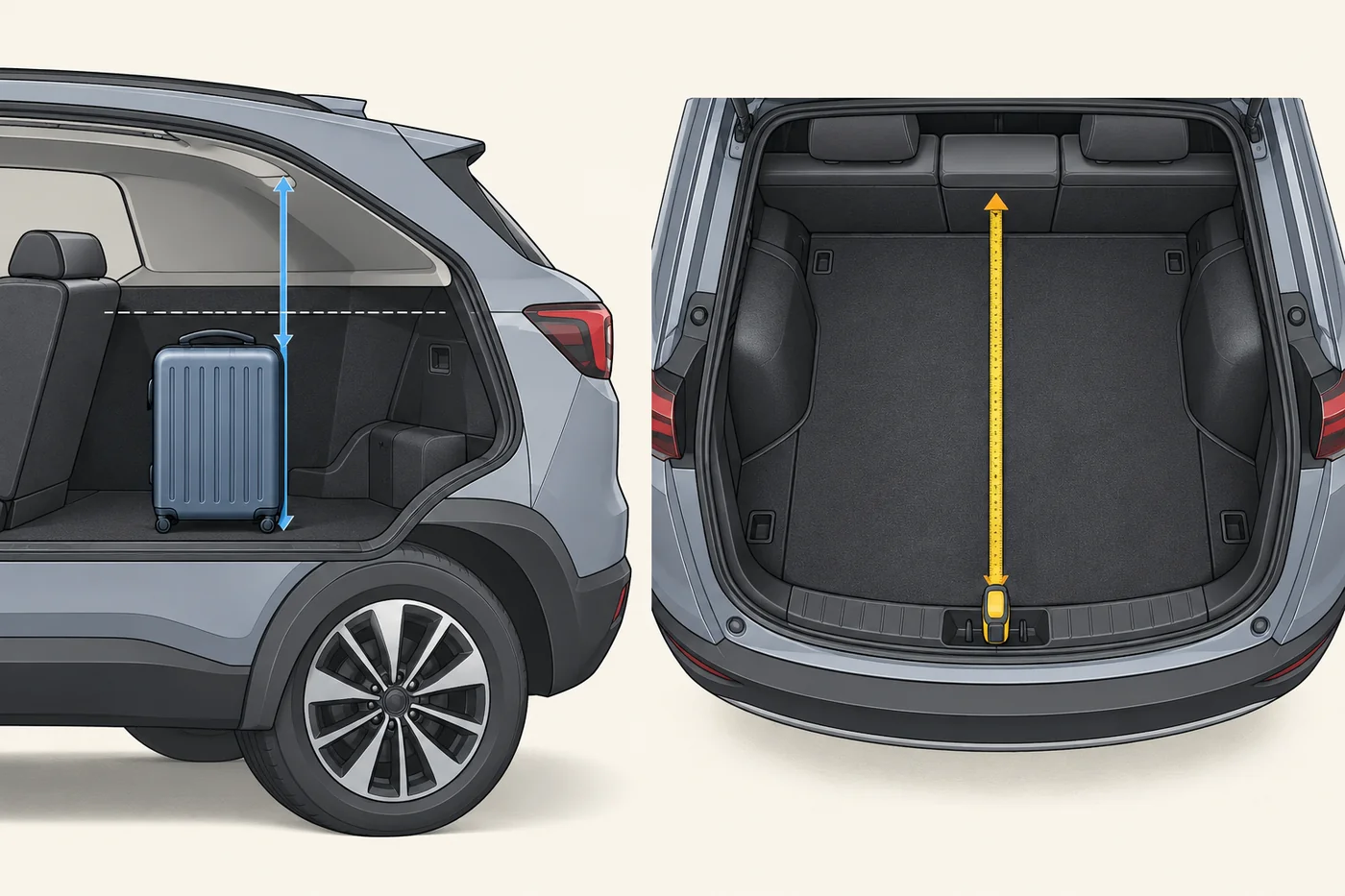
Use the same short load test in both cars:
- Keep the seats you need upright. A folded-seat capacity is irrelevant if those places must be occupied on the journey.
- Bring the difficult item. Try the folded pushchair, mobility aid, dog crate or work case before adding soft bags.
- Check the opening and the closed tailgate. Do not assume an item fits because it sits on the floor while the hatch is open. Close it gently without forcing it against the load.
- Leave room for ordinary use. Check that shopping still fits and that you can remove the main item without dismantling the whole load.
The Taigo’s coupé-style roof is part of its appeal. Try the rear seats with your usual passengers, especially if someone is tall or needs an easy route in and out. Set the front seat for its normal driver first. Where child seats are involved, check the actual installation against the vehicle and child-seat instructions; a broad cabin measurement cannot establish compatibility.
Engines and gearboxes: manual petrol or mild-hybrid automatic?
| Model | Published choice | What it means when shortlisting |
|---|---|---|
| Taigo | 1.0 TSI and 1.5 TSI petrol engines; manual and seven-speed DSG versions, depending on engine and trim. | Includes manual options. Confirm the exact engine output and gearbox in a stock advert. |
| New T-Roc | The current UK tables list 1.5-litre engines at 116PS and 150PS; the range is presented as eTSI mild hybrid with seven-speed DSG. | The verified current comparison is with an automatic mild hybrid. Older T-Roc manual, diesel or other variants are separate choices. |
Volkswagen’s Taigo range page identifies petrol power and both manual and DSG gearboxes. Its new T-Roc range page identifies the mild-hybrid automatic range. Model-year changes and stock availability matter: have the retailer put the engine, transmission and equipment in writing on the quotation.
The T-Roc’s 1.5 eTSI uses a 48V system to recover energy and assist the petrol engine; it can also allow the engine to stop during coasting. It is not a plug-in hybrid and does not need an external charger. Volkswagen’s technical explanation of the eTSI also discusses other planned drivetrains. An international announcement is not proof that a particular version is currently available to order in the UK.
Do not buy the mild-hybrid badge expecting the same use as a full hybrid or an electric car. Our mild-hybrid guide explains that distinction. Equally, an engine capacity or power figure cannot tell you whether you like the accelerator response, gearbox behaviour or noise. Test the exact version on a representative route, with controls familiarised while parked.
Equipment and comfort: compare the actual specification
Matching trim names do not establish matching equipment across the two ranges. Write a short list of features that would change daily ownership: parking sensors, a reversing camera, heated seats, your preferred phone connection or a particular seat adjustment. Ask for a demonstration on the car you are considering.
Try the controls you use most often. Can you adjust the temperature, demist the screen and start navigation without an awkward sequence? Check the view when reversing, the position of the seat belt and how easily everyone gets in. These observations are more personal and more useful than assuming the taller or more expensive car must be more comfortable.
Keep wheel and tyre size on the comparison sheet. Obtain replacement tyre prices for the fitted size and test the same specification if ride comfort matters. We cannot rank these cars for comfort, handling or cabin noise from their dimensions, and a dealer demonstration on a different wheel package may not answer your question.
Which costs less to own?
Compare two written quotations on the same basis. Cash prices should include the same required equipment and delivery assumptions. For finance, compare the deposit, all payments, fees and any final payment, together with mileage and end-of-agreement conditions. A lower monthly figure alone does not establish a lower total cost.
Then add insurance quotes for the actual versions, servicing, tyres and the relevant vehicle tax. Use consumption figures for the exact engine and trim, measured under the same test cycle. Mild-hybrid assistance does not automatically make the larger T-Roc cheaper to fuel than every Taigo; real consumption also depends on your journeys and conditions.
A simple budget example shows why small economy differences need perspective. At 10,000 miles a year, an assumed 50mpg uses about 909 litres, while 55mpg uses about 827 litres. At an illustrative £1.50 per litre, the difference is roughly £124 a year. These are hypothetical imperial-mpg figures, not test results or current fuel prices. A purchase-price gap or work due on a used car can easily matter more.
Both fall under Volkswagen’s standard UK new passenger-car warranty: two years with unlimited mileage, followed by a third year subject to a 60,000-mile limit and the stated conditions. There are exclusions, and ordinary maintenance is not covered. Read the manufacturer’s warranty terms, and check the remaining time and mileage on a used vehicle. The shared warranty does not prove equal reliability.
Which should you inspect first?
Open the situation closest to your main constraint, then use it to plan the viewing.
I need a manual or have a tight parking space
Start with a suitable Taigo: the current range includes manuals and its body is narrower and shorter than the new T-Roc. Confirm the actual gearbox, mirror clearance and door-opening room. If you are considering an older manual T-Roc, compare that car’s own dimensions instead of this new-model table.
I need more room for passengers and luggage
Inspect the new T-Roc first, then bring the same passengers and load to the Taigo. The T-Roc’s greater published volume and body width justify the comparison, but the Taigo’s listed load-floor length may suit some items. Keep occupied seats upright and check the closed hatch.
Both fit, so the price will decide
Compare the exact equipment, full purchase or finance cost, insurance and maintenance due. Put any expected fuel saving on a yearly basis using realistic assumptions. If a used T-Roc is competing with a newer Taigo, include condition and remaining warranty rather than treating the badge as an upgrade by itself.
Buying used: identify the generation before comparing
Record each car’s build or model year, engine, gearbox, trim, registration and mileage. A registration date alone may not resolve whether a T-Roc is old stock from the previous generation. The Cabriolet is a different body style and should not inherit this guide’s boot figures.
Check service records against the applicable schedule, outstanding recalls with the manufacturer, tyre condition and any warning messages. Ask for an explanation and evidence for gaps or inconsistent claims. Where you cannot assess condition yourself, arrange an appropriate independent inspection. Our used-car viewing checklist helps organise that appointment.
If the Taigo’s rear shape is your main hesitation, the T-Cross versus T-Roc comparison covers a different Volkswagen alternative. For this pair, buy the car that fits your space, load and budget in the version actually offered to you.