
Choose windscreen wipers by the exact vehicle application, blade position and arm connector, then confirm the part number and pack contents. A blade of the right length is not enough on its own. Start with the vehicle handbook and a blade manufacturer’s current catalogue; check the body style, production dates and right- or left-hand-drive application before ordering. [1]
The practical aim is to finish with an identifiable part for each position: driver’s side, passenger’s side and, where fitted, the rear window. You should not need to guess which adapter to use when the parcel arrives.
Start with the car, not a measurement
Collect the make, model, body style and year, together with the registration. When a catalogue asks for a production period or steering position, complete those fields too. DENSO’s selection guidance explicitly separates body type, production years and left- or right-hand drive, then provides specifications under the selected part number. [1]
A registration search is a convenient starting point. Read the vehicle description it returns instead of going straight to the basket. If it shows the wrong body style, offers two unexplained alternatives or does not recognise an imported car, stop and ask the supplier to identify the application. Give them the VIN privately if requested, rather than posting it in a public product question.
Treat the blades already on a used car as a clue, not proof of the correct specification: you may not know who fitted them. A visible old part number can help a supplier investigate, but an unexplained mismatch between the old blade and the catalogue needs resolving before purchase.
The checks that matter on a product page
| Check | What to confirm | When to pause |
|---|---|---|
| Vehicle application | Your exact model, body style, production range and any stated steering-side restriction. | The listing only names a broad model family. |
| Position | Driver, passenger, front pair or rear, as specified by the catalogue. | A picture shows two blades but the description sells one. |
| Length | The specified length for each position, keeping millimetres and inches distinct. | You are choosing the nearest available size. |
| Connector | The blade’s listed fitting and, if required, the included adapter for that application. | The length matches but the attachment is unexplained. |
| Pack contents | The exact part number, quantity and whether the rear blade is included. | You cannot tell whether the price covers the complete job. |
Keep a screenshot or note of the selected application and part number. If the delivered box carries a different code, ask the seller to explain the substitution before opening or fitting it. That creates a clear question for customer support instead of an argument about whether two blades look similar.
Check the connector as carefully as the length
The connector is the attachment between the blade and the wiper arm. Different systems exist: DENSO lists hook, bayonet, twin-screw and OE flat applications in its range. The description “flat blade” therefore does not establish a particular attachment. [3]
Likewise, “universal” is a product-range description, not permission to fit a blade to any car. Bosch’s range separates original-adapter, multi-clip and upgrade products, with different adapter arrangements. Select the application first and then check which adapter that product specifies. [2]
If the supplier needs a photograph, take a clear view of the existing attachment without dismantling it. Do not remove the old blade simply to make a shopping comparison. If the connection is concealed or you cannot identify it confidently, use a parts counter or fitting service.
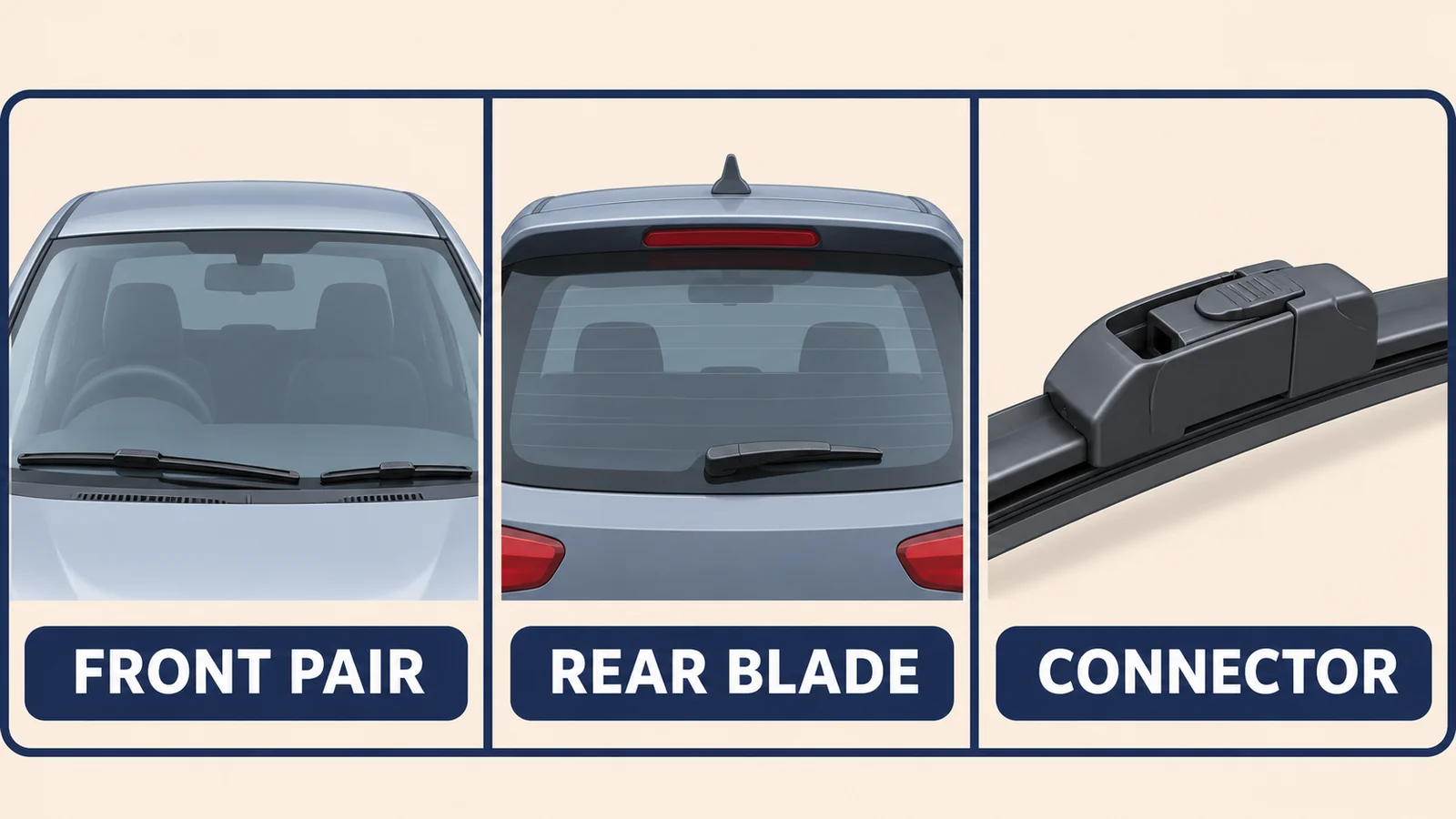
Front pair and rear blade: make separate selections
Check both front positions rather than assuming that two identical blades make a pair. A front set and two single blades are also different buying options: Bosch, for example, lists both set and single packaging across its ranges. Compare the complete requirement, not the lowest price displayed beside one blade. [2]
Look up the rear blade separately if your car has one. DENSO treats rear blades as their own product group. Do not select a short front blade merely because its measured length resembles the rear one. [3]
For example, suppose a search offers a front pair and a separate rear blade. If you need all three positions, the front-pair product alone leaves the rear job unfinished. If you only need the rear, buying the front pair because its photograph is more prominent solves the wrong problem. Read the position and quantity fields before comparing prices.
Conventional, flat or hybrid: choose among confirmed fits
These names describe blade construction. A conventional blade uses an articulated frame; a flat blade has a lower-profile body with a central connection; a hybrid combines elements of the two. They are not grades on a simple good–better–best scale. [3]
For a like-for-like purchase, identify the approved application and compare price, supplied fittings and availability. If you want a different design, look for an explicit upgrade application for your vehicle. Do not assume that choosing the same nominal length makes an upgrade compatible.
Valeo’s passenger-car range illustrates why the product details matter: it offers different conventional, flat and hybrid products and directs buyers to a selector or the packaging QR code to find the correct application. Use that selection information rather than treating the blade shape in a promotional image as a fitment guide. [4]
Is the most expensive blade necessarily the best choice?
First compare products confirmed to fit your car. Then compare the total cost for the positions you need, whether fitting is included and how clearly the seller identifies the supplied part. A premium description or an attractive box cannot resolve an uncertain connector. This guide does not rank brands or claim road-test results.
What if two catalogues disagree?
Keep both part numbers and the vehicle details used in each search. Ask the blade manufacturer or supplier to reconcile the difference, including any production-date or body-style restriction. Do not average two suggested lengths or order both and try to force one to fit.
Before you order: a six-point note to keep
- Vehicle: record the exact catalogue application, including any date or steering-side qualification.
- Positions: list front driver, front passenger and rear separately; mark any position you are not replacing.
- Parts: copy the manufacturer and complete part number for each selection.
- Fittings: confirm the specified connector or adapter is supplied.
- Quantity: check whether each price is for one blade or a set.
- Fitting plan: locate the relevant handbook instructions or book someone to fit and check them.
Do not treat a buying guide as a universal installation procedure. Bosch directs owners to the vehicle handbook for the service position and to the product instructions for fitting. [2]
If the wipers are already failing to clear your view, deal with that before relying on the car in wet conditions. DENSO notes that wear such as splitting rubber can require replacement sooner than its general annual interval; a calendar date is not a guarantee of condition. [3] Include the windscreen and wipers in your checks before your next drive. If you are booking other maintenance, our guide to comparing servicing quotes can help you establish whether blade supply and fitting are included or separate.
Sources
- DENSO — How to: Install DENSO wiper blades, vehicle-selection guidance. Checked 5 November 2026.
- Bosch Mobility Aftermarket UK and Ireland — Wiper blades, product ranges and handbook guidance. Checked 5 November 2026.
- DENSO — Wiper blade types and attachment systems. Checked 5 November 2026.
- Valeo Service — Valeo First wiper blades for cars. Checked 5 November 2026.