Both describe vehicles that can drive all four wheels. AWD commonly means an automatic system suited to everyday road use; 4WD often describes selectable systems with extra off-road functions. Those are tendencies, not reliable operating instructions. Check the exact vehicle’s modes, dry-road restrictions and tyres before deciding what it can do.
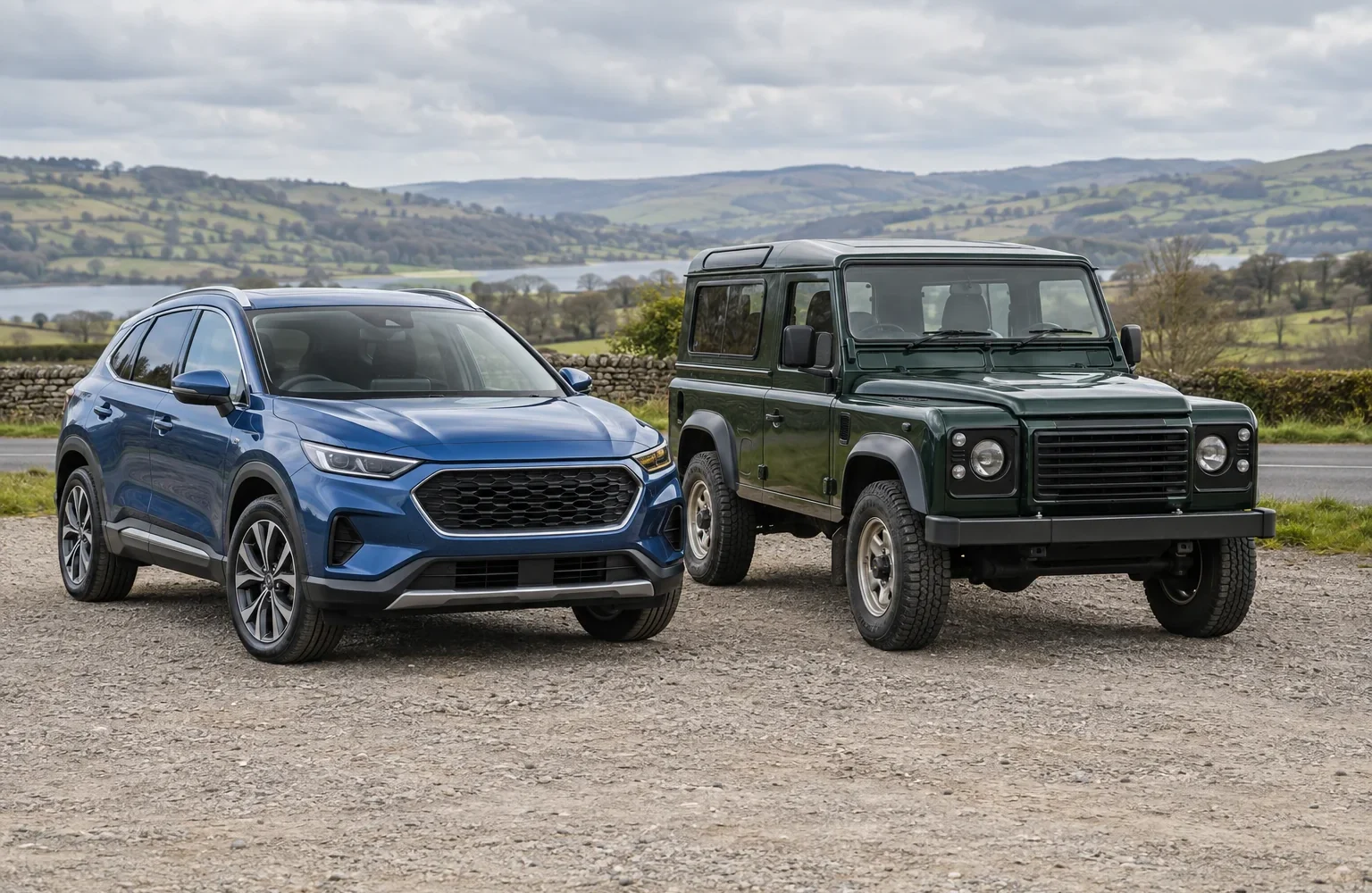
A four-wheel-drive badge tells you less than you might expect. It does not establish whether the car has low-range gearing, whether you can leave every mode selected on tarmac, or how well it will stop on ice. The useful comparison is between the systems fitted to your actual shortlist.
This guide explains the main arrangements, the questions worth asking at a viewing and the limits that matter in everyday ownership. It is based on manufacturer information, not a road test of the illustrated vehicles.
What is the difference between AWD and 4WD?
All-wheel drive and four-wheel drive both concern which wheels can receive driving torque. They do not describe the body shape or whether the gearbox is manual or automatic. A tall SUV is not automatically four-wheel drive, and selecting an automatic gearbox does not tell you which wheels it drives.
Manufacturers use the names differently. Subaru describes its Symmetrical AWD as permanent; Jeep describes both full-time and part-time 4WD systems; Toyota has used a separate rear electric motor for hybrid AWD. These are materially different arrangements under closely related labels. Read the system description rather than treating the badge as a technical specification. See Subaru’s engineering explanation, Jeep’s system glossary and Toyota’s electric AWD explanation.
| Question | Road-focused AWD | Selectable or full-time 4WD |
|---|---|---|
| Who manages drive to the axles? | Usually the system; operation may be continuous or on demand. | May be automatic, driver-selected, or a combination. |
| Can it stay selected on dry tarmac? | The normal road setting is designed for that use; check additional modes. | Depends on the system and mode. A locked part-time setting can be unsuitable. |
| Does it have low range? | Do not assume so. | Some systems do; confirm the exact specification. |
| Does it remove the need for suitable tyres? | No. | No. |
| What decides towing suitability? | The vehicle’s approved limits and the intended combination. | The same checks apply; the badge is not a weight rating. |
The columns describe common buying considerations, not two universal engineering standards. The specific handbook takes precedence.
Four arrangements you may encounter
1. Permanent AWD
A permanent system drives both axles in normal operation. That does not mean every wheel receives an identical share of torque at every moment. The hardware and control strategy determine how drive is distributed. Subaru’s description of Symmetrical AWD provides one example; it is not a blueprint for every vehicle advertised as AWD.
2. On-demand AWD
An on-demand arrangement varies the contribution of the second axle according to conditions and its control logic. You generally do not operate a separate transfer lever for normal road driving. Ford’s AWD guidance describes a system that engages when needed without driver input. Do not translate that into a promise that every system waits for visible wheelspin, responds identically, or can sustain the same conditions indefinitely. Ford: using AWD.
3. Part-time 4WD
A conventional part-time system lets the driver select four-wheel drive for appropriate conditions. Its engaged four-wheel-drive mode links the front and rear driveline without the speed difference that a centre differential permits. On a turn, the axles need to cover different distances. A loose surface can allow the necessary tyre movement; a dry, grippy surface can produce driveline binding. That is why the handbook may prohibit using that setting on dry tarmac.
4. Full-time or multi-mode 4WD
A full-time arrangement can accommodate the required difference between the axles in its normal road mode. Some vehicles then offer separate locked settings for particular surfaces. Jeep’s glossary explains the distinction between its full-time and part-time systems. A vehicle described as 4WD therefore need not spend normal road journeys in two-wheel drive.
Electric motors add another variation. Toyota explains that the 2016 RAV4 Hybrid’s electric AWD used a rear motor without a mechanical connection to the front powertrain. This illustrates why counting traditional differentials or looking for a propshaft is not a universal way to identify AWD. It does not establish the equipment or capability of a later RAV4 or another hybrid.
Why “4H”, “4A” and “lock” need a handbook
The same-looking control can have a different permitted use. Two documented examples make the problem clear:
- Ford Ranger, the cited 2022 manual: its Advanced 4×4 system, where fitted, offers 4A alongside other settings. Ford describes 4A as automatically varying drive to the front wheels for road use. The manual separately warns against using 4H or 4L on dry, hard surfaces. Ranger handbook, four-wheel-drive operation, page 197.
- Mitsubishi L200, the cited 2014-model-year manual: the dry-road instructions distinguish Easy Select from Super Select. For that Super Select system, 4H is permitted on dry paved roads; the locked settings are not. The same manual gives different guidance for Easy Select’s 4H. L200 handbook, four-wheel-drive operation, page 4-34.
These are examples of terminology, not instructions for your vehicle. Do not borrow a speed limit, shift procedure or permitted surface from another model year, market or transfer system.
Low range adds gearing for slow, demanding use. Ford’s Advanced 4×4 description distinguishes that extra reduction from simply selecting four-wheel drive. It is a separate feature to confirm, not something included whenever an advert says “4×4”. Ford: Advanced 4×4 with 4A mode.
A centre lock concerns the relationship between the axles; an axle differential lock concerns wheels on that axle. A button labelled “lock”, or a terrain programme on a screen, is not evidence that a vehicle has every type of locking hardware. Ask what it changes and when the handbook allows its use. Avoid experimenting with unfamiliar locked modes during an ordinary test drive.
AWD does not make tyres or stopping distance less important
The ability to pull away is different from the ability to stop. Ford explicitly cautions that an AWD vehicle’s advantage when accelerating on snow or ice does not give it a corresponding stopping advantage: braking already takes place at all four wheels. See Ford’s AWD explanation. Do not use a successful start on a slippery hill as evidence that the descent or next bend will be safe.
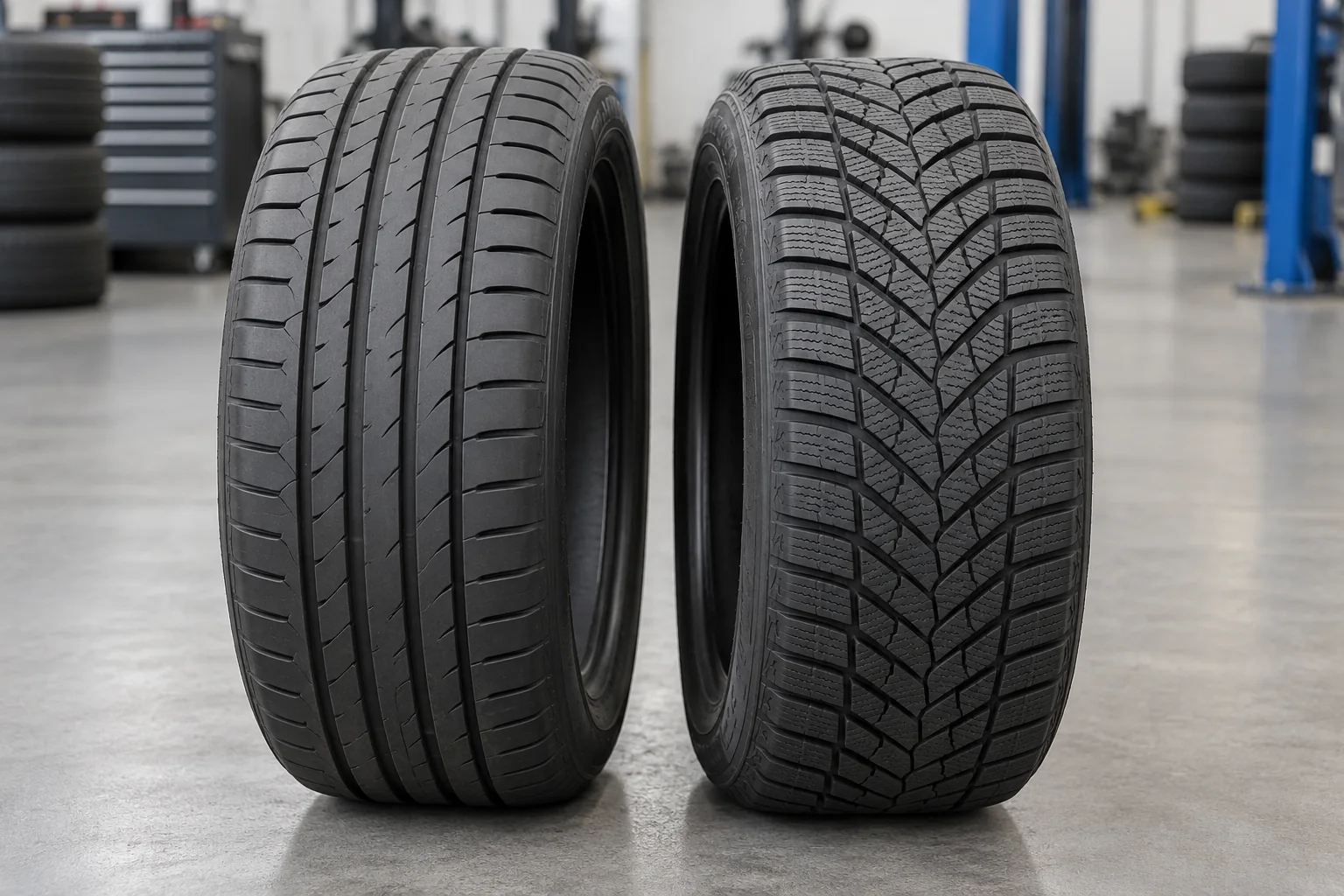
Tyre choice still needs to reflect your conditions and the approved fitment. Michelin’s winter tyre guidance for SUVs specifically addresses four-wheel-drive vehicles. A drivetrain badge is not a substitute for that decision. This guide does not rank tyre models or claim that one illustrated tread pattern is suitable for your car.
Weather can also change whether the journey should happen. Great Britain’s Highway Code’s adverse-weather guidance advises against driving in icy or snowy conditions unless the journey is essential. Owning AWD or 4WD does not create an exception.
Compare the ownership details, not a generic cost premium
Compare like-for-like versions where possible: the same body, engine, gearbox, wheel size and equipment. Otherwise, a price or fuel-consumption difference may reflect several changes at once. Obtain a service schedule for the exact vehicle and ask what maintenance its transfer unit, coupling or differentials require. Do not accept “sealed for life” or a universal fluid interval without the relevant manufacturer information.
Check the tyres as a set. Size is only part of the fitment question. Michelin advises matching make, model, size and wear for four-wheel-drive SUVs. The vehicle handbook determines what combinations, replacement tolerances and spare-wheel arrangements are permitted. Ask a competent tyre specialist to resolve a mismatch before purchase; do not assume that every puncture requires four new tyres or that matching the sidewall size is always enough. Michelin: SUV tyre selection.
Keep two meanings of towing separate. Pulling a trailer depends on the vehicle’s approved towing limits, loading and equipment. GOV.UK directs drivers to the handbook or specification and explains that the loaded vehicle and trailer must remain within the gross train weight. Four driven wheels do not increase an existing limit. GOV.UK: towing weight limits.
Having the car recovered after a breakdown is a different question. Wheel-on-ground recovery restrictions vary with the driveline. Give the recovery service the exact model, gearbox and drive system, and have it follow the manufacturer’s procedure. Ford’s manuals distinguish recovery and recreational towing; that is a reason to consult the correct document, not to copy another vehicle’s permission or exception. Ford handbook example: towing and recovery.
Use these questions with your shortlist
Open the section closest to your use. Write down the answers for each candidate, with the handbook page or specification that confirms them. An unanswered question belongs on the viewing list, not in a guessed capability score.
Most journeys are on surfaced roads
What problem are you asking AWD to solve? Identify an actual access route, gradient or recurring condition, then compare a suitable two-wheel-drive version as well. Which drive mode is intended for normal roads? Are the fitted tyres appropriate? What are the costs of those exact versions? Do not pay for unfamiliar off-road equipment merely because the badge sounds more capable.
Access includes a field, track or steep private driveway
Describe the surface and the conditions in which you would use it. Ask whether the specific vehicle and tyres are suitable, what clearance is needed and which modes are permitted. Confirm access rights and seek practical instruction where appropriate. A generic “off-road capable” description does not assess that route, and photographs cannot establish how much grip it provides.
You tow a caravan or another trailer
Record the exact vehicle’s towing and loading limits before comparing its drive system. Check the intended trailer combination, towbar approval and handbook instructions. Then consider access to your usual pitches or storage area. Extra driven wheels may be relevant to moving on a loose surface, but they do not correct an unsuitable weight combination.
You are viewing a used AWD or 4WD car
Ask for its original specification, correct handbook, service records and tyre-replacement history. Check which system the fitted controls operate, whether any warning is displayed and whether the seller can explain documented repairs. Arrange an appropriate professional inspection for unexplained warnings, noises or inconsistent records. Do not diagnose a coupling or differential from a short driveway manoeuvre.
For example, two advertised “4x4s” might both meet your passenger and luggage needs, but only one may have a normal road mode you can leave selected and the particular low-range function required for a documented use. Conversely, neither extra function may solve a problem you actually have. Put those answers alongside seating, parking and ownership costs in your next-car requirements.
Sources checked 13 October 2026. Manufacturer examples identify particular systems and documents; equipment can vary by model, year and market. The illustrations are not test evidence. Refer to the exact vehicle’s handbook for operating instructions and obtain professional advice for an unresolved fault or suitability question.