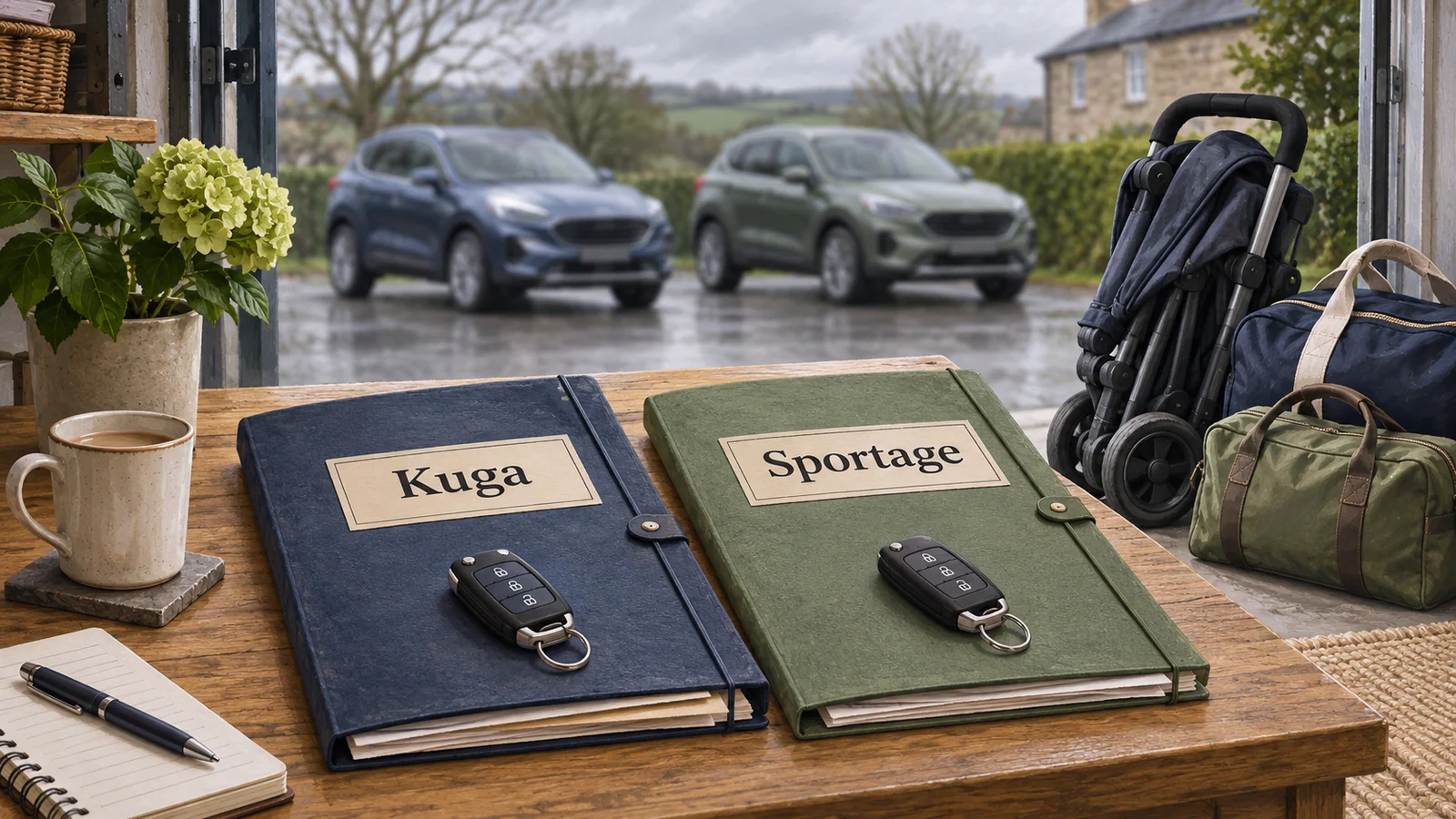
Shortlist the Ford Kuga if adjusting rear-seat space around your luggage is a priority; shortlist the Kia Sportage if longer standard warranty cover matters more. Both offer full-hybrid and plug-in-hybrid choices, so match the powertrain and equipment before deciding which represents better value. For a family without reliable charging, the full hybrids are the more useful starting comparison. [1] [2] [3] [4] [5]
This is a UK new-car shortlisting guide based on specifications checked on 4 November 2026, not a road test. It uses the current Kuga price list, effective 11 September 2026, and current Sportage UK specifications. Earlier cars, including pre-update Sportages and older Kugas advertised with the same trim names, can have different engines and equipment. Confirm the model year and full specification of the car being quoted. [2] [3]
The differences that matter first
| Decision | Ford Kuga | Kia Sportage |
|---|---|---|
| Rear-seat flexibility | Sliding rear seats let you trade some rear legroom for luggage space. | 40:20:40 split-folding rear seats offer separate sections for different loads. |
| Full-hybrid choice | 2.5-litre petrol hybrid; front-wheel drive or selected all-wheel-drive versions. | 1.6-litre turbo petrol hybrid; two-wheel drive or selected all-wheel-drive versions. |
| Plug-in alternative | 2.5-litre plug-in hybrid; front-wheel drive in the checked list. | 1.6-litre turbo plug-in hybrid; the checked page lists two-wheel-drive and all-wheel-drive versions. |
| Central touchscreen | 13.2-inch screen. | 12.3-inch screen across the listed grades. |
| Standard general warranty | Three years or 60,000 miles, whichever comes first. | Up to seven years: unlimited mileage for the first three years, then a 100,000-mile total limit through year seven, subject to terms and exceptions. |
Sources for the table: [1]–[5]. Availability varies by grade; a range-wide feature is not necessarily fitted to every car. Warranty limits above describe general cover, not identical cover for every component.
Choose the type of hybrid before the badge
Full hybrid: begin here if you will not plug in
The current Kuga full hybrid is listed at 180 PS with front-wheel drive or 183 PS with all-wheel drive. The current Sportage HEV is listed at 235 bhp. Those are the manufacturers’ stated units; PS and bhp are slightly different, so do not treat the labels as interchangeable. More power alone does not tell you which car you will prefer in traffic or when joining a motorway. [2] [3] Our guide to PS, bhp and kW explains how to read the figures.
Ask to drive the exact hybrid you are considering. Include a slow queue, a hill start and an ordinary acceleration onto a faster road. Pay attention to how easily you can make a small speed adjustment, the sound when accelerating, the seating position and visibility at a junction. These are personal observations to make on your test drive; this comparison does not claim either car is quieter, smoother or more comfortable.
Plug-in hybrid: compare it against your actual charging routine
The Kuga plug-in hybrid is listed at 243 PS; the Sportage PHEV at 283 bhp. The larger output is not a reason on its own to pay more for a plug-in. [2] [3] First establish where you would charge, what that electricity would cost and how often you would actually connect the car.
Do not compare a plug-in’s weighted fuel-economy headline directly with a full hybrid’s petrol-consumption figure and call the difference a saving. Plug-in test results involve both electricity and petrol, and actual range depends on conditions. [2] Budget for both energy bills. If charging depends on making a special trip, include that inconvenience in the decision rather than assuming a nightly charge.
For the distinction between the systems, read full hybrid versus plug-in hybrid. An efficient car that fits your routine is more useful than a favourable test figure that your routine cannot reproduce.
Boot space: compare with the rear passengers in place
The Kuga’s sliding rear bench is its most useful practical distinction here. Moving it can change the balance between passenger and boot space. [1] When viewing one, set the front seat for the main driver, seat the tallest regular rear passenger comfortably, and only then assess the boot. A luggage arrangement that works with the rear seats pushed forward may not work on a family holiday.
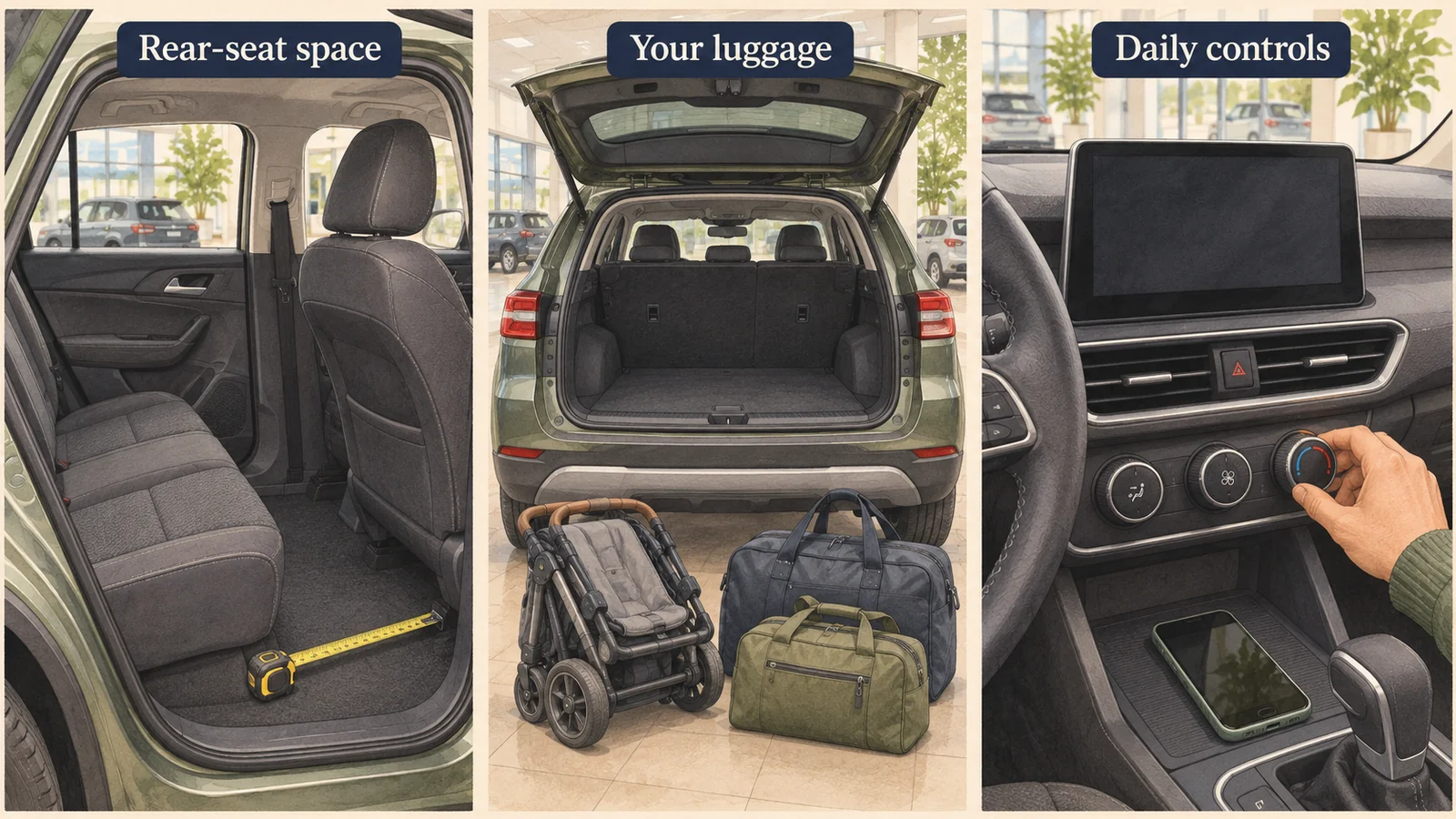
The Sportage’s 40:20:40 split gives you another way to arrange its rear seatbacks. [3] Check the arrangement with the people and objects you normally carry. Neither a maximum litre figure nor a picture of an empty boot answers whether your pushchair will go through the opening without removing a wheel.
We have not used a single headline boot capacity to declare a winner. Before comparing brochure numbers, establish the powertrain, rear-seat position, load-floor arrangement and whether the measurement is to the parcel shelf or roof. Then test the things that are awkward to replace: your pushchair, mobility equipment, dog carrier or instrument case.
Equipment: compare what you will use every week
Trim names are not equivalent packages. On the checked Sportage equipment table, heated front seats are fitted above Pure, while the 360-degree camera is reserved for GT-Line S. Wireless phone integration is listed across the range. [3] On the checked Kuga list, Titanium has a rear camera, while Active, ST-Line and ST-Line X list a 360-degree camera. [2] Recheck the order form, especially for stock cars built to an earlier specification.
Write down three must-have items before asking for quotes. For example: a camera that makes your parking space easier to use, heated seats and a powered tailgate. Price the cheapest suitable version of each car with all three included. Comparing an entry price with a better-equipped demonstrator can make the more expensive quote look worse than it is.
Try your own phone, change the temperature and find the rear-window demister while parked. Check whether the boot opens far enough under your garage ceiling and whether you can reach its closing control. A larger touchscreen does not settle any of those questions.
Which costs less to own?
There is no dependable winner without two matched quotes. Ask for the same ownership period and annual mileage, and use the same assumptions for both cars. This worksheet separates the car’s price from the costs that can change your decision.
| Cost | What to compare |
|---|---|
| Buying or financing | For a cash purchase, compare the full on-the-road price. For finance, compare deposit, every scheduled payment, fees and any final payment needed to own the car. |
| Fuel and charging | Use your annual mileage and a realistic mix of journeys. A plug-in needs an electricity allowance as well as petrol. |
| Insurance | Obtain quotes for the actual versions using identical cover and excess choices. |
| Servicing and tyres | Request the service schedule and itemised plan terms. Price replacement tyres in the wheel size on your quote. |
| Ownership exit | If buying, allow for uncertain resale value. If returning a financed or leased car, read the mileage, condition and end-of-contract terms. |
As a simple break-even example, an extra £600 upfront takes five years to recover from a genuine £120 annual running-cost saving. Those are illustrative numbers, not estimates for either SUV. A change in resale value, insurance or servicing could outweigh that saving, so do not decide from fuel alone.
Warranty is a useful difference, not a reliability verdict
The Sportage’s longer general warranty can matter if you plan to keep the car beyond three years. It transfers to subsequent owners while valid, but servicing requirements and exclusions still apply. Some items have shorter cover; for example, the checked terms limit the original audio and navigation equipment to three years or 60,000 miles. [5] The Kuga’s general warranty is three years or 60,000 miles. [4]
This does not establish which model will develop fewer faults. Ask what remains covered on the specific car, what a service plan includes and whether an extension changes the total cost. Treat high-voltage battery cover as a separate question: do not assume the general warranty summary describes its capacity guarantees.
Choose the scenario closest to yours
I have no dependable charging and carry rear passengers most days
Start with two full-hybrid quotes. Set both cars up for your passengers and luggage, then test-drive the exact versions. Keep all-wheel drive out of the comparison unless you have a specific reason to pay for it. If both fit equally well, compare the equipment and total cost over the years you expect to keep the car.
I can charge routinely and most journeys are short
Add both plug-in hybrids to the shortlist. Ask for the charging specification of the exact version, check that it suits your parking arrangement, and estimate petrol and electricity separately. Compare the additional purchase cost with a full hybrid before deciding that a plug-in will save money.
I am buying used rather than ordering new
Start again with the advert’s registration, model year, powertrain and specification. Do not apply the current power outputs or trim table to an earlier car. Obtain service and repair records, check remaining warranty in writing and arrange an inspection appropriate to the car. Use our used-car viewing checklist to organise the visit.
Before you choose
- Match the two cars by powertrain, driven wheels and must-have equipment.
- Put your usual passengers and luggage into each car before judging its practicality.
- Get two complete quotes using the same mileage and ownership period.
- Confirm the build/model year, warranty and final specification in writing.
The Kuga deserves the first viewing when an adjustable balance of passenger and luggage space is your main need. The Sportage deserves equal attention when you intend to keep the car for several years and value its longer standard cover. If those priorities are tied, let the exact cars, your test drives and the matched quotes decide.
Sources
- Ford UK: Kuga model page — sliding rear seats and central screen.
- Ford UK: Kuga price and specification list, effective 11 September 2026 — model combinations, output units, equipment and fuel-consumption qualifications.
- Kia UK: current Sportage specifications and features — powertrain choices, seating and trim equipment.
- Ford UK: manufacturer warranty — standard passenger-car cover.
- Kia UK: warranty terms and exclusions — mileage periods, transferability, exceptions and maintenance requirements.