The Motability Scheme lets eligible people use a qualifying mobility allowance to lease a vehicle. Its October–December 2026 range includes petrol, hybrid and electric cars, as well as a separate choice of Wheelchair Accessible Vehicles. Start with the current official catalogue, then check the exact version, its Advance Payment and whether you can use it comfortably. A model appearing on the Scheme does not mean every version is available or suitable.

This guide covers the current choice, eligibility and the practical checks before ordering. Sources were checked on 31 October 2026. The examples below are documented catalogue options, not cars we have tested or ranked.
Which cars are on Motability in late 2026?
Motability’s October–December 2026 price-list announcement reports more than 670 car choices. Its examples include the following combinations. This is a dated starting list, not a promise that a particular dealer has stock.
| Model | Listed fuel and gearbox | A useful question at the dealer |
|---|---|---|
| Kia Picanto | Petrol, automatic | Does the seating position and door opening work for each regular occupant? |
| Mazda 2 Hybrid | Petrol/electric hybrid, automatic | Can you load your usual equipment without removing things you need on arrival? |
| Volkswagen T-Cross | Petrol, manual | Is the quoted version definitely manual, and does that suit the intended drivers? |
| Nissan Juke | Petrol, manual | Is the rear-seat access adequate when the front seat is in its normal position? |
| Hyundai Inster | Electric, automatic | Can you access and use the charging arrangements you would actually rely on? |
| MG 3 | Petrol/electric hybrid, automatic | Does the quoted trim include the assistance and comfort features you need? |
Check the official vehicle finder, set the allowance to the one you receive and narrow the results. Record the full model, trim, engine or battery version, gearbox and order price. A search result for a model family is not enough to compare two dealer proposals.
For example, “Juke” does not identify the gearbox: the same quarterly announcement includes separate manual and automatic examples. Ask the dealer to write the complete derivative on the quotation. Our manual versus automatic guide explains the broader differences.
Who can join the Motability Scheme?
You need a qualifying allowance with at least 12 months remaining when you apply. Motability’s current allowances list includes:
- The enhanced-rate mobility part of Personal Independence Payment (PIP).
- The higher-rate mobility part of Disability Living Allowance (DLA).
- The enhanced-rate mobility part of Adult Disability Payment in Scotland.
- The higher-rate mobility component of Child Disability Payment in Scotland.
- The higher-rate mobility component of Scottish Adult Disability Living Allowance.
- War Pensioners’ Mobility Supplement.
- Armed Forces Independence Payment.
A lower mobility rate, PIP daily-living award, Attendance Allowance, Carer’s Allowance or Employment and Support Allowance does not by itself qualify. Read the component and rate on your award letter rather than relying on the benefit’s name. If an award is due to end sooner, check renewal with its provider before making plans around a vehicle order.
You do not have to drive yourself
The eligible person can be a passenger. Motability’s driver rules allow up to three covered drivers on a car or WAV lease, subject to the insurer’s criteria and Scheme policies. The vehicle must be used by, or for the benefit of, the disabled customer; they need not be present for every journey. Only drivers listed on the Certificate of Motor Insurance may drive it.
Agree who will drive before choosing a car. A comfortable passenger seat does not settle whether a different regular driver can use the controls, or whether a proposed driver meets the insurance requirements.
What do you pay, and do you own the car?
Under the Scheme’s payment arrangements, all or part of the qualifying mobility allowance goes directly from the allowance provider to Motability. Most vehicles use the full allowance. Some also require an Advance Payment: an additional upfront amount, not a refundable deposit. Optional extras can cost more.
You lease the vehicle; you do not build an ownership share or have an option to buy it from the Scheme at the end. Compare the allowance you would give up, the upfront payment and your other travel costs with your alternatives. A car advertised with no Advance Payment still uses the applicable allowance.
Motability says an Advance Payment is fixed at the price when you apply, even if the advertised price changes before delivery. Confirm the application and written quotation with the dealer; a screenshot of an earlier advertisement is not an accepted order.
Included cover still has conditions
The package continues to include insurance, servicing and maintenance, and breakdown cover. Check the actual lease and insurance documents for limits and your responsibilities. In particular, an included insurance policy does not mean every claim is cost-free: Motability’s insurance guidance directs customers to their agreement and policy for the applicable excess. It also says you do not build a conventional no-claims bonus while on the Scheme; a claims-history letter may help when arranging insurance after leaving.
Check the 2026 terms, especially mileage
Motability’s current changes page explains that VAT and Insurance Premium Tax affect most new leases ordered from 1 July 2026. Existing leases retain their agreed terms. For customers paid by Social Security Scotland, the new terms now apply, but orders made before 1 September 2026 keep the terms in force when ordered. Do not use an old brochure to judge a new application.
The current mileage rules provide 30,000 miles across a new three-year car lease and 50,000 across a new five-year WAV lease. This is a total lease allowance: 10,000 a year is the average, not a separate annual reset. Excess mileage is charged at the end. The published rate is 25p per mile including standard-rate VAT, or 21p where the lease benefits from VAT relief. Confirm which applies to your agreement.
Worked example: travelling 12,000 miles in each of three years would total 36,000 miles. Against a 30,000-mile allowance, that leaves 6,000 excess miles. At 25p each, the illustrative charge is £1,500. This assumes no agreed additional allowance or other adjustment. It is not a quote or a prediction of your travel.
Include recurring medical, work or education journeys in your estimate. Motability describes support for some customers with higher essential mileage needs; ask about eligibility rather than assuming it will be granted.
Two other details can change a budget:
- Tyre replacements are subject to fair use: up to six during a three-year lease, of which up to four can be for damage; five-year leases allow ten, up to six for damage. Tyre repairs and replacements beyond the included limits are payable by the customer.
- Taking the vehicle abroad requires a VE103 certificate. New terms include a £22 administration fee; the certificate lasts 12 months. Customers in Northern Ireland travelling to the Republic of Ireland are exempt from that fee.
Choose around access, seating and equipment
A car’s exterior size or SUV label cannot establish whether it suits a particular person. Build your shortlist around three separate tasks: getting in and out, travelling comfortably and carrying what you need. Check the exact demonstrator rather than assuming all trims have the same seat adjustment or boot arrangement.
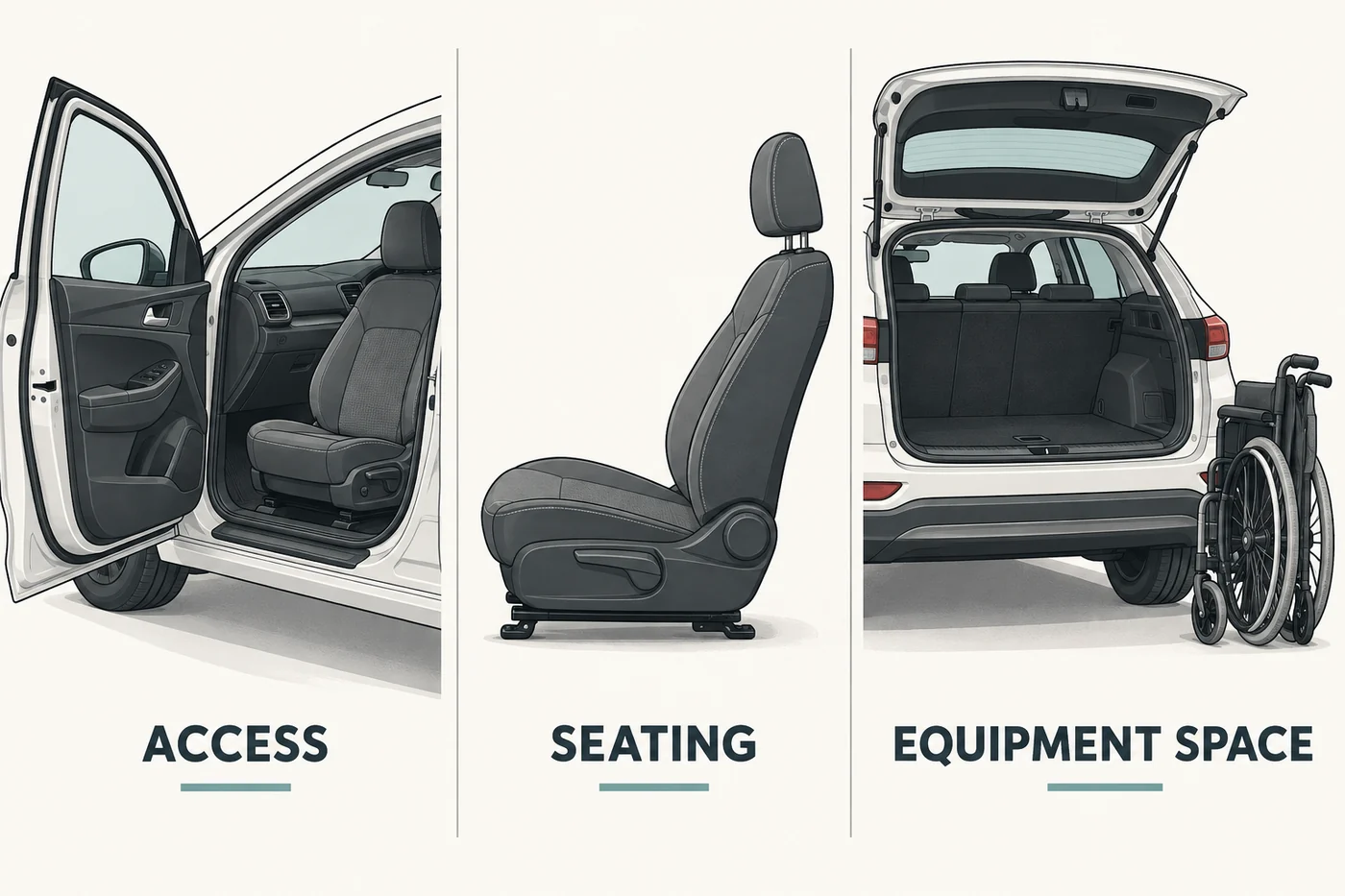
Motability’s dealer-visit guidance recommends trying the cars you are considering, with other intended drivers and regular passengers where possible. Use the visit to answer specific questions:
- Access: can the person enter and leave without an awkward step or obstructed doorway? Recheck with the door opened only as far as a typical parking bay allows.
- Seating: after adjusting the seat, can the occupant reach the belt and sit comfortably? Ask for a proper demonstration of any unfamiliar adjustment.
- Equipment: bring the items normally carried and check the opening, loading process and remaining passenger space. A quoted boot capacity alone does not answer this.
- Everyday use: try the display, ventilation controls and parking manoeuvres. Record anything that needs a further demonstration before deciding.
For an electric option, include the charging task in that assessment: reaching the connector, handling the cable and using the sites available to you. Our home-charging checklist provides the property and installation questions to work through.
Adaptations and WAVs need an earlier conversation
Motability’s adaptations guidance says to speak to an installer before selecting a vehicle, because not every adaptation fits every car. Access aids, adapted driving controls and equipment hoists answer different needs. Do not order a favourite model first and assume the required equipment can be fitted later.
If someone needs to travel while seated in their wheelchair, explore a WAV with a specialist supplier. The vehicle, conversion, wheelchair and occupant need to work together. A car that can carry a folded wheelchair in its boot is not thereby a WAV. The Scheme can also advise about a Driving Mobility assessment where appropriate.
Before you place the order
Keep a short written comparison for your two strongest options: full derivative, allowance payment, Advance Payment, essential adaptations, demonstrated fit, expected delivery and the applicable lease terms. Separate things you have tried from answers still awaiting confirmation.
If cost prevents you obtaining the vehicle or adaptations you need, contact the Motability Foundation’s grants team before ordering. Its car and adaptation grants are means-tested and focus on essential mobility needs. A grant is not guaranteed, and an award may limit the suitable vehicles or features it funds.
For the application itself, follow the official ordering checklist. The documents depend on whether you started online or apply at the dealer. They include identity evidence and the allowance recipient’s National Insurance number or Customer Reference Number; driver details and a grant letter may also be needed. Check the list before your appointment, and provide personal details only through the Scheme’s or dealer’s proper application process.
Ask the dealer to confirm the order, agreed price and expected delivery in writing. If any essential access or adaptation question remains unresolved, arrange the further demonstration or specialist advice before committing to that vehicle.
Common questions before joining
Does a Blue Badge automatically make me eligible?
No. Scheme eligibility depends on a qualifying mobility allowance and the remaining award period. A Blue Badge is not one of the allowances on Motability’s eligibility list. Check your award letter and the official allowance criteria rather than treating parking entitlement as approval to join.
Should I choose the car with the lowest Advance Payment?
Use it as a budget filter, then check whether the exact car meets your needs. A lower upfront amount is not useful if access, seating or necessary adaptations do not work. Compare the allowance commitment, practical fit and applicable mileage terms as well; do not assume a higher Advance Payment proves better suitability.
Can I rely on this model list when I order next quarter?
No. The examples come from the October–December 2026 announcement. Check the live finder and obtain a current dealer quotation for the exact derivative when you are ready. Keep the date of the quotation with your notes, particularly if your search spans a quarterly update.
Research method: current Scheme and Motability Foundation guidance, with a dated official catalogue snapshot. The showroom checklist is an editorial planning aid, not a personal eligibility decision, clinical assessment or vehicle test.