
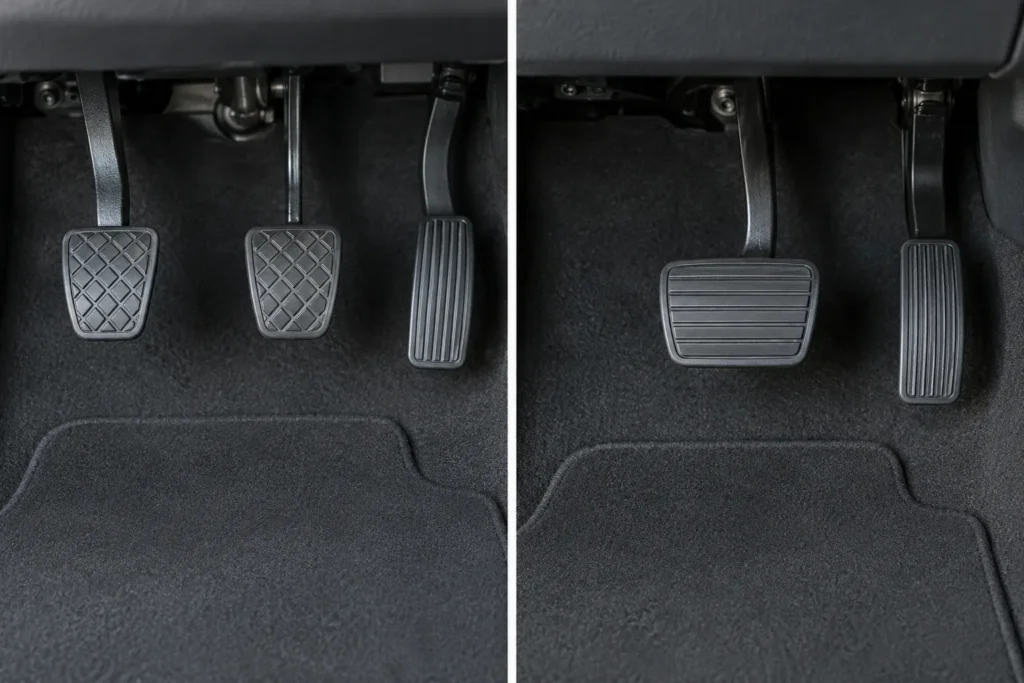
The short answer: a manual gives you a clutch pedal and responsibility for changing gear. An automatic handles those changes for you. Start with an automatic if removing clutch work would improve your everyday journeys; keep a manual on your shortlist if you enjoy choosing gears or it makes a particular used car a better fit. Compare the actual cars, their condition and their running costs before deciding.
The useful question is what you want the gearbox to do on an ordinary Tuesday: manage a queue, make a steep parking space manageable, or give you more involvement on a favourite road. An automatic can suit one job well and feel awkward at another. Two cars advertised as automatic can also use quite different mechanisms.
This guide separates the driving experience, licence rules and ownership questions so you can narrow a shortlist without assuming that every manual is cheap or every automatic is smooth.
Manual vs automatic: the differences that matter
In a conventional manual, you operate the clutch and select the gears. In an automatic, you select a direction of travel and the car manages the transmission during normal driving. Hyundai’s powertrain guide explains the distinction between its manual, automatic and electric transmissions.
| Your priority | Manual | Automatic |
|---|---|---|
| Control of gear changes | You choose the gear and operate the clutch. | The car normally chooses; some offer a manual selection mode. |
| Stop-start traffic | Repeated clutch operation and gear changes. | No clutch pedal to work. Check how smoothly it moves at low speed. |
| Driving involvement | Clutch and gear selection are part of the experience. | You can focus on other driving tasks, but still control the vehicle throughout. |
| Buying used | Assess clutch operation, gear selection and service history. | Identify the gearbox type, then check its behaviour and maintenance requirements. |
| Ownership costs | Price the specific car, including any work due. | Do the same; the automatic label alone cannot predict the bill. |
Check your driving licence before choosing
An automatic-only entitlement does not permit unsupervised driving of a manual car. On a GB photocard, restriction code 78 means automatic transmission only; check the codes alongside your vehicle entitlement. A full manual car entitlement also allows automatic cars, subject to any other applicable restrictions. See the DVLA licence-code list and DVSA's manual and automatic entitlement guidance.
In Great Britain: to upgrade an automatic-only car licence, you must pass a practical test in a manual. You do not need another provisional licence or another theory test. While learning, the usual learner-driver requirements apply, including L plates. Follow the official upgrade instructions for the booking process.
In Northern Ireland: use DVA guidance. A theory retest is normally unnecessary for an upgrade within the same vehicle category, but there is an important exception: an automatic-only NI licence exchanged under the designated country or region scheme requires a valid theory-test pass before booking or taking a manual test. Nidirect explains the distinction; confirm your circumstances with DVA.
If you already hold a manual entitlement but have only driven manuals, leave time to learn the automatic's selector, parking controls and response. Legal entitlement does not provide familiarity with an unfamiliar car.
“Automatic” covers several different gearboxes
Ask for the transmission fitted to the exact engine, model year and registration you are considering. A model name or an advert's transmission filter is not enough to establish how the car works.
Torque-converter automatic
A torque converter transfers drive through fluid and performs the coupling job between engine and transmission. Modern designs can also use a lock-up clutch to reduce losses. ZF describes the mechanism in its technical guide. This is the type people often mean by a “traditional automatic”.
On a test drive, assess how it moves away, changes gear at light throttle and responds when you ask for more acceleration. The mechanism is a useful starting point, not a guarantee of how a particular car will feel.
Dual-clutch transmission: DCT or DSG
A dual-clutch gearbox uses separate clutch-controlled gear paths. In Volkswagen's explained DSG design, one handles odd gears and the other even gears, allowing the next ratio to be prepared before the change. Volkswagen's technical explanation shows how this works.
Do not judge it only by quick changes on an open road. Try a gentle pull-away and parking manoeuvre too. Wet- and dry-clutch versions exist; the same DSG label does not establish identical hardware or maintenance needs. Volkswagen identifies both designs.
Continuously variable transmission: CVT
A conventional belt CVT varies its ratio rather than relying on a fixed sequence of gears. Nissan's Xtronic explanation shows a steel belt running between adjustable pulleys. That allows the engine speed and road speed to change differently from a manual's familiar rise-and-drop rhythm. Nissan explains the ratio control.
Listen to the engine while accelerating normally and joining a faster road. Decide whether the sound and response suit you, rather than expecting a CVT to imitate stepped gears.
Hybrid e-CVT
Do not assume a hybrid's e-CVT contains the same belt-and-pulley arrangement. Toyota's power-split hybrid design uses a planetary gear system to manage engine and electric drive. Its hybrid technology history describes that arrangement. The similar name does not make reliability reports or servicing advice for an unrelated conventional CVT applicable to it.
Automated manual: AMT
An AMT automates clutch operation and gear selection in a manual-based transmission. Hyundai's i10 is one example. Its official features page describes the clutch and shifts being handled automatically. Include low-speed driving and ordinary acceleration in your test: the timing of its changes may matter more to you than the terminology.
Electric cars with a single-speed drive
A battery-electric car can deliver a two-pedal driving experience without a conventional multi-speed automatic gearbox. Electric motors can operate through a single gear, as Hyundai explains. That is a mechanical distinction, not a requirement for a manual licence: DVSA classifies the electric vehicles described in its test guidance as automatic transmission.
Which suits your routine?
Use the decision aid to identify which transmission to try first. It narrows the practical choice; your licence, the individual car and a proper test drive still decide whether it belongs on your shortlist.
Which transmission should you try first?
Tell us about your licence and daily driving. The result explains a starting point for your shortlist, not a rating of individual cars.
Enable JavaScript to use the decision aid. You can still compare the licence rules and driving scenarios in this article.
A first car with a fixed budget
Start with cars you can actually afford to buy, insure and maintain. If you hold a manual licence, compare both versions rather than ruling one out on reputation. A well-kept automatic might be preferable to a neglected manual, or a particular manual might leave more money for imminent maintenance. If you hold an automatic-only licence, keep the current shortlist within that entitlement.
A daily journey through queues
An automatic deserves an early test drive if repeated clutch work is the part of your commute you want to remove. Choose a route that includes the speeds you normally encounter. A brief demonstration on a quiet road will tell you little about following slow traffic or easing into your parking space.
A shared family car
Check every intended driver's entitlement and preferences before buying. Have each driver adjust the seat and try the controls. A gearbox that feels comfortable to one person may feel abrupt or hesitant to another. Practical details such as reversing onto a sloping drive can be more decisive than acceleration figures.
Someone who enjoys changing gear
Keep a manual in contention if the clutch and gear lever are part of what you enjoy. Be specific about that preference: does it still matter during most of your weekly mileage? An occasional enjoyable drive and a regular congested commute can pull the decision in different directions.
Compare costs using two real cars
A broad claim that one gearbox is always cheaper mixes different cars, ages and conditions. Make a side-by-side record for the two vehicles you are considering.
- Purchase price: compare similar age, mileage, engine and equipment. Note anything that explains a price gap besides the transmission.
- Insurance: obtain quotes for the actual registrations using the same drivers, cover and excess. A general average is not your premium.
- Servicing: ask for the schedule applicable to that gearbox and evidence of completed work. Establish what will fall due during your planned ownership.
- Known work: get written estimates for identified issues rather than a seller's rough allowance.
- Warranty: read which gearbox components are covered, claim limits and exclusions.
For fuel use, compare figures for the precise variants using the same test procedure. An old NEDC figure and a newer WLTP result are not equivalent evidence. The Vehicle Certification Agency also explains that official figures are for comparison and actual consumption depends on factors including driving style, weather and load. Read the VCA's fuel-consumption guidance.
To turn an economy estimate into a working budget, use: annual miles ÷ UK mpg × 4.54609 × fuel price per litre. For illustration, 8,000 miles at 45 mpg and £1.50 a litre is about £1,212 a year; at 50 mpg it is about £1,091. The roughly £121 difference is arithmetic from those assumptions, not a measured manual-versus-automatic saving. Test whether the price difference between your actual cars is justified by the whole ownership picture.
What to check on a used-car test drive
Arrange insurance and permission before driving. Ask for a route that lets you assess everyday operation without rushing. A test drive helps you judge suitability; it cannot certify the internal condition of a gearbox.
- Identify the car: confirm its exact transmission and obtain the relevant handbook and maintenance requirements.
- Try normal low-speed tasks: moving away, stopping, reversing and parking. Is the response predictable enough for you?
- Assess ordinary driving: note whether gear selection, response and noise feel consistent as the car warms up. In a manual, pay attention to clutch operation and whether the gears select cleanly.
- Record concerns: warning messages, repeated shuddering, difficulty selecting drive or gears, or unexplained noises deserve investigation. Do not diagnose the cause from a short drive.
- Match the paperwork: ask what any gearbox invoices actually covered. An engine service stamp does not tell you every transmission-related job was done.
If something feels wrong, pause the purchase and arrange an independent inspection by someone familiar with that transmission. For the rest of the vehicle, use our car-viewing checklist.
Other questions worth settling
Is a car with paddles or a manual mode still an automatic?
For GB testing and licensing, the absence of a driver-operated manual clutch is the important distinction. DVSA regards the semi-automatic systems it describes, where the driver can choose gears without a clutch pedal, as automatics. A plus/minus selector or steering-wheel paddles do not by themselves require a manual entitlement. See DVSA's transmission definitions.
Does learning in an automatic make the driving test easier?
It removes manual clutch and gear operation from the controls you must learn. It does not remove the need to observe, judge gaps and drive safely. DVSA states that the GB practical test is the same for manual and automatic cars. Choose the learning route with an instructor based on your progress and likely vehicle needs, rather than a promise of passing sooner.
Sources checked on 11 October 2026. This comparison explains transmission types and buying decisions; it is not a first-hand road test of the models mentioned.