To move a private registration between cars, first take it off the donor vehicle through DVLA, then assign it to the receiving vehicle. Keeping the number for later is called retention. Buying physical plates does not complete either transaction. If you are selling the donor car, finish the retention process and receive the required documents before handing it over.

This guide covers DVLA-registered vehicles in the UK. Fees and procedures were checked on 30 October 2026. Use the official service for the actual application; the checklist here helps you arrange the steps and avoid leaving the registration on a car you no longer control.
Retention, assignment and transfer: which do you need?
Think of the registration as a right to use a number. The metal or plastic plates are its display. A number can be held on a document without being attached to your next car. That distinction matters when there is a gap between selling one vehicle and buying another.
| Your situation | Route to follow | Main planning point |
|---|---|---|
| Selling your car and keeping its private number | Take off and retain | Complete this before the sale |
| Moving your number to another car | Take off, then assign | Both vehicles must meet the relevant conditions |
| Number already held on a valid document | Assign | Check the receiving car and entitlement document |
| No suitable car yet | Keep the right and track expiry | You do not need to rush into an assignment |
The DVLA overview explains the two-stage online transfer and the option to retain a number. If buying privately, do not confuse an attractive set of plates with a valid entitlement to the registration. DVLA also warns against sharing photographs or scans of a V750 or V778: someone could use the information to assign the number.
What the documents mean
- V750: certificate of entitlement associated with a purchased private number.
- V778: retention document for a number taken off a vehicle.
- V5C: the vehicle’s registration certificate, often called its log book.
- V317: the postal application used to transfer or retain a vehicle registration.
Keep a simple record for each car: its current registration, keeper details and the document you will use. Our V5C guide explains why the registered keeper and the vehicle’s owner are not necessarily the same person. A private registration document answers a different question again: who has the right to assign that number.
Check eligibility before arranging the handover
DVLA’s conditions include a UK registration, a vehicle that moves under its own power, the relevant test requirement, availability for inspection and a continuous tax or SORN history for the preceding five years. The vehicle must also currently be taxed or have a SORN in place. Long-term SORN and historic vehicles have additional MOT requirements. Check the full take-off eligibility list for the actual car; do not assume an MOT exemption automatically settles registration-transfer eligibility.
There are also restrictions on the number itself. You cannot use an age-related registration to make a vehicle appear newer. Q and QNI registrations have restrictions too. The DVLA buying guidance is a useful check before paying a seller. A number that looks right in an advert may still be unsuitable for your particular car.
If the car has been off the road for some time, gather its records before booking collection. Read our SORN guide for the separate off-road declaration process. SORN is not a substitute for checking the transfer conditions.
Taking a number off: cost and timing
Taking a private number off costs £80. You need the vehicle’s V5C. If the vehicle is not in your name, DVLA requires a postal application. Online removal can be immediate where no inspection is needed; the confirmation provides a reference that can be used for assignment. The original registration is usually restored. Before driving the donor car after the change, fit its restored or replacement plates and tell the insurer the new registration. A replacement V5C can take four to six weeks.
Before selling or scrapping the donor vehicle, DVLA says you must have both the V778 and the new V5C. Do not build a sale timetable around the assumption that every application is instant. Check the confirmation and document requirements before agreeing an irreversible handover.
Using the postal route
The current V317 form and instructions cover retaining a number or transferring it to another vehicle, including somebody else’s. Where two keepers are involved, both need to complete the relevant information. The application requires the registration documents specified on the form and the £80 fee.
Use the current form rather than an old downloaded copy. Check which sections apply, whether a new-keeper slip and V62 are needed, and the postal address printed on the form. An incomplete application can disrupt the sale and purchase schedule even when the number itself is eligible.
Assigning it to the next car
Assignment is free through DVLA. Have the receiving vehicle’s V5C and a valid V750, V778 or eligible online reference ready. If you have just bought a used car, wait for the V5C in your name. For a brand-new car, ask the dealer to handle the application with your entitlement document.
If the receiving car already carries another private number that you want to keep, retain that number first. An assignment can take effect immediately if no inspection is required. Fit the correct plates before driving and wait for the new V5C before disposing of the vehicle. Follow the official assignment guidance, including its instructions if the V5C does not arrive.
Planning example: you sell a hatchback this month and expect to buy an estate later. Retaining the number lets you separate those two decisions. Keep the entitlement document safe, complete the hatchback’s paperwork, and only plan assignment when the estate and its documents are ready. This is a scheduling example, not a promise about processing time.
After the change: plates, insurer and accounts
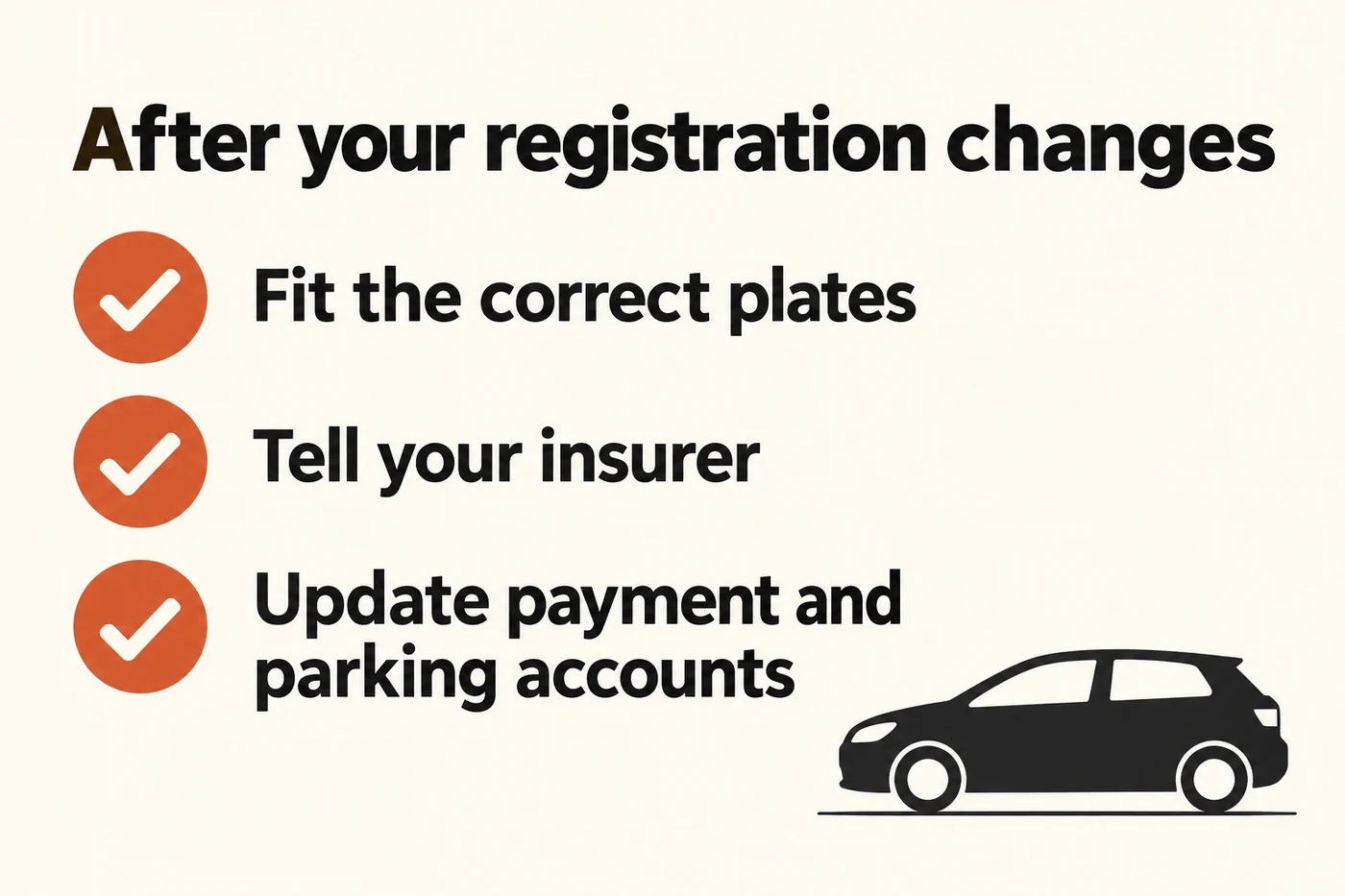
Tell your insurer about the new registration and update automatic road-charge accounts. DVLA specifically highlights services such as Dart Charge, ULEZ, the Congestion Charge and Clean Air Zones. Review parking apps, resident permits, workplace access and breakdown-cover records as applicable; these are practical checks, not a claim that every provider uses the same process.
Have compliant plates made by a registered number-plate supplier. You need documents proving your identity and entitlement. The supplier’s checks do not themselves assign a number to a vehicle.
A personalised number does not create an exception to the display rules. For a typical car, the front has black characters on white and the rear black on yellow. Do not alter spacing or characters to manufacture a name or word. Check the applicable standard and required markings with the supplier.
Keeping a number without a car
If the number is not in use on a vehicle, the right must be renewed every ten years. Renewal is free. You can apply in the 28 days before the document expires; DVLA says late applications are not accepted and the right is permanently lost if not renewed in time. Set your own reminder and keep contact details current rather than relying only on a reminder arriving.
The renewal and replacement guidance distinguishes online V750 renewal from the postal route and explains lost or stolen documents. Check the expiry date and who is named as the grantee before requesting a replacement.
Check your situation
Can I put the plates on while the application is pending?
No. Wait for confirmation that the registration has been assigned. A purchase receipt or a freshly made set of plates is not assignment confirmation. Plan fitting around the confirmed change and tell your insurer before using the vehicle under its new registration.
Is an immediate online result a reason to sell the donor car straight away?
No. The online transaction and the documents needed for a sale are separate milestones. Follow DVLA’s requirement to receive the V778 and replacement V5C before selling or scrapping a vehicle whose private number you are keeping.
Will changing the registration update my parking and toll accounts automatically?
Do not assume so. Make a list of services that recognise the vehicle by registration and update each relevant account. Keep confirmations, and check the vehicle selected in an app before starting a parking session or chargeable journey.
Editorial basis: DVLA administrative guidance checked on 30 October 2026. This guide does not determine eligibility or submit an application.