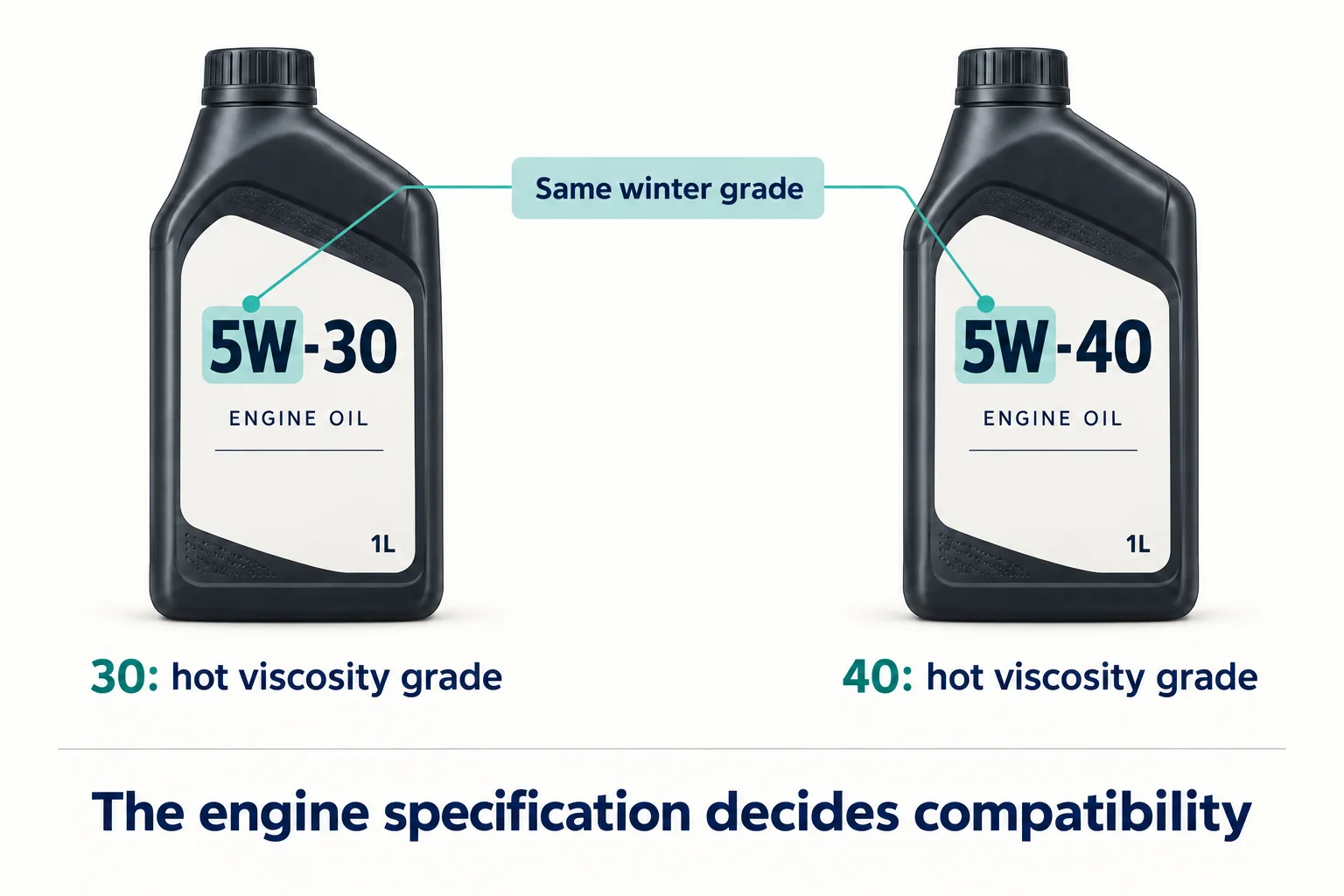
5W-30 and 5W-40 share the same winter viscosity grade, but 5W-40 has a higher viscosity at the standard hot-oil test temperature. Neither is automatically better for your car. Use a grade allowed for your exact engine, with the required performance specifications and manufacturer approvals. The shared “5W” does not make the two interchangeable.
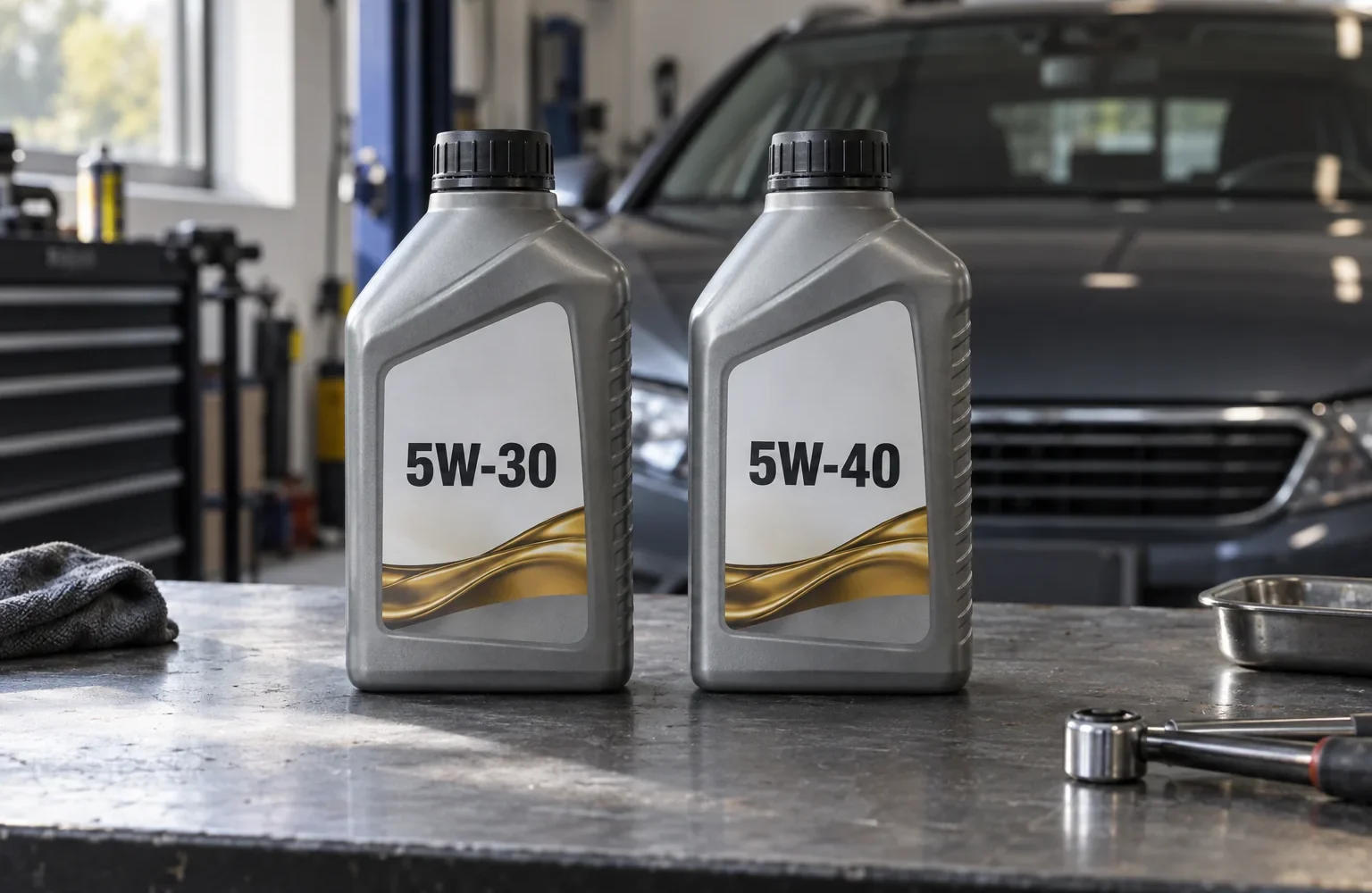
This comparison explains what changes between the grades, what stays unknown from those numbers, and how to handle a proposed substitution. It does not recommend a product or diagnose an engine problem.
5W-30 vs 5W-40 at a glance
| Question | 5W-30 | 5W-40 |
|---|---|---|
| Winter classification | SAE 5W | SAE 5W |
| Hot viscosity grade | SAE 30: lower viscosity than SAE 40 at 100°C | SAE 40: higher viscosity than SAE 30 at 100°C |
| Identical cold behaviour? | The same winter class does not mean two products have identical measured viscosity at every cold temperature. | |
| Correct for a diesel or petrol engine? | The grade alone cannot answer this. Check the exact engine and oil specification. | |
| Suitable for a particulate filter? | Not established by 5W-30 or 5W-40. The oil’s performance specification and approval matter. | |
| Can it replace the other grade? | Only where the vehicle manufacturer’s instructions permit the alternative and the complete oil specification matches. | |
The grade system describes viscosity, or resistance to flow. SAE’s J300 classification explicitly covers those flow characteristics rather than all the other qualities of an engine oil. It is not an overall quality score.
What do 5W, 30 and 40 actually mean?
5W is the winter grade
The W stands for winter. Both oils must meet the requirements of the 5W class for low-temperature performance. This helps explain why their main grade difference is on the hot side, but it does not prove that they flow identically during every British winter start.
A classification sets limits; it does not give you one exact measurement for every product carrying it. Nor does “5W” mean the oil is designed only for 5°C weather. Castrol’s viscosity guide explains the separate cold and hot parts of the label.
30 and 40 describe the hot viscosity grade
The second number includes the oil’s viscosity classification at 100°C. At that same test temperature, SAE 40 oil is more viscous than SAE 30, as explained in Castrol’s comparison of the grades. The numbers are grade designations, not maximum outdoor temperatures: 5W-30 does not stop being suitable when the weather reaches 30°C.
Oil normally becomes thinner as it heats up. A multigrade label does not mean it starts thin and then thickens into “40” when hot. Compare two oils at the same temperature, rather than comparing the first number with the second.
Why matching the grade is not enough
Think of an oil label as answering different questions. SAE viscosity describes flow behaviour. An ACEA or API category describes a set of performance requirements. A vehicle manufacturer’s specification can add requirements for particular engines. “Fully synthetic” does not replace any of those checks.
The UK Lubricants Association’s oil factsheet identifies viscosity, performance and exhaust-system compatibility as separate considerations. That is why buying another bottle of the same grade can still give you the wrong oil.
For example, an SAE 5W-30 carrying ACEA A5/B5 is not automatically suitable for an engine requiring SAE 5W-30 and ACEA C3. ACEA’s light-duty oil sequences define different requirements for these categories and warn that some are unsuitable for certain engines. Its C categories address catalyst and particulate-filter compatibility, but the individual category still has to suit the vehicle. A larger category number is not a universal upgrade.
There is another distinction on the back of the bottle: an oil maker’s claim that a product meets a specification is not necessarily a formal approval issued by the vehicle manufacturer. FUCHS UK explains the difference between suitability claims and OEM approvals. Read the actual requirement and the product’s current technical information, rather than relying on a retailer’s abbreviated title.
Can I use 5W-40 instead of 5W-30?
Sometimes, but not on the strength of the grade numbers alone. If the manufacturer’s guidance explicitly permits both grades for your engine and conditions, an oil meeting the relevant specification may be an option. If only 5W-30 is specified, do not assume 5W-40 is an acceptable alternative because it is thicker when hot. The reverse substitution also needs permission.
Use the following questions to identify what is missing from the decision. They do not certify a particular bottle as compatible.
My handbook lists only 5W-30. The shop has 5W-40.
Do not substitute it just to complete the purchase. Find the specified product, or obtain engine-specific confirmation from the manufacturer or a qualified workshop using current service information. A general statement that “5W-40 suits older cars” is not that confirmation.
The handbook allows both grades. Is either bottle suitable?
Check the performance specification and any required manufacturer approval on each bottle. Also check whether the alternative depends on temperature, the engine variant or a particular service regime. Two permitted grades do not make every product in those grades acceptable.
The garage suggests switching because the car has high mileage.
Ask which manufacturer guidance supports the change for this engine, which exact oil it proposes, and what problem the change is meant to address. Mileage alone is not evidence that the specified oil has become unsuitable. Record the answer on the service paperwork.
I cannot identify the exact engine or the required approval.
Pause the choice and establish those details. Give the manufacturer or workshop the registration, VIN and existing service information. Do not resolve a mismatch by choosing whichever bottle sounds more protective.
For a service booking, our guide to comparing servicing quotes explains what to request in writing. An invoice that names the actual oil and specification is more useful than one saying only “premium engine oil”.
Can you mix 5W-30 and 5W-40 for a top-up?
There is no blanket yes based on those grades. Mobil’s UK guidance on mixing oils makes suitability conditional on both oils being appropriate for the vehicle and recommended by its manufacturer. Being physically mixable is not the same question as meeting your engine’s requirements.
If the handbook gives an emergency top-up alternative, follow its exact conditions and limits. Do not invent a universal “small amount is fine” rule. Mixing equal amounts also does not create a certified “5W-35”: averaging the printed numbers cannot establish a tested grade or an approval.
If you have already added an uncertain oil, keep the container or a photograph of its full label. Record roughly how much was added, what was already in the engine if known, and whether the engine has run. Ask the manufacturer or a qualified workshop what action is needed for that combination. Do not try to correct it by adding more oil and risking overfilling.
Does 5W-40 offer better protection, or 5W-30 better economy?
Neither conclusion follows universally. Manufacturers balance lubrication and efficiency for the engine they designed. Mobil’s viscosity explanation discusses the efficiency role of lower viscosity, but that does not establish a fuel saving from changing your car’s oil. There is no honest percentage saving to promise from this comparison.
Likewise, a hot UK summer, towing trip or turbocharger does not by itself authorise a switch to 5W-40. Follow any specific operating-condition guidance for the car. Do not use a thicker grade as an assumed cure for oil consumption, smoke or an oil-pressure warning; those require the appropriate investigation.
An oil-pressure warning is not a viscosity-selection question. Follow the vehicle’s warning instructions and seek qualified assistance; a normal dipstick reading does not establish normal pressure. Ford’s UK-market handbook guidance, for example, distinguishes oil level from a low-pressure fault that remains when the level is correct. This comparison cannot establish whether an affected car can be driven.
Sources checked on 15 October 2026. This is a researched explanation of viscosity and substitution limits, not a laboratory comparison, product recommendation or mechanical inspection. Consult current manufacturer guidance for the exact engine before changing its oil specification.
The conversation