Choose between a Mercedes-Benz Sprinter and Volkswagen Crafter by matching the body, usable payload and equipment to your work. In the comparable high-roof examples below, the Crafter has a slightly longer floor and more width between the wheel arches; the Sprinter has more interior height. Those small differences matter only if they help your actual load fit. Neither name establishes a payload, reliability or running-cost winner.
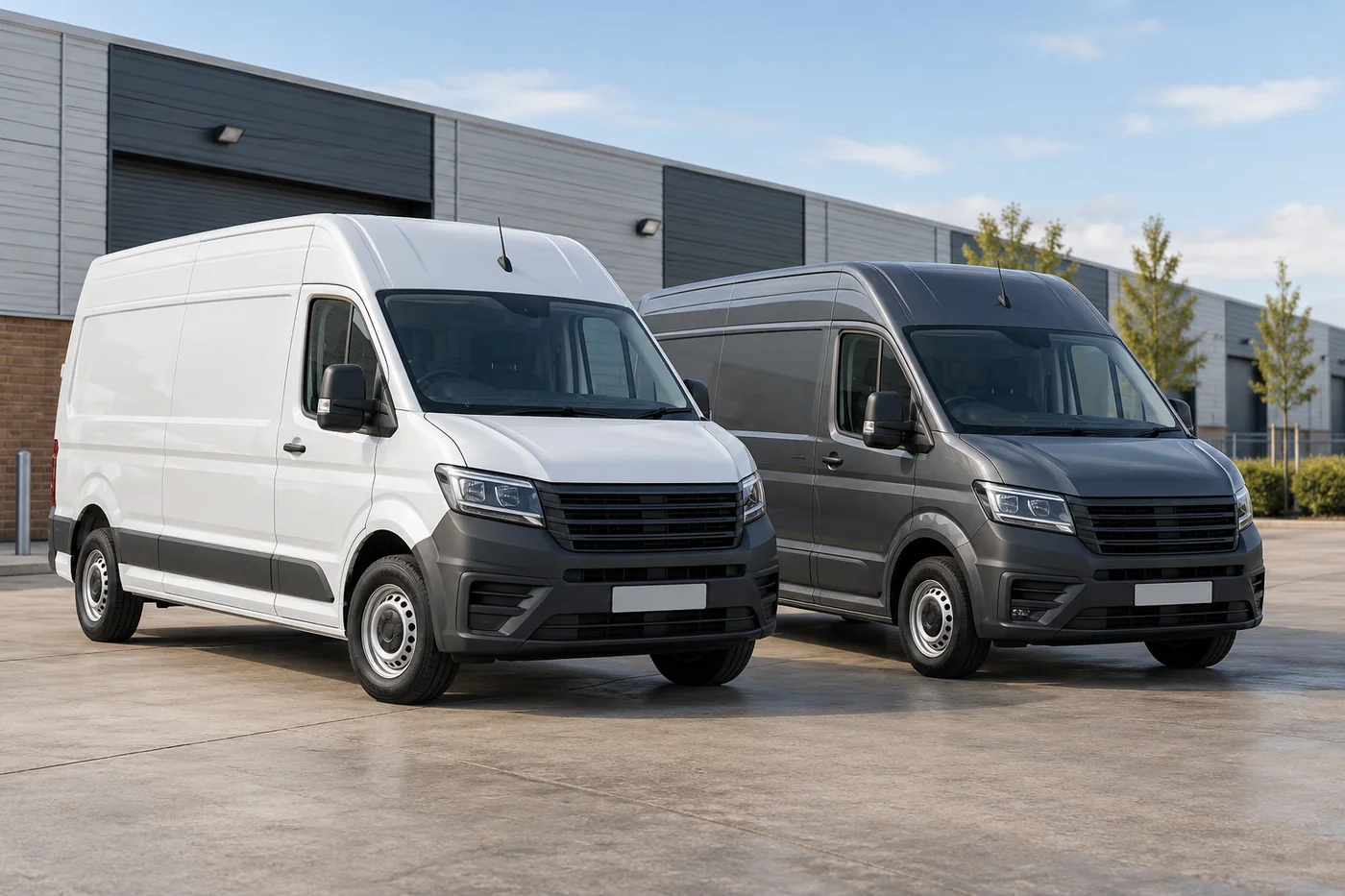
This guide compares diesel panel vans using UK manufacturer information checked on 29 October 2026. The worked size comparison is a 3.5-tonne Sprinter L2 H2 rear-wheel-drive van against a Crafter CR35 medium-wheelbase, high-roof, front-wheel-drive van. Longer bodies, other roofs, heavier weight ratings, crew vans, conversions and the electric eSprinter need separate figures. We have not driven or loaded these vans; this is a document-based buying comparison.
Dimensions: match the body before comparing the badge
Mercedes publishes the Sprinter figures below as EU-standard reference data on its UK website. Confirm the ordered UK van’s dimensions; equipment can change the figures.
| Measurement | Sprinter L2 H2 RWD | Crafter MWB high roof FWD |
|---|---|---|
| Overall length | 5,932 | 5,986 |
| Overall height | 2,620 | 2,590 |
| Width including mirrors | 2,345 | 2,427 |
| Maximum load-floor length | 3,375 | 3,450 |
| Maximum load-compartment width | 1,787 | 1,832 |
| Width between wheel arches | 1,350 | 1,380 |
| Load-compartment height | 2,009 | 1,961 |
Sources: Mercedes-Benz’s Sprinter technical data, the UK Crafter brochure, issued 1 April 2026, and VW’s dimensions page. VW’s web table retains an October 2024 data note; the linked brochure supplies the detailed cargo measurements. Use these figures to shortlist, then confirm the ordered vehicle’s specification.
The Crafter example offers 75mm more maximum floor length and 30mm more width between the arches. The Sprinter has 48mm more internal height. A box that clears the arches in one may therefore be awkward in the other, but lining, racking and the shape of the load can absorb that difference. Maximum floor length is not a promise of the same length at every height.
Outside, include the mirrors when checking a narrow gate. Measure the height of the finished van with any roof rack or equipment fitted, and leave appropriate clearance rather than treating a brochure height as a barrier test. Also check the space needed to open the rear doors and unload. A van that fits inside a parking bay may still be unusable there.
Run a load test before choosing a longer van
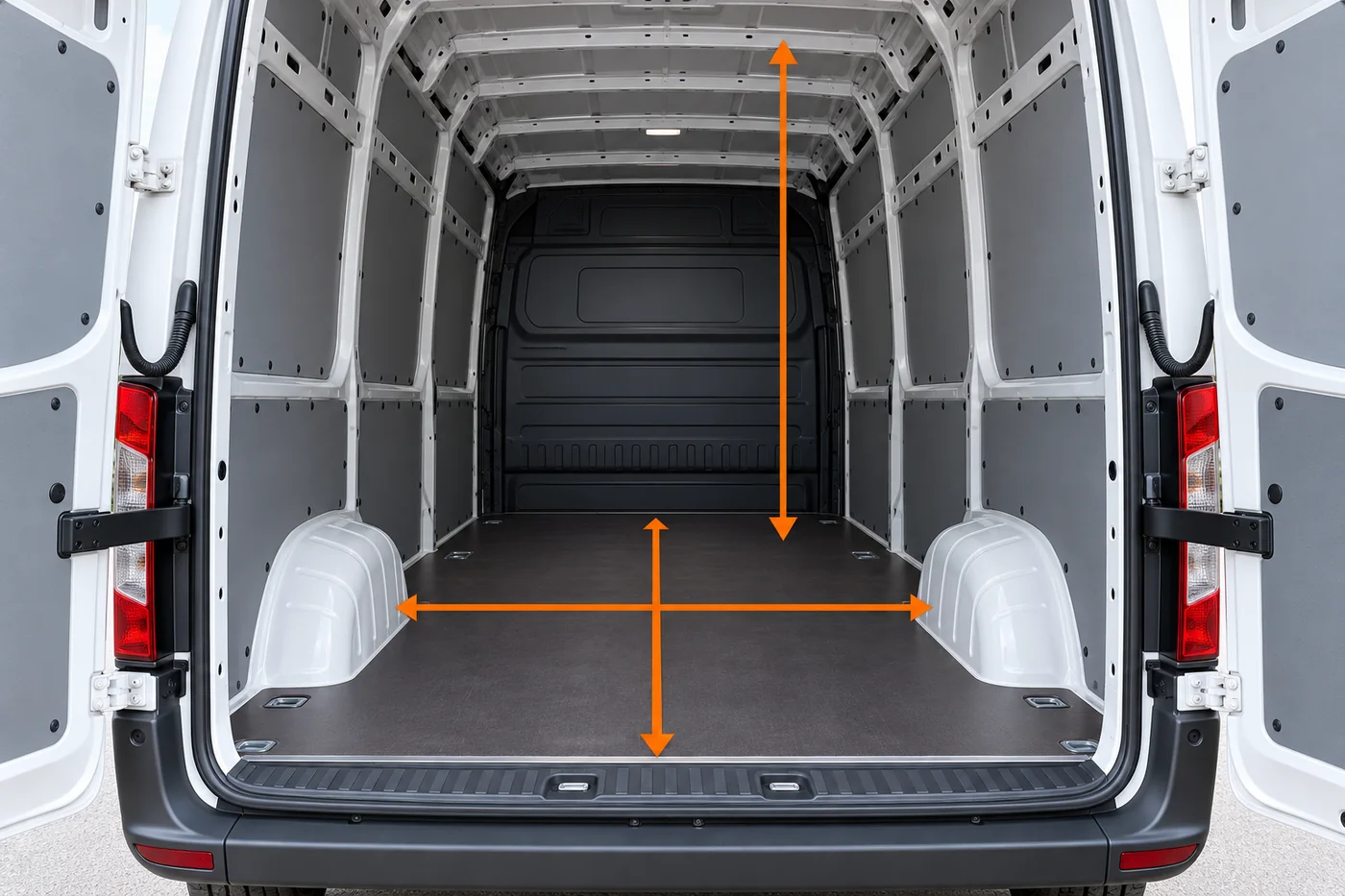
Bring the dimensions of your awkward items to the viewing: a machine in its transport case, sheet material, a trolley or the largest delivery package. Include handles, protective packaging and anything that cannot be removed during a normal working day.
- Check the route into the van. Measure the rear and side door openings, not only the compartment beyond them. Confirm that your trolley or handling equipment can approach the doorway.
- Lay out the floor. Mark the space needed for each item and the proposed racking. Account for the wheel arches and bulkhead; allow access to the equipment used most often.
- Check loading and restraint. Identify suitable securing points and a load-restraint arrangement appropriate to the cargo. Space for a box does not establish that it can be transported safely.
- Repeat the check with the normal crew. A crew seat or conversion changes the working space. Do not use a panel-van drawing to approve a different interior.
- Try the daily delivery sequence. Work out whether the first item can be removed without unloading everything else. An extra door or a better shelf layout may help more than extra body length.
VW’s brochure distinguishes front-wheel-drive Crafter load height from rear-wheel-drive and 4MOTION versions: the latter have a floor raised by 100mm in the relevant CR35 variants. That is why a drive-layout change needs another fit check. Do not carry the FWD column above into a quotation for a different drivetrain.
Payload: cubic metres do not tell you how much weight you can carry
A large empty compartment can reach its weight limit well before it looks full. The useful question is how much capacity remains after the van is equipped and ready for your work, including occupants, fuel, tools, racking and other equipment.
DVSA’s guidance on driving a van in Great Britain explains that the permitted gross weight includes the vehicle, driver, passengers, fuel and load. It also warns against exceeding individual axle limits and points drivers to a weighbridge. Check the vehicle’s plate and documents, then obtain a suitable weight check; a brochure’s maximum payload is not a measurement of your finished van.
Illustrative calculation: a van plated at 3,500kg that weighs 2,750kg with its normal crew, fuel and permanent work equipment has 750kg of gross-weight headroom for additional cargo. This is an invented arithmetic example, not a quoted Sprinter or Crafter payload. It does not prove that 750kg can be placed anywhere in the van: axle limits and proper load distribution still apply.
Ask both suppliers for the weight assumptions behind their quotation. Does the stated figure include the driver, a particular fuel level, factory options and the accessories you have selected? Do not subtract something twice if it is already included. For a converted van, obtain the completed vehicle’s weights and approval documents, rather than relying on the original empty shell.
For the wider trade-off between a compact vehicle and a large van, our small-van dimensions and payload guide helps organise the same load information.
Drivetrain, gearbox and cab: compare the exact vehicle
The table deliberately compares a rear-wheel-drive Sprinter with a front-wheel-drive Crafter. VW also lists rear-wheel drive and 4MOTION across its range; Mercedes offers all-wheel drive on request. Availability depends on the derivative. These labels do not, by themselves, tell you which van will suit every load or surface.
Give the supplier a clear account of your work: typical and maximum load, frequent gradients, access surfaces, annual mileage and any trailer. Ask for the relevant weight and towing limits in writing. A range-wide “up to” towing figure cannot be attached to every engine, gearbox or gross-weight version, and a trailer introduces separate limits and operating requirements.
Try the actual cab before choosing the trim. Adjust the seat, check your view of the mirrors and rear camera, and operate the heating and navigation while parked. If two people will regularly share the passenger bench, have them try it together. During an agreed test drive, assess the gearbox and manoeuvrability on a representative route; our research cannot establish a comfort or refinement winner.
Specify equipment by function: air conditioning, reversing camera, sensors, phone connection, a particular door arrangement or a suitable driver’s seat. An advert photograph may show an option that the quoted van does not include. Write the required equipment onto both quotations.
Compare the cost of doing the same job
Start with equivalent bodies, weight ratings and equipment, then ask for itemised offers. A low monthly figure is difficult to judge without the initial payment, contract length, mileage allowance and what happens at the end.
| Cost or condition | What to record |
|---|---|
| Acquisition | Cash price or all contract payments, fees, delivery, VAT basis and any final payment. |
| Work equipment | Lining, racking, security, towbar or conversion, including their effect on usable capacity. |
| Routine use | Insurance for the actual use, fuel assumptions, servicing, tyres and mileage. |
| Time off the road | Local workshop availability, booking arrangements and any replacement-vehicle provision. |
| End of ownership | Return conditions or a clearly labelled resale assumption; do not treat a forecast as a guaranteed value. |
Mercedes-Benz’s UK van warranty terms explain a two-year manufacturer warranty plus a third year for Sprinter, Vito and Citan vans supplied through an authorised UK dealer, all without a mileage limit. Obtain the applicable cover documents for the actual purchase, especially an import. VW’s warranty terms specify three years with unlimited mileage for Crafter vehicles registered after 24 April 2018. Conditions and exclusions apply; ordinary maintenance and wear are not a blanket warranty entitlement.
Check who covers added equipment and conversion work. Ask separately about breakdown assistance and a replacement vehicle: a repair warranty does not automatically promise that every lost working day is covered. Warranty length alone is not reliability evidence.
Which should you inspect first?
I carry bulky items but relatively little weight
Compare the exact cargo openings and floor plan first. The Crafter example’s extra floor length and arch clearance may help a particular item; the Sprinter’s extra interior height may matter more for another. Test the item and restraint arrangement before paying for a longer body.
I carry dense equipment, tools or materials
Ask both suppliers for the completed van’s usable payload and axle information. Include crew and the full working fit-out. Choose the configuration that can accommodate the job within its limits, then compare cost and access; a bigger empty compartment does not resolve a weight shortfall.
I am choosing between two used vans
Prioritise the actual specification, records and condition. Match VIN and documents, check service invoices, investigate damage and modifications, and arrange an appropriate independent inspection if needed. A tidy cab or famous badge cannot substitute for evidence about that van.
Used Sprinter or Crafter: keep the paperwork tied to the vehicle
Record the build year, engine, gearbox, drive layout, body length, roof and plated weights for each candidate. Earlier generations and previous specifications can differ substantially from the examples here. Confirm outstanding recalls with the manufacturer or dealer and obtain invoices for claimed repairs or maintenance.
Inspect the load floor, doors, hinges, roof and any fitted shelving for damage or alteration. Have unexplained warning messages, poor operation or missing records assessed before committing. Our used-vehicle viewing checklist provides a starting structure, but a working van and its equipment may need a specialist inspection.
Finally, check the rules for the actual vehicle and its use, including licence entitlement, any business-operation requirements and the applicable speed limits. Our UK speed-limit guide for cars, vans and towing explains why a large panel van should not simply be driven to the limits used for a car.