A DPF is a diesel particulate filter: an exhaust component that traps soot rather than letting it leave the tailpipe. The car normally reduces this soot through a high-temperature process called regeneration. A warning does not automatically mean the filter needs replacing, but it must not be ignored. Check the exact message in your vehicle’s handbook; a generic motorway drive is not a suitable response to every DPF fault.
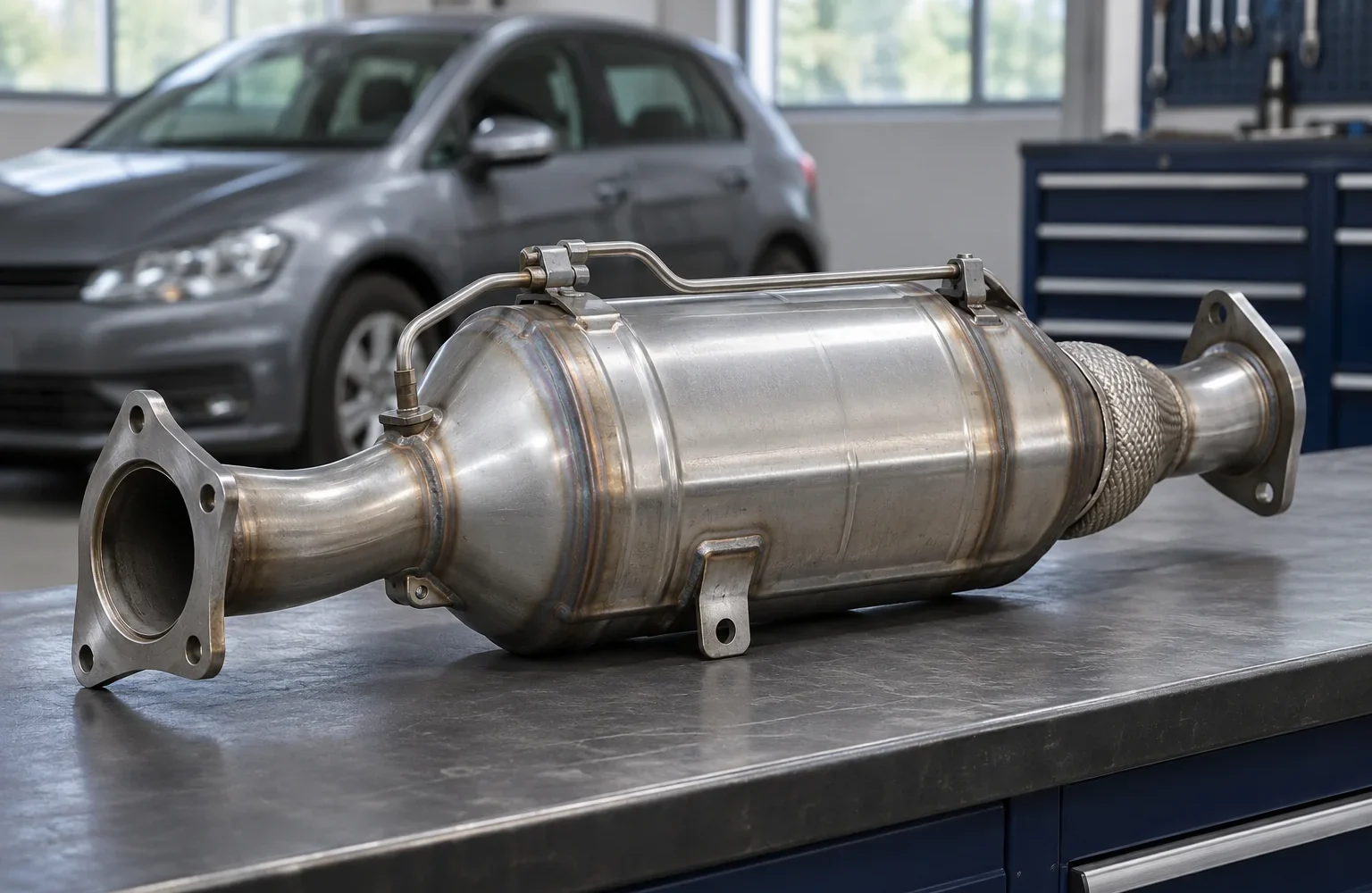
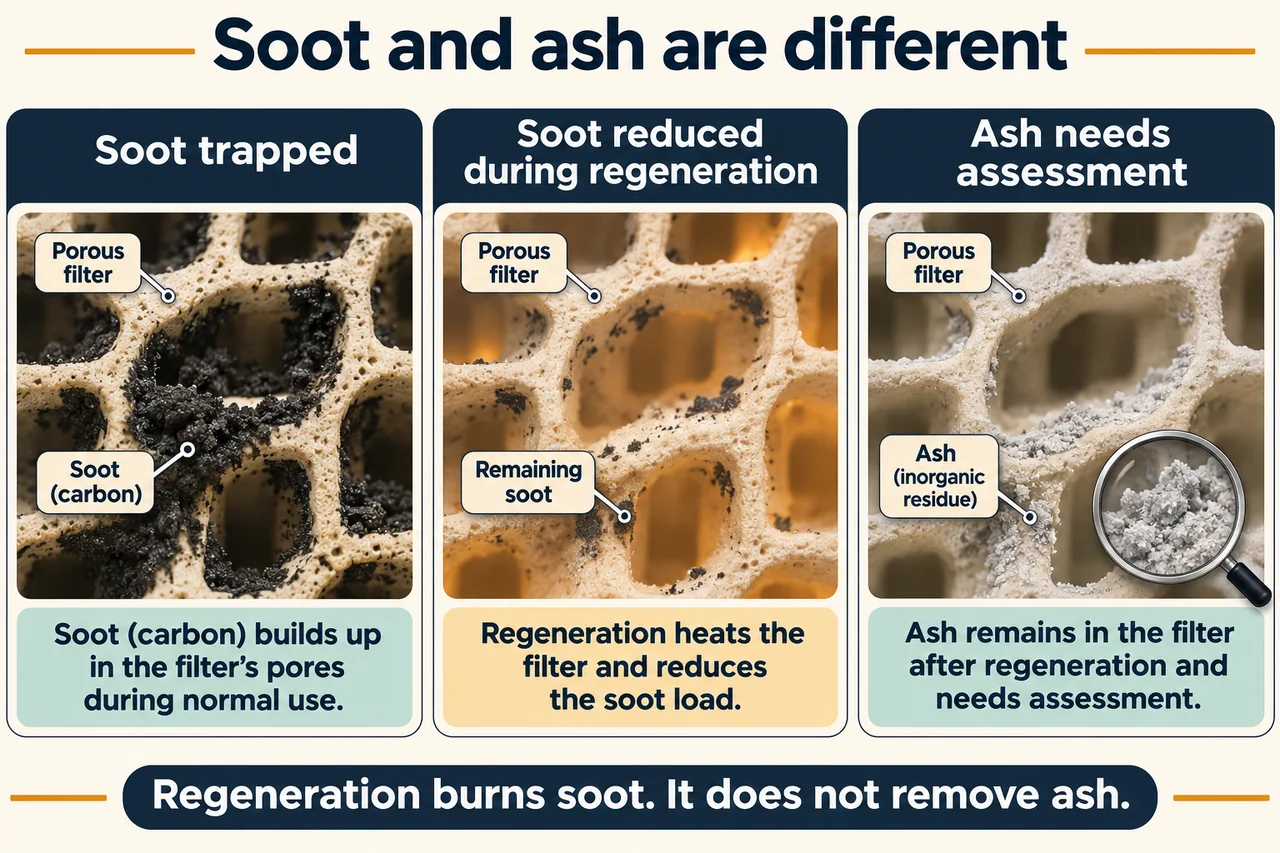
Understanding three different problems makes repair advice easier to assess: soot that may be regenerated, ash that cannot be burned away in the same way, and a fault elsewhere that prevents the system working properly. They need different responses.
What does a DPF do?
The filter sits in the exhaust system of a diesel vehicle. Gas passes through its porous filtering structure while solid particles are retained. The Department for Transport explains that this reduces particulate emissions and that accumulated soot must be removed periodically through regeneration.
A DPF is not the engine’s air filter or fuel filter. It is also not another name for the AdBlue tank. Bosch’s explanation of selective catalytic reduction describes AdBlue dosing as part of the system that reduces nitrogen oxides. The particulate filter’s job is to capture particles. A diesel may use both systems, and an AdBlue warning should not be treated as a request to clean the DPF.
Exhaust assemblies can combine several functions, so appearance alone is a poor way to identify a component. Our catalytic converter guide explains the related conversion of exhaust pollutants.
Regeneration, cleaning and replacement are different
Regeneration burns off accumulated soot under suitable operating conditions. It does not make every used filter equivalent to a new one. HELLA’s technical explanation notes that ash remains and that an ash-saturated filter needs assessment for cleaning or replacement.
| Term | What it describes | Limit to remember |
|---|---|---|
| Passive regeneration | Soot oxidises when the exhaust conditions allow it during use | Not guaranteed by a particular road name or speed |
| Active regeneration | The engine management system creates conditions to reduce the soot load | Requires the conditions specified for that vehicle |
| Service or forced regeneration | A workshop initiates a controlled regeneration using diagnostic equipment | Not appropriate until faults and safety preconditions are checked |
| Filter cleaning | A separate assessed cleaning process, potentially involving removal | Ask what contamination it addresses and how the result is measured |
| Replacement | A suitable replacement filter is fitted | The reason for the original failure still needs attention |
Snap-on’s UK diagnostic guidance distinguishes regeneration methods and stresses vehicle-specific readings and checks before a forced regeneration. Its workshop procedures are not an instruction for an owner to run a parked car at high engine speed.
Why short trips can cause trouble
Frequent journeys that end before the engine reaches operating temperature can make regeneration harder to complete. For example, Volvo’s UK 2019 XC40 diesel handbook specifically warns about repeated short, low-speed journeys and cold conditions.
That explains why annual mileage alone is an incomplete buying test. Two drivers may cover the same distance, but one does it in longer journeys and the other in repeated brief trips. Before choosing a diesel, compare your actual use with the handbook for the engine you are considering. Our petrol versus diesel comparison puts that question alongside running costs and journey type.
Some changes in behaviour can accompany regeneration, but they are not a dependable owner diagnostic test. Volvo lists temporary changes in fuel consumption and engine response, and a hot smell, for the diesel model covered by its page. An unfamiliar smell, warning or loss of performance should not be dismissed as “just a regen”.
What to do when the DPF warning appears
Read the complete message once safely stopped and identify all illuminated warnings. Look up the instructions for the correct model, engine and year. A manufacturer’s procedure may permit a regeneration drive in a particular situation; another message may require workshop assistance instead.
The distinction is real: Volkswagen UK’s DPF warning page separates a single warning from multiple warning lights and directs the latter case to roadside assistance. Its stated driving procedure belongs to that guidance, not to every diesel car.
| Situation | Useful next step | Avoid |
|---|---|---|
| A DPF message with a clear handbook procedure | Check that all conditions are met and follow it only where safe and lawful | Substituting a universal speed, gear or duration from a forum |
| Several warnings, restricted performance or a service instruction | Contact the manufacturer, garage or breakdown provider for advice on moving the car | Trying to clear it through harder driving |
| The warning persists after the permitted procedure | Arrange diagnosis and report what was attempted | Repeating regeneration attempts indefinitely |
| A red stop instruction, overheating or unsafe behaviour | Stop as soon as safe and seek assistance in accordance with the handbook | Continuing a regeneration drive to protect the filter |
Do not start a forced regeneration using a scan tool merely because the menu offers it. Equally, do not leave the engine running in an enclosed space or improvise a stationary high-rev routine. The exhaust can become extremely hot; follow the handbook’s parking and fire precautions.
What a proper diagnostic quote should establish
A request for “DPF cleaning” can skip the most valuable part of the job: finding out why the warning appeared. A filter-related code identifies a system to investigate, not necessarily a filter to replace. HELLA’s example involving a 2015–2019 VW T6 2.0-litre diesel with engine code CXHA illustrates that pressure-sensor work and vehicle-specific diagnostic steps can form part of the repair. It does not establish that your car has the same fault.
Ask the workshop to put the following in its estimate or report:
- The fault codes and findings, including whether sensor information is credible.
- Whether the concern is soot loading, ash accumulation, physical damage or another system fault.
- Why a regeneration, cleaning or replacement is appropriate for this vehicle.
- What is included in the price: diagnosis, labour, any removal and refitting, parts and VAT.
- How the result will be checked, and what happens if the original warning returns.
Keep a short record of the exact messages, mileage, recent journey pattern, servicing and any earlier attempts to clear the warning. This makes a repeat fault easier to investigate. Our guide to comparing garage quotes explains how to separate diagnosis from routine service work.
Can you remove the DPF or pass an MOT without it?
Removing a factory-fitted DPF is not a legitimate repair for a road car. The government guidance explains that using a vehicle modified so it no longer meets the emissions standards it was designed to meet can breach the law.
For Great Britain, the current DVSA MOT manual classifies missing, obviously modified or obviously defective manufacturer-fitted emissions equipment as a Major defect. Evidence of DPF tampering is also Major. A past MOT pass does not make a subsequent removal acceptable.
Common questions before booking work
Will a DPF cleaner fix a warning light?
Do not treat a bottle as a diagnosis. Check whether the vehicle manufacturer permits the product and what fault the workshop has identified. A product claim does not establish that the filter is suitable for treatment, that a sensor works, or that accumulated ash has been removed. Do not confuse a separately specified factory additive system with an aftermarket fuel additive.
Does a blocked DPF always need replacing?
No. The appropriate repair depends on the cause, loading and physical condition. Ask for findings that justify the proposed work. Conversely, a promise that every DPF can be restored by a regeneration or cleaning is too broad. Get a written explanation of the result the provider expects and the limitations.
How often should a DPF regenerate?
There is no single interval for every diesel. The engine, filter system, operating conditions and vehicle control strategy matter. Do not use another owner’s mileage as a pass/fail test. If the pattern changes substantially or warnings recur, record the change and ask for vehicle-specific assessment.
The conversation