
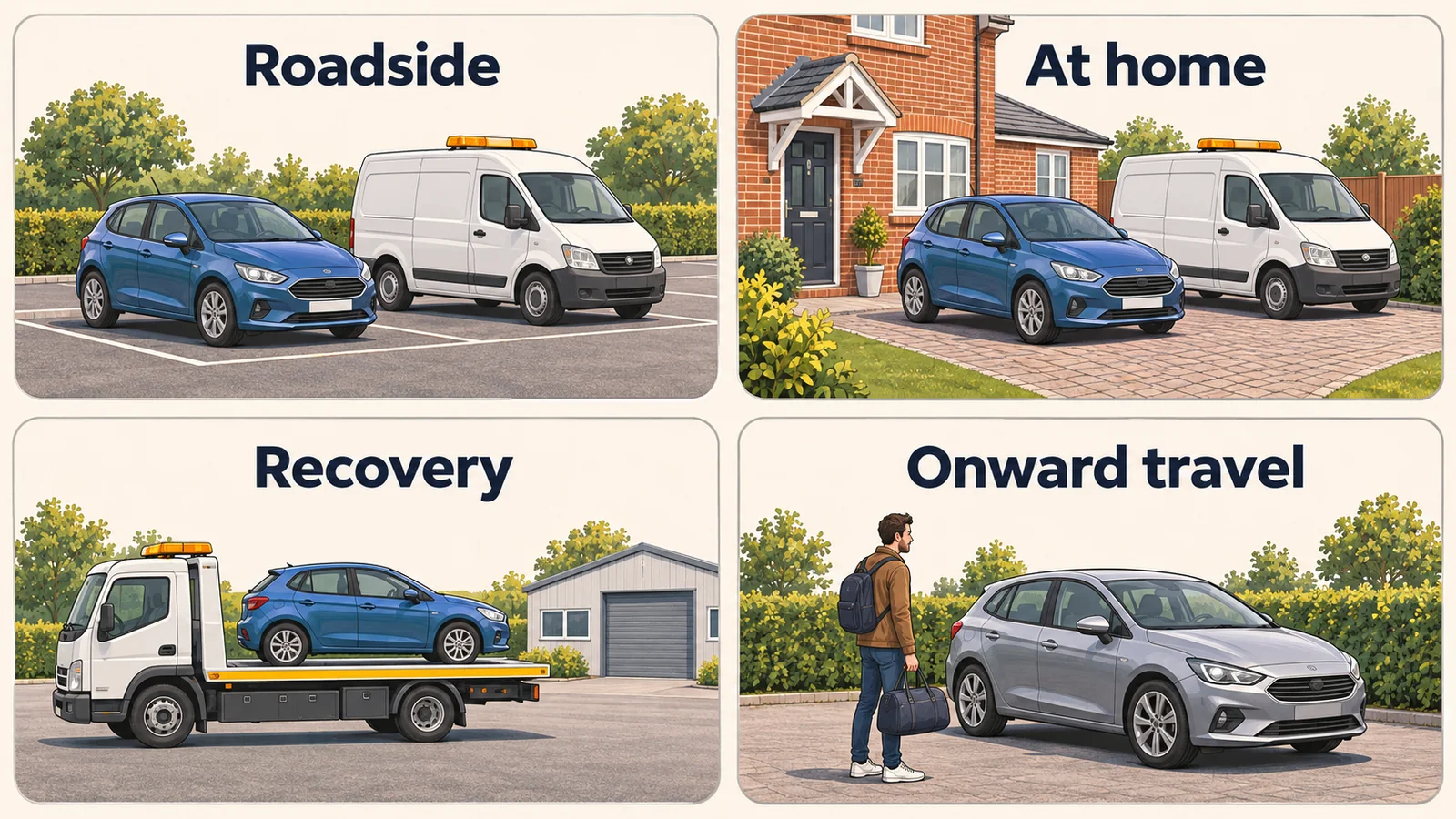
For a qualifying breakdown, roadside assistance sends help when a car breaks down away from home; recovery determines where it can be taken if it cannot be fixed; home assistance extends help to your driveway and the area around your home. Onward travel deals with your journey after the car is out of action. Those are separate questions, even when a provider sells them together. [1]
Compare the actual services and conditions before comparing the price. A package that gets a car to a nearby garage might leave a different problem from one that takes it home: how will you get to work tomorrow? This guide explains the distinctions for UK drivers, using policy information checked on 5 November 2026.
What each level of breakdown cover does
| Service | Question it answers | Detail to check |
|---|---|---|
| Roadside assistance | Will someone attend the breakdown? | Distance from home and local towing arrangements. |
| Home assistance | Will they come if the car will not start at home? | Home-address boundary and where an unrepairable car goes. |
| National recovery | Can the car be taken farther than a local garage? | Permitted destination, passenger allowance and qualifying conditions. |
| Onward travel | How can I continue while the car is being repaired? | Transport or accommodation options, limits and approval process. |
| European cover | What happens during a driving trip abroad? | Countries, trip dates, vehicle eligibility and return arrangements. |
Roadside assistance: attendance and a local solution
The first step is normally an attempt to get the vehicle going. If that is not possible, basic cover may include only local recovery. The provider’s definition matters: one policy may specify a mileage limit, another a suitable local repairer. Do not read “recovery included” as “any destination I choose”. [1] [5]
Use a familiar journey to test the wording. If you broke down halfway between home and a weekend destination, identify where the policy would take the car. Then consider who would collect it after repair. That second journey can be inconvenient even when the original recovery is covered.
Home assistance: location matters
Home assistance, sometimes called home start, covers qualifying breakdowns at or close to the recorded home address. A quarter-mile boundary is used in the examples linked here, but check your own contract. National recovery alone does not establish that help at home is included. [2]
A useful question is: “If the car cannot be fixed on my driveway, where can it be taken?” Home attendance and long-distance transport are separate benefits. For example, the home-cover page in source 2 describes a tow of up to 10 miles to a garage when a repair is not possible there.
National recovery: where the car goes
National recovery widens the destination choice beyond a local tow. Read the destination and passenger rules, and whether the cover applies where the breakdown happened. Source 3 describes UK-wide recovery under its qualifying packages, while its basic package has a 10-mile limit. These are examples, not universal industry limits. [3]
Decide what a useful destination would actually be. Returning the car to your driveway and delivering it to a garage that can inspect it are different outcomes. Ask whether the policy provides one recovery destination or permits a later transfer; do not build your plan around two journeys unless the wording supports them.
Personal cover or vehicle cover?
Personal cover follows a named person travelling as a driver or passenger in an eligible vehicle. Vehicle cover follows a listed vehicle, regardless of which eligible driver is using it. With personal cover, the covered person normally needs to be travelling in the car when it breaks down. “Any car” still has eligibility conditions. [1]
Map the arrangement against actual use rather than counting cars alone:
- One car shared by two people: establish whether both are protected when travelling separately.
- One person regularly using two cars: compare naming both vehicles with covering that person, including passenger journeys.
- A household with an adult child living elsewhere: check address and family-cover definitions instead of assuming the family label includes everyone.
- A car used for paid deliveries or trade work: describe that use accurately to the provider and check eligibility before buying.
These are comparison prompts, not recommendations for a particular policy. The same household can have several workable options with different restrictions.
Onward travel: getting the people moving
Recovery transports the car; onward travel offers a way to manage without it. Depending on the policy, that may mean a hire car, public transport or accommodation. Benefits can be alternatives rather than cumulative payments. Check the hire period, monetary limits and when the benefit becomes available. [4]
A hire car is not automatically equivalent to your own vehicle. Age and licence conditions, available vehicles and the number of passengers can affect the option offered. Source 4 explicitly notes hire restrictions and alternatives when available cars are unsuitable. Consider luggage, child seats, mobility needs and pets when asking how the arrangement would work.
Try this scenario: your seven-seat car needs a garage repair while you are away with six people. A line saying “hire car included” does not answer whether everyone can travel together. Record the provider’s answer, the fallback option and any costs you would have to meet. Keep the claims contact and authorisation instructions with the policy.
Exclusions that deserve a proper read
Breakdown cover is not a general maintenance budget. The membership terms in source 5 distinguish emergencies from routine work, exclude known pre-existing faults and set conditions for repeated call-outs. They also limit vehicle size and use. Ordinary assistance does not mean every replacement part or subsequent garage bill is paid. [5]
In each quote, find the sections covering:
- faults already present before cover starts, and repeat incidents after temporary assistance;
- vehicle age, weight, dimensions, trailers and business use;
- call-out limits, excesses and costs payable by the member;
- keys, misfuelling, punctures, running out of fuel or charge, and accident recovery;
- parts, labour, storage and recovery arranged without prior approval.
This list identifies things to check, not a claim that all policies exclude them. Save written clarification if a feature matters and the document is unclear. For the maintenance side of ownership, our guide to car servicing explains the separate routine work to plan for.
Can I buy cover after the car has broken down?
Do not assume a normal new policy will pay for an existing breakdown. The terms in source 5 describe waiting periods and an additional fee for immediate assistance. Ask for the full immediate-assistance price and the ongoing membership commitment before agreeing. [5]
Does adding an upgrade solve a breakdown already in progress?
Not necessarily. Source 4 says its onward-travel upgrade starts after 24 hours and cannot be added for an existing breakdown. Check the effective time of each benefit rather than relying on the date a payment leaves your account. [4]
European cover needs a separate trip check
A UK policy should not be treated as proof of European assistance. Check every country on the route, outward and return dates, vehicle details and trip-length rules. The European policy in source 6 requires purchase before leaving the UK and coverage for the whole trip; other policies need their own check. [6]
Read the sections for local repairs, alternative travel, accommodation and getting the vehicle home. Repatriation means returning the vehicle to the UK, but its availability, cost limits and timing depend on the contract and circumstances. It is not a promise that the car will return with you. Ask what happens if repairs extend beyond the planned holiday and what approvals are required before spending money. Our road-trip planning guide covers the wider journey preparation.
Check existing cover before paying twice
Look through your motor-insurance documents, vehicle purchase or manufacturer-assistance paperwork and bank-account benefits. A bundled benefit may already meet part or all of the need. Packaged bank accounts can include breakdown cover; value depends on whether the benefits are useful and usable, not simply on the number advertised. [7]
Put the existing and proposed cover side by side. Check the people, vehicle, services and expiry date, then identify the precise gap you are trying to fill. Two policies with the same roadside service do not automatically provide home assistance or a larger hire car. Before cancelling anything, confirm the replacement’s start time and the old arrangement’s cancellation terms.
A checklist to use with two quotes
Copy these headings into a note and answer each for Quote A and Quote B. Mark an unanswered point “unconfirmed”, rather than treating a missing exclusion as a benefit.
- Who and what? Named people, registered vehicles, usage and eligibility.
- Where? Home boundary, UK territory and any overseas trip.
- If it cannot be fixed? Destination, tow limit and passenger transport.
- While it is repaired? Hire, travel or accommodation terms that suit your party.
- What can I be charged? Excess, call-out limits, parts and other excluded costs.
- When does each benefit work? Start time, waiting periods and renewal date.
- How is help arranged? Contact method, approval requirements and documents to keep.
- What am I already paying for? Existing cover and the remaining gap.
Only then compare the total price over the same period. Check whether a monthly quote is a rolling arrangement or instalments on a longer contract. A cheaper headline is useful only once you understand the service you would receive in the situation that concerns you.
Sources
- RAC: breakdown cover guide — cover types and roadside assistance.
- RAC: home assistance — location and recovery scope.
- RAC: national recovery — destinations and qualifying cover.
- RAC: onward travel — alternatives, hire restrictions and start time.
- The AA: UK Personal and Vehicle Breakdown Cover terms and conditions, September 2026 (PDF).
- The AA: European Breakdown Cover terms and conditions, September 2026 (PDF).
- Financial Ombudsman Service: packaged bank accounts and the usefulness of bundled benefits.