
Start with the largest thing you carry and the seats you need on the same journey. A generous boot capacity is useful for bags. For a folded pushchair, toolbox or mobility aid, the deciding measurements are the opening, the narrowest usable width and the distance from the upright seatback to the closed tailgate. Take the item to a viewing if you can. A few minutes getting it in and out will tell you which figures matter.
Which estates belong on the shortlist?
If you are shopping used, three familiar UK estates illustrate how much the choice of version matters. The figures below are for the specifications named, with the rear seats in use. Match the advert to the model year, estate body and powertrain before comparing it with the next car. A registration year alone can cover more than one specification.
| UK estate and specification | Capacity |
|---|---|
| Škoda Octavia SE Technology Estate, model year 2021, standard estate | 640 litres [1] |
| Škoda Superb SE Technology Estate, model year 2021 | 660 litres, or 510 litres in the iV plug-in hybrid [1] |
| Toyota Corolla Touring Sports, December 2021 UK specification | 598 litres in the 1.8 Hybrid, 581 litres in the 2.0 Hybrid [2] |
The two Superb estates in the table have the same published exterior length of 4,862 mm. Choosing the plug-in version changes the figure behind the rear seats by 150 litres. Someone measuring a driveway would come to the same answer for either car. Someone packing a family holiday should look in both boots. [1]
When reading an advert, check whether the quoted capacity is measured with the back seats up or folded. If everyone travels together, the folded figure has little bearing on the choice. If the advert leaves the reference height or floor setting unclear, ask for a photograph of the boot with the luggage cover and floor in their normal positions.
Will the load get through the tailgate?
Measure your item as it travels. Include pushchair wheels, a handle that stays extended, toolbox catches or the rigid corners of a suitcase. A soft bag can take up the awkward pocket beside a wheel arch. A rectangular case needs clear space for its full width and height along its route into the boot.
- Check the opening at the height of the load. A tailgate can be wide at bumper level and taper towards the roof. Measure between the pieces of trim your object must pass. Include the turn if you need to tip it before sliding it in.
- Measure the floor at the narrowest point. Measure between the wheel-arch housings and look for rails or side pockets that project into the usable space. A brochure figure labelled “maximum width” describes a different measurement.
- Check the depth at two heights. Start at the floor, then repeat at the height of the top corners of the load. An inclined rear seatback or sloping tailgate can take away the last few centimetres. Check the closed position with an empty mock-up, keeping hands clear and stopping if anything touches.
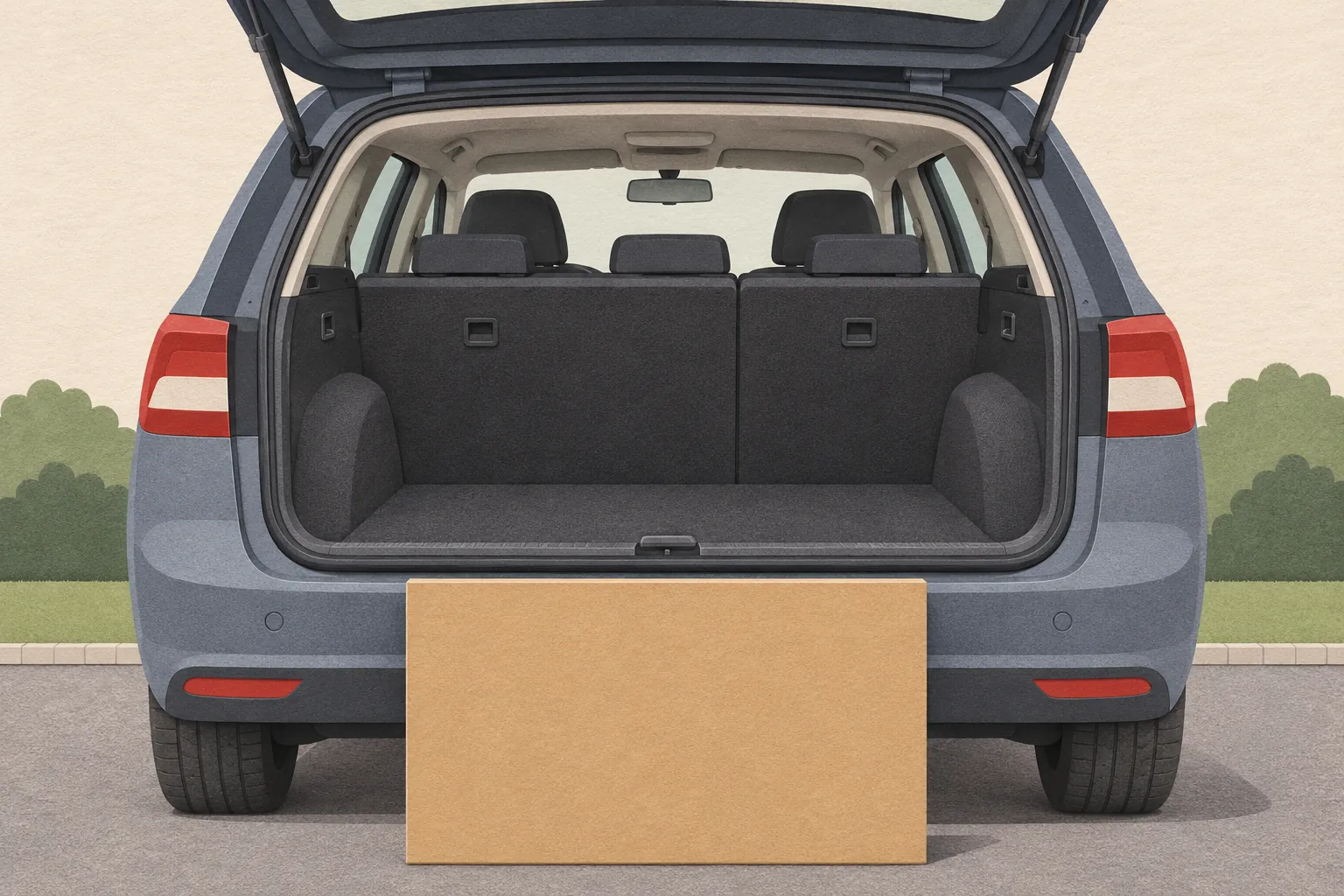
One useful example is the 660-litre Superb Estate above. Its side-view drawing shows 1,131 mm along the floor behind the rear seats. Suppose you have a rigid 1,100 mm equipment case. That leaves 31 mm on paper at floor level. The drawing gives you a reason to try the case in person. It cannot tell you whether the top corner of your particular case clears the glass. [1]
What changes with the floor or cover in place?
In the cited Corolla Touring Sports specification the maximum loadspace width is 1,430 mm and the loadspace height to the tonneau cover is 520 mm. The first figure does not give you the width between the wheel arches. The second is particularly useful if you want your luggage out of sight. An upright carton 550 mm high exceeds that quoted height by 30 mm. Check another orientation if the contents allow it, or choose a different carton. [2]
If the car has an adjustable boot floor, ask the seller to show you both positions. With the floor raised, try sliding a bulky item over the sill. With it lowered, check how far you have to lift the item back up to get it out. Also see whether the cover has somewhere to go when removed. A parcel shelf left across the garage is a nuisance if the next journey involves shopping you want to cover.
Try the journey you actually make
A pushchair and passengers
Set the front seats where the driver and passenger normally sit and leave the rear seats upright. Load the folded pushchair as you would on a wet day. If it needs a wheel removed, try finding space for that wheel, a changing bag and the shopping. Check whether the bag you need first can come out without unloading the pushchair.
A long item and someone in the back
Fold just the section you would be able to spare on the journey. Check which side the narrow section is on, the step where the seat folds and the usable length with the driver’s seat in its normal position. Make sure the remaining passenger has a usable seat and belt. If the item can only fit with both sections down, record the car as a two-person option for this trip.
A mobility aid you load frequently
With the car parked, try the loading motion you normally use, with your usual assistance if needed. Record the height from the ground to the sill and the drop from the sill to the floor. A wide opening can still involve an awkward lift. A lightweight template can check the outline if bringing the aid is impractical. Arrange a trial with the actual equipment before relying on the fit.
Check the tailgate where you park at home as well. There may be enough room to shut the garage door around the car but too little to stand behind it with a pushchair while the hatch rises. For a used example, add the boot trial to the used-car viewing checklist and try the latch, floor panels and seat releases on that particular car.
Room for a load and permission to carry it
Boot capacity measures volume. For heavy kit, check the permitted weights for the particular car in its handbook or with the manufacturer, taking the occupants and other luggage into account. In Great Britain the load must be secure, the vehicle must stay within its permitted loading limits and a projecting load must not cause danger. Check how your item can be secured before buying a car to carry it. [3]
Sources
- Škoda UK — SE Technology range pricing and specification, model year 2021. See the Octavia dimensions on PDF page 19 and the Superb Estate table and side-view drawing on PDF page 32.
- Toyota GB — Corolla technical specifications, December 2021. See the Touring Sports columns in the interior dimensions table on PDF page 4.
- Department for Transport — The Highway Code, rules for drivers and motorcyclists. Rule 98 covers vehicle loading in Great Britain.