Hire purchase (HP) spreads the cost of buying a car across an agreed term. You normally pay a deposit, regular instalments and any option-to-purchase fee before becoming the owner. Compared with personal contract purchase (PCP), conventional HP usually has higher monthly payments but no large optional balloon payment. Compare the total cost of ownership, not just the monthly figure.

The right comparison starts with what you want at the end: a car you own, or the option to return it. This guide explains conventional UK consumer HP, how it differs from PCP and the questions to put beside two actual quotations. Sources were checked on 31 October 2026. It is general information, not a recommendation of a lender or a credit agreement for your circumstances.
What are you paying for with hire purchase?
Under HP the finance provider owns the vehicle while you use it and pay under the agreement. Ownership follows completion of the required payments and purchase requirements. Having the keys, insuring the car or appearing as its registered keeper does not make you its legal owner during the agreement.
MoneyHelper’s HP guide explains the deposit, instalments and final option-to-purchase fee. Check your own quotation: a deposit is not necessarily refundable, and an advertised monthly amount may exclude a fee due at the end. Insurance, fuel or charging, maintenance and repairs still need a separate budget unless your contract explicitly includes an item.
For example, a payment that fits your budget on payday may still leave no room for an annual insurance renewal or an unexpected tyre replacement. Set a monthly ownership budget first, then see how much of it remains for finance. Our guide to choosing your next car helps keep the vehicle requirement separate from the available monthly payment.
HP vs PCP: compare the end position
| Question | Conventional HP | PCP |
|---|---|---|
| What do instalments repay? | The financed purchase price, plus interest and applicable charges. | Part of the purchase price is deferred to an optional final payment; interest still applies to the financed balance. |
| Large final payment? | Usually no large balloon; check any purchase fee. | A large optional final payment if you want ownership. |
| Who owns it during the agreement? | The finance provider. | The finance provider. |
| If you complete the purchase | You own the car after meeting the purchase requirements. | You own the car only after paying the optional final amount and meeting the purchase requirements. |
| If you return it | Early return requires an appropriate exit route, not simply leaving it with the dealer. | End-of-term return is an option, subject to contractual mileage, condition and other obligations. |
| Mileage planning | Usually no contractual annual cap, but read the agreement. | Choose a realistic allowance and check the excess-mileage charge for a return. |
MoneyHelper’s PCP explanation makes an important distinction: deferring the balloon does not mean borrowing only the amount covered by the regular instalments. A lower monthly figure is therefore not evidence of lower total borrowing costs.
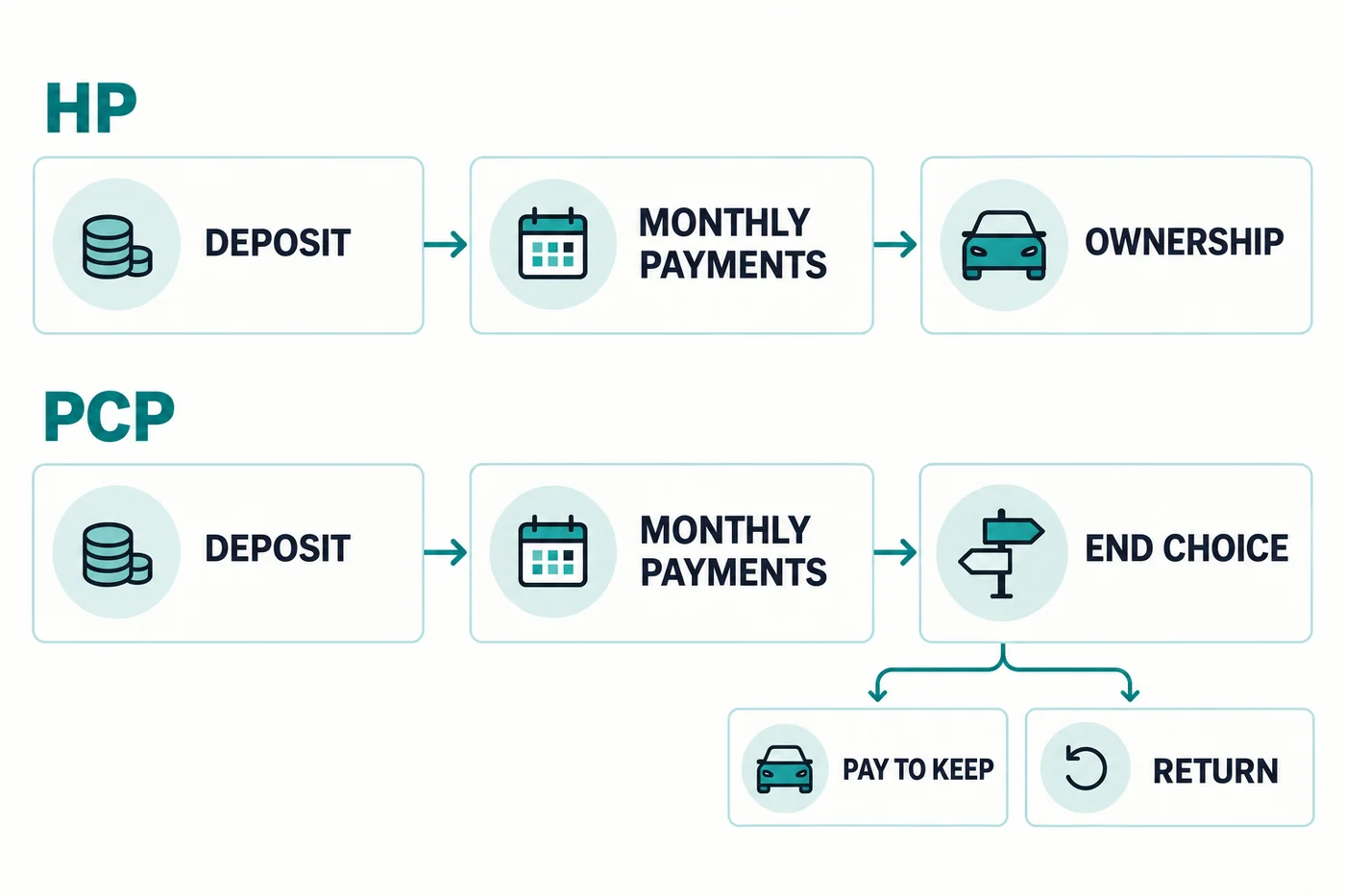
PCP can also end with a vehicle being part-exchanged, but do not assume there will be a deposit waiting for the next car. Any equity depends on its value relative to the amount needed to settle the finance. A fresh agreement also means a fresh affordability decision.
A worked comparison: why £200 a month can cost more to own
These are invented figures for explaining the arithmetic, not available offers or market rates. Both examples use a £12,000 cash price and £2,000 customer deposit. The instalments already include their hypothetical finance charges; no APR is inferred from them.
| Item | HP example | PCP example |
|---|---|---|
| Deposit | £2,000 | £2,000 |
| Regular payments | 36 × £320 = £11,520 | 36 × £200 = £7,200 |
| Final purchase payment | £10 option fee | £5,000 balloon, including any purchase fee in this example |
| Total paid to own | £13,530 | £14,200 |
| Total if PCP is returned as agreed | Not a comparable end-of-term rental figure | £9,200 before any return charges; no car owned |
The PCP payment is £120 lower each month, yet buying that car at the end costs £670 more in this example. Returning it costs less in payments, but leaves you without the asset. Those are different outcomes, so placing £9,200 beside £13,530 and calling the former “cheaper ownership” would be misleading.
Now test the reverse boundary. If a real PCP quotation has a subsidised rate or a contribution that makes its ownership total lower, the product label alone should not override the figures. And if an HP offer stretches payments over more years, a smaller monthly instalment does not establish a lower total cost. Use the exact dates, fees and amounts on each quotation.
The quotation worksheet to complete before signing
- Match the car. Compare the same vehicle, specification, condition and cash price. A cheaper trim is not a cheaper financing method.
- Separate your deposit from a contribution. Write down your cash, part-exchange value, any outstanding finance and any dealer or manufacturer contribution separately.
- Record the full payment schedule. Count the regular instalments. Identify whether a quoted final payment replaces an instalment or comes after it.
- Add the ownership total. Customer deposit plus every contractual payment needed to own the vehicle. Do not add a fee twice if it is already included.
- Record APR and the total charge for credit. Use the personalised figures offered to you, not only the headline advertisement.
- List return obligations separately. For PCP, record agreed mileage, the excess rate, condition standards and collection or administration charges.
- Price optional extras individually. Ask whether an add-on is financed and therefore increases interest as well as the instalment.
- Leave with the documents. Resolve differences between the advert, written quotation and salesperson’s explanation before committing.
MoneyHelper explains representative APR: it is not a promise that every successful applicant receives that rate. A personalised quotation is more useful than comparing one firm’s representative figure with another firm’s accepted offer.
Check whether HP is the right problem to solve
If you want to keep the vehicle for a long time, inspect the full purchase cost and the reliability of your budget. If your priority is changing cars regularly, compare the cost of use and return conditions as well. If neither agreement leaves room for running costs, reconsider the price of the vehicle rather than only extending the term.
MoneyHelper’s wider buying guide also covers cash, personal loans and leasing. Cash avoids finance interest but uses savings. A personal loan can allow outright purchase while leaving a separate repayment obligation. Personal contract hire is a lease and normally offers no contractual purchase option. Compare those end positions before deciding that HP and PCP are your only choices.
Financing does not replace checking the car. Use our used-car viewing checklist and confirm what the seller promises in writing.
Early settlement and voluntary termination are different
Early settlement means obtaining a dated settlement figure from the lender and paying what is required to clear the agreement. It is not the same as adding the remaining monthly instalments, and a figure can expire. Confirm the lender’s procedure and ownership position before selling or part-exchanging a financed car.
Voluntary termination is a different route under qualifying regulated HP and PCP agreements. The relevant halfway figure is half the agreement’s total amount payable, not half the car’s cash price or half the months. With PCP, the balloon is included, so reaching halfway can take much longer than expected. Check the termination section of your own agreement and get advice about any balance, arrears or condition dispute.
You do not have to wait until you have actually paid 50% before giving a valid termination notice. Any amount needed to meet the halfway liability can still be payable. National Debtline’s detailed HP guide explains the timing: the right applies before the final instalment is due and can be lost if the lender has already terminated the agreement or the full balance has become payable. Get advice promptly if either may have happened.
National Debtline’s England and Wales guidance explains why formally terminating in writing differs from voluntarily surrendering the vehicle. The consequences can differ substantially. Its jurisdiction is stated here deliberately; use advice appropriate to your location and agreement. Do not simply stop payments or hand over the keys and assume the debt has ended.
Three questions worth resolving before you choose
Can I sell a car while it is on HP?
You cannot treat it as an unencumbered car you already own. Ask the finance provider for a settlement figure and its authorised sale or part-exchange process. Check how the buyer or dealer will clear the finance and obtain confirmation; an informal promise to keep paying is not the same as settling it.
Does a V5C prove that I own a financed car?
No. The V5C identifies the registered keeper and is not proof of ownership. The finance agreement determines the lender’s ownership interest. Our V5C guide explains the separate keeper and ownership roles.
Is a lower payment worth a longer contract?
Only compare it after writing down the extra months, total payable and the period you expect to keep the car. A longer term can reduce the instalment while increasing the overall commitment. Include maintenance and the possibility that your needs change before the finance finishes; do not assume you can exit at no cost.
If payments or the car become a problem
Contact the lender promptly if payments become difficult. Ask what support is available and get free debt advice before agreeing a change you do not understand. A payment extension can affect the length and cost of the commitment; it is not automatically a saving.
For a faulty car supplied under finance, the lender’s role matters. The Financial Ombudsman Service’s car-finance guidance explains complaints about vehicle quality, misdescription and charges. Keep the advert, agreement, messages, inspection reports and a dated record of the problem. Complain to the business first; the Ombudsman explains the next steps if the matter remains unresolved.
Historic commission complaints have separate, changing arrangements. For those, use the FCA’s current car-finance claims guidance. Do not build a new affordability calculation around an assumed future compensation payment.
The conversation