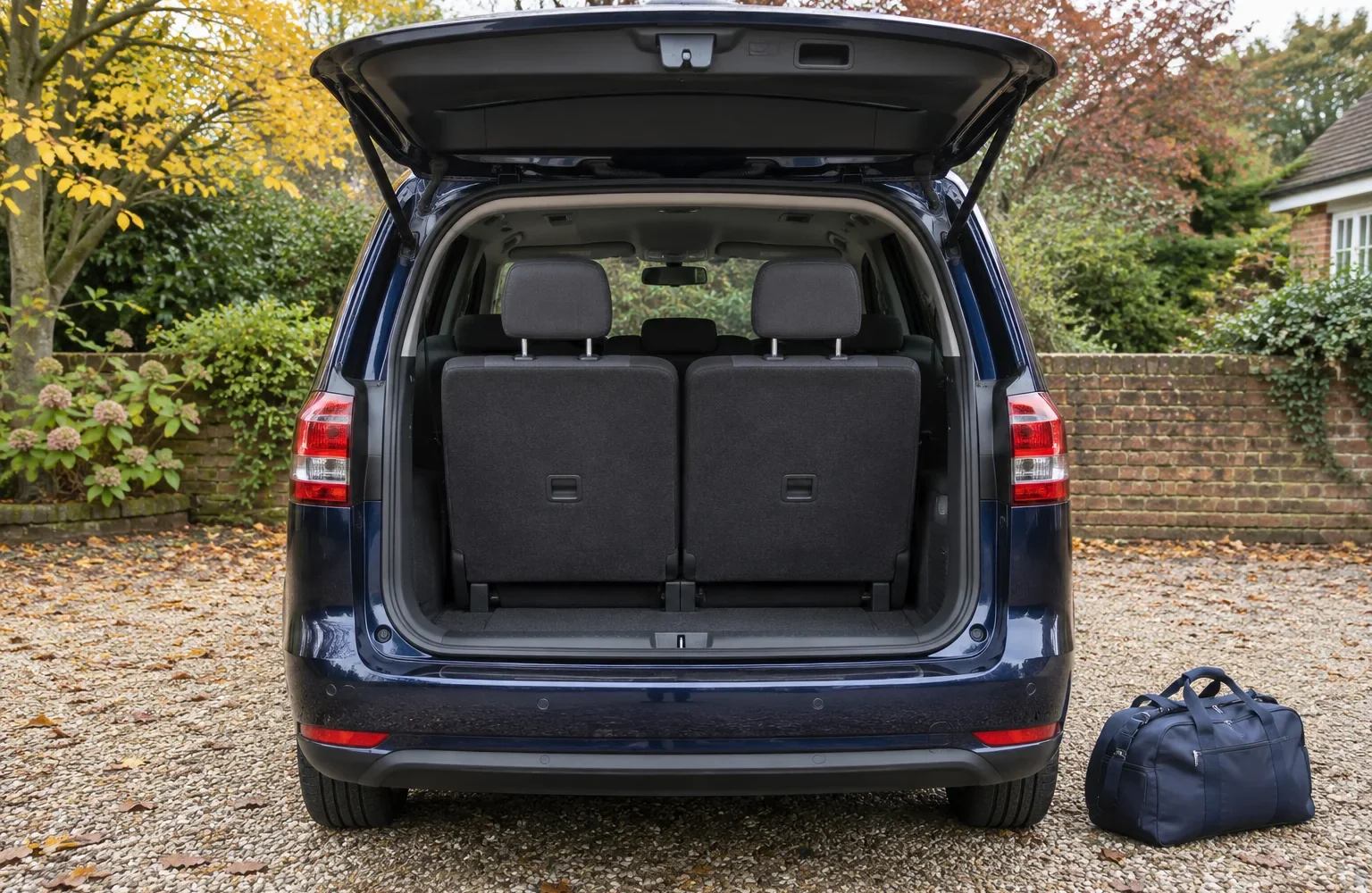
Stand at the open boot with both third-row seats upright. Could you close the tailgate on the pushchair or bags you need when all seven places are taken? Then try the rear passenger door: can the person who will sit in the back reach their seat with the middle row arranged as you normally use it? A seven-seater has to pass both checks on the same journey.
The short and long Volkswagen Caddy illustrate why the exact version matters. With the third row fitted, their published luggage-floor lengths behind it are 317 mm and 629 mm respectively. The rear opening is the same width on both. Looking through the tailgate alone, you could easily miss the difference that matters to a suitcase. [1]
Compare the seats you will actually use
Write down two trips before opening the adverts. One might be a school run with six people, schoolbags and no overnight luggage. The other might be a week away with seven people, a folded pushchair and two rigid cases. If one rear seat can stay folded on the school run, that tells you little about the holiday. Pick the trip the car must manage without another vehicle.
For each candidate, note the model year, body length, powertrain and seating option. Ask the seller for a photograph of the actual car with both rear seats raised, taken from the open tailgate. Ask for a second picture from the side door with the entry seat moved forward. Stock photographs, a seven-seat model name and a figure headed “maximum capacity” do not answer those questions.
| Seven-seat example | All seven places available | What changes the result? |
|---|---|---|
| Volkswagen Caddy Life, short wheelbase, with third row | 191 litres; 317 mm of floor length behind row three. | The sliding side-door opening is 701 mm wide. The rear opening is 1,185 mm wide. [1] |
| Volkswagen Caddy Maxi Life, long wheelbase, with third row | 446 litres; 629 mm of floor length behind row three. | The side opening is wider at 844 mm, while the rear opening is still 1,185 mm wide. [1] |
| Dacia Jogger, seven-seat UK dimensions listing | 212 litres in the seven-seat configuration. | With row two in place: 699 litres with row three folded, or 820 litres with it removed. [2] |
Compare the two Caddys within the same technical sheet: the Maxi gives another 312 mm of floor length behind the back seats. Now consider a rigid box measuring 500 mm front to back in its intended position. On the published floor lengths, it exceeds the short car’s space in that orientation; it is within the Maxi’s quoted length. You still need its width and height, the seatback angle and clearance inside the closed tailgate. Turning it sideways might change the outcome in either car. [1]
The Jogger figures answer a different question. Folding and removing the back seats both leave five places available, but the difference in the quoted boot volume is 121 litres. If you unexpectedly need to give two teammates a lift home after football practice, it matters whether those seats are folded in the car or sitting in your garage. These are manufacturers’ specifications, not measurements from a Motoring Desk road test. The sources do not establish identical volume-measurement methods across brands. [2]
Try getting in and out from the side you use
Begin with the driver’s seat adjusted for the regular driver and a passenger sitting behind it in their usual position. If you create third-row legroom by pushing the middle row fully forward, have the middle passenger try that position too. A brochure drawing cannot tell you whether both people can sit comfortably at once.
On the seven-seat electric Peugeot E-5008 introduced in 2024, an upper seatback control lets the second-row seat tilt and slide forwards together. Its two third-row backrests can fold independently. Those details tell you which movements to ask the seller to demonstrate. They do not tell you whether a particular passenger can reach the control, clear the sill or turn into the opening. [3]
At a stationary viewing, try the sequence in both directions. Have the seller demonstrate the mechanism first, with the moving seat empty and the path clear. Let the intended rear passenger try entering and leaving at their own pace. Where do they put their first foot? Is there a handhold they can actually reach? Do their shoes catch under the seat ahead? Can they get out without a person outside having to move to the other side of the car?
Repeat with the rear door only as far open as your driveway or usual parking bay allows. A showroom door swung fully open is a different proposition from a gap beside a wall. A sliding door may solve the outside-clearance problem while leaving a high step or a narrow turn inside. If someone regularly boards from the pavement, check that side specifically.
Measure the awkward item, then the boot
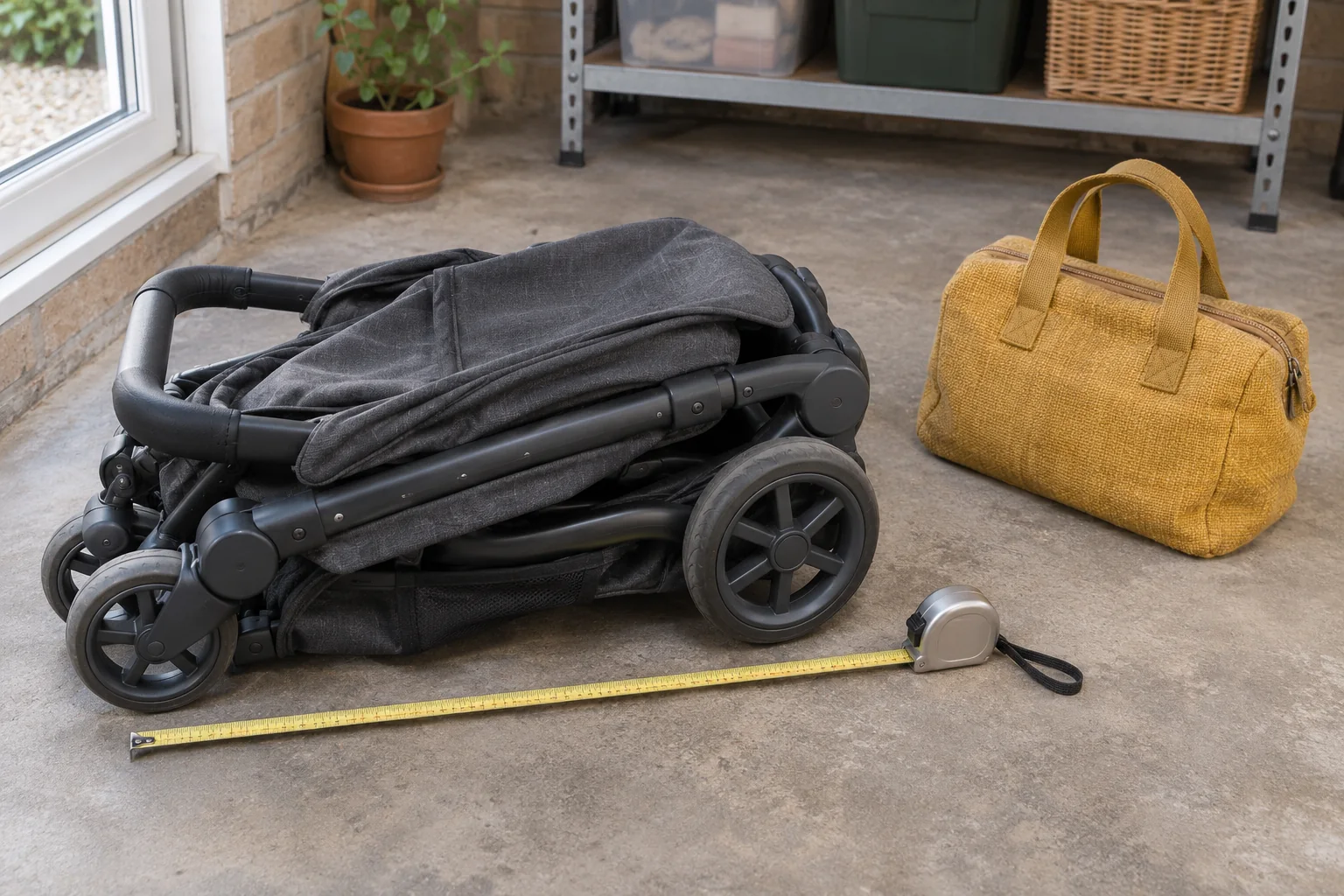
Bring the item that is hardest to rearrange. A soft overnight bag can change shape; a pushchair frame or hard case has fixed corners. Record the longest, widest and tallest points in the position in which you intend to load it. Include handles, wheels and anything that protrudes. A cardboard template of the footprint is useful if you cannot bring the item, but it will not reveal a clash higher up.
- Start at the opening. With the car parked and the tailgate open, compare the narrowest part of the entry with your item. Notice the height of the lip and whether you can lift the item over it without an awkward turn.
- Measure at more than floor level. Set all required seats upright in their normal travelling positions. Measure from the rearmost seatback towards the tailgate at floor level and again at the height of the item’s widest part. Allow for the slope of the glass and the tailgate’s inner trim.
- Try the complete load. Place the rigid item first, then add the bags that must travel alongside it. Keep the load clear of passengers; ask the seller to show you the handbook’s load-securing provisions. Check tailgate clearance without forcing it against the luggage.
- Test the first thing you need back. Can you take the pushchair or overnight bag out at a rainy stop without unloading everything else? If a quoted storage compartment is under the floor, check that you can reach its cover once the main boot is packed.
A photograph from the same angle, with the same item in each candidate, is more useful than a note saying “big boot”. Record anything you had to remove to make it work. Taking a wheel off a pushchair twice a year may be fine; doing it at every nursery drop-off could decide the purchase.
Which layout should you try at the viewing?
We usually carry six people and sports kit
Draw the six occupied places first. If you need one rear seat, ask whether the other folds separately on this version. Try the long kit bag beside the occupied seat, following the handbook’s loading arrangements. Check the route out for that passenger with the bag in place. A six-person layout that works well can be more useful than the largest two-seat boot figure in the shortlist.
Seven people and luggage travel together regularly
Do the whole loading check with all seats available and with the middle row left where its passengers need it. Record where the last case would go. If it fits only after a passenger’s seat is folded, the car has failed this particular trip. Before comparing a longer model, check its length against your parking space and whether you can still stand behind the open tailgate.
A child restraint normally stays in the middle row
Tell the retailer which seat and restraint you use and on which side. Establish the positions and arrangements permitted by both handbooks before relying on a particular entry route. A tilting seat in an empty showroom car does not establish that it can be moved with your restraint installed. Ask to see how the rear passengers would board without disturbing an installation you need to keep in place.
We are looking at a used seven-seater with removable seats
Ask to see the actual third-row seats and head restraints supplied with the sale. A picture of an empty load bay does not show that the missing parts are in the seller’s garage. Have the seller demonstrate the permitted seat configurations and show where removed seats or covers would be stored. If a seat will not latch as described in the handbook, have the issue assessed before relying on that passenger place. Use the used-car viewing checklist for the rest of the inspection.
Leave with a record you can compare
For each car, keep one note with the exact version, who sat in each row, which side they used to get in, what you loaded and anything that had to stay at home. Mark each required trip as fits as used, fits with a change we accept or does not fit. Keep “not tried” as a separate answer if the seller could not supply the seats or allow a loading check.
The telling detail might be a sliding door a passenger can use beside your wall, or enough depth to lay a case flat with the seventh seat upright. Once two cars both meet those needs, the wider guide to choosing your next car can help you compare the rest of the buying decision.
Sources
- Volkswagen Commercial Vehicles UK — The Caddy Life brochure, issue 2 October 2026, PDF page 19. See the Caddy and Caddy Maxi columns under Dimensions.
- Dacia UK — Jogger dimensions. Boot-capacity table for the seven-seat version, including the separate folded and removed third-row configurations.
- Peugeot UK — E-5008 launch release, 20 March 2024. Second-row access mechanism and independently folding third-row backrests on the model described.