An A-rated tyre has a better rolling-resistance grade than a C-rated tyre, so it should need less energy to roll under comparable conditions. The letters do not promise a fixed MPG increase or a guaranteed cash saving. Check the wet-grip rating separately, compare the exact tyre specification and calculate whether any extra purchase cost makes sense for your mileage.
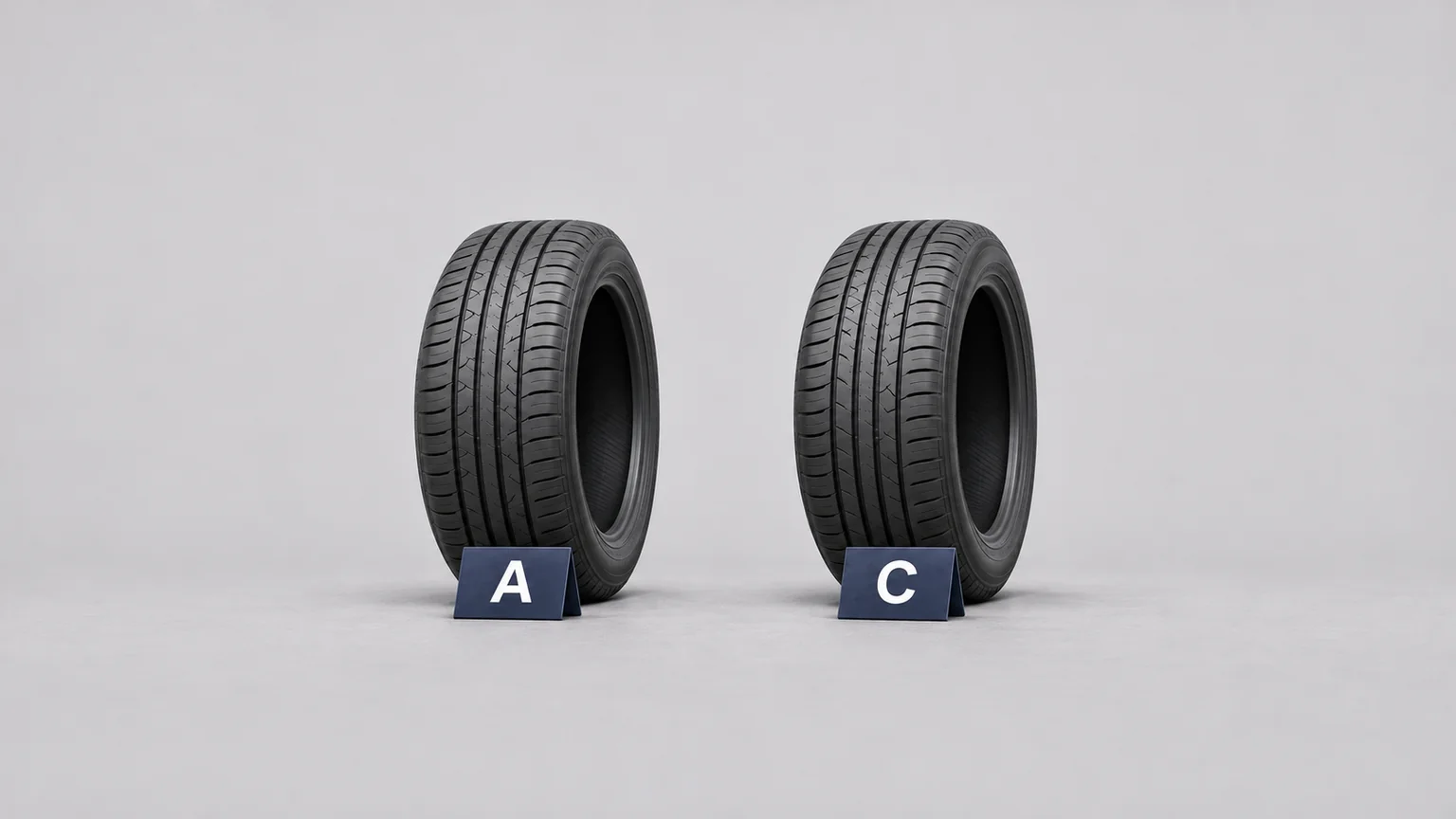
This guide compares the fuel-efficiency letters on passenger-car tyre labels. It does not rank tyre brands or claim that we have tested particular products. Sources were checked on 3 November 2026.
What does A versus C actually measure?
A tyre continually changes shape as it rolls. Some energy is lost in that process, which contributes to rolling resistance. The label groups measured rolling-resistance performance into classes; A is the more efficient class. It is a tyre measurement, not a fuel-economy test of your complete car on your commute.
The European Commission’s explanation of tyre labels describes the role of tyre construction, pressure, load, road conditions and temperature. Lower rolling resistance matters for an electric car’s energy use too, even though no petrol or diesel is being burned.
That leaves two different questions. “Which has the better efficiency grade?” is answered by A versus C. “How many pounds will I save?” needs more information. Do not turn two letter steps into a universal percentage reduction in your fuel bill.
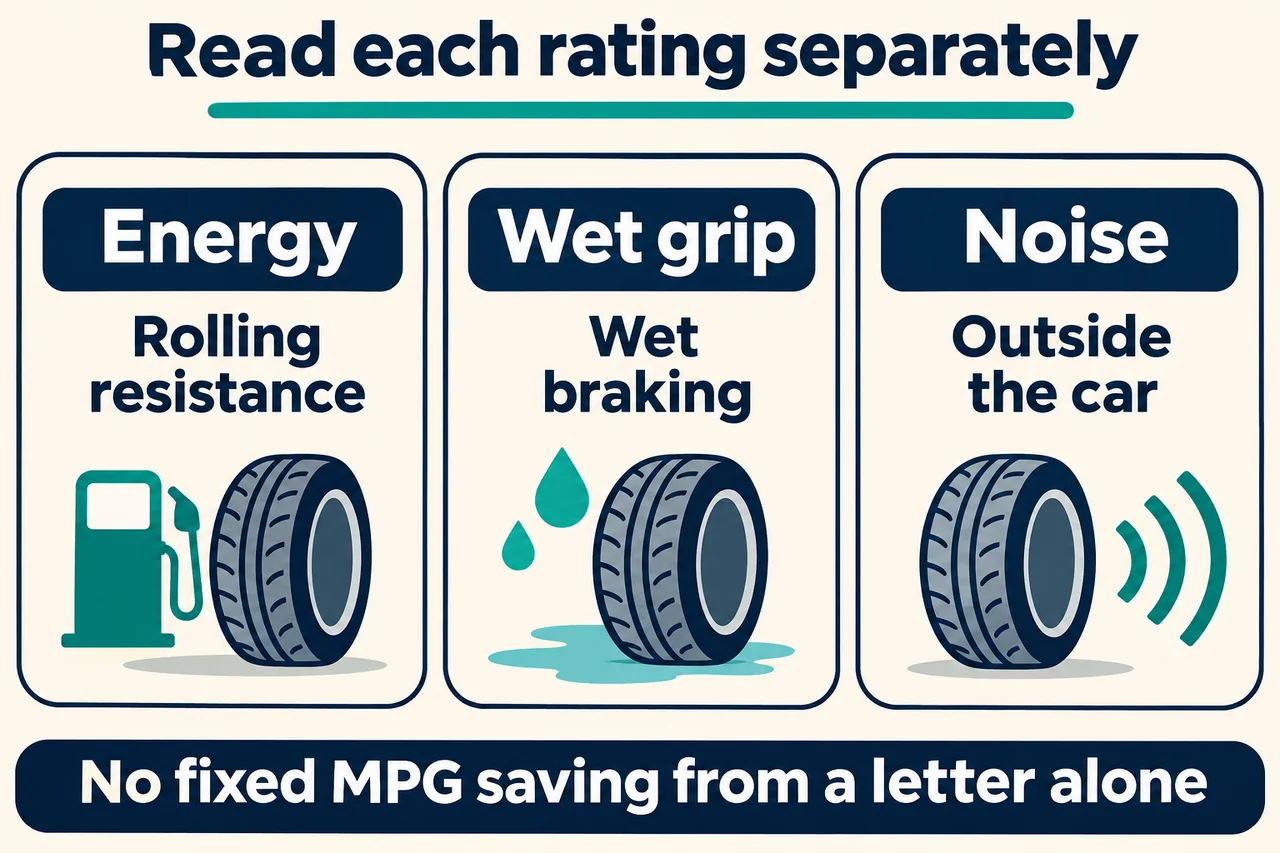
Read the three ratings separately
| Label item | What it tells you | What it does not establish |
|---|---|---|
| Fuel efficiency | Rolling-resistance class: A is better than C. | Your exact MPG or the tyre’s overall safety and handling. |
| Wet grip | A separate assessment related to braking on a wet surface. | All-weather handling or every aspect of aquaplaning resistance. |
| External rolling noise | Noise outside the vehicle, with a decibel value and classification. | How quiet the cabin will feel on your usual road. |
A listing with fuel efficiency C and wet grip A has not received one contradictory score. It reports two different properties. Conversely, an A for efficiency does not tell you its wet-grip class. Ford’s label guide also identifies factors beyond the label, including longevity, aquaplaning resistance and steering precision. Use the label as part of the choice, alongside relevant tyre-test evidence and the vehicle’s requirements.
Why do some labels show A–G and others A–E?
The legal labelling schemes differ within the UK. DVSA’s current guidance describes A–G classifications for Great Britain. For Northern Ireland it specifies A–E for fuel efficiency and wet grip, and A–C for external noise.
You can also encounter the newer EU-format label in a UK product listing: Ford UK, for example, explains that format on its consumer page. Do not assume that every label you see must have seven coloured rows, or mistake the noise-class scale for the efficiency scale. Read the heading and pictogram, then the rating attached to that measurement.
If a retailer’s search result, full product page and downloaded label disagree, ask for the label for the exact product code being supplied. A generic range image is not enough to resolve the discrepancy.
How much fuel could an A-rated tyre save?
There is no single dependable A-to-C saving for every vehicle. The Vehicle Certification Agency describes a 7.5% fuel-economy difference between the best and worst classes for a full set on an average car. That is not an A-versus-C promise and should not be copied into your own budget as one.
A complete set, one replacement tyre and a change to a different size are different comparisons. Your vehicle, use and fitting combination matter. Even a fuel log showing improvement after replacement would not isolate tyres if the weather, routes or load also changed. Record fuel use if it is useful to you, but do not treat a single tank as a controlled test.
A useful cost check without inventing a saving
Start with the price difference between two suitable, fully fitted sets. Divide that premium by the number of years you expect to use them. This gives the annual saving needed to recover the premium, rather than pretending the label guarantees it.
The following figures are hypothetical arithmetic, not tyre prices, fuel-price forecasts or predicted A-to-C savings. Suppose one suitable set costs £80 more, you expect to keep it for four years, and fuel costs £1.50 per litre in your calculation.
| Calculation | Result |
|---|---|
| £80 divided by 4 years | £20 per year |
| £20 divided by £1.50 per litre | About 13.3 litres per year |
| If annual fuel use were 1,000 litres | 13.3 litres would be about 1.33% of that fuel use |
This tells you the break-even requirement. It does not establish that these tyres will deliver it. If you keep the tyres for only two years, the required saving doubles to £40 a year. If you drive fewer miles, there is less fuel spending from which to recover the same premium. Wear life, damage and a change of car can also alter the calculation; equal four-year use is an assumption here.
For an EV, the same cost test can be expressed in electricity: divide the extra tyre cost by the years of use and then by your assumed price per kWh. The result is the annual energy saving required, not a range forecast.
A five-step comparison before ordering
- Confirm the approved specification. Record size, load index, speed rating and any vehicle-specific requirements. An efficient tyre that does not meet the car’s requirements is not a suitable alternative.
- Match the exact variant. Check the product code and label. A shared range name does not mean every size or version carries the same result.
- Read wet grip alongside efficiency. Keep seasonal suitability and relevant independent test results in the decision. Our winter versus all-season tyre guide covers that separate choice.
- Compare complete fitted prices. Ask what is included in fitting, balancing, valves or sensor work and disposal. Record any remaining charges before comparing totals.
- Keep the evidence. Save the quotation, specification and label, then check the supplied tyre matches before fitting. Resolve a substitute product with the fitter rather than accepting a range-name match alone.
Michelin’s comparison guidance explains that one tyre line can include different sizes and versions with different speed, load and original-equipment specifications. Compare the version you can actually fit, rather than the most attractive rating advertised anywhere in that range.
Do not change pressures to chase the letter
Use the vehicle manufacturer’s pressure specification for the load carried. Great Britain’s Highway Code maintenance guidance requires this and warns that both under-inflation and over-inflation affect braking and steering. An A-rated purchase does not remove the need to maintain the tyres afterwards.
Our tyre-pressure guide explains how to find the correct figures and make the check. Do not invent a higher pressure to improve economy, and do not postpone replacing an unsafe tyre while waiting for an efficiency upgrade.
Three common buying questions
Is a C-rated tyre automatically a bad tyre?
No. C describes its position in one test category. Check that the letter is for efficiency, then read its other ratings and confirm suitability. A single letter cannot establish the best overall tyre for a particular vehicle or use.
Should I pay more for A if both tyres have the same wet-grip grade?
A is the stronger efficiency grade, but the two tyres may still differ in wear life, noise, handling or suitability. Compare the exact products and fitted prices, then use the premium calculation above. Without credible evidence of your likely saving, do not promise yourself that the extra cost will be recovered.
Will fitting two A-rated tyres give half a full-set saving?
That cannot be assumed. A label is not a calculator for your particular combination of tyres. Have the fitter check the vehicle manufacturer’s replacement and matching requirements, especially where those specify how tyres should be matched. Do not apply a full-set headline percentage to two replacements.