All-season tyres are worth considering for year-round use in a moderate climate, especially if you can avoid journeys during severe weather. Dedicated winter tyres deserve closer consideration when prolonged cold, snow or difficult winter routes are a regular part of your driving. Choose around the journeys you need to make, the exact tyre’s evidence and your car’s requirements. Neither type guarantees a safe journey on ice or snow.
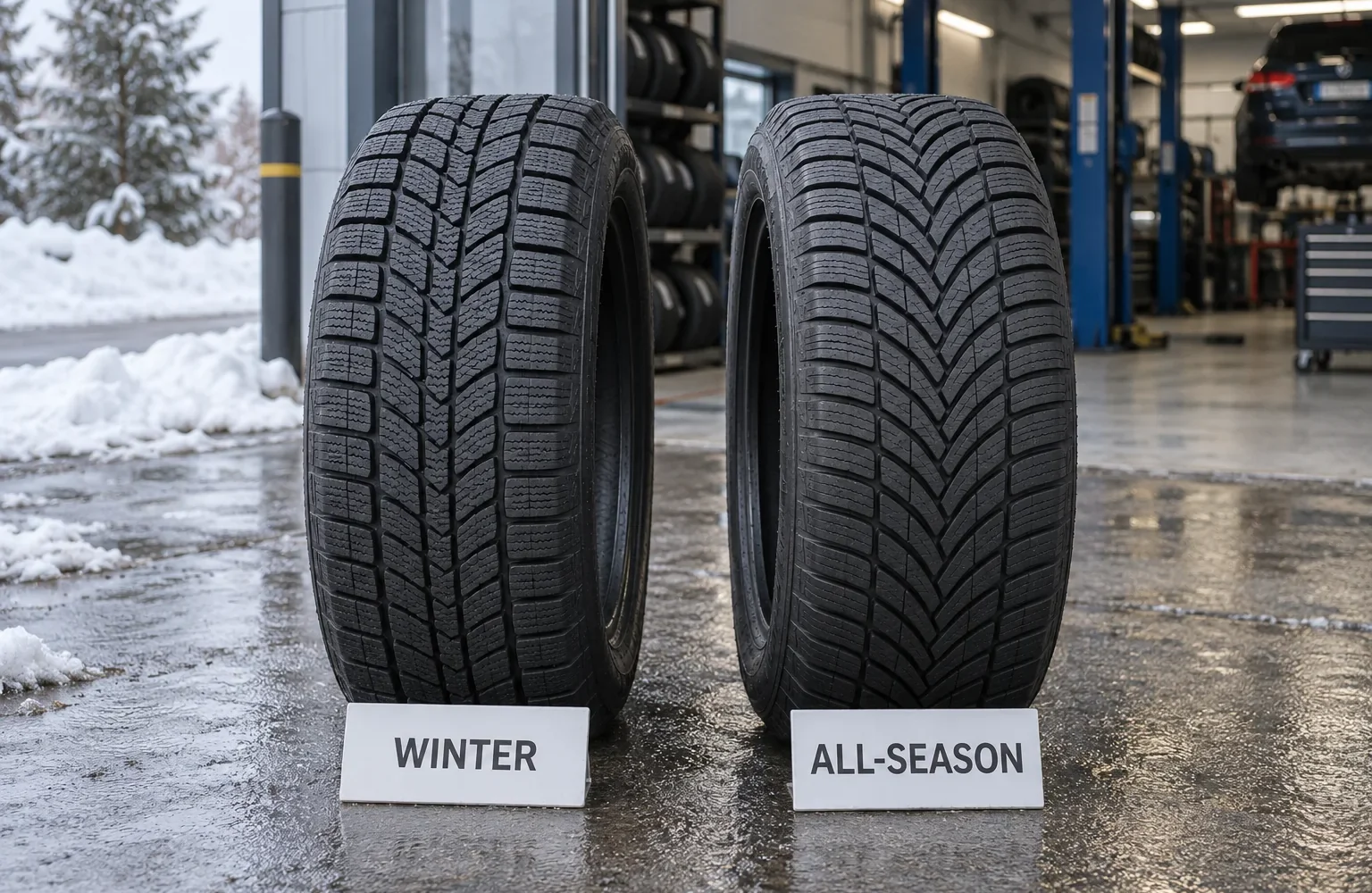
The useful comparison is between one suitable set used throughout the year and a seasonal arrangement with a second set. That changes the purchase, storage and fitting costs as well as the tyre characteristics. A national weather average cannot answer the question for a steep lane outside your home or a regular mountain trip.
Winter and all-season tyres: what changes?
Continental’s comparison identifies local climate, driving frequency and destination as key selection factors. Winter tyres use compounds and tread designs intended for colder conditions; all-season designs combine requirements across a wider seasonal range.
| Question | Winter tyres | All-season tyres |
|---|---|---|
| Main role | A seasonal option for cold-weather use. | A year-round option balancing different conditions. |
| When to investigate | Repeated exposure to demanding winter routes. | Moderate conditions with occasional winter weather. |
| What happens in warmer months? | Plan a change to an appropriate warmer-weather set. | Designed to remain in use across seasons. |
| Extra logistics | Changeover appointments and storage for the unused set. | No routine seasonal changeover, but normal checks and replacement still apply. |
| What the category cannot tell you | The exact product’s wet performance, wear, suitability for your vehicle or behaviour on every surface. | |
This is a comparison of intended uses, not a ranking of individual products. A category name is not a substitute for evidence about the tyre in the size and specification you intend to buy.
Is 7°C a reliable switching point?
You will often encounter 7°C in tyre advice. Michelin uses it when discussing its European winter tyres and explains the compromise as temperatures rise. It is a useful manufacturer guideline for seasonal planning, not proof that every winter tyre beats every all-season tyre as the thermometer crosses one exact number.
The source’s product guidance does not establish a universal crossover for all tyre pairs, road surfaces and tests. Consider the weather during the hours you actually drive, how often snow lies on your routes and the conditions at your destinations. A single cold morning is less informative than the pattern across your winter.
Nor is “winter tyre” one uniform design worldwide. Michelin distinguishes European winter products from Nordic designs for more extreme conditions. Ask a tyre specialist which type is being proposed for your use; do not select an unfamiliar product simply because its name sounds more capable.
3PMSF and M+S: what the markings establish
The three-peak mountain snowflake symbol, usually shortened to 3PMSF, indicates that the tyre meets a defined snow-performance requirement under a standardised test. It can appear on both winter and all-season tyres. Its presence does not make an all-season tyre a dedicated winter tyre.
M+S means mud and snow. Michelin’s markings guide explains that M+S alone does not require the certified performance test used for 3PMSF. Do not treat the two markings as equivalent evidence.
3PMSF is a threshold, not an overall score. It does not rank every qualifying tyre against another, certify equal ice performance or guarantee grip on your next journey. Check the exact product’s markings and manufacturer documentation; a retailer’s broad “all weather” description is not enough.
Compare wet grip separately from snow capability
Wet-road performance matters independently of the snow symbol. The DVSA’s tyre-labelling guidance describes information on wet grip, fuel efficiency and external rolling noise. The noise value concerns sound outside the vehicle, not a promise of cabin quietness.
The guidance distinguishes Great Britain and Northern Ireland. It describes the GB label on an A–G scale, while Northern Ireland uses A–E for fuel efficiency and wet grip, with additional label information including snow or ice suitability. Ask the seller for the applicable label and product information for the tyre being quoted; do not assume every UK label has an identical layout.
A strong wet-grip class does not measure every wet-road situation or establish snow performance. Likewise, the snow marking does not tell you the wet-grip class. Keep both questions on your shortlist rather than letting one symbol decide the purchase.
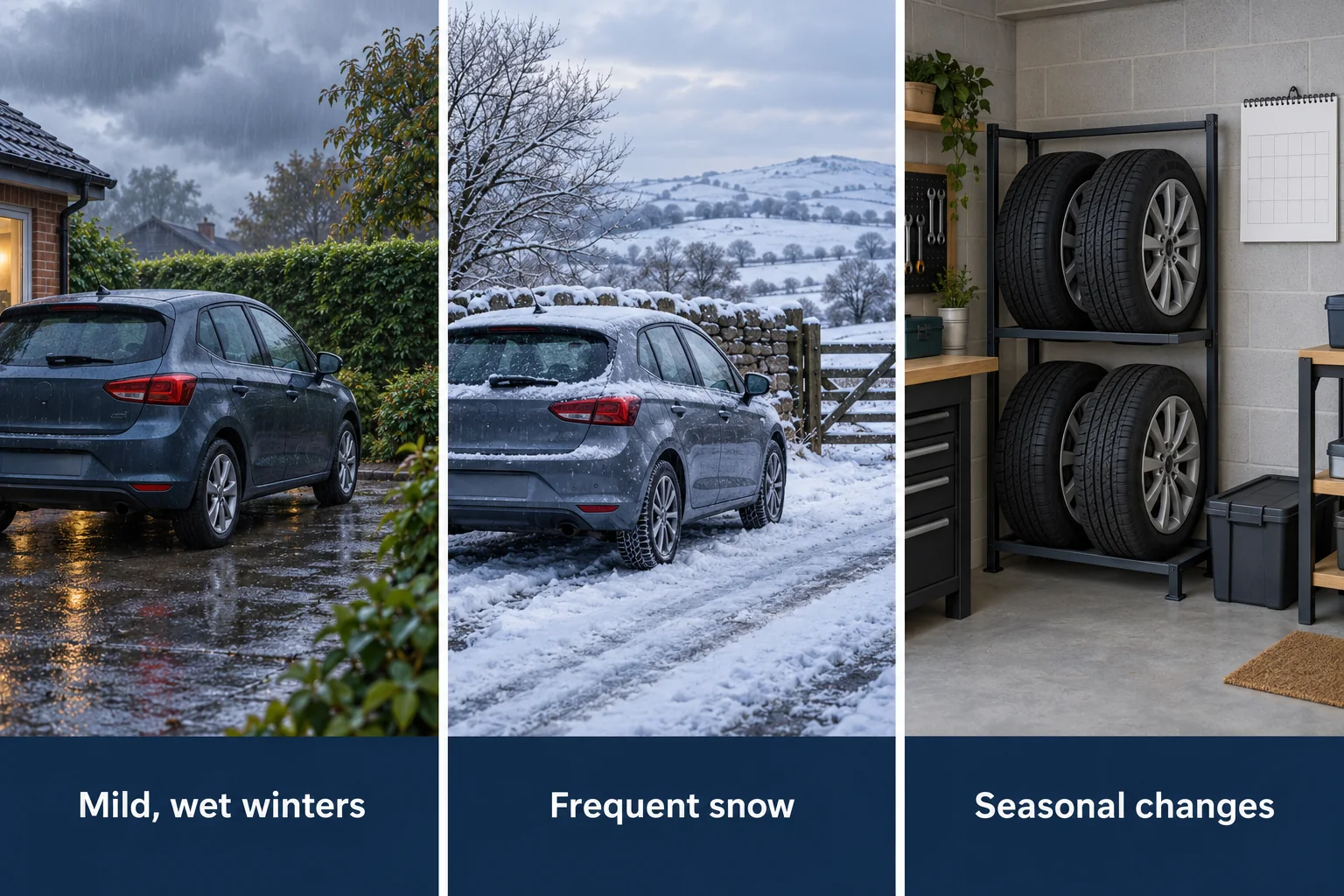
Open the scenario closest to your driving
Mostly local journeys, with flexibility in severe weather
Put suitable all-season products on the shortlist. Record whether you can work from home, postpone a shopping trip or use another option when conditions deteriorate. This is part of the decision, not evidence that one tyre makes every local road manageable.
Regular early starts on exposed or rural routes
Ask for a comparison that includes a dedicated winter arrangement. Describe the roads, hills and hours rather than simply asking for “winter grip”. Discuss your warmer-weather set and changeover plan at the same time. Make a separate contingency plan for journeys that cannot safely proceed.
Occasional winter trips to mountains or another country
Give the fitter your actual itinerary and dates. Check official requirements in every country and relevant region on the route, including any equipment requirements. A tyre that meets your everyday needs at home does not by itself establish compliance or suitability for the whole trip.
These are prompts for comparing options, not automatic recommendations. Your exact vehicle, available tyre sizes and the evidence for individual products may change the shortlist.
Plan a compatible set, not two tyres for the driven wheels
TyreSafe advises using the same seasonal type on all four wheels, rather than mixing winter, summer and all-season tyres. Treat a seasonal change as a whole-car decision and have the fitter check the vehicle’s requirements. This does not mean every car uses identical front and rear tyre sizes.
Ask the supplier to confirm the specified sizes, load and speed ratings, and any vehicle-specific restrictions. If a second wheel set is proposed, include wheel compatibility and tyre-pressure monitoring requirements in the quote. Do not use this article as a fitting instruction.
Get two quotes you can actually compare
Ask for written quotes using the same vehicle details and these items:
- Exact products: brand, model, size, ratings, seasonal type, markings and relevant labels.
- Installed price: fitting, balancing, valves or applicable sensor work, disposal and VAT.
- Seasonal arrangement: any second wheels, each changeover and storage charges.
- Storage terms: what is stored, condition checks, collection arrangements and responsibility for loss or damage.
- Future availability: how a damaged tyre would be replaced with an appropriate compatible product.
Do not compare one loose tyre’s online price with a fitted four-tyre package. Nor should a second set’s purchase price be treated as pure annual consumption: both sets accumulate use over time. There is no honest universal saving without your actual quotes, mileage and replacement assumptions.
Tyre choice does not remove the weather decision
Great Britain’s Highway Code advises avoiding icy or snowy journeys unless essential. Its guidance also warns that road conditions can change over short distances. A tyre purchase should not become a reason to disregard warnings or continue a journey that needs postponing.
Maintain the tyres whichever category you choose. Use our tyre-pressure guide to find the correct vehicle-specific checking process, and our slow-puncture guide if pressure keeps falling. Seasonal suitability does not explain away damage or a recurring pressure loss.
Sources checked on 15 October 2026. This is a researched purchase comparison, not a tyre test, fitting guide or certification that a particular journey is safe. No braking-distance, lifespan or cost advantage has been assumed for an untested product.
The conversation