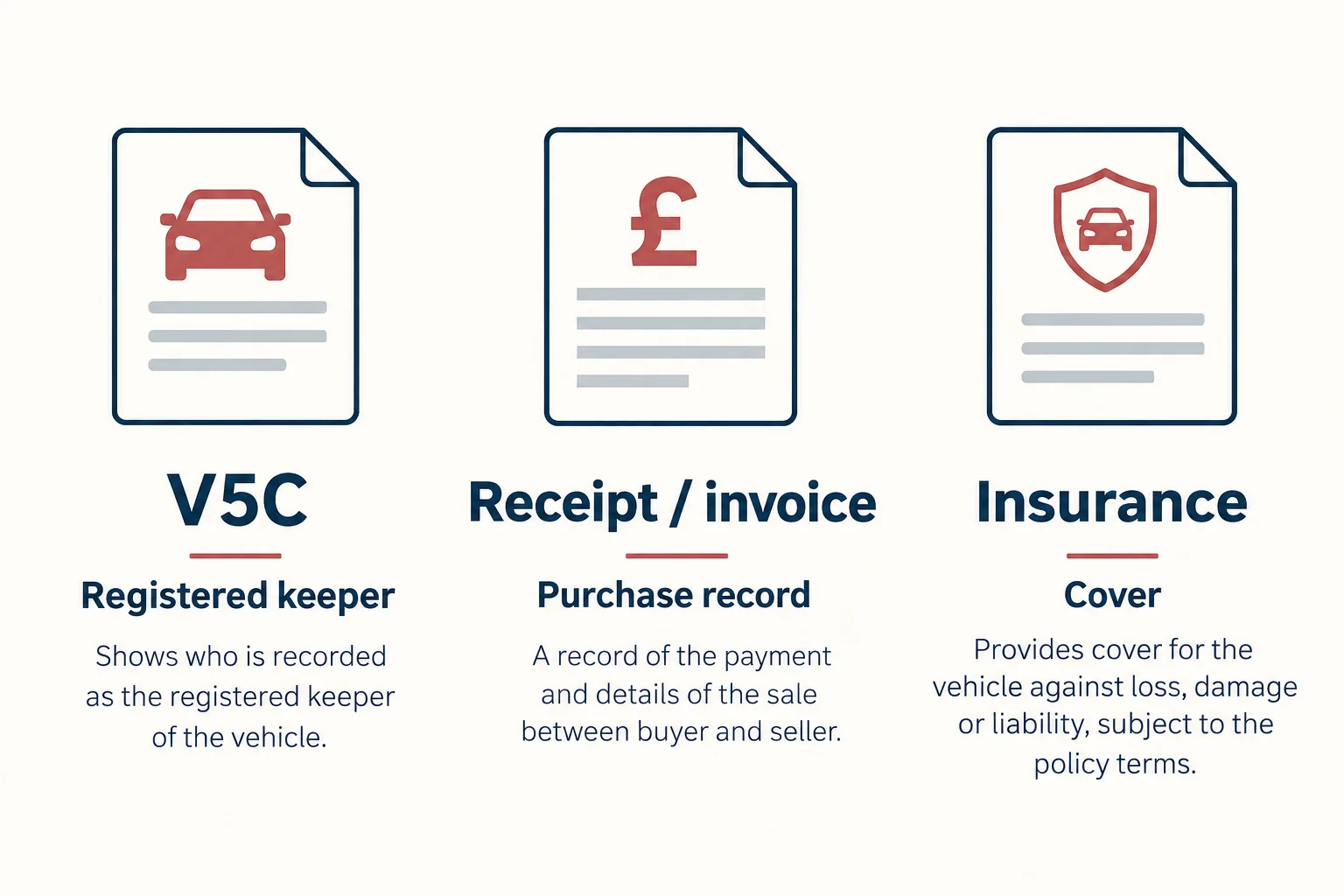
A V5C is the vehicle registration certificate, commonly called the log book. It records the registered keeper; it does not prove who owns the car. The right DVLA process depends on what has happened: losing your own document, buying a car and moving house are different tasks. Start with your situation below rather than ordering a replacement automatically.
This guide covers ordinary DVLA vehicle paperwork for UK keepers. It helps you choose the official service and understand the document’s limits. It does not decide an ownership dispute, verify a particular seller or replace the checks needed before buying a used car.
Registered keeper and owner: why the distinction matters
The registered keeper is the person or organisation recorded for keeping the vehicle. The owner is whoever legally owns it. Those can be the same, but a company or finance arrangement can separate them. The police’s keeper-versus-owner explanation confirms that the registration certificate is not ownership evidence on its own.
For a buyer, this means “my name is on the V5C” is not the whole answer to “do you have the right to sell this car?” Keep the purchase invoice or receipt and the relevant agreement. If documents or explanations conflict, resolve the discrepancy before paying; changing the keeper does not settle a dispute about ownership.
Which V5C service do you need?
Open the situation that matches yours. These links lead to GOV.UK guidance; this page does not collect your registration number, document reference or personal details.
I already keep the car, but my log book is missing or damaged
Use the replacement V5C service if you are already the registered keeper and the details are unchanged. Online applications require the vehicle to be in your possession. If your address or name also needs changing, use the relevant change and missing-document instructions instead; an ordinary duplicate goes to DVLA’s recorded address.
I have bought a car and need the V5C in my name
Start with registering a newly bought vehicle. The seller normally notifies DVLA and gives you the green new-keeper slip. A missing new document is not the same situation as losing a V5C already in your name.
I have moved and still have the log book
Use the address-change service for a move to a UK address. Updating your driving licence does not update the log book. If the V5C is also lost, or your name is changing too, check the alternative route on that page.
My name has changed, or a name is misspelt
Follow DVLA’s name-change instructions. This uses the log book and supporting information by post. Changing your own name is different from transferring the vehicle to another keeper.
I have sold or given the car to someone else
Use the sale or transfer service. If you have no V5C, DVLA provides a postal notification route. Do not use the address-change service to put the buyer’s details on your record.
What to check when buying a car
Ask to see the V5C and compare it with the vehicle and the seller’s information. GOV.UK’s used-vehicle checks include matching the vehicle identification number and engine number to the log book, as well as checking the document’s watermark and specified suspicious serial-number ranges. Use the current official list rather than relying on the colour of the paper.
The registration number identifies a vehicle record. It is not a substitute for checking the actual car’s identity. Equally, an apparently convincing V5C is only one part of the paperwork. Our used-car viewing checklist covers the wider inspection, while questions to ask the seller helps you prepare before travelling.
If the V5C is missing, DVLA advises against buying the vehicle. A promise that the buyer can apply later does not resolve the missing-document concern. If you have already bought a car without one, follow the official registration route using form V62; do not treat that route as an endorsement of buying without the document.
At handover: who keeps which paperwork?
When the seller registers a used vehicle to you online, they complete and give you the green new-keeper slip, then destroy the old V5C. If notifying by post, they complete and send the appropriate V5C sections to DVLA and still give you the green slip. Section numbers differ between versions, so follow the instructions for the document in front of you.
Save your sale paperwork and any confirmation of the notification. A useful handover note records what was submitted, when, and which documents each person retained. This gives you something specific to refer to if the new V5C does not arrive.
Vehicle tax does not pass to the buyer. DVLA’s sale and transfer guidance says the seller’s tax is cancelled after notification, with a refund for full unused months. The buyer must arrange their own tax before driving, or declare the car off the road where appropriate.
Replacing a lost V5C: cost and information
For an eligible online duplicate, the DVLA replacement service usually costs £25. Have the registration, VIN or chassis number, and the name and postcode recorded on the V5C available. You cannot use this route to change details, or while DVLA already has the document for an amendment. The service lists further exclusions, including fleet-scheme and overseas registrations.
Where a postal application is required, form V62 is a print-and-post form, not an online submission. Download it from GOV.UK, read its current notes and use the payment and postal instructions for your circumstances. A fee is not required in every situation.
Changing your address, name or vehicle details
Moving house
Updating a V5C address is usually free. The address-change guidance also requires separate updates to your driving licence and vehicle-tax Direct Debit, if used. Relevant personalised-registration documents need updating too. Before changing the V5C, check the guidance if tax falls due within the next four weeks: you may need to tax the car using the existing document first.
Changing your name
The name-change process is usually free and asks for an explanation; whether evidence is needed depends on the reason. Follow its instructions for the V5C version you hold. If both name and address are changing, use the combined-change instructions, including the separate guidance for a missing log book.
A detail about the car is wrong or has changed
Keeper details and vehicle details are separate. DVLA’s vehicle-details guidance covers corrections and changes such as colour, engine or fuel type. Some changes require evidence or inspection. Changing a tax class follows its own process; writing a new description on the V5C does not complete that task.
How long should you wait?
The route matters more than a single “V5C delivery time” quoted elsewhere. The following information was checked on 15 October 2026; use the linked service’s current instructions when applying.
| Application | Usual guidance |
|---|---|
| Eligible online duplicate | Usually 5–7 working days. Contact DVLA if it has not arrived after two weeks. |
| Used car registered by the seller online | Usually 5–7 working days. The registration guide says to contact DVLA if it has not arrived after four weeks. |
| Postal replacement under the lost-log-book guidance | Usually four weeks. Contact DVLA once four weeks have passed without delivery. |
Sources: online duplicate, new keeper and postal replacement. These are expectations, not delivery guarantees. Do not leave a missing document unreported: the guidance warns that failing to notify DVLA before six weeks can mean paying for another replacement.
Other routes have their own timelines. Name changes can take up to six weeks, although DVLA asks you to contact it after four weeks if the document has not arrived. Follow the instructions for the service you used.
If a posted new-keeper application has not produced a V5C, the postal guidance explains the V62 route with the green slip. The slip must come from the most recently issued V5C for the relevant fee exemption; check its issue date against DVLA’s vehicle enquiry service if unsure.
Can you tax the car before the new V5C arrives?
A new keeper can use the green slip through the official vehicle-tax service. An existing keeper may use a qualifying tax reminder or a V5C in their name. If you have none of those documents, the guidance directs you to a replacement-log-book route; an eligible registered keeper can apply for a duplicate and tax online together.
Do not assume a first-time buyer without documents qualifies for the existing-keeper online service. The postal alternatives include possible combined tax and V62 applications at a participating Post Office. Confirm the requirements before travelling. Post Office tax applications in Northern Ireland have additional insurance and MOT or exemption-evidence requirements, set out on the tax page.
Completing registration paperwork alone does not establish that the car can be driven. Tax, insurance and any applicable MOT requirements still need addressing. If you cannot complete the required arrangements, resolve them before collecting the car to drive home.
A short checklist before you submit anything
- Name the task: duplicate, new keeper, address change, name change or vehicle correction.
- Check what you hold: the full V5C, a green slip, a reminder or none of these.
- Read the exclusions: particularly changed details, a document already with DVLA or a vehicle outside the UK.
- Check tax timing: a pending V5C application is not a substitute for arranging tax.
- Keep a record: save the application date and official confirmation; note the relevant follow-up date.
- Read the replacement when it arrives: check the details and use DVLA’s correction instructions if something is wrong.
The conversation